

Thailand Pairs Up With Laos to Welcome More Regional Tourism as Halley’s Debris Lights Skies

Published
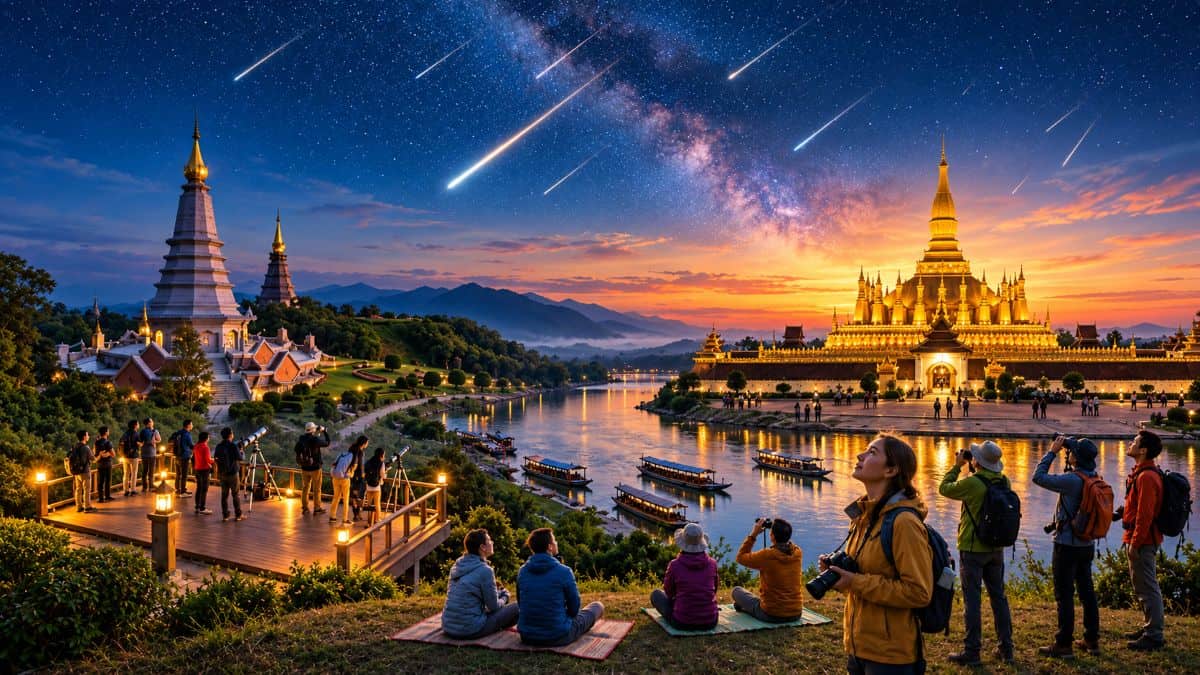
Thailand is strengthening its appeal as an astrotourism destination by promoting cross-border travel opportunities for visitors seeking spectacular celestial displays this autumn. Tourism stakeholders and astronomical organisations are highlighting rural landscapes, protected natural areas and remote viewing locations where limited artificial lighting can offer clearer views of the night sky. The initiative aims to diversify the kingdom’s tourism offering beyond traditional beach holidays, shopping and cultural sightseeing.
Across Southeast Asia, astronomy enthusiasts are preparing for the annual Orionid meteor shower, a fascinating celestial event associated with debris left behind by Halley’s Comet. As Earth passes through this stream of cosmic particles, tiny fragments enter the atmosphere at high speeds, producing luminous streaks commonly known as shooting stars. The shower typically peaks in October, offering travellers an opportunity to combine astronomy, outdoor recreation and cultural exploration.
Northern Thailand’s mountainous terrain, peaceful countryside and elevated viewpoints could attract visitors hoping to experience the spectacle away from urban light pollution. Local communities may benefit from increased demand for accommodation, transport, regional cuisine, guided excursions and organised stargazing activities.
The growing interest also creates opportunities to promote responsible tourism. Encouraging visitors to minimise artificial lighting, respect protected environments and support local businesses can help preserve dark-sky destinations. With favourable weather and suitable viewing conditions, Thailand’s meteor-watching season could strengthen regional tourism connections while introducing more travellers to the beauty of astronomical observation and the importance of night-sky conservation.
Advertisement
Advertisement
Regional Coordination Expands Astrotourism Across Borders
The National Astronomical Research Institute of Thailand has confirmed that the display will reach peak activity during the overnight hours spanning late October. Observers positioned in designated dark sky reserves can anticipate seeing up to twenty shooting stars per hour under clear conditions. Cross-border travel initiatives between Thailand and neighbouring territories like Laos have simplified overland journeys for astronomy clubs and nature photographers. This collective push reflects a broader economic pivot towards sustainable, low-impact travel that benefits peripheral villages and national parks. Local hospitality providers report rising reservations as stargazers secure rural accommodations well in advance.
Municipal authorities across the northern highlands have collaborated with environmental agencies to dim non-essential streetlights during the peak observation window. This cooperative measure ensures that international visitors and domestic observers experience optimal visibility without intrusive atmospheric glare. Tour operators in Chiang Mai and Chiang Rai have developed specialised nocturnal itineraries, bundling campsite logistics with professional telescope workshops led by experienced astronomers. Transport networks connecting provincial transport hubs to protected forest areas have expanded their night schedules, allowing seamless transit for independent adventurers. Such thoughtful planning reinforces the kingdom’s reputation as a dependable hub for scientific ecotourism.
Advertisement
Advertisement
The orbital path of comet 1P/Halley sheds cosmic dust that intersects Earth’s upper atmosphere every October, producing exceptionally fast and luminous meteors. Because these microscopic remnants enter the atmosphere at speeds exceeding sixty-six kilometres per second, they frequently leave persistent ionised gas trails visible for several seconds. Scientists emphasise that observing this natural spectacle requires no specialized optical equipment, making it an accessible draw for casual holidaymakers and seasoned astrophotographers alike. Cross-border tour agencies are marketing these celestial viewing sessions alongside daytime cultural excursions, generating balanced itineraries that prolong visitor stays and bolster community development.
Scientific Rigour Underpins Celestial Viewing Standards
To guarantee public safety and protect fragile wilderness zones, conservation rangers have established strict visitor thresholds across sensitive highland parks. Forest officers are stationed along popular hiking routes to prevent accidental habitat disruption while educating visitors on responsible nocturnal outdoor practices. The astronomical research institute continues to issue updated meteorological bulletins, advising travellers on cloud cover variations and optimal elevation bands. By integrating verifiable scientific data directly into regional visitor guides, authorities are building an authoritative framework for educational leisure travel. This rigorous preparation reassures international visitors seeking verified and memorable night-sky journeys.
| Observation Region | Peak Activity Window | Predicted Frequency | Recommended Equipment |
| Doi Inthanon, Thailand | 22:30 to 05:00 Local Time | 15–20 meteors per hour | Naked eye, warm clothing |
| Pha Taem, Thailand | 23:00 to 04:30 Local Time | 12–18 meteors per hour | Reclining chair, star chart |
| Luang Prabang, Laos | 23:30 to 05:00 Local Time | 14–20 meteors per hour | Wide-angle lens camera |
| Phu Kradueng, Thailand | 00:00 to 04:45 Local Time | 15–20 meteors per hour | Red-light torch, sleeping mat |
Economic benefits from nocturnal leisure travel are spreading beyond traditional metropolitan centres into surrounding farming settlements. Homestay operators, independent restaurateurs, and regional transport cooperatives are experiencing tangible revenue gains from incoming astrotourists. Regional administrations have provided English-language briefing materials to community hosts, ensuring smooth communication and cultural exchange between rural residents and international sightseers. Furthermore, local craft markets and agricultural collectives have aligned their trading hours with evening departure schedules, offering locally sourced provisions to excursionists embarking on overnight mountain vigils. This integrated economic structure ensures that conservation-friendly tourism directly enriches local families.
Astromorphology Informs Cosmic Particle Behaviour
Scientific analysis of cometary debris reveals that the physical geometry of Halley particles directly governs how they interact with thermal radiation. According to recent remote sensing research on blackbody temperatures, non-spherical dust grains such as prolate cylinders and agglomerated debris sustain higher thermal profiles, whereas highly porous fractal aggregates remain substantially colder. This thermal behaviour demonstrates that the physical porosity of interplanetary particles shapes their thermodynamic response across space. Understanding these microphysical characteristics provides essential context for the brilliant ionised trails observed during atmospheric entry, offering astronomy enthusiasts a deeper scientific appreciation of the annual autumn display.
Enhancing Visitor Experience and Environmental Integrity
Regional conservation bodies have launched waste-minimisation campaigns across designated stargazing perimeters to protect native wildlife habitats. Clear guidelines advise visitors to pack out all disposable packaging and avoid single-use plastics during nocturnal camping expeditions. Park wardens are enforcing red-light torch protocols within observation zones to preserve human night vision and limit light contamination. Educational booths established at park entrances offer brochures explaining the life cycle of cometary fragments, transforming recreational excursions into informative nature masterclasses. These combined operational policies ensure that increasing tourist footprints do not degrade delicate ecological balances.
Meteorological analysts forecast favourable atmospheric transparency over the higher elevations, although lowland valleys may experience intermittent early morning mist. Tour leaders advise travellers to monitor official weather advisories closely before ascending steep mountain switchbacks late at night. Vehicle rental providers in major provincial transit junctions report high demand for four-wheel-drive vehicles capable of navigating unpaved forestry access roads. Emergency medical teams and roadside assistance units have also stepped up monitoring along main routes leading to designated viewing zones, guaranteeing rapid responses to any unforeseen travel disruptions.
Advertisement
Advertisement
Promoting the night sky as a natural asset reflects a significant maturation of Southeast Asian tourism marketing strategies. Rather than relying solely on conventional heritage temples or coastal resorts, destinations are actively curating seasonal natural events to diversify their offerings. Collaborative efforts between Thailand and adjacent nations demonstrate how shared environmental phenomena can cultivate regional goodwill and synchronized transit corridors. Observers standing on mist-shrouded mountain peaks will witness remnants of our solar system’s distant past, creating shared experiences that transcend national boundaries through wonder and science.
Halley Debris Sparks Astrotourism: How Cometary Dust Shields Explain the Science of Meteor Showers
The annual arrival of meteor showers linked to Halley’s Comet offers skywatchers across Southeast Asia a front-row seat to the physics of hypervelocity cosmic dust. While travellers witness these cometary remnants burning up into bright streaks across the upper atmosphere, space agencies face the opposite operational challenge: defending interplanetary spacecraft against the very same high-speed cometary dust grains.
Recent research on hypervelocity particle impacts and spacecraft protection—such as studies developed for the Dust Impact Sensor and Counter (DISC) aboard the European Space Agency’s Comet Interceptor mission—illuminates exactly why cometary debris behaves so dynamically in our night skies.
Cosmic Dust Dynamics: The Physics Behind the Glow
The glowing trails admired by night-sky tourists are produced by high-velocity kinetic collisions occurring tens of kilometres above Earth:
- Extreme Hypervelocity Speeds: Dust shed along cometary orbits intersects Earth’s atmosphere and scientific space probes at relative speeds typically spanning 10 to 60 km/s.
- Intense Energy Dissipation: At speeds exceeding tens of kilometres per second, incoming cometary grains experience rapid compression and catastrophic deceleration, generating immediate friction and thermal ablation.
- Ionised Trails: The microscopic fragments disintegrate and ionise surrounding atmospheric gases, transforming kinetic energy into the radiant shooting stars that draw astrotourists to dark sky reserves.
Spacecraft Armour vs. Cometary Dust: The DISC Shield Blueprint
To study comets up close without being destroyed by the same dust grains lighting up our skies, deep-space probes rely on advanced multilayer shielding systems. The DISC instrument utilizes a lightweight, aerogel-stuffed Whipple shield engineered to disperse high-momentum cometary particles.
| Component Layer | Material & Thickness | Operational Function |
| Layer 1: Bumper | Aluminum plate (0.5 mm) | Acts as both the DISC sensing plate and sacrificial outer barrier to shatter incoming particles |
| Separation Gap | Empty spacing (10 mm) | Allows the resulting debris cloud to expand and disperse its impact energy over a broader area |
| Layer 2: Stuffing Core | Silica Aerogel (12 mm) | Highly porous, crushable foam layer that decelerates fragments and absorbs momentum |
| Layer 3: Rear Wall | Aluminum structural frame (1.5 mm) | Arrests any residual fragments to protect payload electronics and the spacecraft bus |
Key Takeaways for Curious Astrotourists
- Tiny Mass, Tremendous Momentum: Cometary particles are often no larger than grains of sand or small millimetre-sized beads, yet their hypervelocity momentum is high enough to necessitate multi-layered space armour or generate second-long luminous sky trails.
- Resilience in Numbers: Testing shows that tailored aerogel shields can stop high-speed projectiles with momentum 100 times greater than typical flyby encounters, proving just how much kinetic energy these delicate-looking comet fragments truly carry.
- A Shared Phenomenon: When stargazers watch Halley’s debris disintegrate harmlessly across remote mountain sanctuaries, they are viewing the exact hypervelocity disruption process that planetary scientists replicate in light-gas gun laboratories to protect deep-space missions.
| Observational Parameter | Local Astrotourism Setting | Extragalactic Survey Setting |
|---|---|---|
| Physical Phenomenon | Cometary fragments ablating in Earth’s atmosphere | Gravitational tidal stripping during galaxy interactions |
| Observation Altitude | Upper atmosphere (80–100 kilometres) | Circumgalactic medium across cosmological horizons |
| Primary Matter Source | Debris stream from Comet 1P/Halley | Gas-rich interacting galaxies and quasar absorbers |
| Driving Energy | Hypervelocity kinetic friction and ionisation | Gravitational shear producing extended tidal tails |
| Viewing Method | Naked eye and amateur ground-based optics | Integral field spectroscopy and space telescopes |
| Visual Signature | Luminous shooting stars and glowing streaks | Extended circumgalactic gas envelopes and tidal plumes |
| Value for Observers | Inspires sustainable night-sky eco-journeys | Clarifies star formation and galactic evolution |
Conclusion
The partnership between Thailand and Laos to spotlight the Orionid meteor shower demonstrates how seasonal astronomical events can drive high-value, sustainable tourism across Southeast Asia. By coupling public interest in cosmic wonders with rural conservation, dark sky protection, and cross-border connectivity, both nations are establishing a resilient blueprint for scientific ecotourism. As stargazers look to the night skies to witness cometary dust harmlessly ignite the atmosphere, the initiative delivers meaningful economic gains to local communities while fostering a shared regional identity rooted in scientific wonder and environmental stewardship.
Advertisement
Advertisement
Frequently Asked Questions
What is the Orionid meteor shower?
The Orionid meteor shower is an annual celestial event caused when Earth travels through the debris stream left behind by Halley’s Comet.
When is the best time to see the meteors?
The optimal viewing window occurs from late night on 21 October through to the early dawn hours of 22 October across clear locations.
How many meteors are expected per hour?
Under favourable viewing conditions and away from light pollution, skywatchers can expect to observe approximately twenty meteors every single hour.
Advertisement
Advertisement
Do I need a telescope or binoculars?
No optical equipment is required because meteors move swiftly across vast sections of the night sky, making naked-eye observation the best method.
Where are the best observation locations in Thailand?
High-altitude dark sky reserves such as Doi Inthanon National Park and designated dark sky sanctuaries offer the clearest, darkest atmospheric conditions.
What causes the meteors to produce bright light?
Tiny particles of cometary dust enter Earth’s atmosphere at immense speeds, generating intense friction that vaporises the material into brilliant glowing streaks.
Advertisement
Advertisement
Is it necessary to travel away from cities?
Yes, ambient light from major cities washes out faint meteors, meaning rural dark sky areas provide significantly superior viewing opportunities.
How should visitors prepare for night viewing?
Travellers should bring warm clothing, a reclining mat or chair, red-filtered torches to preserve night vision, and plenty of drinking water.
Are there organised tours available for the event?
Numerous registered travel operators in northern provinces provide structured itineraries combining transport, campsite permits, and guided commentary from trained amateur astronomers.
Advertisement
Advertisement
Will cloudy weather affect visibility of the shower?
Heavy cloud cover or low-lying fog will obscure the night sky, making it essential to monitor local meteorological forecasts before travelling.
Advertisement
