

Greece Stands Alongside Spain and Portugal as Europe’s Wildfire Tourism Preparedness Faces a Defining Test of Holiday Safety and Visitor Protection

Published
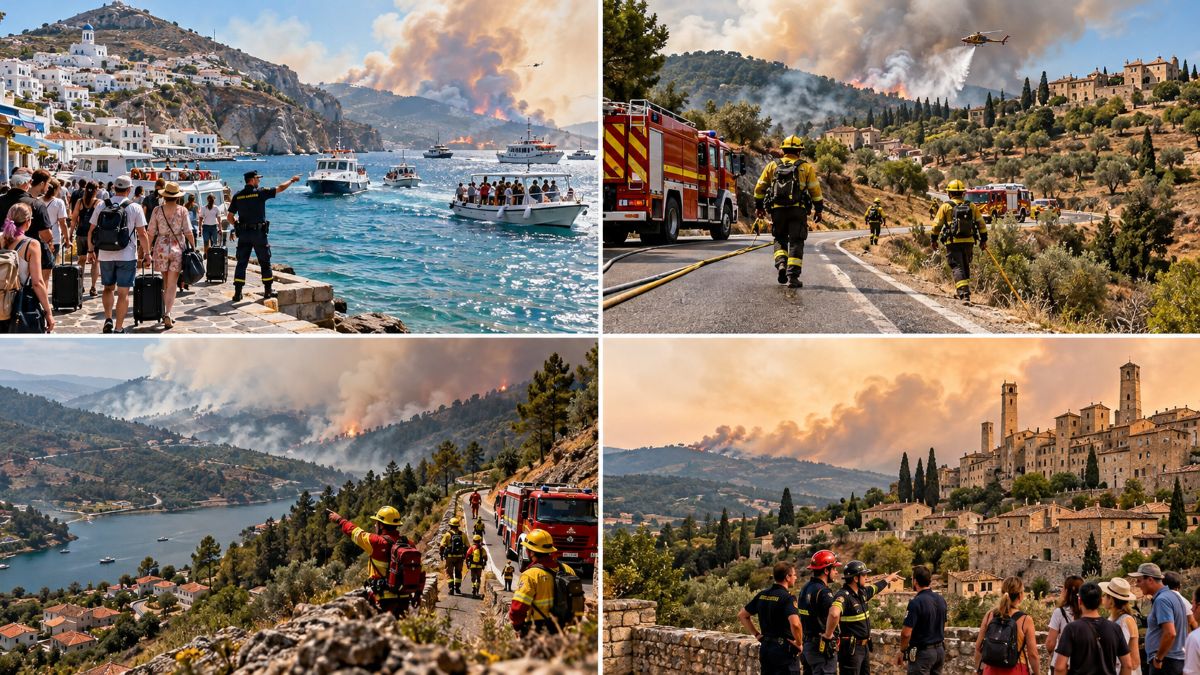
Europe’s record-breaking wildfire season in 2025 has intensified questions about how effectively Mediterranean destinations protect holidaymakers during extreme fire conditions. Greece, Spain, Portugal and Italy face a critical test as tourism authorities balance visitor safety, emergency evacuations and the continuity of holiday services. The European Union recorded 1,079,538 hectares burned in 2025, its highest annual total since EFFIS monitoring began in 2006. Meanwhile, European authorities expanded their 2026 response arrangements to include 777 strategically positioned firefighters from 14 countries. For travellers, however, firefighting capacity tells only part of the story. Reliable warnings, accessible evacuation routes, emergency accommodation and transparent cancellation arrangements increasingly determine whether destinations can maintain visitor confidence.
Europe’s Record Fire Season Changes Holiday Planning
The scale of the 2025 fires exposed the growing challenge facing European tourism. The European Forest Fire Information System (EFFIS), operated by the European Commission’s Joint Research Centre, mapped 7,783 fires across 25 EU member states. The resulting burned area approached twice the average recorded between 2006 and 2024.
August proved particularly destructive. A prolonged heatwave triggered 22 very large fires across Portugal and Spain, burning a combined 460,585 hectares. That represented approximately 43% of the EU’s total burned area during 2025. Germany, Spain, Cyprus and Slovakia also recorded their highest annual burned areas in the EFFIS series.
The geographical consequences extend beyond forests. Fires can threaten resort accommodation, rural guesthouses, heritage attractions, hiking routes and transport connections. Consequently, travellers need destination-specific information rather than broad assurances about national safety.
Advertisement
Advertisement
The threat also extends beyond the traditional summer peak. European research indicates that the fire season is expanding, with serious incidents increasingly occurring outside the historical June-to-mid-September period. This development creates a longer planning challenge for tour operators, accommodation providers and destinations selling spring and autumn holidays.
The 2026 Response Adds a European Safety Net
European authorities have strengthened collective firefighting arrangements following the devastating 2025 season. In June 2026, the European Commission announced 777 firefighters from 14 countries for strategic pre-positioning across high-risk areas in Cyprus, Greece, Italy, France, Spain and Portugal.
Advertisement
Advertisement
The EU also prepared 22 firefighting aircraft and five helicopters to support countries facing overwhelming demand. The wider response included ground teams and specialist emergency expertise, while the Emergency Response Coordination Centre maintained round-the-clock operational support.
These arrangements represent a significant expansion from the 236 firefighters and six participating countries involved when the pre-positioning initiative began in 2022. Nevertheless, additional firefighting resources do not guarantee uninterrupted holidays. Their primary purpose is to protect people and communities, while tourism continuity depends on local evacuation plans, transport availability and clear communication.
The European Commission also presented a more integrated wildfire risk-management approach in March 2026. It addresses prevention, preparedness, emergency response and recovery, encouraging countries to strengthen landscape management, risk assessment and resilience planning.
For the tourism industry, the shift matters because it recognises that fire management cannot begin when flames approach a resort. Preventive land management, early warnings and coordinated recovery arrangements can influence how much disruption an emergency ultimately causes.
Four Destinations Face Different Visitor Risks
Greece, Spain, Portugal and Italy share Mediterranean fire exposure, but their tourism geography creates different challenges. A single national ranking would overlook the differences between island resorts, inland forests, coastal accommodation and historic attractions.
| Destination | Principal tourism vulnerability to investigate | Critical preparedness test |
|---|---|---|
| Greece | Islands, coastal resorts and limited evacuation corridors | Coordination between road transport, ferries, emergency services and hotels |
| Spain | Rural accommodation, protected landscapes and extensive regional tourism networks | Regional alerts, transport continuity and accurate local closure information |
| Portugal | Forested inland areas, rural tourism and communities near exposed landscapes | Prevention, evacuation communication and assistance for affected businesses |
| Italy | Heritage sites, archaeological areas, rural destinations and complex itineraries | Attraction closures, regional coordination and verified reopening information |
These are research priorities, not a verified ranking of national performance. The available evidence does not establish which country has the strongest overall system for protecting tourists.
Advertisement
Advertisement
Spain and Portugal require particular attention following the enormous fires of August 2025. However, burned hectares alone cannot establish how many visitors were evacuated or how many bookings were lost. Those outcomes require separate civil-protection records, accommodation data and published cancellation figures.
Greece offers a detailed case study of emergency evacuation and visitor recovery. Italy presents another important test because the closure of a single archaeological site, heritage area or scenic route can affect an itinerary without necessarily disrupting an entire region.
Rhodes Reveals the Human Cost of Fire Emergencies
The July 2023 wildfires on Rhodes provide a clear example of how a wildfire becomes a tourism emergency. Greek authorities estimated that approximately 19,000 people were moved to safety during the operation, including residents and tourists staying in threatened areas.
Officials reported that 16,000 people travelled by land, while another 3,000 were evacuated by sea. Authorities used organised evacuation messages and moved visitors from affected settlements and hotels. The operation demonstrated the importance of combining emergency communications with road transport, boats, police and firefighting services.
However, evacuation numbers do not reveal the full visitor experience. Travellers also need to know where they will sleep, whether their belongings remain accessible and how they can arrange onward journeys. Families with children, older visitors and people with reduced mobility may require additional assistance during rapidly changing conditions.
Greece subsequently introduced Rodos Week, a programme offering eligible visitors a free week-long stay. It targeted people whose hotels were evacuated during the July 2023 fires, regardless of nationality. The scheme created a tangible recovery mechanism, connecting emergency disruption with a future holiday opportunity.
Advertisement
Advertisement
Its eligibility rules also illustrate an important limitation. A targeted programme for visitors at evacuated hotels does not automatically cover every traveller whose itinerary was affected. Visitors staying elsewhere, travelling independently or facing transport cancellations may have different entitlements.
The Rhodes experience therefore offers two lessons for other destinations. Effective evacuation requires coordination across public services and tourism businesses, while credible recovery requires transparent eligibility rules and practical support after immediate danger passes.
Portugal’s Fire Statistics Demand Closer Scrutiny
Portugal’s 2025 fire season provides a particularly striking measure of the challenge. A provisional national report recorded 254,296 hectares burned between 1 January and 31 August 2025 across mainland Portugal. It counted 7,042 rural fires during the same period.
The report recorded 259% more burned land than the average for the corresponding period across the preceding decade. Yet the number of fires remained 23% below that historical average. This contrast demonstrates why incident counts alone can obscure the scale of a fire season.
The findings are provisional and cover mainland Portugal through August, rather than the complete calendar year. They should not be confused with EFFIS figures, which use satellite mapping and a different reporting methodology. The two datasets offer complementary perspectives, but they are not directly interchangeable.
For travellers, the critical question is how fires affect particular destinations. A major inland incident may threaten rural accommodation, walking routes and road access while leaving distant coastal resorts operational. Conversely, smoke, road closures or evacuation orders may disrupt a holiday beyond the area visibly burned.
Advertisement
Advertisement
Portugal’s preparedness assessment should therefore examine both prevention and visitor support. Forest management and early detection matter, but so do accessible alerts, transport alternatives, temporary accommodation and clear advice from local authorities. Published evidence of visitor cancellations and tourism losses remains necessary before any national performance judgement can be justified.
Spain’s Regional Systems Need Consistent Information
Spain’s extensive tourism geography makes regional coordination central to wildfire resilience. Its visitor economy spans Mediterranean resorts, island destinations, rural accommodation, national parks and historic inland cities. The practical consequences of a fire can differ sharply between these settings.
The 2025 EFFIS record placed Spain among the countries reaching an unprecedented burned area. The August heatwave also contributed to the 22 very large fires recorded across Spain and Portugal. These findings establish the scale of the hazard, but they do not independently measure the effectiveness of Spanish evacuation arrangements.
The research must examine regional civil-protection notices alongside national guidance. Travellers need to identify the affected municipality, understand evacuation instructions and establish whether nearby roads, rail services or attractions remain open. A national fire-risk forecast cannot replace incident-specific instructions from local authorities.
Spain’s tourism resilience should also be assessed through the quality of closure and reopening notices. A protected landscape may close while nearby accommodation remains operational, or transport restrictions may make an otherwise open attraction inaccessible. Clear distinctions can help visitors avoid unnecessary cancellations while respecting emergency orders.
The same evidence should establish whether visitors can find reliable information in languages they understand. Tour operators and hotels can help distribute official warnings, but their advice should remain consistent with civil-protection instructions. The final comparison must verify these arrangements rather than assume that regional variation necessarily indicates weaker preparedness.
Advertisement
Advertisement
Italy Must Protect Heritage and Holiday Routes
Italy’s tourism offer creates a different set of continuity challenges. Archaeological parks, historic settlements, protected landscapes and rural accommodation often form part of multi-stop itineraries. A wildfire can therefore disrupt a carefully planned journey even when the visitor’s hotel remains outside the immediate danger zone.
For this comparison, Italy’s preparedness should be examined through regional civil-protection bulletins, municipal closure notices and official attraction updates. Researchers should establish when sites closed, whether authorities issued alternative access information and how reopening decisions were communicated.
The distinction between a safety closure and physical damage is particularly important. An attraction may temporarily restrict entry because smoke, access roads or nearby firefighting operations create risks. Such a closure does not necessarily indicate that the site has suffered structural damage.
Italy’s tourism recovery assessment should also consider whether operators can redirect visitors towards accessible alternatives. Clear information about open museums, alternative routes and revised itineraries can reduce confusion without encouraging people to enter restricted areas.
However, no reliable comparison should claim that Italy performs better or worse without comparable incident records. Its heritage-rich tourism model identifies the questions that matter; documented responses must determine the eventual assessment.
Tourism Growth Makes Recovery More Important
The stakes extend well beyond individual holiday bookings. Eurostat estimated that tourists spent approximately 3.1 billion nights in EU tourist accommodation during 2025, an increase of 2.2% from 2024. Spain recorded 513.6 million nights, while Italy registered 476.9 million.
Advertisement
Advertisement
These figures demonstrate the economic significance of tourism in two of the countries under review. They do not measure wildfire-related losses, however, and national growth can conceal substantial disruption in individual regions.
The geographical concentration of tourism makes regional analysis essential. Eurostat reported that the Canary Islands recorded 99.5 million accommodation nights in 2024, while Catalonia recorded 88.7 million. Greece’s southern Aegean islands also depend heavily on international visitors, making dependable emergency communication particularly important.
| Tourism indicator | Latest relevant published figure | What it reveals |
|---|---|---|
| EU accommodation nights, 2025 | Approximately 3.1 billion | The scale of the tourism economy exposed to disruption |
| Spain, accommodation nights in 2025 | 513.6 million | The size of Spain’s visitor market |
| Italy, accommodation nights in 2025 | 476.9 million | The importance of continuity across destinations |
| EU land burned during 2025 | 1,079,538 hectares | The unprecedented scale of the fire season |
| Portugal, mainland land burned by 31 August 2025 | 254,296 hectares | The severity of the provisional national fire record |
Tourism recovery cannot be measured through arrivals alone. Researchers should compare accommodation nights, occupancy, regional tourism receipts and reopening timelines against appropriate historical baselines. Where possible, they should also separate the fire’s effects from seasonality, transport changes and other influences on demand.
The distinction matters to businesses as well as travellers. Hotels need to understand whether demand has shifted to unaffected areas, while tour operators need reliable information about substitute attractions and revised itineraries. Regional authorities also need evidence showing whether recovery assistance reaches the businesses and communities most affected.
Transparency Could Become a Competitive Advantage
Preparedness depends partly on whether travellers can obtain trustworthy information before and during an emergency. Official websites should make it easy to locate current alerts, affected areas, evacuation instructions and verified reopening updates. Clear information helps visitors act quickly without relying on rumours or outdated social media posts.
The four countries should be assessed against the same transparency criteria. Researchers should record whether alerts identify precise locations, provide timestamps and explain what visitors should do next. They should also check whether information is available in multiple languages and whether authorities maintain accessible updates when circumstances change.
Advertisement
Advertisement
A destination should not receive a poor assessment simply because researchers cannot find a cancellation statistic. Instead, the report should distinguish missing public evidence from demonstrated operational failure. That distinction is essential for a credible comparison and for fair treatment of national tourism authorities.
The EU’s integrated wildfire approach strengthens the policy context by placing prevention, preparedness, response and recovery within a broader framework. Nevertheless, European cooperation cannot replace clear instructions from the authority responsible for a specific destination. Travellers need local information that reflects actual conditions, not merely evidence that a national or European response system exists.
What Travellers Should Check Before Departure
Holidaymakers can improve their preparedness by checking official information shortly before travelling. Fire danger changes quickly, so a forecast consulted several weeks before departure may not reflect conditions on arrival. Travellers should monitor official civil-protection alerts and follow any evacuation instructions issued for their location.
Visitors should also confirm whether planned attractions, hiking routes and transport connections remain accessible. Those travelling between regions should check for road closures and service interruptions rather than assuming that a functioning airport guarantees access to the final destination.
Accommodation providers and tour operators can clarify their procedures for emergencies, relocation and booking changes. Travellers should also review their insurance wording, particularly the conditions governing evacuation, trip interruption, alternative accommodation and cancellation. Coverage varies by policy, and a general travel insurance policy should not be assumed to cover every wildfire-related expense.
These precautions do not mean avoiding Mediterranean holidays. They help travellers make better-informed decisions while recognising that emergency authorities may change restrictions as conditions evolve.
Advertisement
Advertisement
Better Preparedness Must Protect Holiday Confidence
The evidence points towards a more demanding standard for Mediterranean tourism. Firefighting resources remain essential, but resilient destinations also need precise warnings, coordinated evacuations, practical visitor assistance and transparent recovery arrangements. Greece’s Rhodes experience demonstrates the importance of linking emergency action with post-crisis support, while Portugal’s 2025 statistics underline the scale of the underlying hazard. Spain and Italy require equally rigorous, incident-based assessments before any fair ranking becomes possible.
For travellers, European wildfire tourism preparedness should become part of holiday planning alongside transport, accommodation and seasonal weather. The most reliable destination is not necessarily the one that avoids every fire, but the one that communicates clearly and protects visitors when conditions deteriorate.
Advertisement
