
RAKEZ Highlights Ras Al Khaimah’s Food Manufacturing Potential at Future Food Summit 2026
Published
Ras Al Khaimah is strengthening its position as a destination for food and beverage manufacturing, with RAKEZ highlighting industrial opportunities, infrastructure and sustainability initiatives at Future Food Summit 2026. The summit brought together UAE food industry stakeholders to examine investment, supply chains, food security and sustainable sector growth.
What did RAKEZ highlight at Future Food Summit 2026?
Ras Al Khaimah Economic Zone (RAKEZ) used its participation at Future Food Summit 2026 to showcase the emirate’s potential as a base for food and beverage manufacturers seeking to establish operations, expand production and reach regional markets. The economic zone participated as a Silver Sponsor at the eighth edition of the annual event, which was held on 2 October 2026.
Advertisement
Advertisement
Organised by the UAE Food Cluster and the UAE Food & Beverage Business Group under the patronage of the Ministry of Economy and Tourism, the summit provided a platform for businesses and industry stakeholders to discuss the changing priorities of the UAE food ecosystem.
For RAKEZ, the event represented an opportunity to engage directly with manufacturers, suppliers, investors and other companies operating across the food and beverage value chain. The discussions also reflected the broader transformation taking place within the UAE’s industrial economy, where food manufacturing is increasingly linked with food security, supply-chain resilience, resource efficiency and regional trade.
Advertisement
Advertisement
Why is Ras Al Khaimah attracting food manufacturers?
Ras Al Khaimah is positioning itself as a competitive location for companies that require industrial facilities, connected infrastructure and practical business support. Through RAKEZ, businesses can access an economic-zone environment designed to support companies across different stages of development, from establishing operations to expanding manufacturing capacity.
The food and beverage industry requires more than production facilities. Manufacturers also depend on logistics, suppliers, storage, utilities, waste-management systems and access to regional markets. The concentration of these requirements within a connected industrial ecosystem can help companies manage operations more efficiently as they scale.
Advertisement
Advertisement
RAKEZ Group CEO Ramy Jallad said food and beverage manufacturing was an important part of the UAE’s industrial growth story, while emphasising the role Ras Al Khaimah can play in helping businesses establish and expand.
He also pointed to sustainability and resource efficiency as increasingly important considerations for manufacturers. This reflects a wider shift in the global food industry, where businesses are under growing pressure to reduce resource consumption, improve production efficiency and build more resilient supply chains.
Advertisement
Advertisement
How is RAKEZ addressing sustainable food production?
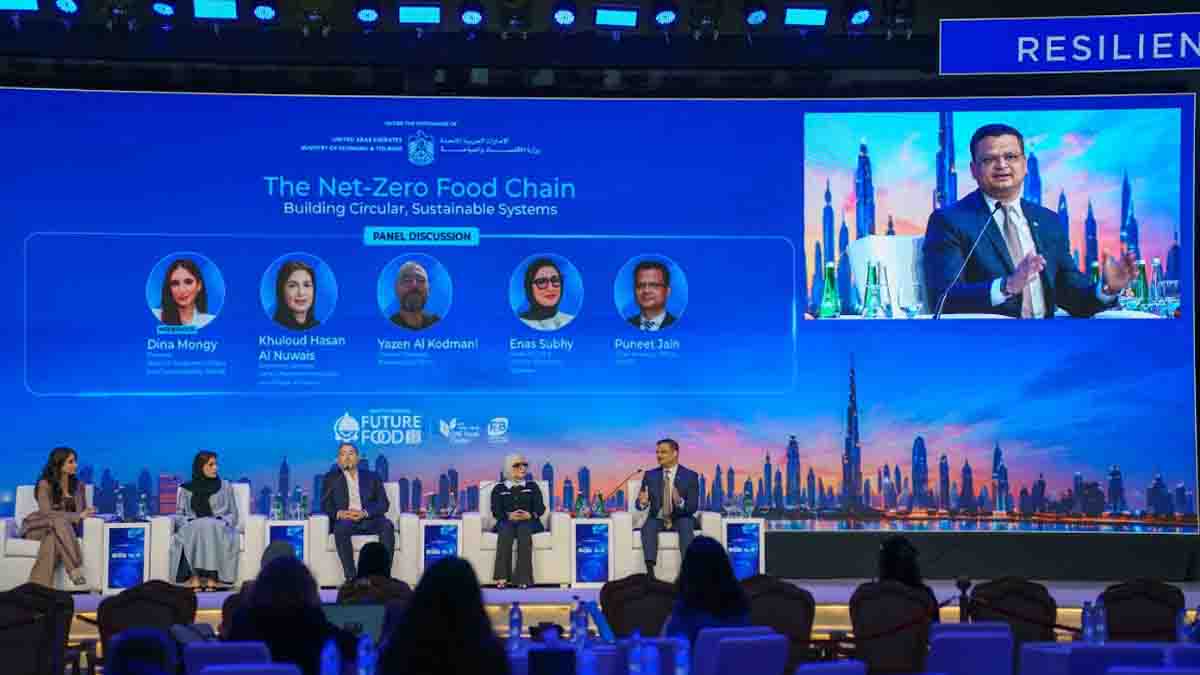
Sustainability was a central theme of RAKEZ’s presence at the summit. Puneet Jain, Chief Strategy Officer at RAKEZ, participated in the panel discussion titled ‘The Net-Zero Food Chain: Building Circular, Sustainable Systems’.
The session examined how the food sector can move towards more circular production models while strengthening collaboration between businesses. Rather than treating manufacturers as independent operations, the circular approach considers how companies within an industrial ecosystem can exchange resources, infrastructure and materials.
Economic zones can play an important role in this model because they bring different types of businesses into connected locations. Food manufacturers, suppliers, logistics companies, technology providers and service businesses can operate within the same wider ecosystem, creating opportunities for collaboration.
This can be particularly relevant when materials or by-products from one operation can potentially become useful inputs for another. Such resource exchanges can reduce waste while improving the overall efficiency of industrial activity.
Advertisement
Advertisement
Why does circularity matter to the food and beverage sector?
Food manufacturing uses significant quantities of water, energy, packaging and raw materials. At the same time, the sector generates organic waste, packaging waste and other by-products throughout production and distribution.
Circular production seeks to reduce the amount of material that becomes waste by keeping resources in productive use for as long as possible. For food and beverage companies, this can involve improved waste segregation, recycling, water reuse, resource recovery and more efficient use of energy.
At Future Food Summit 2026, Jain highlighted the importance of making sustainability practical for businesses. Environmental measures are more likely to be adopted when companies can implement them without compromising operational efficiency or commercial competitiveness.
Shared infrastructure can therefore become an important part of the transition. Companies may benefit from access to common facilities, technologies and services that would otherwise require substantial individual investment.
This approach also creates potential for businesses to collaborate on solutions rather than developing every sustainability measure independently.
What role can economic zones play in the net-zero food chain?
Economic zones can provide a physical and commercial framework for building interconnected industrial ecosystems. Their role extends beyond providing land or industrial units because they can facilitate proximity between manufacturers, suppliers, logistics providers and supporting service companies.
Advertisement
Advertisement
For the food sector, this proximity can help create shorter and more efficient supply chains. It can also support partnerships around waste management, recycling, water efficiency, cleaner energy and resource recovery.
Jain’s contribution to the Future Food Summit discussion underlined the potential of economic zones to enable these connections. When businesses operate within a coordinated ecosystem, opportunities can emerge to share infrastructure and identify ways of converting materials that would otherwise be discarded into useful resources.
The approach is particularly relevant as manufacturers face the combined challenge of controlling costs while meeting increasingly demanding environmental expectations.
How does sustainability support business competitiveness?
Sustainability and competitiveness are increasingly interconnected in manufacturing. Reducing energy consumption, improving water efficiency and minimising material waste can lower operating costs while also reducing environmental impact.
For food manufacturers, resource efficiency can therefore become both an environmental objective and a commercial consideration. Businesses that use energy and water more efficiently may be better positioned to manage operational costs, while effective waste-management systems can reduce disposal requirements and create opportunities for material recovery.
RAKEZ’s approach reflects this practical perspective. The focus is not simply on encouraging manufacturers to adopt sustainability principles, but on creating an environment where companies can access the facilities, services and partnerships required to implement those principles.
Advertisement
Advertisement
This distinction is important for businesses considering new manufacturing locations. Investment decisions are influenced by the availability of infrastructure, logistics, operating costs, market access and the ability to expand production over time.
How does the initiative support UAE food security?
The development of domestic food manufacturing is closely connected to the UAE’s wider food-security ambitions. The country has been seeking to strengthen the resilience of its food supply chains, encourage innovation and develop a more future-ready food ecosystem.
RAKEZ’s participation at Future Food Summit 2026 supports these broader objectives by highlighting the role that industrial ecosystems can play in strengthening food manufacturing capacity.
A resilient food system requires cooperation across multiple stages of the value chain. Production, processing, packaging, storage, logistics, technology and waste management all contribute to the sector’s ability to respond to changing market conditions.
The UAE’s National Food Security Strategy 2051 provides a long-term framework for improving food security and developing a more resilient food system. Industrial investment and sustainable manufacturing can contribute to that objective by increasing local capabilities while supporting efficient connections with international markets.
What does Future Food Summit 2026 mean for the region?
The summit demonstrated the growing importance of collaboration within the UAE’s food and beverage industry. Bringing manufacturers, investors, suppliers and policymakers together allows businesses to discuss common challenges and identify potential areas for cooperation.
Advertisement
Advertisement
For Ras Al Khaimah, the event also provided an opportunity to communicate its proposition to companies considering expansion within the UAE and wider region.
The food and beverage sector is likely to remain an important component of the UAE’s industrial development as companies seek locations that combine infrastructure, operational efficiency and market connectivity. Sustainability is becoming an increasingly important part of that decision-making process.
RAKEZ’s participation therefore reflects a broader effort to position Ras Al Khaimah as an industrial destination capable of supporting both manufacturing growth and the transition towards more resource-efficient production.
What is the outlook for Ras Al Khaimah’s food manufacturing sector?
The future growth of food manufacturing in Ras Al Khaimah will depend on the ability of businesses and industrial ecosystems to combine commercial performance with resource efficiency. Infrastructure, logistics, technology and collaboration will remain central to that process.
RAKEZ’s engagement at Future Food Summit 2026 places these priorities within the wider context of UAE food-sector development. Its focus on connected infrastructure, business support and sustainable industrial solutions provides a framework for companies seeking to scale while adapting to changing expectations around environmental performance.
As food manufacturers increasingly examine their supply chains and resource use, economic zones that can support collaboration across the value chain could become increasingly important. Ras Al Khaimah is seeking to strengthen its position in this evolving landscape by connecting investment opportunities with practical industrial capabilities.
Advertisement
Advertisement
RAKEZ’s participation in Future Food Summit 2026 highlights Ras Al Khaimah’s ambitions in food and beverage manufacturing. Its focus on connected infrastructure, circularity, resource efficiency and business support reflects the UAE’s broader push for resilient food systems. The approach could strengthen the emirate’s appeal to manufacturers seeking sustainable regional growth.
“RAKEZ’s focus on sustainable food manufacturing demonstrates how economic zones can support both industrial growth and long-term resilience. Connecting manufacturers, infrastructure and circular solutions is increasingly important as the UAE strengthens its food ecosystem and positions Ras Al Khaimah as a competitive regional investment destination.” — Anup Kumar Keshan, Founder and Editor-in-Chief, Travel And Tour World
Advertisement
