

Canada Stands Alongside the United States and Others as ICAO Aviation Talks Review Travel Assistance at Airports

Published
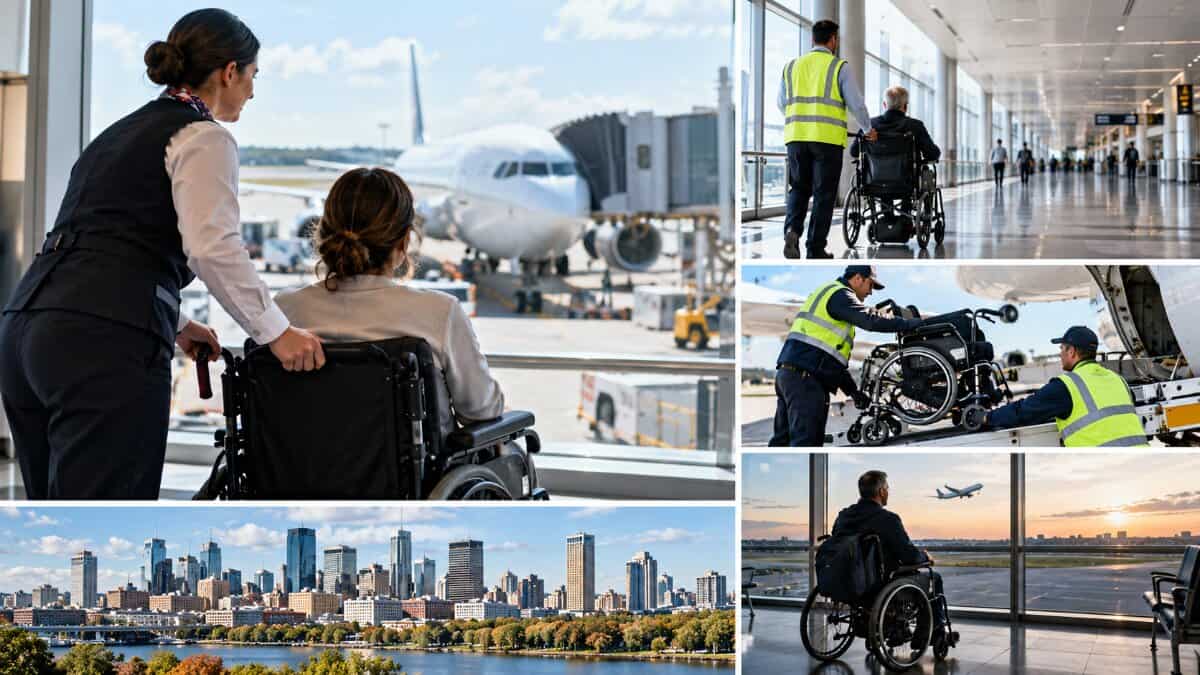
International aviation regulators and industry bodies will meet in Montréal on 14–15 October 2026 to examine how passengers with disabilities and reduced mobility can travel more easily from booking to arrival. The second joint symposium of the International Civil Aviation Organization (ICAO), Airports Council International and International Air Transport Association comes as Canada, the United States, the United Kingdom and France operate distinct systems for airport assistance and passenger protection. The central issue is whether booked help continues through boarding, connections and arrival.
The meeting at ICAO headquarters is a global discussion, not a newly announced four-country agreement. Canadian and US regulators appear on the programme; the UK and France are relevant comparators, not announced partners. No new international legal rights have been adopted ahead of the meeting.
Advertisement
Advertisement
Montréal Symposium Puts the Whole Accessible Travel Journey on the Agenda
According to ICAO’s official event notice, the meeting follows the first joint accessibility symposium held in Montréal in December 2024. The meeting considers implementation under Annex 9 on facilitation.
The programme published on 9 October schedules discussions on regulation, airport design, travellers’ lived experience, digital accessibility and safety. A 15 October session will examine performance monitoring, cooperation and implementation priorities. The opening sessions also consider the 2026–2028 strategic direction.
Advertisement
Advertisement
Accessible websites, boarding equipment and staff coordination can determine whether holidays and business trips proceed as booked. The agenda does not establish any new global service standard.
Canada, United States, United Kingdom and France Share the Goal, but Not One Rulebook
All four markets protect disabled travellers, but legal coverage and accountability vary across connecting journeys.
Advertisement
Advertisement
| Market | Main official framework | Airport and boarding implications | Detail relevant to cross-border travel |
|---|---|---|---|
| Canada | Accessible Transportation for Persons with Disabilities Regulations | Covered carriers and airports have specified accessibility duties, including support with mobility aids and boarding | Many services can require 48 hours’ notice; some assessments involving documents can require up to 96 hours |
| United States | Air Carrier Access Act and 14 CFR Part 382 | Airlines must arrange requested assistance, including transfers between connecting gates | Applies to US airlines’ flights and foreign airlines’ flights to or from the US |
| United Kingdom | UK passenger accessibility rules overseen by the Civil Aviation Authority | Airports organise assistance through boarding and after arrival; airlines handle assistance in flight | Passengers should request support when booking or at least 48 hours before departure |
| France | EU Regulation 1107/2006 | Airport operators arrange free terminal, boarding and disembarkation assistance; airlines handle onboard support | Assistance notifications received 48 hours ahead must normally be passed to relevant airports and operators at least 36 hours before departure |
Legal coverage depends on the carrier, journey, requested service and safety requirements.
Canada: Connecting Services and Mobility Aid Protection Remain Priorities
According to the Canadian Transportation Agency’s 2026–27 departmental plan, accessibility training, safer mobility-aid handling and continued work on ICAO’s long-term accessibility strategy remain priorities. Its projects include safer mobility-aid storage and ground-handling guidance.
Advertisement
Advertisement
Under its advance-notice guidance, covered carriers must arrange many requested services after at least 48 hours’ notice. Certain requests requiring supporting information may need up to 96 hours. Shorter notice does not automatically remove the obligation to make reasonable efforts.
A less obvious distinction concerns extra seats: Canada’s one-person, one-fare provision for eligible disability-related seating needs applies to domestic travel, not automatically to international itineraries. Agents must check international support-person fares separately.
United States: Wheelchair Mishandling Data Exposes a Measurable Travel Risk
The US Department of Transportation’s passenger disability rights guidance covers requested assistance between gates, boarding, disembarkation and accessible information. Airlines remain responsible for compliance by their contractors. The guidance also prohibits leaving someone unattended for more than 30 minutes in a wheelchair or device in which they cannot move independently.
The September 2026 Air Travel Consumer Report provides a revealing operational measure. In July 2026, reporting US operating carriers mishandled 953 of 80,285 wheelchairs and scooters carried, a rate of 1.19%, compared with 889 of 78,892, or 1.13%, in July 2025. This is not a global damage rate.
Advertisement
Advertisement
A separate August 2026 federal notice extends enforcement discretion on selected wheelchair-rule provisions until 30 April 2027. The limited pause covers liability, training, notification and fare-difference provisions without cancelling existing statutory protections.
United Kingdom: More Assistance Users, but Difficulties Persist
According to the UK Civil Aviation Authority’s report published on 4 August 2026, a record 5.9 million passengers used UK airport assistance services in 2025. Requests had risen 115.8% since 2015, while overall passenger growth was 23.9% over the same period.
All 28 assessed airports achieved either good or very good ratings for 2025–26. Yet the regulator’s survey found 58% of disabled consumers experienced difficulties accessing or using airports and flying. Satisfaction was 82% among people with accessibility or disability needs, compared with 88% overall.
Under the CAA’s passenger guidance, travellers can request help through their airline, agent or tour operator, preferably at booking and at least 48 hours ahead. Airports coordinate terminal assistance, while airlines provide the relevant onboard support. Ratings cannot guarantee barrier-free journeys.
France: The EU Handover Deadline Matters for Connecting Passengers
France applies EU Regulation 1107/2006. Its transport ministry’s official guidance identifies the airport managing body as responsible for free assistance through the terminal and boarding process. The airline takes responsibility once the passenger is seated onboard.
An important deadline governs information-sharing. Where an assistance request arrives at least 48 hours before departure, airlines, agents and tour organisers must normally pass the relevant details to departure, arrival and transit airports at least 36 hours before the scheduled flight. Airports must still make reasonable efforts where timely notice was not provided.
Advertisement
Advertisement
For French connections, correct transmission matters as much as the original request. The French guidance also recommends allowing sufficient time between connecting services and confirming dimensions and battery specifications for electric mobility aids.
Official Figures Show Why Accessibility Needs More Than a Legal Checklist
| Official indicator | Latest period available by 13 October | Verified figure | What it measures |
|---|---|---|---|
| UK passengers using airport assistance | Calendar 2025 | 5.9 million | Demand for services, not the number of people facing failures |
| UK airports assessed positively | 2025–26 reporting period | 28 of 28 | Regulatory airport ratings, not a guarantee for individual journeys |
| US wheelchairs and scooters mishandled | July 2026 | 953 of 80,285; 1.19% | Reported handling incidents among specified US operating carriers |
| Canadian air accessibility complaints | Fiscal 2024–25 | 0.04 per 100 flights | Complaints received by the Canadian regulator, not all incidents |
| People worldwide living with disability | WHO estimate reaffirmed August 2026 | More than 1.3 billion; about 16% | Broader population context, not an aviation passenger count |
The Canadian rate appears in the agency’s 2026–27 plan; the global estimate appears in the World Health Organization’s August 2026 factsheet. Different denominators preclude direct rankings. Better airport ratings can coexist with delayed wheelchairs or poor transfer information.
The Overlooked Gap: A Single Booking Can Involve Several Assistance Handover Points
Consider a traveller leaving Canada, connecting through the United States, continuing to the United Kingdom and arriving in France. This is an illustrative itinerary, not a newly announced route. The traveller may make one request through a booking channel, yet the service depends on several airlines, airport teams and national legal frameworks.
The critical stages are easy to identify but difficult to manage consistently: the departure drop-off point, security, the boarding gate, a transfer chair, loading a personal wheelchair, arrival at the next gate, and onward movement to another aircraft. A request entered correctly in a reservation is not itself proof that each service team has received actionable instructions.
That distinction creates a testable operational question for airlines and agencies: who confirms receipt of the assistance information at every transfer? An end-to-end approach could identify a lead contact, preserve an accurate record of equipment specifications, verify boarding arrangements before ticketing and record completed handovers after each sector.
These are proposals, not Montréal decisions. They would reduce uncertainty for travellers and help travel sellers distinguish a journey that is legally bookable from one whose practical accessibility has been checked. They also offer a more meaningful measure than counting assistance requests alone.
Advertisement
Advertisement
Airports, Travel Technology and Corporate Travel Face Practical Decisions
The 14 October ICAO programme includes universal airport design and digital accessibility. Its discussions cover wayfinding, booking platforms, passenger-controlled information sharing and the implications of biometric or digital identity processes for people with visible and non-visible disabilities.
For airports, investment priorities include usable assistance points, appropriate lifts, accessible information and trained personnel. For technology suppliers, the challenge is to make accessibility details accurate across booking systems without forcing passengers to repeat sensitive information unnecessarily. Privacy and consent matter alongside operational reliability.
For MICE and corporate travel, accessible venues alone are insufficient if transfers and flights remain uncertain. No confirmed symposium decision announces airport construction spending, route expansion or a new international funding programme.
What Travel Agents and Tour Operators Should Do Now
- Record the whole journey: Confirm assistance needs separately for departure, every connection, arrival and the return trip.
- Check notice periods: Aim for at least 48 hours; allow longer where Canadian assessments or equipment documentation require it.
- Verify mobility equipment: Share dimensions, weight, battery type, handling instructions and the planned return point with the relevant carrier.
- Examine transfers: Check gate changes, terminal moves, boarding equipment and realistic connection times before issuing complex itineraries.
- Keep evidence: Retain assistance confirmations and identify airline or airport complaint channels before departure.
- Plan disruption support: Establish a procedure for missed connections, aircraft substitutions and unavailable mobility equipment without assuming automatic assistance continuity.
What Happens After Montréal and Why It Matters for Travel Growth
The symposium concludes on 15 October 2026 with a scheduled discussion of implementation, monitoring and follow-up. Canada’s existing work on an ICAO accessibility strategy, the UK regulator’s planned framework review and the US enforcement timetable extending into April 2027 provide separate developments to monitor. No worldwide rule takes effect this week.
More reliable assistance could widen practical access to leisure, business and group travel, while weak connections and equipment failures continue to create planning risks. The strategic opportunity is to treat accessibility as measurable service quality across the whole itinerary. No official forecast quantifies an associated tourism-growth gain.
FAQs
Is Montréal introducing new worldwide disability passenger rights on 14–15 October?
No. ICAO has scheduled discussions about accessibility policy and implementation. The published programme does not itself create new legally enforceable rights or a four-country agreement.
Advertisement
Advertisement
Is airport assistance free in Canada, the US, the UK and France?
Applicable national frameworks require covered accessibility assistance without an extra service charge. Exact coverage, eligible services and circumstances differ, so travellers should check the rules governing their airline and route.
When should travellers request help for a connecting itinerary?
At booking where possible. Forty-eight hours is an important planning benchmark across the compared markets, while some Canadian requests requiring assessment may need up to 96 hours. Shorter notice does not automatically erase existing protections.
Who is responsible when assistance fails at a connection?
Responsibility depends on where the journey is taking place and which service failed. UK and French airport operators manage much terminal support, while US carriers carry substantial airport assistance obligations. Travellers should record the incident and contact the responsible provider.
Do the latest official figures show international air travel is fully accessible?
No. UK ratings indicate improvement, but passenger survey difficulties remain. US equipment-handling data document continuing incidents, while Canadian complaint figures describe a different reporting measure. The statistics cannot be combined into a single global accessibility score.
Advertisement
