
Zambia Moonbow Travel: How to See the Rare Victoria Falls Lunar Rainbow

Published
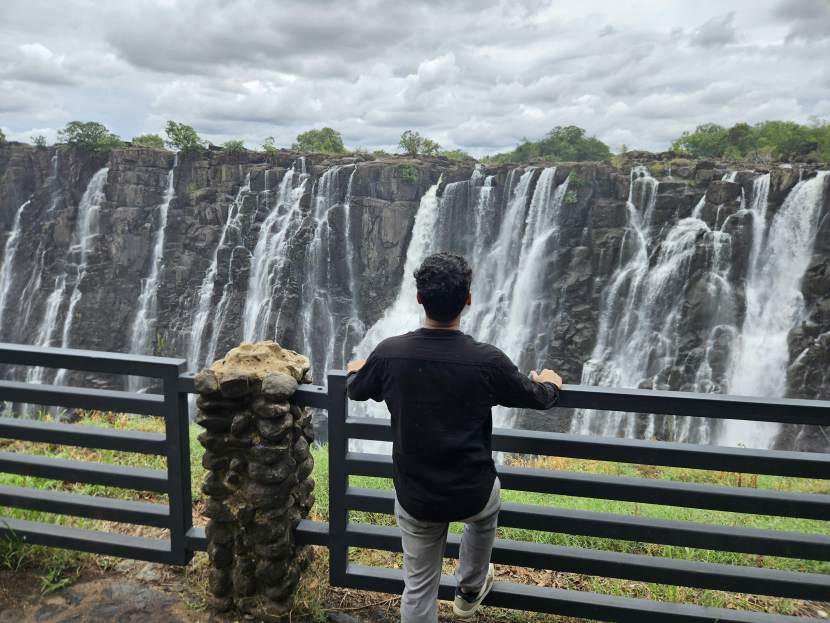 Image generated with Ai
The intersection of atmospheric precision and untamed geography is beautifully demonstrated during a specific nocturnal event in Southern Africa. The lunar rainbow at Victoria Falls, Zambia, is classified among the rarest optical spectacles on Earth, drawing observers who seek to witness a phenomenon that defies ordinary daytime expectations. Often referred to colloquially as a moonbow, this event occurs when the light of a full moon is refracted through the dense mist produced by the Zambezi River as it plunges into the bat-eared basalt chasm below. Unlike its solar counterpart, which vibrant daylight renders easily visible to the naked eye, the nocturnal variant presents itself as a subtle, ethereal arc of silver and pale white, requiring specific environmental conditions to manifest in its complete glory.
The unique geography of Mosi-oa-Tunya, translated as The Smoke That Thunders, serves as the perfect amphitheater for this event. For a lunar rainbow at Victoria Falls, Zambia to be successfully perceived by the human eye, an alignment of three absolute variables is mandatory: a completely unclouded night sky, a bright full moon positioned low in the heavens, and an abundant volume of airborne water particles. Because the river flow varies dramatically across the seasons, the visibility of the phenomenon is highly dependent on the calendar, with the peak high-water months of April and May offering the most dramatic displays of mist, though sometimes at the cost of obscuring the waterfall structure itself.
Environmental Dynamics and Optical Principles
To understand why this specific location is favored globally for such sightings, the physical attributes of the gorge must be analyzed. The waterfall spans an approximate east-west orientation, which interacts uniquely with the trajectory of celestial bodies. As the moon rises in the eastern horizon, its illumination travels across the chasm, hitting the suspended droplets produced by the constant hydraulic impact. For an observer positioned on the pathways of the rainforest, the moon must remain directly behind their vantage point while the spray rises directly ahead. This alignment dictates that the most favorable viewing angles are oriented toward the west during the hours immediately following moonrise, before the celestial body ascends too high into the night sky and diffuses its beams.
The sensory transition from day to night within the national park boundaries introduces an entirely different atmospheric quality. During daylight hours, the site is dominated by the roar of the current and the bright green hues of the surrounding vegetation. After twilight, however, the landscape becomes a study in monochrome and shadow. The paths, which are traversed by thousands of international tourists during the day, are navigated under the guidance of park authorities at night, with the presence of local wildlife such as elephants and buffalo adding an element of wilderness predictability to the excursion. The water, illuminated by the lunar rays, shimmers with a distinct metallic sheen that sets a dramatic stage for the appearance of the arc.
Advertisement
Advertisement
The Challenge of Nocturnal Perception
The human visual apparatus is uniquely challenged by the presentation of a moonbow. Human eyes utilize two distinct types of photoreceptors: cones, which detect color in bright conditions, and rods, which are highly sensitive to light but incapable of resolving color in low-contrast environments. Because the light reflected by the moon is significantly less intense than direct solar radiation, the lunar rainbow typically appears to human onlookers as an ash-white or ghostly silver ribbon arching over the abyss. It is only through the utilization of long-exposure photography that the true nature of the optical spectrum is revealed, as digital sensors accumulate the sparse photons over several seconds to unveil vivid bands of red, green, and blue hidden within the night.
Preparation for this specific excursion demands deliberate planning, as the mist generated by the falling river is sufficiently dense to simulate a continuous downpour. Visitors are frequently enveloped in a localized rain system created by the upward updrafts of the canyon. Protective gear for both individuals and sensitive photographic equipment is deemed essential, with waterproof layers and dry storage bags being standard requirements for anyone approaching the edge of the cliffs. The journey along the wet stone pathways, punctuated by the rhythmic thundering of the Zambezi River, culminates in viewpoints where the spray is heavy enough to generate the refraction but clear enough to allow the background landscape to remain discernible.
Advertisement
Advertisement
Seasonal Variations and Lunar Calendars
The predictability of the phenomenon is tied strictly to the lunar cycle, occurring only during a three-night window each month: the night preceding the full moon, the night of the event itself, and the night immediately following. Outside of this brief period, the illumination provided by the moon is insufficient to generate a visible spectrum against the dark backdrop of the gorge. Furthermore, regional weather patterns heavily influence the success of an expedition. The dry season, spanning from September through December, sees a dramatic reduction in water volume, causing the eastern portion of the falls on the Zambian side to dry up completely, thereby eliminating the necessary mist and rendering moonbow tracking futile during those months.
In contrast, the transition into the early middle months of the year brings an abundance of water fed by upstream rainfall in the Angolan highlands. The resulting torrent ensures that the entire width of the geological fault line is utilized, maximizing the spray generation. Special celestial events, such as micro full moons or rare seasonal double full moons, provide unique variations in light intensity that are closely monitored by astronomy enthusiasts and specialized tour operators alike. The experience of standing in the dark, surrounded by the deep vibrations of the earth as a pale arc forms across the mist, remains one of the most compelling reasons why this specific border region continues to be celebrated by modern travelers.
Advertisement
