
Sri Lanka Reconnects Badulla With Nanu Oya by Rail and Expands Nuwara Eliya Highland Tourism

Updated
Published
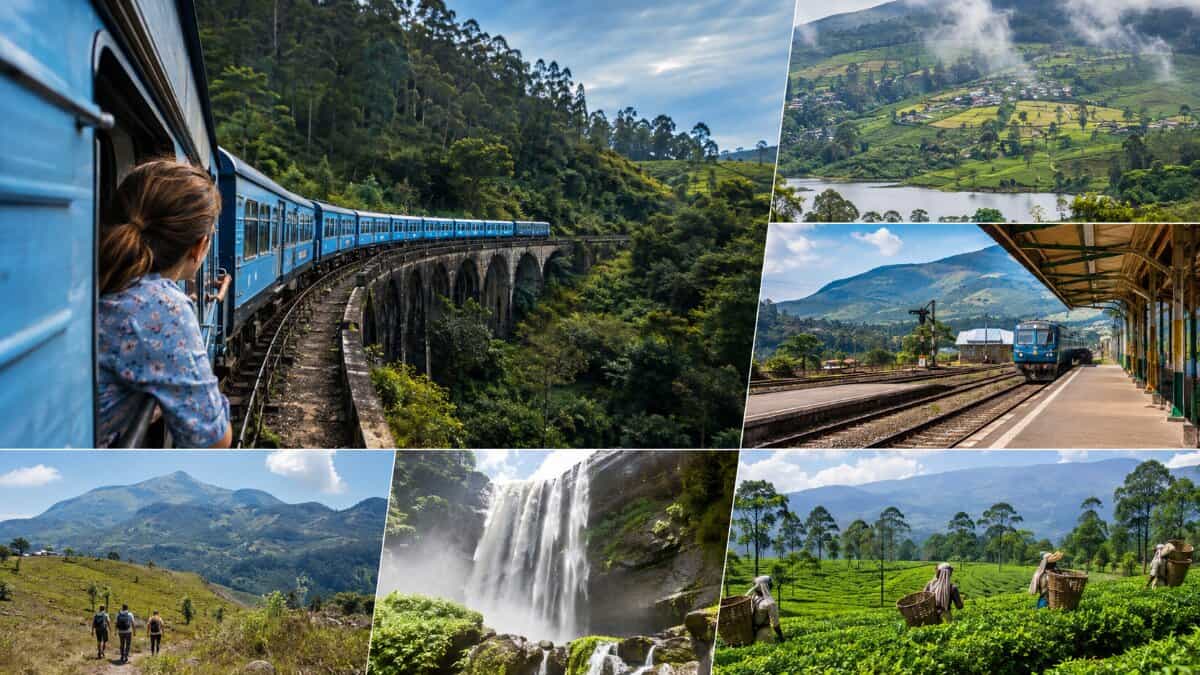
Sri Lanka’s restoration of rail services from Badulla through Ambewela to Nanu Oya has created a broader tourism opportunity than the original Badulla–Ambewela tourist-train plan. The reopened corridor now reconnects the railway with the Nuwara Eliya gateway while linking two districts containing 4,608 registered accommodation rooms. It arrives as Sri Lanka recorded 1,436,929 international tourists through 13 August 2026 about 2.1% below the equivalent 2025 period. The commercial opportunity therefore extends beyond sightseeing towards longer stays with regional visitor spending alongside accommodation distribution and new highland tourism investment.
Badulla–Nanu Oya Restoration Changes The Sri Lanka Rail Tourism Story
Sri Lanka’s highland railway story has moved materially beyond the proposal for a regional tourist train between Badulla and Ambewela. Regular services on the Badulla–Ambewela section had resumed from 20 December 2025 after disruption to the Main Line. Sri Lanka Railways subsequently identified 1 January 2026 as the planned introduction date for a regional tourist service between the two stations, subject to railway works and immediate safety requirements.
Advertisement
Advertisement
The more consequential tourism development arrived on 18 June 2026, when Sri Lanka Railways confirmed that trains from Badulla to Nanu Oya had resumed following restoration of the Ambewela–Nanu Oya section damaged by Cyclone Ditwa. Nanu Oya functions as the railway gateway for the wider Nuwara Eliya highlands, meaning the operational geography now extends substantially beyond the originally proposed Badulla–Ambewela tourism product.
That distinction matters to tour operators. A short regional excursion has limited capacity to influence length of stay. A functioning corridor stretching from Badulla through Ambewela towards Nanu Oya can instead support multi-stop itineraries, accommodation nights and ground transfers across two important highland tourism districts.
Advertisement
Advertisement
| Official railway milestone | Confirmed development | B2B tourism significance |
|---|---|---|
| 20 December 2025 | Regular Badulla–Ambewela services resumed | Restored initial access through the disrupted highland section |
| 30 December 2025 restoration programme | Badulla–Ambewela regional tourist service listed for planned introduction from 1 January 2026 | Established an explicit railway-tourism strategy |
| 18 June 2026 | Badulla–Nanu Oya services resumed after Ambewela–Nanu Oya restoration | Extended practical rail connectivity towards the Nuwara Eliya gateway |
| 16 August 2026 source review | No separate current Sri Lanka Railways notice or dedicated timetable located confirming the proposed tourist train as a distinct presently marketed product | Trade should distinguish confirmed regular operations from the separately announced tourist-train concept |
According to the official Sri Lanka Railways disaster-recovery programme, the railway network suffered more than 159 landslides, 95 washouts and extensive additional weather-related damage. The preliminary estimate placed disaster-resilient infrastructure damage at Rs 341 billion, while rehabilitation and reconstruction requirements were estimated at Rs 128 billion. The scale of that disruption makes the June reopening strategically relevant beyond tourism promotion: dependable railway access itself is part of destination resilience.
Why Badulla And Nuwara Eliya Create A Different Tourism Economy Together
The most compelling evidence for the new tourism-distribution angle comes from accommodation data rather than railway marketing.
Advertisement
Advertisement
According to the Sri Lanka Tourism Development Authority Year in Review 2024, updated in April 2026, Badulla District contained 2,055 registered accommodation rooms, while Nuwara Eliya District contained 2,553. Combined, the two markets represented 4,608 rooms before considering subsequent changes to inventory.
More important than their combined size is their markedly different composition.
| SLTDA accommodation indicator | Badulla District | Nuwara Eliya District | Commercial implication |
| Total registered rooms | 2,055 | 2,553 | 4,608-room combined highland base |
| Classified hotel rooms | 241 | 787 | Nuwara Eliya has substantially deeper conventional hotel capacity |
| Guest-house rooms | 751 | 966 | Both markets can accommodate independent and touring demand |
| Rooms in home-stay units | 742 | 67 | Badulla has a particularly strong community-scale accommodation component |
| Tourist hotel rooms | 301 | 174 | Badulla also retains a meaningful formal hotel layer |
| Average graded-establishment occupancy in 2024 | 44.6% | 46.9% | Both recorded occupancy close to the national 44.5% sample average |
Calculated from the SLTDA inventory, rooms in home-stay units represented about 36.1% of Badulla’s registered capacity, compared with roughly 2.6% in Nuwara Eliya. Classified hotels, by contrast, represented approximately 30.8% of Nuwara Eliya’s inventory against around 11.7% in Badulla. These figures reveal complementary tourism structures rather than duplicate destinations.
For B2B itinerary planners, that creates the possibility of pairing a more established highland hotel market around Nuwara Eliya with smaller-scale accommodation options across Badulla District. Rail connectivity can therefore become an itinerary-distribution mechanism rather than simply transport between viewing points.
Badulla’s Investment Pipeline Adds A Second Commercial Dimension
The investment figures strengthen that case.
The same SLTDA review recorded 10 tourism accommodation projects received in Badulla during 2024, covering 275 proposed rooms and US$42.633 million in stated investment value. Nuwara Eliya recorded two projects covering 37 rooms and US$7.677 million. These are projects received by the authority rather than proof that every development has subsequently been completed or opened.
Advertisement
Advertisement
| 2024 investment indicator | Badulla | Nuwara Eliya |
| Projects received | 10 | 2 |
| Proposed rooms | 275 | 37 |
| Stated investment value | US$42.633m | US$7.677m |
| Relative Badulla advantage | 5 times as many projects | — |
| Relative proposed room pipeline | About 7.4 times larger | — |
| Relative stated investment value | About 5.6 times larger | — |
This does not establish future supply automatically. It does, however, show why restored transport infrastructure matters commercially. Badulla already has a substantial community accommodation base while simultaneously appearing prominently in Sri Lanka’s recent accommodation investment pipeline. Better highland connectivity can improve the commercial context in which that inventory develops.
Sri Lanka’s 1.44 Million Visitors Make Regional Yield More Important
The timing is particularly relevant because Sri Lanka’s 2026 tourism recovery is not following a uniform growth trajectory.
According to the SLTDA weekly tourist-arrivals series, Sri Lanka received 1,436,929 visitors between 1 January and 13 August 2026. The comparable 2025 figure was 1,467,694, leaving the current year approximately 2.1% lower at the same point.
| Period | 2026 arrivals | Comparable 2025 arrivals | Calculated change |
| January–July | 1,343,418 | 1,368,288 | -1.8% |
| 1–13 August | 93,511 | 99,406 | -5.9% |
| 1 January–13 August | 1,436,929 | 1,467,694 | -2.1% |
The pattern is mixed. January grew 9.7% year on year and February rose 16.2%, while March, April and June contracted. July finished 1.7% below July 2025. This makes regional tourism infrastructure commercially significant even without another national arrival record.
Sri Lanka does not only need additional arrivals to generate tourism value. It can also extract greater economic benefit by spreading existing demand across more locations, encouraging additional overnight stays and giving travellers practical reasons to use accommodation outside the most familiar circuits.
India remained the largest source market during 1–13 August with 20,378 arrivals and a 22% share. The United Kingdom contributed 10,491, France 7,198 and China 6,383. That diversified mix creates scope for tour operators to position highland rail itineraries across short-haul regional markets and longer-stay European segments rather than treating the product as a single-market excursion.
Advertisement
Advertisement
B2B Analysis: The Real Opportunity Is Itinerary Architecture
The information gain for the travel trade lies in combining the railway and accommodation datasets.
A dedicated Badulla–Ambewela sightseeing service would primarily create a transport product. The restored Badulla–Nanu Oya corridor can potentially create an itinerary architecture. It links a district where community-scale accommodation forms a striking share of registered capacity with another district that has a much deeper classified-hotel base. Badulla also showed considerably greater accommodation investment activity in the latest SLTDA district figures.
That combination can support two- or three-night highland programmes in which rail becomes the spine rather than the entire experience. Travellers can enter or leave through Nanu Oya, incorporate Ambewela as part of the rail sector and continue towards Badulla, while operators distribute accommodation nights according to product tier and traveller profile.
The strategic significance is stronger in a year when national arrival volume is running marginally behind 2025. When incremental visitor growth becomes less predictable, increasing geographic dispersal, accommodation conversion and overnight yield becomes more valuable.
There is also a resilience dimension. The same corridor has demonstrated exposure to severe weather disruption. Tourism growth therefore depends not merely on promoting scenery but on reliable engineering, timetable visibility, booking systems, contingency planning and clear operational communication.
Booking Infrastructure Still Requires Careful Trade Management
There is an important operational caveat as of 16 August 2026. Sri Lanka Railways’ general e-services timetable portal is currently displaying a temporary maintenance notice. Its separate online seat-reservation system remains accessible.
Advertisement
Advertisement
The official reservation rules state that online advance reservations can normally be made up to 30 days before travel and as late as two hours before departure, subject to train and seat availability. E-tickets are accepted, reservations are non-transferable, and online purchases carry a 5% convenience charge.
For physical support, Sri Lanka Railways lists Nanu Oya and Badulla among its mTicketing-enabled locations.
| Railway station | Published counter hours | Official contact |
| Nanu Oya | 07:00–23:00 | 052 222 2873 |
| Ella | 06:00–21:30 | 057 222 8571 |
| Bandarawela | 05:00–22:00 | 057 222 2271 |
| Badulla | 05:00–21:00 | 055 222 2271 |
These details should be rechecked close to travel because railway operations, availability and digital services can change.
Operational Takeaways For Travel Agents And Tour Operators
- Sell the confirmed corridor, not an unverified product label. Badulla–Nanu Oya operations are officially confirmed, while the original dedicated Badulla–Ambewela tourist service should not be advertised as a separately operating product without current Sri Lanka Railways confirmation.
- Build Nanu Oya into Nuwara Eliya packages as the rail gateway. This allows the restored line to support accommodation and onward ground arrangements rather than a point-to-point excursion alone.
- Use Badulla’s accommodation mix strategically. Its large home-stay and guest-house inventory can support community-oriented, experiential and smaller-scale touring programmes.
- Maintain road-transfer contingencies. The railway’s recent disaster history demonstrates that weather resilience remains an operational consideration.
- Avoid tightly timed onward connections. Operators should protect itineraries with realistic buffers where rail travel is followed by fixed transfers or flights.
- Check schedules immediately before ticketing. The general railway timetable portal is under maintenance as of 16 August, making direct reservation-platform and station verification particularly important.
- Explain cancellation conditions clearly. Railway booking rules, service charges and refund percentages should be incorporated into traveller terms before payment.
- Track future dedicated-tourist-service notices. A separately published Badulla–Ambewela tourism timetable could create additional packaging opportunities if Sri Lanka Railways formally confirms it.
What The Highland Railway Corridor Could Mean For Sri Lanka Tourism
The long-term opportunity is considerably larger than another scenic train journey. Sri Lanka Railways has already moved from partial restoration between Badulla and Ambewela to confirmed services reaching Nanu Oya thereby strengthening railway access to the Nuwara Eliya highlands. Meanwhile official tourism data reveal two complementary accommodation markets which includes one with an unusually strong home-stay component and substantial recent investment interest and another with deeper conventional hotel capacity.
If service reliability, timetable transparency and disaster resilience continue to improve, this corridor could help Sri Lanka turn railway tourism from a sightseeing activity into a regional economic-distribution tool. That is the important development for the international travel trade in August 2026. The strongest opportunity is not simply persuading more travellers to ride a train. It is using dependable highland rail connectivity to encourage them to stay longer, move farther, use different accommodation categories and distribute spending across Badulla and Nuwara Eliya.
With national arrivals currently slightly below the corresponding 2025 level, that shift from pure visitor volume towards regional value creation could become increasingly important to Sri Lanka’s tourism growth strategy through the remainder of 2026 and beyond.
Advertisement
