
Austria Walks Alongside Germany as Rail Closures Reshape Train Travel to Other Alpine Nations

Published
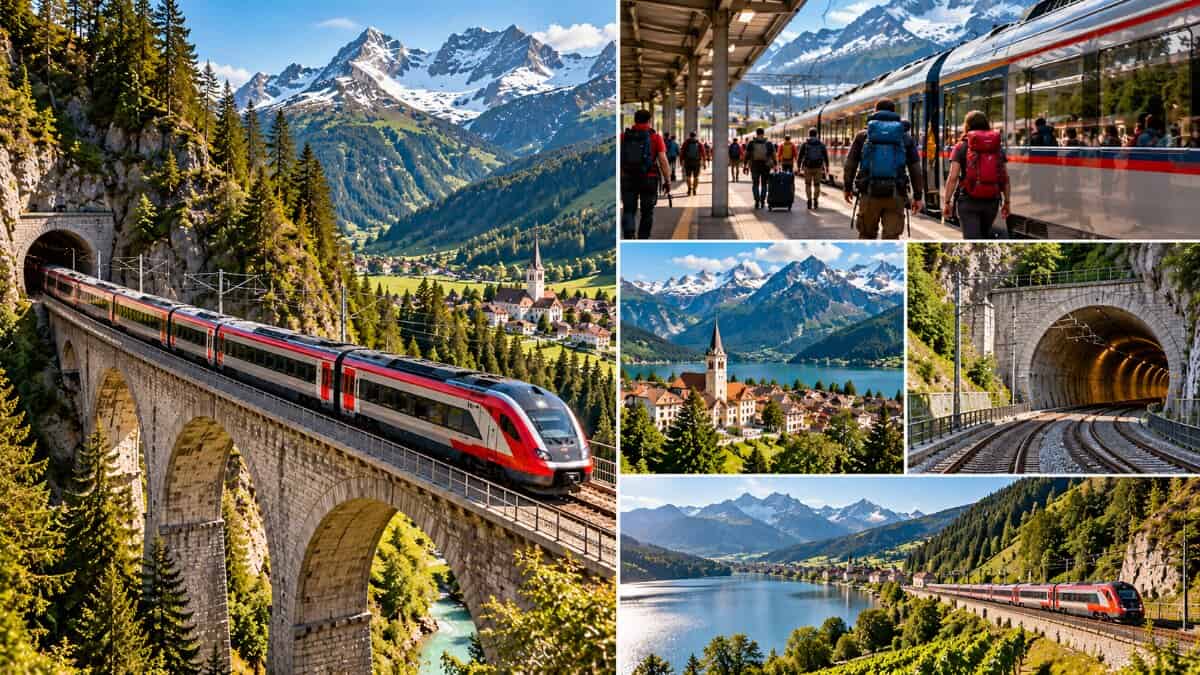
Austria and Germany’s overlapping railway closures from February to July 2027 will significantly alter Alpine train travel, forcing international passengers to navigate longer journeys, replacement buses, diverted Railjet services and suspended overnight connections. According to Austrian Federal Railways (ÖBB) and Deutsche Bahn, the German Rosenheim–Freilassing corridor and Austria’s Tauern railway will undergo major engineering works during the same five-month period. The consequences will extend across four interconnected European railway markets, affecting adventure travellers, cycling holidays, mountain tourism and long-distance journeys towards Italy and Switzerland.
Why Will Austria and Germany’s 2027 Railway Closures Affect Four European Countries?
The simultaneous closures create an unusually complex operational challenge because Germany, Austria, Italy and Switzerland depend on interconnected Alpine railway services for international mobility.
Germany’s engineering programme will close the Rosenheim–Freilassing section from the evening of 7 February until 9 July 2027. Austria will close the Tauern railway between Schwarzach-St. Veit and Mallnitz-Obervellach from 8 February until 9 July. These projects affect separate corridors but overlap almost completely.
According to ÖBB’s official 2027 timetable announcement, replacement transport and diversions will maintain important international connections. However, passengers travelling towards western Austria and Zurich will face altered itineraries, while published Nightjet restrictions will reduce overnight options towards Italy during overlapping periods.
Advertisement
Advertisement
Four-country railway impact assessment
| Country | Railway connection | Confirmed operational consequences |
|---|---|---|
| Austria | Tauern railway, Salzburg–Innsbruck and western Railjet corridors | Tunnel closure, replacement buses, diverted services and longer journey times |
| Germany | Rosenheim–Freilassing, Munich–Salzburg and international connections | Full line closure, modified EuroCity operations and regional replacement transport |
| Italy | International Nightjet routes towards Venice, Bologna, Florence and Rome | Sleeper suspensions and shortened overnight services during specified periods |
| Switzerland | Austrian Railjet services towards Zurich via Innsbruck and Vorarlberg | Alternative bus-and-train itineraries or longer direct train journeys |
The distinction matters for travellers. The principal infrastructure closures are in Austria and Germany, while Italy and Switzerland face consequences through their international railway connections. Not every Italian or Swiss train service will be disrupted.
Germany’s Rosenheim–Freilassing Closure Will Restructure International Railway Services
Germany’s railway modernisation will cover an 82-kilometre section between Rosenheim and Freilassing. According to Deutsche Bahn’s 14 October 2026 infrastructure announcement, the programme includes approximately 40 kilometres of track renewal, work on more than 40 switches and around 100 kilometres of overhead lines.
Advertisement
Advertisement
Deutsche Bahn will also modernise nine stations and upgrade five signal boxes, preparing them for the European Train Control System.
During the closure, Munich–Vienna Railjet services will divert through Passau instead of Salzburg. Munich–Salzburg passengers will have limited EuroCity alternatives via Mühldorf. Germany will deploy more than 70 replacement buses across nine regional routes, alongside a two-hourly faster rail connection via Mühldorf.
Advertisement
Advertisement
For railway-dependent holidays, these changes introduce different routing, interchange and ticketing requirements rather than a complete loss of regional accessibility.
Austria’s Tauern Tunnel Closure Will Change Access to Major Alpine Destinations
Austria faces a second major railway restriction during the same period.
According to ÖBB Infrastructure’s Tauern railway project information, the approximately 81-kilometre Tauern railway connects Schwarzach-St. Veit with Spittal/Drau and forms a strategic north–south Alpine transport corridor.
The Tauern Tunnel opened in 1909. Its first recent refurbishment phase ran from November 2024 to July 2025. The second phase will close the tunnel between 8 February and 9 July 2027.
Advertisement
Advertisement
Replacement buses will serve affected long-distance journeys between Bischofshofen and Spittal/Millstättersee, alongside connections between Schwarzach-St. Veit and Bad Gastein. Night trains using the affected route will require diversions.
This directly concerns rail passengers accessing the Gastein Valley, Carinthia and mountain-based holidays. Travellers carrying specialist outdoor equipment will need to consider transfer arrangements, not simply the scheduled departure time.
Actual 2027 Replacement Timetables Reveal How Alpine Journeys Will Change
The practical effect becomes clearer when examining confirmed operator timetables rather than assuming a fixed delay for every passenger.
According to Westbahn’s published 2027 replacement transport schedule, Salzburg-to-Innsbruck passengers will have designated train-and-bus connections through Salzburg Taxham Europark.
| Westbahn itinerary | Published departures | Published arrival |
|---|---|---|
| Salzburg Hbf–Innsbruck Hbf | Train 11:39; bus from Taxham 11:55 | Innsbruck 14:30 |
| Salzburg Hbf–Innsbruck Hbf | Train 13:39; bus from Taxham 13:55 | Innsbruck 16:30 |
| Salzburg Hbf–Innsbruck Hbf | Train 19:39; bus from Taxham 19:55 | Innsbruck 22:30 |
| Salzburg–Kufstein–onward rail | Train 08:39; bus 09:00; onward train 10:51 | Kufstein 10:30 before onward train |
| Innsbruck–Salzburg–onward rail | Bus 06:00; connecting train 08:52 | Salzburg 08:30 before onward train |
These are published replacement itineraries, not estimates of additional journey time. Passengers should not confuse their total scheduled duration with the difference from a normal railway journey.
ÖBB separately forecasts approximately 60 additional minutes for selected replacement-bus journeys, 90 minutes for diverted Salzburg–Innsbruck Railjets and 120 minutes for certain through services towards Vorarlberg and Zurich. Actual itineraries must be checked individually.
Advertisement
Advertisement
Italy’s Nightjet Network Faces Confirmed Overnight Service Suspensions
Italy’s principal exposure concerns international sleeper connectivity.
According to ÖBB Nightjet’s official 2027 service restrictions, construction-related restrictions will affect overnight connections linking Italian destinations with Germany and Austria.
| Overnight railway service | Confirmed affected period | Operational status |
|---|---|---|
| Stuttgart–Venice | 7 February–9/10 July 2027 | Service unavailable |
| Munich–Rome | 7 February–4/5 May 2027 | Service unavailable |
| Munich–Rome | 5/6 May–28/29 August 2027 | Terminates at Bologna rather than continuing to Florence and Rome |
| Vienna–Venice | 24/25 May–11 July 2027 | Service unavailable |
| Vienna–Rome | 5–6 May 2027 | Operates only to Bologna on the specified dates |
These restrictions are not identical in duration. They also must not all be attributed exclusively to the Rosenheim and Tauern closures, because Nightjet identifies construction works more broadly.
For railway holiday specialists, the commercial consequence is clear. Itineraries previously built around direct overnight arrivals may require alternative sleeper routes, daytime connections or revised accommodation arrangements.
Nightjet has also extended advance booking for direct services to 360 days. However, connecting and EuroNight ticket availability follows separate arrangements, making complete journey planning particularly important.
Switzerland’s Zurich Rail Connections Will Remain Available Through Alternative Routes
Switzerland faces a different challenge because the affected Alpine railway services will continue operating through modified corridors.
Advertisement
Advertisement
According to ÖBB’s 2027 German railway works passenger information, Railjet Xpress services will divert every two hours through Bischofshofen and Wörgl, maintaining through-train travel towards Vorarlberg and Zurich.
Alternatively, passengers can use replacement buses from Salzburg towards Innsbruck before continuing by train to Switzerland.
These alternatives offer different trade-offs. Staying aboard a diverted Railjet avoids changing between trains and buses, while replacement transport may provide a shorter overall itinerary.
Separately, Swiss Federal Railways’ 2027 timetable plans identify an expansion from one to two daily direct Zurich–Venice services in each direction. This creates additional Switzerland–Italy rail connectivity but is not an announced replacement for the disrupted Austrian corridor.
Why Cycling Holidays and Adventure Rail Tourism Face an Overlooked Transport Problem
The most consequential operational distinction for adventure travellers concerns bicycle acceptance.
ÖBB explicitly prohibits bicycles on its replacement buses serving the German works. Westbahn, by contrast, permits bicycles on its own replacement transport only where travellers have secured the required advance bicycle-space reservation.
Advertisement
Advertisement
Westbahn also requires advance reservations for wheelchair places and confirms that DB and ÖBB tickets do not authorise travel on its replacement buses.
For cycling holidays, the difference can determine whether an itinerary remains viable.
A rail ticket with an associated bicycle reservation does not automatically guarantee that the replacement road vehicle will accept the equipment. Tour operators therefore need to verify the specific bus service, ticket acceptance and bicycle capacity before confirming a booking.
The issue extends to guided Alpine holidays involving multiple railway companies. A journey that appears connected in an online itinerary may involve separate operating conditions at the replacement-bus stage.
For hiking groups and other adventure travellers carrying substantial luggage, transfer locations, handling requirements and onward transport should become part of the itinerary assessment.
Through-Tickets and Passenger Rights Add Another Layer of Railway Risk
International rail bookings require particular attention when passengers change operators or travel on multiple tickets.
Advertisement
Advertisement
Under European Union rail passenger rights guidance, qualifying through-ticket passengers facing an expected arrival delay of at least 60 minutes may receive rerouting or reimbursement options.
Compensation can reach 25% of the ticket price for delays between 60 and 119 minutes and 50% for delays of 120 minutes or more, subject to the applicable conditions.
However, passengers generally cannot claim delay compensation when the relevant delay was disclosed before they purchased their ticket. Planned engineering restrictions therefore do not automatically create compensation entitlement.
Separate ticket contracts can also provide less comprehensive missed-connection protection.
For Switzerland, Swiss Federal Railways’ passenger rights guidance distinguishes single-transaction international bookings from journeys purchased under separate contracts.
The central recommendation for travel businesses is to confirm the contractual status of each international itinerary before sale, including whether replacement transport forms part of the booked journey.
Advertisement
Advertisement
Railway Investment and European Tourism Growth Explain the Broader Commercial Stakes
The disruption comes against a backdrop of substantial European railway demand.
According to Eurostat’s May 2026 railway passenger statistics, EU passengers made 8.7 billion railway journeys in 2024, representing 444.5 billion passenger-kilometres.
Germany accounted for 109.1 billion passenger-kilometres, while Italy contributed 55.9 billion. Austria recorded 35.6 railway passengers per resident, among the highest rates in the European Union.
Meanwhile, ÖBB plans to introduce 57 additional trains in 2027 as part of a €6.1 billion investment programme covering 330 new and modern trains by 2030.
Italy is also preparing international expansion. According to Ferrovie dello Stato Italiane’s September 2026 announcement, planned Frecciarossa services will connect Munich with Milan and Rome through Austria from summer 2027, subject to successful authorisation.
Together, these developments illustrate the tension between short-term infrastructure restrictions and longer-term international railway expansion.
Advertisement
Advertisement
Independent Analysis: Alpine Adventure Rail Holidays Need a New Approach to Journey Planning
The central commercial risk does not arise from one cancelled train. It emerges when a disrupted railway journey forms the first segment of a larger holiday.
Consider a traveller combining a German departure, an Austrian railway connection and a multi-day Alpine cycling itinerary. A bus replacement may preserve the passenger journey while preventing the accompanying bicycle from travelling. In that situation, the itinerary becomes impractical even if the published passenger timetable remains workable.
The same principle applies to overnight rail packages. A suspended sleeper could require travellers to arrive during the day, change their accommodation arrangements or adjust the first activity of their holiday.
Consequently, travel businesses should assess itinerary reliability across four dimensions: confirmed railway operation, transfer feasibility, equipment acceptance and ticket protection.
An important distinction emerges between railway connectivity and holiday accessibility. Operators may successfully maintain services through diversions and buses, yet particular specialist holidays may still become difficult to deliver.
This analysis suggests that railway tour operators should evaluate alternative connections against the requirements of the complete travel package rather than selecting routes based solely on the shortest scheduled journey.
Advertisement
Advertisement
What Should Travel Agents and Tour Operators Do Before Selling 2027 Alpine Rail Holidays?
The following operational safeguards should guide bookings involving Austria, Germany, Italy and Switzerland:
- Verify the complete route: Recheck every rail segment against the operator’s published 2027 timetable.
- Confirm sleeper availability: Check Nightjet restrictions before selling overnight connections to Italy.
- Validate equipment transport: Obtain confirmation of bicycle acceptance and reservations for every replacement-bus segment.
- Protect international connections: Prefer qualifying through-tickets where practical and clarify separate-ticket risks.
- Review accessible transport: Arrange required assistance and replacement-bus reservations in advance.
- Maintain alternative itineraries: Identify feasible daytime rail routes and adjust accommodation or onward transfers when necessary.
The Longer-Term Outlook for Alpine Railway Tourism
The February–July 2027 closures represent a substantial short-term test of international railway coordination.
Germany’s infrastructure renewal aims to improve long-term reliability, while Austria’s Tauern programme addresses essential maintenance on a major transalpine corridor.
At the same time, planned new trains and Italy-bound high-speed connections demonstrate continued investment in cross-border rail travel.
For the tourism industry, the long-term outcome will depend on more than completed engineering works. Reliable connections, integrated ticketing, accessible replacement transport and transparent timetable information will determine whether passengers can confidently choose rail for increasingly complex international holidays.
FAQs
1. When will the 2027 Alpine railway closures begin and end?
Germany will close Rosenheim–Freilassing from the evening of 7 February until 9 July 2027. Austria will close the affected Tauern railway section from 8 February until 9 July.
Advertisement
Advertisement
2. Will passengers still be able to travel between Salzburg and Innsbruck?
Yes. ÖBB plans diverted Railjet services and replacement buses. Westbahn has separately published scheduled bus-and-train itineraries between Salzburg and Innsbruck.
3. Which overnight trains to Italy will be cancelled?
Confirmed restrictions include Stuttgart–Venice, Munich–Rome and Vienna–Venice services during specified 2027 periods. Some Munich–Rome journeys will operate only as far as Bologna.
4. Will Switzerland lose its direct railway connections through Austria?
No. Diverted Railjet services will preserve through-train options towards Zurich, although ÖBB forecasts longer journeys. Replacement-bus alternatives will also be available.
5. Can travellers take bicycles on replacement buses during the closures?
Acceptance depends on the operator. ÖBB prohibits bicycles on the relevant replacement buses, while Westbahn permits them only with a valid advance bicycle-space reservation. Travellers should verify the conditions for their specific itinerary.
Advertisement
