
Thailand Tourism Faces Severe 2026 Growth Slowdown as Bangkok, Phuket, Chiang Mai and Pattaya Battle Global Travel Crisis, Rising Airfare Costs and Weak International Bookings

Published
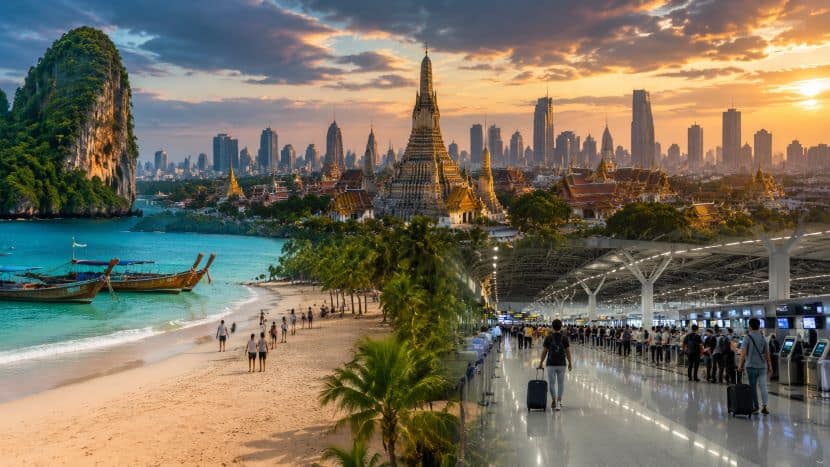
Thailand’s tourism industry, long regarded as one of Asia’s strongest travel engines, is now entering a clear slowdown phase in 2026. Major destinations such as Bangkok, Phuket, Chiang Mai and Pattaya are experiencing a visible cooling in forward bookings, as global economic pressure, rising airfare costs and geopolitical uncertainty reshape international travel demand.
According to official tourism monitoring frameworks and national economic assessments, the sector is shifting from rapid post-pandemic recovery into a more fragile and uneven growth pattern. While international arrivals remain significant, the pace of growth has softened, signalling a major transition for Thailand’s tourism-dependent economy.
Advertisement
Advertisement
International Tourism Growth Weakens as Thailand Moves Away from Post-Pandemic Surge
Thailand’s tourism sector had previously benefited from a strong rebound following global travel reopening. However, 2026 data trends show that this momentum is no longer accelerating at the same pace.
Official tourism tracking indicators suggest that while visitor numbers remain high, year-on-year growth has slowed across key entry points including Bangkok Suvarnabhumi Airport, Phuket International Airport and Chiang Mai International Airport.
Advertisement
Advertisement
Short-haul markets in Asia continue to support steady inflows, but long-haul demand from Europe and select Middle Eastern regions is showing inconsistency. This imbalance has created an uneven recovery pattern where some destinations remain active while others experience reduced occupancy and slower seasonal demand.
Global Economic Pressure and Airfare Inflation Disrupt Travel Confidence
One of the most significant factors impacting Thailand’s tourism slowdown is the rise in global travel costs. Official aviation and economic monitoring bodies have highlighted that higher fuel prices, fluctuating currency conditions and international geopolitical tensions are directly influencing airline ticket pricing.
Advertisement
Advertisement
As airfare costs increase, particularly for long-haul routes into Southeast Asia, many international travellers are either postponing trips or switching to shorter regional destinations. This has had a direct impact on Thailand’s core tourism markets, especially long-stay leisure travellers from Europe, Australia and the Middle East.
In addition, ongoing global uncertainty has reduced travel confidence, leading to shorter booking windows and a preference for flexible, last-minute travel planning.
Hotel Industry Across Thailand Reports Weaker Forward Bookings
Thailand’s hospitality sector is beginning to feel the impact of softer demand patterns. Hotel operators across key destinations report that while current occupancy levels remain stable due to seasonal travel, forward bookings for upcoming months are weaker compared to previous years.
Bangkok continues to maintain relatively balanced demand driven by business travel and transit passengers. However, resort destinations such as Phuket, Krabi and Koh Samui are experiencing more noticeable fluctuations, particularly in premium leisure segments.
Chiang Mai and northern tourism regions are also seeing slower advance reservations, reflecting reduced international travel planning confidence. This trend suggests that the industry is increasingly dependent on last-minute bookings, which adds volatility to revenue forecasting.
Shift Towards High-Value Tourism Strategy Becomes Central Focus
In response to the changing global environment, Thailand is reinforcing its shift towards a value-based tourism model. This approach prioritises high-spending travellers, longer stays and premium travel segments over mass tourism expansion.
Advertisement
Advertisement
Tourism planners are increasingly focusing on wellness tourism, cultural experiences, eco-tourism and luxury travel offerings. The goal is to increase revenue per visitor rather than relying solely on increasing arrival numbers.
This strategic repositioning reflects a broader recognition that global tourism markets are becoming more competitive, cost-sensitive and segmented. Thailand’s long-term sustainability now depends on attracting quality demand rather than purely volume-driven growth.
Regional Travel Trends Show Uneven Recovery Across Source Markets
International travel demand to Thailand is no longer uniform across source markets. Short-haul Asian markets continue to provide stable support, particularly from neighbouring economies where travel costs remain relatively manageable.
India remains one of Thailand’s strongest and most consistent growth markets, supported by strong leisure travel demand and increasing outbound tourism capacity. However, even high-performing markets are showing signs of cautious booking behaviour due to global uncertainty.
Meanwhile, long-haul markets such as Europe are experiencing slower recovery, influenced by higher travel costs and competing destination options. This uneven performance highlights the fragmented nature of Thailand’s tourism recovery in 2026.
Thailand Tourism Outlook Shifts from Expansion to Stabilisation
Thailand’s tourism industry is expected to maintain its position as a leading regional destination, but growth dynamics are clearly changing. Instead of rapid expansion, the sector is now entering a stabilisation phase marked by moderate growth, fluctuating demand and increased sensitivity to global economic conditions.
Advertisement
Advertisement
While Thailand continues to benefit from strong global brand recognition, diverse tourism products and established air connectivity, the industry is increasingly exposed to external shocks and shifting traveller behaviour.
The future outlook depends heavily on Thailand’s ability to adapt to global cost pressures, strengthen high-value tourism segments and maintain competitiveness in an increasingly uncertain international travel environment.
For now, Bangkok, Phuket, Chiang Mai and Pattaya remain central to Thailand’s tourism economy, but each is navigating a more complex and challenging global landscape than in previous recovery years.
Advertisement
