
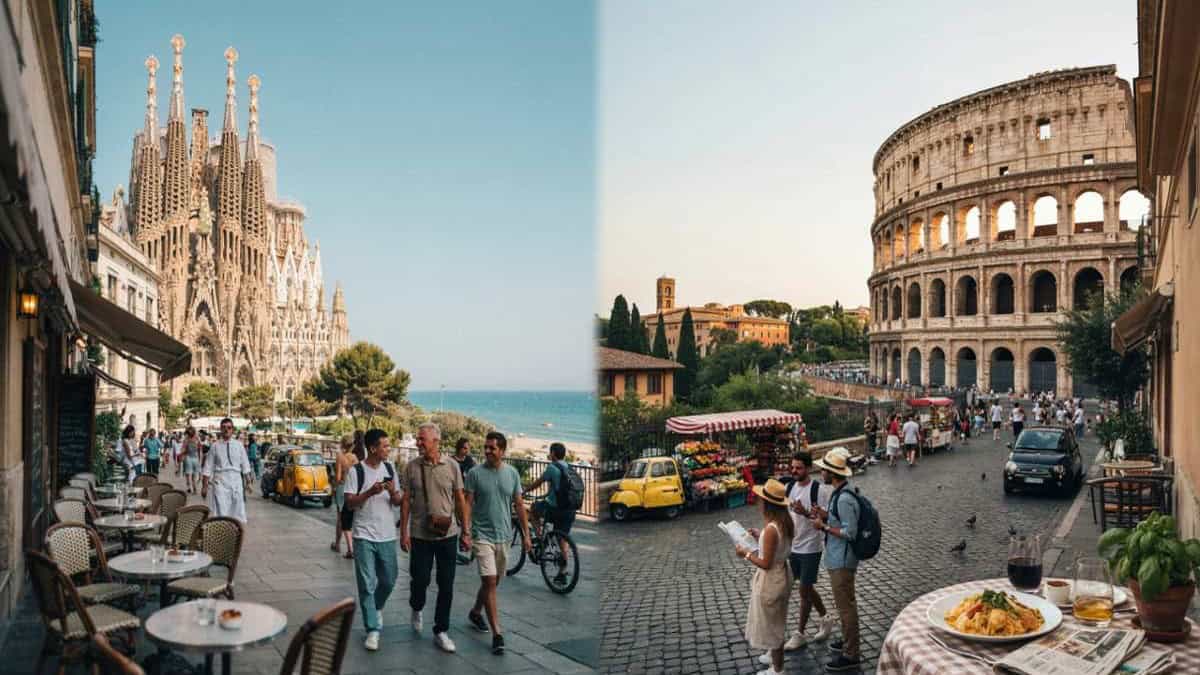
Image generated with Ai
Europe’s tourism industry is making waves with Greece and Italy at the helm as it prepares for an unprecedented phase. While uncertainties prevail globally, visitor numbers continue to grow strongly in Europe. Greece is reinforcing its tourism supremacy through sunshine, islands, rich history, and coastal delights. Italy is following suit through Rome, Venice, Florence, the Alpine Mountains, and the famous culinary arts. The case of Greece and Italy underscores the fact that Europe continues to remain a top tourist destination in 2026. More interestingly, tourists are still looking out for safe, thrilling, and worthwhile locations despite changes in the travel landscape due to economic and geopolitical challenges. Europe is adapting rapidly to changing circumstances. Visitor numbers are also increasing in areas not known as traditional destinations. Nevertheless, more is happening in the tourism sector than just an increase in visitor numbers. Changes in tourist behavior, increases in costs, and changes in global demands are bringing about change in the tourism sector. Travel and Tour World encourages its audience to read on and learn how Greece and Italy challenge global uncertainties to redefine Europe’s 2026 tourism crown.
| Tourism Industry Indicator | 2026 Figure | What It Shows |
|---|---|---|
| EU tourism nights, Q1 2026 | 471.1 million | Strong accommodation demand across Europe |
| Year-on-year growth in EU tourism nights | +3.4% | Tourism continued expanding despite uncertainty |
| Foreign visitor nights | +5.5% | International demand remained particularly strong |
| Domestic visitor nights | +1.7% | European residents continued supporting the market |
| International tourist arrivals to Europe | +5.6% | Strong start to 2026 compared with 2025 |
| International overnight stays | +5.5% | Foreign visitors generated substantial additional demand |
| Foreign share of EU accommodation nights | 46.6% | Nearly half of EU tourism nights came from international visitors |
| Short-term rental nights, Q1 2026 | 144.3 million | Online accommodation continued gaining momentum |
| Short-term rental growth YoY | +9.7% | Platform-based tourism grew faster than overall accommodation |
| Short-term rental growth vs Q1 2024 | +16.6% | Alternative accommodation demand accelerated strongly |
| Intra-European tourism demand | Around 80% | Europe’s internal travel market provides major resilience |
Europe’s tourism machine has roared into 2026 with remarkable force. Despite wars, rising costs and economic worries, travellers keep choosing Europe. International arrivals were 5.6% higher year to date in early 2026 than during the same period in 2025, according to the European Travel Commission. The result is striking. Europe has not escaped global turbulence. Instead, it has adapted to it. Travellers are changing where, when and how they travel. They seek safety, value and flexible trips. Meanwhile, Europe’s huge home market keeps demand moving. From Spain and Italy to Ireland and Finland, the continent is proving surprisingly hard to stop.
Advertisement
The strongest proof comes from Eurostat. EU tourist accommodation recorded 471.1 million overnight stays during the first quarter of 2026. That was 3.4% more than in the first quarter of 2025. January rose 3.2%. February climbed 3.4%. March increased 3.7%. The pattern matters because growth appeared through the whole quarter. Tourism did not depend on one sudden burst. It kept building month after month. Foreign visitors drove much of that strength, with their nights rising 5.5%. Domestic nights also increased, by 1.7%. Together, these figures show a broad European tourism recovery rather than a narrow, temporary travel spike.
“Europe’s tourism resilience in 2026 is remarkable. Despite global uncertainty, travellers continue to choose Europe for its safety, diversity, connectivity and value. Strong arrivals, rising accommodation demand and growing intra-European travel show that the industry is adapting rapidly. This momentum could make Europe an even stronger global tourism leader.” — Anup Kumar Keshan, Founder and Editor-in-Chief, Travel And Tour World
Advertisement
Advertisement
Europe’s international tourism performance looks even more impressive when the wider mood is considered. The European Travel Commission said geopolitical tensions, conflicts and climate events remained major risks in 2026. Yet international arrivals still increased. Europe therefore appears to be absorbing shocks rather than collapsing under them. Travellers may worry about the world, but many still want a holiday. They are also making practical choices. Safety matters. Price matters. Climate matters. Flexible travel matters. This behaviour helps explain Europe’s resilience. Instead of cancelling travel altogether, many visitors adjust destinations, trip lengths and spending. The suitcase stays packed, but the strategy changes.
| Country | Key 2026 Tourism Indicator | Growth / Scale | Why It Matters |
|---|---|---|---|
| Spain | Q1 foreign visitor nights | 54.1 million | Largest foreign-visitor tourism market in Q1 |
| Italy | Q1 accommodation nights | +5.0 million nights | Biggest absolute increase in EU |
| Germany | Q1 accommodation nights | +2.0 million nights | Major contribution to EU tourism growth |
| Ireland | Q1 accommodation nights | +35.3% | Fastest growth among EU countries |
| Malta | Q1 accommodation nights | +11.1% | Strong international tourism dependence |
| Denmark | Q1 accommodation nights | +9.3% | One of the fastest-growing EU markets |
| Finland | International arrivals | +12% | Strong Northern European performance |
| Austria | International arrivals | +7% | Strong winter and ski tourism |
| France | International arrivals | +5% | Major mature tourism market |
| Switzerland | International arrivals | +3% | Continued growth in Alpine tourism |
Northern Europe has emerged as one of the early 2026 stars. Ireland recorded international arrival growth of about 30%, while Finland rose about 12%, according to the ETC. Ireland also delivered spectacular accommodation growth. Eurostat reported a 35.3% increase in total tourism nights during the first quarter. Foreign visitor nights jumped 42.3%. Those numbers reveal powerful demand beyond Europe’s famous southern capitals. Travellers are looking for new experiences, nature and destinations that can feel different from crowded classics. Northern Europe offers that mix. Its performance also shows that tourism growth is spreading across the continent rather than remaining locked inside the traditional Mediterranean circuit.
The Mediterranean remains a giant force in European tourism. Southern destinations continue to lead travel demand, and travellers still love sun, beaches, food and culture. The ETC’s spring and summer research found stronger interest in Southern and Mediterranean Europe. Sun and beach holidays remained the leading choice, while city breaks and culture and heritage trips also attracted major interest. This combination gives Europe a powerful advantage. One continent can offer beaches, mountains, museums, islands and historic cities within relatively easy reach. That variety lets travellers change plans without abandoning Europe. When global uncertainty rises, familiar attractions can become even more valuable.
Spain sits at the centre of this tourism story. The country entered 2026 after another record year for EU tourism. Eurostat recorded 513.6 million tourism nights in Spain during 2025, the highest total among EU countries. Spain also benefited from shifting travel patterns in 2026. Reuters reported that unrest in the Middle East redirected some travellers towards Spain, which was viewed as a safer option. Aena airports handled 156.2 million passengers during the first half of 2026, up 3.7% year on year. Spain therefore combines scale, connectivity and strong international appeal. Its tourism engine remains one of Europe’s most powerful.
Advertisement
Advertisement
Italy is another heavyweight driving Europe’s tourism strength. Eurostat reported that Italy recorded 476.9 million tourism nights in 2025. In the first quarter of 2026, Italy gained about five million additional accommodation nights compared with the same period a year earlier. That was the largest absolute increase among EU countries. Italy also enjoyed extra attention from the Milano Cortina 2026 Winter Olympics. Sport, history, food and famous cities give Italy an unusually broad tourism offer. Visitors can move from Alpine landscapes to Renaissance streets and Mediterranean shores. This depth makes Italy resilient because one destination can satisfy many different travel moods.
France and Germany remain crucial pillars too. In 2025, France recorded 471.7 million tourism nights, while Germany recorded 442.1 million. Together with Spain and Italy, they accounted for 61.7% of all EU tourism nights. Yet their roles differ. France attracts visitors through culture, food, cities, countryside and coastlines. Germany combines major cities, business travel, festivals, nature and regional tourism. Their scale provides stability for the wider European market. Even when one segment weakens, another can support demand. This diversity helps Europe absorb shocks. It also gives travellers countless alternatives when prices, weather or international conditions change their plans.
Europe’s domestic and intra-European market is a secret weapon. The ETC says about 80% of European tourism demand is intra-regional. That means the continent does not depend only on visitors flying in from distant markets. Europeans themselves keep moving. The latest ETC survey found that 81% planned to travel between June and November 2026, four percentage points above the previous year. Most planned to holiday within Europe. This internal demand can cushion the impact of weaker long-haul markets. When distant travel becomes expensive or uncertain, Europeans can choose a nearby country instead. Europe’s dense transport network makes that switch especially practical.
The spring and summer outlook was even more striking. In April 2026, the ETC reported that 82% of Europeans planned to travel between April and September. That was the highest level recorded since 2020. However, travellers were not behaving recklessly. They planned fewer and shorter trips and kept closer control of budgets. This is an important lesson. Strong tourism does not always mean lavish spending. People can protect travel by changing the shape of their holidays. A shorter European break may replace a costly long-haul trip. A nearby rail journey may replace an expensive flight. Demand survives because travellers adapt.
Value has become a powerful force in European travel. The ETC says safety, affordability and climate considerations are shaping destination choices in 2026. This means tourists are asking harder questions before booking. Is the destination safe? Can I afford it? Will the weather be manageable? Can I travel there easily? These questions can shift demand quickly. They also create opportunities for less famous places. A smaller city may offer lower prices and fewer crowds. A shoulder-season trip may stretch a budget further. Europe benefits because it has an enormous range of places and price points. Travellers can keep travelling while spending more carefully.
Climate is also changing the European tourism map. Travellers increasingly consider heat, weather and environmental conditions when choosing destinations. This can push some visitors towards cooler regions or different travel months. It can also encourage nature-based and experience-led holidays. The ETC’s long-haul research found growing interest in nature, wellness and experience-led travel. Europe is well placed for these trends. It has mountains, forests, lakes, islands, national parks and rural communities across a compact geographic area. Tourism therefore has room to spread. Instead of relying only on famous capitals and beaches, travellers can discover quieter landscapes and alternative experiences.
Online accommodation is adding another layer to the boom. Eurostat reported 144.3 million guest nights in EU short-term rentals booked through Airbnb, Booking or Expedia during the first quarter of 2026. That represented a 9.7% increase from the first quarter of 2025 and a 16.6% rise from 2024. The numbers show that travellers are using more than traditional hotels. Apartments and short-stay homes can provide flexibility, space and different price options. This matters during periods of uncertainty. A wider accommodation market gives tourists more ways to manage budgets and trip styles. It also spreads tourism beyond conventional hotel districts.
Europe’s tourism resilience is not uniform, and that makes the story more interesting. Malta, Cyprus and Luxembourg had extremely high shares of foreign overnight stays in the first quarter of 2026. Foreign visitors represented 93.3% of nights in Malta, 85.6% in Cyprus and 85.1% in Luxembourg. Germany, Poland and Romania were far more dependent on domestic demand. This contrast shows how differently European destinations experience global shocks. A highly international island can feel changes in foreign markets quickly. A country with stronger domestic demand may have more protection. Europe’s strength comes partly from this varied tourism structure across countries and regions.
Long-haul travel remains the weaker part of the picture. The ETC reported that global long-haul travel sentiment was subdued during summer 2026. Affordability concerns, geopolitical uncertainty and demand for shorter, flexible trips were influencing decisions. Yet Europe continued to outperform many competing destinations. Safety, value and connectivity supported its appeal. This distinction is vital. Europe is thriving, but not because every market is booming equally. Some long-distance demand is softer. European destinations are winning by adapting to the new reality. Their advantage lies in choice, transport links and a strong reputation. The continent can capture demand even when travellers become cautious.
Europe is also seeing changing source markets. The ETC expects Chinese arrivals to Europe to rise strongly in 2026, while Indian arrivals are also expected to grow. At the same time, some traditional long-haul markets are showing softer momentum. This diversification can strengthen Europe over time. A destination that relies on one visitor group becomes vulnerable when that market weakens. Europe has many markets to draw from. It can welcome neighbouring Europeans, Americans, Asians and other international visitors. The challenge is to keep access affordable and convenient. If Europe manages that balance, changing global travel patterns could become an opportunity rather than a threat.
Safety has become one of the biggest tourism currencies in 2026. Geopolitical conflict can change travel choices almost overnight. Reuters reported that Middle East unrest helped redirect some travellers towards Spain, where airports recorded strong passenger growth. Yet this benefit comes with a warning. A safer perception can boost arrivals, but new instability can quickly reverse flows. European destinations therefore cannot treat resilience as permanent. They must communicate clearly, protect visitor confidence and maintain strong transport links. Travellers want reassurance as well as excitement. Europe’s challenge is to offer both. The winning destinations will be those that make people feel comfortable enough to explore.
There is another reason Europe remains powerful: sheer choice. A traveller can visit a historic capital, a beach resort, a mountain village or a rural retreat without leaving the continent. The ETC found growing interest in less popular destinations and off-the-beaten-path experiences. That shift could help Europe manage pressure on famous hotspots. It can also spread tourism income to smaller communities. This matters for the future. If visitors move beyond the biggest attractions, Europe can offer richer experiences while reducing dependence on a handful of crowded places. The tourism boom could therefore become broader, more balanced and more sustainable.
| Country | Foreign Share of Accommodation Nights, Q1 2026 | Foreign Visitor Trend | Tourism Market Character |
|---|---|---|---|
| Malta | 93.3% | Strong | Highly international island market |
| Cyprus | 85.6% | Strong | Heavily dependent on overseas visitors |
| Luxembourg | 85.1% | Mixed | Highly international tourism market |
| Ireland | High growth | +42.3% foreign nights | One of Europe’s fastest-growing international markets |
| Slovakia | — | +15.4% foreign nights | Strong increase in foreign demand |
| Lithuania | — | +24.1% foreign nights | Significant international growth |
| Spain | Major foreign market | Strong | Europe’s leading foreign-visitor destination by volume |
| Germany | 19.9% | Moderate | Strong domestic tourism base |
| Poland | 20.2% | Moderate | Domestic demand remains important |
| Romania | 22.4% | Moderate | Relatively strong domestic tourism component |
Still, Europe cannot become complacent. Rising travel costs, fuel prices, economic pressure, geopolitical conflict and climate events remain real risks. The ETC has warned that these forces could weaken confidence. Travellers are already showing caution through shorter trips, moderate budgets and later booking behaviour. The next challenge is therefore clear. European tourism must remain attractive without becoming unaffordable. Destinations must also manage overcrowding, protect local communities and respond to climate pressures. Growth alone is not enough. Europe needs smart growth. The continent has momentum, but maintaining it will require better value, stronger resilience and careful management of tourism pressure.
Europe’s early 2026 tourism story is therefore bigger than a simple boom. It is a story of resilience under pressure. International arrivals rose. EU accommodation nights increased. Short-term rental demand surged. Europeans kept travelling. Spain, Italy, France and Germany retained enormous scale, while Ireland, Finland and other destinations showed that growth can spread. At the same time, tourists became more careful about safety, price, climate and flexibility. That mix explains Europe’s strength. The continent is not immune to global turbulence. It is simply adapting faster than the shocks can stop it. For travellers, Europe remains open, varied and fiercely tempting in 2026.
Why Europe has remained one of the most attractive destinations for tourists in 2026 has become evident with Greece and Italy. In spite of all uncertainties in the world today, tourists have not stopped choosing Europe because of its culture, beaches, history and value for money. What is more important, high tourist inflows prove that Europeans are confident about their continent’s future in terms of tourism. Greece entices tourists with its islands and Mediterranean character, while Italy enchants them with its cities, culture and experiences. Yet, despite the changes in prices and challenges in the world, Europe should stay flexible enough.
Advertisement
Tags: EU tourism market, EU tourism statistics, Europe accommodation demand, Europe holiday demand, Europe tourism analysis
Advertisement
Advertisement













Friday, September 4, 2026

Friday, September 4, 2026

Friday, September 4, 2026

Thursday, September 3, 2026

Wednesday, September 2, 2026

Friday, September 4, 2026

Friday, September 4, 2026