
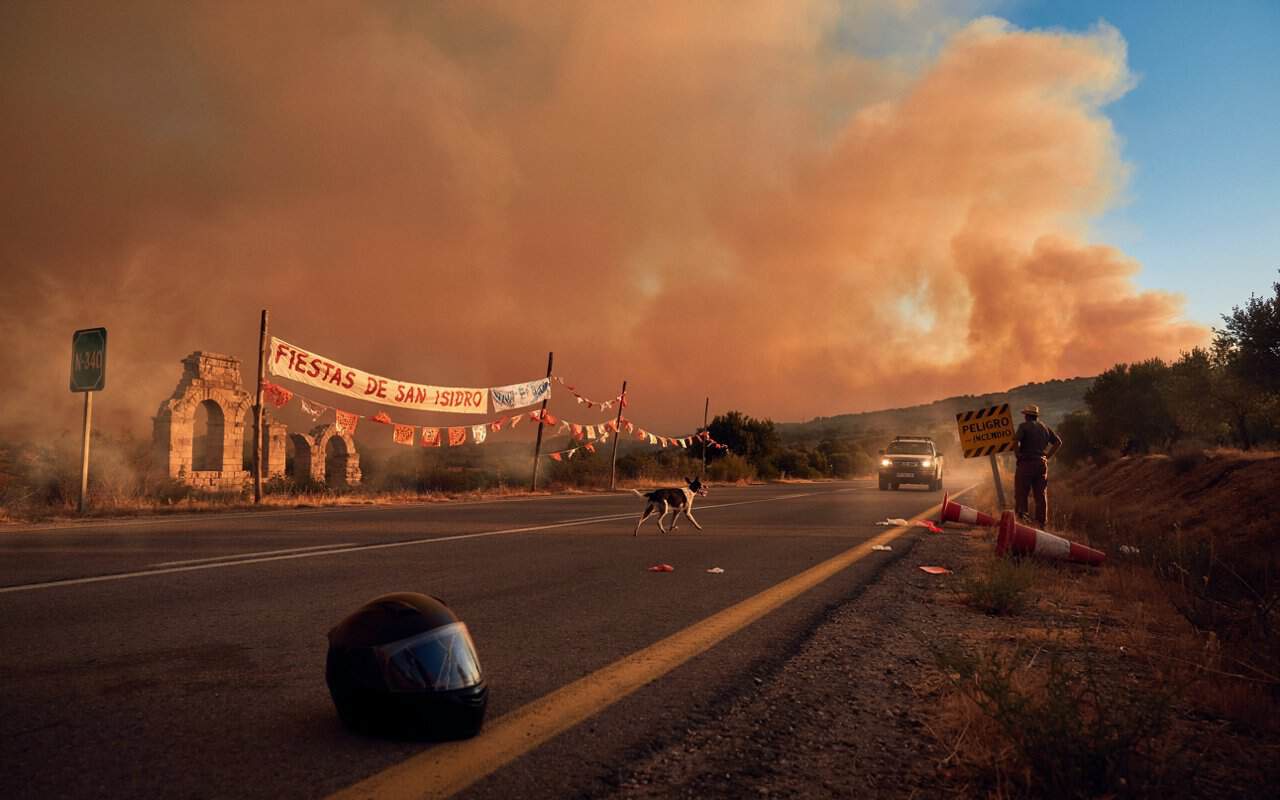
Image generated with Ai
Spain’s hot weather and dry brush have created wildfires that are burning out of control and causing chaos for summer tourists and locals trying to enjoy the annual festivals in the country.Roads are now completely jammed with panicked tourists trying to escape the flames, while local authorities are left struggling to contain the situation.
The summer of 2026 has witnessed an unprecedented global collision where extreme climate-driven wildfires overlap directly with massive cultural gatherings, tourism peaks, and mega-festivals across Spain, France, Canada, and the United States, severely straining emergency infrastructures and forcing a radical overhaul of modern event planning.
Advertisement
Mid-summer across Southern Europe brings a massive influx of international holidaymakers alongside historic local fiestas and open-air cultural celebrations. When record-breaking heatwaves ignite severe wildfires in regions like Spain and France, standard evacuation routes instantly gridlock with incoming tourist traffic. This dangerous convergence forces regional authorities to execute complex reverse-logistics while protecting rural hospitality sectors from total devastation. Traditional tourism economics heavily rely on these peak months to sustain local businesses, yet the escalating frequency of dry lightning storms and severe droughts turns picturesque rural landscapes into tinderboxes. Consequently, emergency planners must urgently re-evaluate how thousands of temporary visitors can be safely evacuated when transit corridors are narrow and overwhelmed by sudden fire emergencies.
For real-time road updates and official emergency notices during transport disruptions, consult the Dirección General de Tráfico (DGT).
Advertisement
Advertisement
France recently recorded its first-ever pyrocumulonimbus fire-induced thunderstorm cloud near Bordeaux, directly threatening densely packed outdoor music festivals and rural heritage sites. Event organisers and local municipalities face impossible choices regarding whether to evacuate thousands of campers or risk sudden smoke toxicity and erratic firestorms. Consequently, traditional open-air celebrations must now integrate advanced meteorological tracking and emergency protocols to handle sudden convective atmospheric hazards. Managing massive crowds requires foolproof communication channels and reliable backup power grids that will not fail during regional utility blackouts caused by encroaching flames.
“Watching our historic town transform into a smoke-filled bottleneck during the peak festival season was terrifying beyond belief. We rely entirely on summer tourism and our beloved local fiestas to feed our families throughout the entire year, yet this sudden blaze caught everyone completely off guard. The local authorities tried their best to manage the gridlocked traffic on the narrow rural highways, but the sheer volume of holidaymakers fleeing the flames created total chaos. It is clear that regional planners must radically rethink emergency evacuation routes and safety protocols before another devastating climate disaster hits our community.”
— Anup Kumar Keshan, Founder and Editor-in-Chief, Travel And Tour World
Canada’s vast boreal forests provide a picturesque backdrop for indigenous powwows, regional music festivals, and remote camping tourism during the warmer months. However, severe air quality index spikes and sudden highway closures frequently isolate festival-goers and cut off rural communities without warning. Cultural organizers face devastating financial losses and difficult dilemmas when deciding whether to proceed under hazardous particulate pollution or cancel altogether. These remote communities often lack the dual-lane highway capacity required to move large concentrations of tourists away from fast-moving crown fires during peak holiday weekends.
The American West relies heavily on outdoor arts festivals, amphitheatre concert series, and historic community fairs to drive its vibrant summer economy. As large blazes scorch millions of acres across California, Oregon, and Washington, these celebrations are increasingly transformed into public health hazards. Organisers must now invest heavily in industrial-grade air filtration tents, mass N95 mask distribution, and last-minute artist contingency plans to stay operational. Balancing public safety with the financial survival of regional arts organizations demands proactive risk assessments long before the first smoke plume appears on the horizon.Country Wildfire Impact Cultural Event Collision Key Mitigation Spain Multi-year droughts and intense heatwaves scorching up to 77,000 hectares. Peak tourist influx colliding with historic local fiestas and open-air festivals. Executing complex reverse-logistics for congested rural evacuation corridors. France Destructive Gironde blazes burning over 42,000 hectares with pyrocumulonimbus storms. Dense summer music festivals and heritage tourism sites near Bordeaux. Deploying advanced meteorological tracking and emergency camper evacuations. Canada Extreme fire weather burning millions of hectares of boreal forest. Remote camping tourism, regional music festivals, and Indigenous powwows. Managing severe air quality spikes and establishing alternative transit routes. United States Over 100 active large wildfires across drought-stricken Pacific Northwest states. Multi-day arts festivals, amphitheatre concerts, and historic community fairs. Installing industrial filtration tents and distributing mass N95 masks.
The main reason is the years-long droughts and record-breaking heat, which dry the forest to a crisp. The only solution is to create emergency reverse-logistics (for returning the evacuees), and climate-proof evacuation routes. The root cause is the combination of the long-term rural depopulation, influx of tourists during peak season, and the inadequacy of the current infrastructure to handle the mass evacuation of both residents and visitors. Spain should consider redesigning its emergency management model to avoid putting its population at risk, while also protecting the region’s tourism-industry economy. Upgrading early-warning systems and transit infrastructure will prevent future bottlenecks during evacuations. The region’s cultural heritage is a high priority for local authorities, who also understand the need to maintain natural ecosystems.
Advertisement
Advertisement
Advertisement













Sunday, September 6, 2026

Sunday, September 6, 2026

Sunday, September 6, 2026

Sunday, September 6, 2026

Saturday, September 5, 2026

Saturday, September 5, 2026

Sunday, September 6, 2026

Saturday, September 5, 2026



