
Orlando Converges With Las Vegas, Salem and Other US Destinations as Permanent Horror Attractions Challenge Halloween’s Seasonal Grip

Published
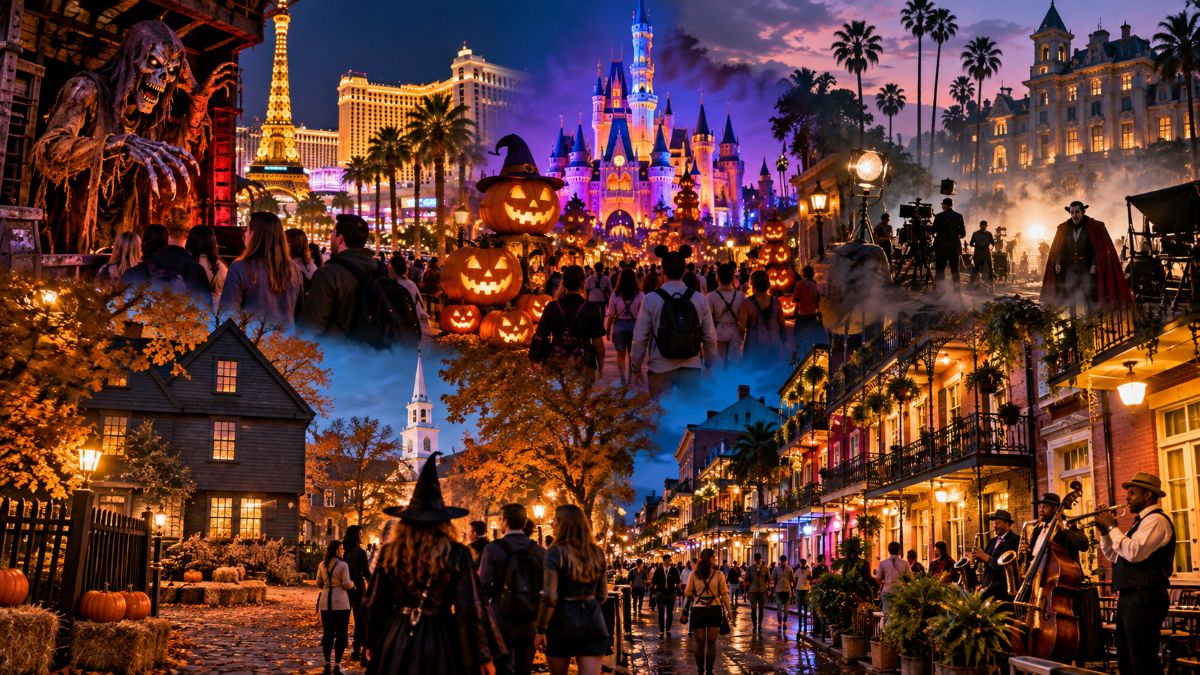
Las Vegas, Orlando, Los Angeles, Buena Park and Salem are redefining US horror tourism in 2026, as permanent attractions challenge traditional Halloween festivals. Universal Horror Unleashed offers four haunted houses in Las Vegas throughout the year, while Orlando’s Halloween Horror Nights runs from 28 August to 1 November. Hollywood’s event operates from 3 September to 1 November, extending the autumn entertainment calendar across major American destinations. Meanwhile, Salem attracted approximately 1.1 million unique downtown visitors during October 2025, demonstrating the enormous appeal of concentrated seasonal travel. However, national hotel revenue per available room declined 13.9% over Halloween weekend in 2025. The contrasting figures raise a crucial question about whether horror attractions generate additional overnight tourism or redistribute existing visitor spending.
Las Vegas Brings Permanent Horror Into Focus
Las Vegas has introduced a significant alternative to America’s traditional autumn scare circuit. Universal Horror Unleashed, which opened in 2025, operates as a permanent indoor entertainment venue within AREA15’s Zone 2 district.
The attraction occupies approximately 110,000 square feet, featuring four haunted houses, immersive entertainment, themed dining and retail facilities. Its climate-controlled environment allows operators to offer elaborate theatrical experiences without relying on October weather.
Unlike conventional Halloween festivals, the Las Vegas attraction can welcome customers across different seasons. However, year-round availability does not mean daily operation, and its published schedule varies according to business requirements.
Advertisement
Advertisement
The attraction’s ticket structure also distinguishes it from traditional theme-park events. Visitors can purchase unlimited haunted-house access, single-entry admission or a lower-priced ticket excluding the houses.
| Las Vegas Admission Category | Advertised Starting Price | Access |
|---|---|---|
| Unlimited general admission | $89 | Unlimited entry to four houses |
| One-time general admission | $59 | One entry to each house |
| Fraidy Cat admission | $19 | Entertainment and venue access, excluding houses |
Prices in US dollars, excluding applicable taxes. Published ticket listings can change by date and offer.
Advertisement
Advertisement
The venue also offers themed restaurants, live performances and character encounters. Universal estimates that guests purchasing unlimited access typically spend two to three hours exploring.
For visitors, this creates a practical alternative to organising an entire holiday around Halloween. A horror experience can instead complement a convention visit, weekend escape or wider Las Vegas itinerary.
Nevertheless, its long-term contribution to destination tourism remains uncertain. Publicly verified annual attendance and attraction-specific hotel-night generation figures are not available in the reviewed material.
Orlando Turns Late Summer Into Halloween
Orlando demonstrates how seasonal entertainment can extend a destination’s commercial calendar without becoming permanent. Universal Studios Florida launched its 2026 Halloween Horror Nights season on 28 August, with selected performances continuing until 1 November.
The programme celebrates its 35th edition with 10 haunted houses, scare zones and live entertainment. Its schedule generally covers Wednesday through Sunday, with an additional Monday performance on 12 October.
The operating window spans 66 calendar days, although the event does not operate every night. This distinction matters when comparing seasonal capacity with permanent attractions.
Advertisement
Advertisement
Universal also markets multi-night Fear Passes, Express access, guided R.I.P. Tours and behind-the-scenes experiences. These products allow the operator to capture different spending levels within the same event.
Moreover, Orlando’s extensive resort infrastructure supports overnight packages. Universal advertises accommodation combined with Halloween admission, dedicated entry arrangements and transport benefits at participating resort hotels.
For holidaymakers, the strongest advantage is the ability to combine evening entertainment with daytime theme-park visits. However, standard daytime admission does not automatically include the separately ticketed Halloween event.
The extended schedule may also redistribute demand across late August, September and October. Travellers who avoid peak Halloween weekends can potentially select less congested dates, although actual queues depend on attendance.
Hollywood and Buena Park Compete for October Visitors
Southern California offers a particularly revealing comparison because two established operators compete within the same regional tourism economy. Universal Studios Hollywood stages Halloween Horror Nights, while Knott’s Berry Farm operates Knott’s Scary Farm in Buena Park.
Hollywood’s 2026 programme runs on selected nights between 3 September and 1 November. The attraction advertises eight haunted houses, its Terror Tram experience and additional scare zones.
Advertisement
Advertisement
Knott’s Scary Farm follows a different heritage-led strategy. Its annual Halloween event dates back more than five decades, making it one of the region’s longest-established seasonal horror products.
The event transforms the regular amusement park into an evening destination with haunted mazes, theatrical performances and roaming characters. However, guests generally require separate event admission, regardless of daytime park tickets.
A published Knott’s ticket listing provides a useful illustration of its admission structure. It advertised standard admission from $69, an all-inclusive package from $229 and a Fright & Fast Lane upgrade from $139.
These advertised figures are reference prices rather than a verified, date-matched 2026 comparison. Travellers should confirm the current season’s prices before budgeting.
| Southern California Comparison | Hollywood | Buena Park |
|---|---|---|
| Principal event | Halloween Horror Nights | Knott’s Scary Farm |
| Format | Film-inspired horror and Terror Tram | Haunted mazes and park-wide entertainment |
| Operating model | Selected autumn nights | Selected autumn nights |
| Daytime park admission | Separate from Halloween admission | Separate from Scary Farm admission |
| Visitor advantage | Film-studio setting | Established amusement-park setting |
The two attractions create opportunities for multi-event holidays, especially among dedicated horror enthusiasts. However, their geographical separation requires careful transport planning, particularly after late-night performances.
Visitors should compare accommodation near Universal City with hotels around Buena Park. Parking, rideshare availability and return journeys can materially influence the total holiday cost.
Advertisement
Advertisement
Salem Shows the Power of Seasonal Concentration
Salem offers a fundamentally different economic model from purpose-built entertainment complexes. Its October visitor economy combines historic sites, witch-trial heritage, museums, guided experiences, independent businesses and public celebrations.
Destination Salem recorded approximately 1.1 million unique downtown visitors during October 2025, broadly matching the previous year’s record. Total visits reached 1.4 million, representing a 6.3% annual decline.
The difference between visitors and visits is important. The first measures distinct individuals, while the second counts visitor presence across separate 24-hour periods.
Halloween itself attracted 96,600 visitors in 2025, an increase of 7.2% from 2024. This demonstrates the continuing concentration of demand around the holiday’s most prominent date.
Salem’s October Visitor Growth
| Year | Unique Downtown Visitors (Approx.) |
|---|---|
| 2019 | 782,000 |
| 2020 | 445,000 |
| 2021 | 993,000 |
| 2022 | 1,000,000 |
| 2023 | 1,000,000 |
| 2024 | 1,100,000 |
| 2025 | 1,100,000 |
The figures are rounded and reflect downtown footfall estimates, not hotel guests or attraction ticket sales.
The 2025 results also demonstrate the influence of weather. Destination Salem reported nine rainy days during October, compared with no measurable rain during October 2024.
Advertisement
Advertisement
Adverse conditions disrupted ferry services and reduced repeat visits. Nevertheless, the number of distinct visitors remained broadly stable.
For 2026, Salem’s Haunted Happenings celebrations carry additional significance through the city’s 400th anniversary. The programme began on 1 October and includes a planned 400-drone Halloween display.
The destination also offers attractions beyond the autumn programme, including museums and historic walking experiences. Consequently, travellers can explore Salem’s cultural heritage without relying exclusively on October events.
However, the city’s strongest Halloween demand creates pressure on transport, public spaces and accommodation. Visitors should examine rail connections and consider neighbouring communities when central accommodation becomes expensive or unavailable.
New Orleans Offers a Different Calendar
New Orleans illustrates how supernatural storytelling can become part of an established destination identity. Its French Quarter, historic cemeteries, distinctive architecture and folklore support ghost-themed excursions beyond Halloween.
The city’s official tourism platforms promote walking experiences, cemetery sightseeing and evening history tours. One listed interactive ghost-and-spirits walking tour starts at $27 for approximately two hours.
Advertisement
Advertisement
Another combined city, cemetery and Garden District experience starts at $55 and lasts approximately three hours. These advertised products demonstrate how dark-history tourism can fit into an ordinary sightseeing itinerary.
Unlike a seasonal amusement-park event, these experiences do not necessarily require travellers to arrive during October. However, operating dates, tour permissions and individual itineraries can change.
New Orleans also provides an important caution against oversimplifying hotel demand. Its hotel market recorded substantial year-on-year declines during the week ending 1 November 2025.
Average daily rate fell 23.9% to $168.61, while revenue per available room declined 38.3% to $104.29. CoStar attributed the comparison partly to major entertainment and conference activity during the corresponding 2024 period.
Therefore, lower hotel performance does not establish declining interest in ghost tourism. Wider event calendars can exert considerably greater influence on citywide accommodation results.
Hotel Figures Challenge the Halloween Boom
The accommodation market provides one of the strongest tests of the industry’s economic claims. Although individual attractions can generate substantial attendance, national hotel performance does not always improve during Halloween.
Advertisement
Advertisement
CoStar reported US hotel occupancy of 59.3% for 26 October–1 November 2025. Average daily rate reached $156.09, while revenue per available room stood at $92.54.
Occupancy declined 2.6% year on year, despite a modest 0.4% increase in average room rates. Revenue per available room consequently fell 2.3%.
More strikingly, national weekend RevPAR declined 13.9% across 31 October and 1 November 2025. The Friday decline reached 18.2%, showing that Halloween does not guarantee stronger nationwide hotel trading.
| US Hotel Performance | 2025 Result | Annual Change |
|---|---|---|
| Occupancy | 59.3% | −2.6% |
| Average daily rate | $156.09 | +0.4% |
| Revenue per available room | $92.54 | −2.3% |
| Halloween weekend RevPAR | Not reported here as an absolute value | −13.9% |
Weekly indicators cover 26 October–1 November 2025. Weekend RevPAR change covers 31 October–1 November.
The findings suggest that horror-related travel demand remains highly localised. Salem’s October footfall cannot automatically represent conditions across Orlando, Las Vegas or the wider country.
Hotel operators must also distinguish additional visitors from existing customers purchasing extra experiences. A guest attending Halloween Horror Nights during an already planned Orlando holiday does not necessarily generate another room night.
Advertisement
Advertisement
By contrast, an event that encourages an additional overnight stay could create measurable incremental demand. Establishing that effect requires destination-level occupancy, booking and visitor-origin data.
Attendance Data Reveals Important Reporting Gaps
Salem’s visitor figures provide unusually useful evidence because its tourism organisation publishes detailed October estimates. Comparable standalone attendance figures remain harder to establish for commercial haunted attractions.
Theme-park attendance, Halloween ticket sales and individual haunted-house admissions measure different activities. Combining them without qualification would exaggerate the scale of the market.
IAAPA’s North American economic-impact research examines attendance, revenues, employment and taxation across multiple attraction categories. These include amusement parks, museums, entertainment centres and cultural attractions.
However, broad industry estimates cannot establish the financial performance of a particular Halloween event. Nor can ticket prices alone reveal profitability, since staffing, construction and operating expenses vary substantially.
Permanent venues face recurring property, maintenance and staffing commitments across the year. Seasonal events concentrate operating activity but must also manage installation, dismantling, storage and specialised labour.
Advertisement
Advertisement
A permanent attraction may achieve more operating opportunities without generating higher annual utilisation. Conversely, a seasonal event could achieve stronger attendance per operating night while remaining closed for much of the year.
For tourism investors, the essential measures are attendance per operating day, spending per visitor and additional overnight stays. Published evidence remains insufficient to rank the featured attractions consistently against those measures.
What Visitors Actually Pay Beyond Admission
Headline ticket prices rarely capture the complete cost of a horror-themed holiday. Travellers must consider accommodation, transport, parking, premium access, food and booking charges.
Las Vegas provides a transparent starting point because its permanent attraction advertises several admission levels. Its $59 one-time house-access ticket would cost $118 for two adults before taxes.
Choosing the $89 unlimited option raises the combined starting admission cost to $178. The $60 difference reflects admission privileges, not necessarily a longer stay or guaranteed additional entertainment.
| Illustrative Las Vegas Budget | Two Adults |
|---|---|
| One-time house admission | $118 |
| Unlimited house admission | $178 |
| Difference between options | $60 |
| Accommodation | Date-dependent |
| Transport and dining | Additional |
These are admission calculations, not full holiday quotations. They exclude hotel costs, transport, food and applicable taxes.
Advertisement
Advertisement
For seasonal theme-park events, visitors should examine whether premium queue access is included or sold separately. They should also confirm entry conditions, cancellation policies and whether the ticket permits re-entry.
Universal’s Halloween events carry age-related advisories and restrictions on costumes or masks. Families should examine those rules before purchasing, particularly when travelling with younger children.
Late-night transport deserves equal attention. An inexpensive hotel farther from the attraction may become less economical after parking charges or lengthy rideshare journeys.
Longer Seasons Create New Commercial Opportunities
The most consequential development is not simply the increasing visibility of haunted attractions. It is the emergence of different ways to monetise horror entertainment throughout the travel calendar.
Orlando and Hollywood extend their Halloween programmes into late summer and early November. Las Vegas instead offers a permanent experience that can accompany trips throughout the year.
Salem combines exceptional October concentration with historic attractions outside the festival period. New Orleans incorporates supernatural heritage into broader cultural sightseeing.
Advertisement
Advertisement
These approaches support different travel behaviours and spending patterns.
| Destination | Principal Business Model | Strongest Travel Proposition |
|---|---|---|
| Las Vegas | Permanent immersive venue | Horror added to an existing city break |
| Orlando | Extended seasonal event | Multi-day theme-park holiday |
| Hollywood | Seasonal film-themed event | Entertainment-focused Los Angeles visit |
| Buena Park | Established autumn festival | Dedicated scare attraction itinerary |
| Salem | Historic destination and festival | October heritage and cultural travel |
| New Orleans | Heritage-based guided experiences | Flexible year-round sightseeing |
For travel agencies, this diversification creates opportunities to sell themed itineraries beyond conventional October packages. Operators can combine attraction admission with hotels, restaurants and complementary sightseeing.
Nevertheless, the distinction between attraction spending and destination growth remains essential. Higher ticket expenditure does not automatically produce additional arrivals, hotel nights or tourism employment.
The strongest future evidence will come from independently measured off-season attendance and hotel demand. Until then, permanent horror represents an expanding commercial format rather than proof of a nationwide, year-round tourism surge.
What the Changing Calendar Means for Travellers
America’s horror attractions now offer considerably more flexibility than the traditional Halloween weekend. Visitors can choose permanent immersive entertainment, extended theme-park festivals or historic destinations with established supernatural associations.
For dedicated Halloween holidays, Orlando, Hollywood, Buena Park and Salem offer concentrated seasonal programming. Las Vegas and New Orleans provide alternatives for travellers unable to visit during autumn.
Advertisement
Advertisement
However, US horror tourism should be judged through verified attendance, realistic holiday costs and measurable accommodation demand. Salem’s strong visitor figures and the weaker national hotel results show why that distinction matters.
Ultimately, the most valuable development for travellers is greater choice. The next test is whether the industry can convert that flexibility into sustained tourism growth beyond October.
Advertisement
