
United States Sees Four JFK AirTrain Overnight Closures as Free Shuttle Buses Support Terminal Travel

Updated
Published
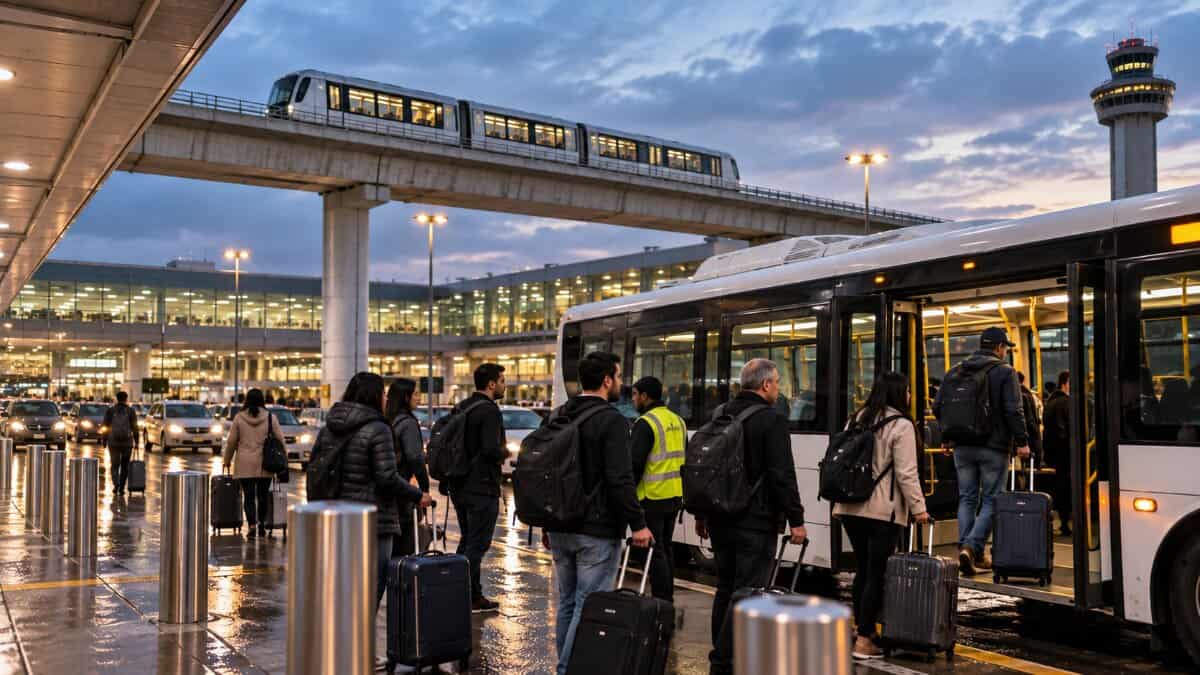
Travellers using John F. Kennedy International Airport face a significant overnight ground-access change on 5, 6, 13 and 14 October 2026, when AirTrain JFK will stop operating across all station lines between 10pm and 6am. Free shuttle buses will replace trains at Terminals 1, 4, 5, 7 and 8 and every AirTrain station. The disruption matters well beyond the United States because JFK’s affected terminals serve carriers associated with the United Kingdom, France, UAE, Türkiye, Ireland, Qatar, Germany, Spain, India, China, Japan, South Korea, Canada and other major international markets.
JFK AirTrain shutdown creates a wider international airport-access issue
According to JFK Airport‘s official full-system disruption advisory, AirTrain service will be unavailable across all station lines during four separate overnight periods. Free shuttle buses will operate between AirTrain stations and the ground-level frontages of passenger terminals. Customer-service staff will also be deployed at stations and bus stops to help passengers navigate the temporary arrangement.
Advertisement
Advertisement
The affected windows are:
| Date | AirTrain closure | Scheduled restoration |
|---|---|---|
| Monday, 5 October | 10pm | Tuesday, 6 October at 6am |
| Tuesday, 6 October | 10pm | Wednesday, 7 October at 6am |
| Tuesday, 13 October | 10pm | Wednesday, 14 October at 6am |
| Wednesday, 14 October | 10pm | Thursday, 15 October at 6am |
Together, those scheduled windows represent 32 hours of overnight AirTrain unavailability.
Advertisement
Advertisement
A separate Port Authority travel advisory for 2–8 October confirms that the first two suspensions are for system upgrades and are weather permitting. If weather prevents that work, a contingency suspension is scheduled from 10pm on 7 October until 6am on 8 October.
This is therefore not an airline shutdown. Flights have not been cancelled by the AirTrain notice. The principal risk is additional landside transfer time, particularly for passengers arriving late, departing early, changing terminals, reaching public transport or accessing relocated ground-transport facilities.
Advertisement
Advertisement
The exclusive travel angle lies in JFK’s changing ground-transport chain
The most important traveller issue is the interruption of what is normally JFK’s principal internal transport link.
According to JFK Airport, AirTrain normally moves passengers between terminals in under 10 minutes, runs approximately every five to 15 minutes, and connects the airport with Jamaica Station, Howard Beach, parking areas, rental-car facilities and hotel-shuttle services. The airport describes the system as capable of reaching on-airport destinations in under 20 minutes.
Advertisement
Advertisement
That creates a distinctive October 2026 situation.
The Port Authority is already urging JFK passengers to favour mass transit because the airport is undergoing a $19 billion transformation, including major roadway work. Travellers using Long Island Rail Road services can reach Jamaica from Grand Central Terminal or Penn Station in about 20 minutes before transferring towards JFK.
During the overnight AirTrain closures, however, that journey changes at the airport end. The train-to-terminal connection becomes a bus movement.
For travel agents, tour operators, corporate travel managers and passengers with fixed international check-in deadlines, this distinction matters. A journey planned around normal AirTrain frequencies cannot simply be treated as an ordinary rail connection during the affected periods.
Advertisement
Advertisement
Jamaica Station passengers face an extra transfer at Lot 66
The operational details are especially important for travellers entering JFK through Jamaica Station.
According to the official airport advisory, passengers travelling between Jamaica Station and the Central Terminal Area must transfer at Lot 66 during the shutdown. They should therefore not assume that a replacement bus from Jamaica provides a one-seat journey directly to their airline terminal.
Passengers travelling between the Central Terminal Area and Howard Beach or Lefferts Boulevard, meanwhile, will have direct replacement buses operating from terminal frontages.
| Journey during shutdown | Temporary arrangement |
|---|---|
| Jamaica Station to airline terminals | Shuttle journey involving transfer at Lot 66 |
| Airline terminals to Jamaica Station | Transfer through Lot 66 |
| Terminal area to Howard Beach | Direct replacement bus from terminal frontage |
| Terminal area to Lefferts Boulevard | Direct replacement bus |
| Inter-terminal movement | Replacement shuttle buses instead of AirTrain |
| Normal rail operation | Restarts after each scheduled 6am reopening, subject to official updates |
This makes Jamaica-origin journeys particularly relevant for passengers carrying substantial luggage, families, organised groups or anyone operating on a narrow airport-arrival buffer.
Terminal 5 and Terminal 7 passengers have another reason to plan carefully
A second layer of the story emerges from JFK’s current construction-related ground-transport arrangements.
According to the Port Authority’s 2 October 2026 travel advisory, for-hire vehicle pick-ups at Terminal 5 and Terminal 7 are currently relocated to the Howard Beach Ride App & Car Services Lot. Under normal arrangements, passengers are instructed to take AirTrain to Howard Beach to reach that facility.
Advertisement
Advertisement
That instruction intersects directly with the October AirTrain suspension.
During closure hours, travellers from those terminals cannot rely on the normal AirTrain journey to Howard Beach and instead must follow the temporary bus arrangements and airport signage.
Terminal 7 also has temporary changes affecting departure drop-offs and taxi operations as redevelopment work continues. These overlapping changes make late-evening airport ground transportation more complex than the AirTrain shutdown alone suggests.
For the travel trade, this is the strongest information-gain angle: the interruption affects not only train users heading into the metropolitan transport network, but potentially passengers trying to reach transport services that have themselves already been relocated because of airport construction.
United States disruption connects directly with major global travel markets
JFK currently lists 75 operating airlines across its passenger terminals. The AirTrain shutdown therefore touches an airport ecosystem extending across North America, Europe, Asia, the Middle East and Oceania.
The countries below are not experiencing aviation shutdowns themselves. Their relevance comes from home-country airlines operating at JFK terminals covered by the AirTrain suspension.
Advertisement
Advertisement
| Country | Major associated JFK airline examples | Current JFK terminal | Common link to disruption |
|---|---|---|---|
| United States | Delta, JetBlue, American | 4, 5/4, 8 | Primary country where disruption occurs |
| United Kingdom | British Airways, Virgin Atlantic | 8, 4 | Large transatlantic passenger flows through affected terminals |
| France | Air France | 1 | Terminal access changes during shutdown |
| United Arab Emirates | Emirates, Etihad | 4 | Long-haul passengers depend on affected ground network |
| Türkiye | Turkish Airlines | 1 | Terminal 1 linked to replacement bus system |
| Ireland | Aer Lingus | 7 | Terminal 7 also affected by separate ground-access changes |
| Qatar | Qatar Airways | 8 | Terminal 8 served by replacement buses |
| Germany | Lufthansa | 1 | International passengers face altered terminal access |
| Spain | Iberia, LEVEL, Air Europa | 8, 4 | Multiple Spanish-linked operations span affected terminals |
| South Korea | Korean Air | 1 | Overnight access changes apply to Terminal 1 |
| India | Air India | 4 | India-linked passengers use affected Terminal 4 |
| China | Air China, China Eastern, China Southern | 1, 8 | Chinese carriers span multiple affected terminals |
| Japan | ANA, Japan Airlines | 7, 8 | Two terminals involved in replacement arrangements |
| Canada | Air Canada | 7 | Terminal 7 ground access changes are especially relevant |
| Mexico | Aeromexico, Viva Aerobus | 4, 1 | Passenger journeys connect through affected terminals |
| Netherlands | KLM | 4 | Terminal 4 access changes apply |
| Singapore | Singapore Airlines | 4 | Ultra-long-haul passengers use affected terminal |
| Australia | Qantas | 8 | Terminal 8 passengers share the replacement network |
Current airline and terminal assignments come from JFK Airport’s official airline directory.
Passenger numbers show why the international angle matters
The latest complete annual Port Authority traffic report shows that JFK handled 62,629,455 revenue passengers in 2025, of whom 34,528,047 were international passengers. International traffic therefore represented roughly 55.1 per cent of JFK’s revenue passenger throughput.
Several home-country airlines linked to the countries above also ranked among JFK’s largest carriers in 2025.
| Carrier | Associated country | JFK passengers in 2025 |
|---|---|---|
| British Airways | United Kingdom | 1,299,498 |
| Virgin Atlantic | United Kingdom | 1,091,705 |
| Air France | France | 1,023,822 |
| Emirates | UAE | 848,904 |
| Turkish Airlines | Türkiye | 659,751 |
| Aer Lingus | Ireland | 636,754 |
| Qatar Airways | Qatar | 588,560 |
| Lufthansa | Germany | 571,454 |
| Iberia | Spain | 515,175 |
| Korean Air | South Korea | 460,490 |
These are airline passenger totals, not country-market totals. They should not be interpreted as the number of passengers travelling solely between JFK and each airline’s home country. They are useful because they demonstrate the scale of major international airline operations at terminals covered by the suspension.
Terminal 4 shows the scale of international passenger exposure
Terminal 4 alone illustrates why an overnight ground-transport interruption can have international consequences.
JFK states that Terminal 4 handles approximately 75,000 passengers per day, with about 50 per cent travelling to international destinations. Airlines operating there include Air India, Emirates, Etihad, KLM, Singapore Airlines, Virgin Atlantic, Aeromexico, Air Europa and Delta.
Advertisement
Advertisement
That does not mean all Terminal 4 passengers will be affected by the four shutdown periods. The suspension only applies between 10pm and 6am.
It does mean, however, that travel companies handling late international arrivals or early departures should treat terminal ground access as an operational component of the itinerary rather than an afterthought.
The disruption comes during a much larger United States airport transformation
The timing also provides wider infrastructure context.
JFK is undergoing a $19 billion redevelopment involving new terminals, upgraded existing facilities and a redesigned roadway system. According to the Port Authority, the wider programme includes the $9.5 billion New Terminal One, the $4.2 billion Terminal 6 and previously completed expansion work at Terminals 4 and 8.
The Port Authority’s 2026–2035 capital planning also calls for a future transformation of AirTrain JFK, including new train cars intended to double capacity and upgraded stations.
The authority has not stated that every element of the October shutdown is part of that wider capital programme, so the two should not be conflated. The confirmed reason for the early-October closures is system upgrades. The broader investment nevertheless demonstrates the importance being placed on airport-access capacity as JFK evolves.
Advertisement
Advertisement
JFK demand also remains substantial. Port Authority figures show that its commercial airports handled 67 million passengers during the first half of 2026. JFK’s traffic was five per cent below the same period of 2025, but it continued to operate as one of the authority’s primary international gateways.
Why travel agents and tour operators should build additional buffer time
The practical issue for the travel industry is not merely whether a bus exists. It is the loss of normal journey predictability.
AirTrain ordinarily provides a high-frequency, fixed-guideway connection. Replacement buses operate on roads, require loading and unloading, and may involve additional wayfinding or transfers.
For individually ticketed travellers, the inconvenience may mean a longer airport journey. For organised groups, premium transfers, MICE movements or passengers connecting across terminals, the same change can affect meeting points, coach scheduling, baggage handling and airport assistance arrangements.
Travel professionals handling departures between late evening and early morning should therefore treat the disruption as an airport-transfer planning issue, not as an airline schedule change.
Critical operational takeaways for travel agents and tour operators
- Identify affected departure and arrival times. The suspension applies from 10pm to 6am on four scheduled nights.
- Add ground-transfer buffer time. JFK itself instructs travellers to allow additional time.
- Flag Jamaica transfers. Passengers travelling between Jamaica and terminals must change at Lot 66.
- Check Terminal 5 and Terminal 7 ground transport carefully. Ride-app pick-ups are currently relocated to Howard Beach.
- Do not describe this as a flight shutdown. No system-wide airline cancellation has been announced in connection with the advisory.
- Reconfirm arrangements for groups and assisted travellers. Replacement buses alter normal station-to-terminal movements.
- Monitor weather-related changes. The first round of system-upgrade work is weather dependent, with a contingency window on 7–8 October.
- Check JFK’s advisory immediately before travel. Infrastructure work and temporary traffic arrangements can change.
What the JFK AirTrain shutdown signals for future international travel
The October interruption is temporary, but it highlights a longer-term issue for large international gateways: the resilience of the ground journey is becoming almost as important as the flight network itself.
Advertisement
Advertisement
JFK’s expanding terminals, roadway transformation and planned AirTrain capacity upgrades show how airport competitiveness increasingly depends on the entire passenger chain. Airlines can add routes and terminals can increase capacity, but international visitors still require predictable movement between aircraft, terminals, public transport and onward ground services.
For the United States travel market, the four overnight closures provide a relatively short operational test. For the global travel trade, they offer a broader lesson. As airport infrastructure becomes larger and more interconnected, temporary changes to a single transport component can influence passengers linked with numerous international markets even when flights themselves remain fully operational.
Advertisement
