

United States Suspends Green-Card Processing for TCS, Infosys and Six Tech Giants Travel Impact Explained

Published
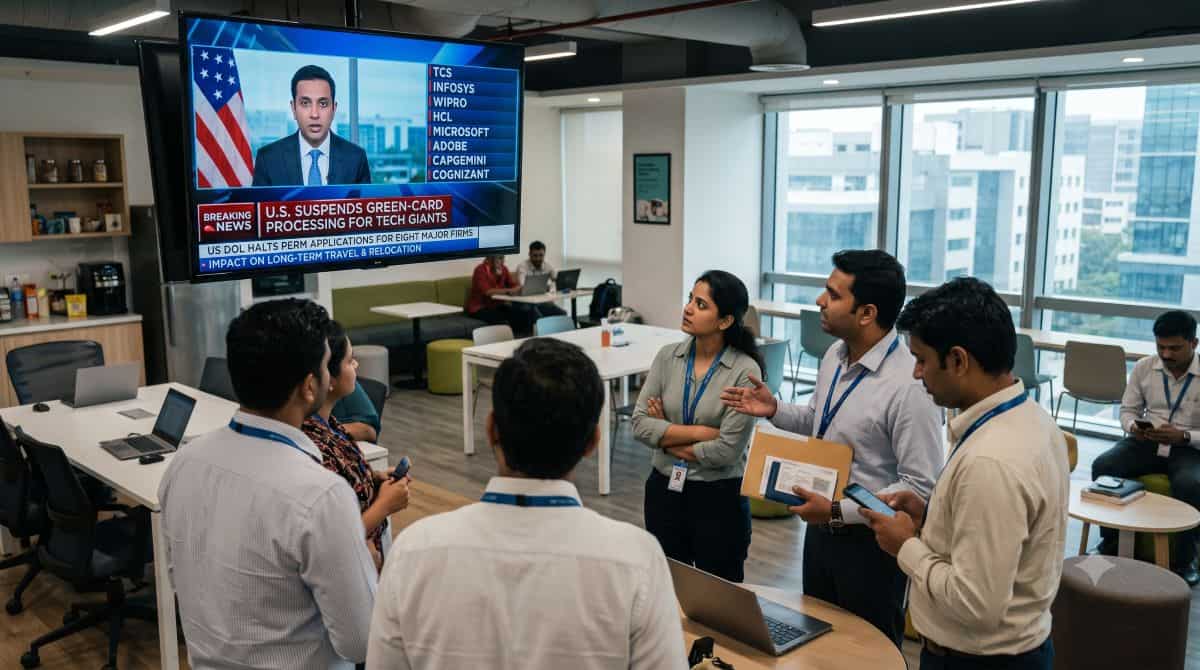
The United States has suspended employment-based green-card processing for eight major technology companies, including Tata Consultancy Services (TCS), Infosys, Wipro, HCL Technologies, Microsoft, Adobe, Capgemini and Cognizant. Announced on 8 October 2026, the decision could complicate long-term relocation plans for some Indian technology professionals seeking permanent residency. However, the suspension does not automatically cancel existing H-1B visas or impose a general travel ban on employees of these companies. For workers preparing to move abroad, the key question is how the decision affects their immigration status, employment plans and future journeys to America.
US Immigration Crackdown Targets Eight Technology Companies
The Trump administration announced the suspension amid an expanded effort to investigate suspected misuse of employment-based immigration programmes. US officials alleged that some employers had used foreign-worker recruitment practices that disadvantaged American workers.
Advertisement
Advertisement
According to Reuters, the suspension covers eight companies, including several major Indian IT services providers. US Labour Secretary Keith Sonderling said the government would stop accepting new PERM applications involving the companies and would not process pending applications while the suspension remained in effect.
Vice President JD Vance also criticised the companies’ use of foreign labour. However, the government had not publicly released detailed, company-specific findings establishing the alleged violations at the time of the announcement. The companies’ inclusion in the suspension should therefore not be treated as proof of wrongdoing by every affected employer or employee.
Advertisement
Advertisement
What Is the PERM Programme and Why Does It Matter?
The Permanent Labour Certification programme, commonly known as PERM, is an important step in many employer-sponsored employment-based green-card applications.
The US Department of Labor explains that employers generally need labour certification to demonstrate that hiring a foreign worker will not adversely affect the wages and working conditions of similarly employed US workers. The process also involves requirements concerning the availability of qualified American workers.
Advertisement
Advertisement
For eligible foreign professionals, PERM can form part of the route from temporary employment towards permanent residency. Suspending this stage can interrupt an employee’s long-term immigration plans, even when that individual continues to work legally in the United States.
The distinction matters because a green card offers permanent-resident status, while a temporary work visa serves a different purpose. Employees affected by the decision may need to discuss their individual cases and available options with their employers and qualified immigration advisers.
Does the Decision Mean an H-1B Visa Ban?
No. The reported suspension specifically concerns PERM applications involving the named companies. It does not, by itself, revoke existing H-1B visas or prevent every employee of these businesses from working in America.
The H-1B programme allows eligible US employers to hire foreign professionals in qualifying specialty occupations. PERM, meanwhile, is generally associated with the employment-based permanent-residency process.
This difference is particularly important for Indian professionals who already live and work in the United States. Their immediate ability to remain employed depends on their individual immigration status and applicable rules, rather than the PERM suspension alone.
Nevertheless, employees should not assume that every immigration issue remains unchanged. Separate visa restrictions, petition requirements and entry rules may apply to particular circumstances. Anyone planning international travel should verify their documentation and eligibility before departure.
Advertisement
Advertisement
How the Suspension Could Affect International Travel
The decision could create uncertainty for professionals planning long-term relocation, particularly those who expected employer-sponsored green-card processing to progress alongside their careers.
Some workers may reconsider the timing of a move, family relocation or future international assignment while they wait for clarification. Employers could also review staffing arrangements and immigration strategies for personnel expected to work in the United States.
However, these are potential consequences rather than confirmed changes in travel demand. There is currently no verified evidence that the PERM suspension has directly reduced tourist arrivals, airline bookings or hotel reservations.
For business travellers, the practical distinction is between permission to enter the United States for a particular purpose and eligibility to pursue permanent residency. A delay in one immigration pathway does not automatically invalidate every other travel permission.
Employees should check their visa validity, employment documentation and applicable admission requirements before booking non-refundable flights. Travellers whose circumstances have changed should seek individual advice rather than relying on general headlines.
Separate H-1B Restrictions Add Another Consideration
The PERM announcement also comes amid wider scrutiny of employment-based immigration. A separate White House proclamation introduced a $100,000 payment requirement for certain H-1B petitions involving workers outside the United States, subject to the proclamation’s scope and exceptions.
Advertisement
Advertisement
That measure is distinct from the October suspension. It should not be interpreted as a universal $100,000 charge on every existing H-1B holder or every international journey.
For employees preparing to start a new US assignment, employers should establish whether the separate requirement applies to their particular petition. Existing workers travelling abroad should independently confirm the rules governing their status and return.
What Indian IT Professionals Should Do Next
Workers employed by the affected companies should first establish whether their PERM applications have been filed, are pending or have reached a later stage in the green-card process. They should ask their employers for case-specific guidance and avoid assuming that the same outcome applies to every employee.
Those planning to travel should separately review their current visa, employment authorisation and entry documentation. An immigration announcement affecting permanent residency should not be treated as automatic permission to travel, nor as an automatic prohibition on travel.
The US Department of Labor and the relevant US immigration authorities remain the appropriate sources for official programme information and subsequent policy updates.
A Change That Demands Careful Travel Planning
For Indian professionals who have spent years building careers in the United States, immigration uncertainty can affect more than paperwork. It can influence when they move, whether their families join them and how confidently they plan their next professional chapter. The latest suspension does not mean that every affected employee must leave America, but it does make careful planning more important. Until further official clarification emerges, workers should distinguish between temporary work authorisation, permanent residency and permission to enter the country before making decisions that affect their careers or international travel.
Advertisement
