

France and Italy Tighten Tourist Photography Rules as Europe’s Iconic Landmarks Enforce Drone and Tripod Restrictions

Published
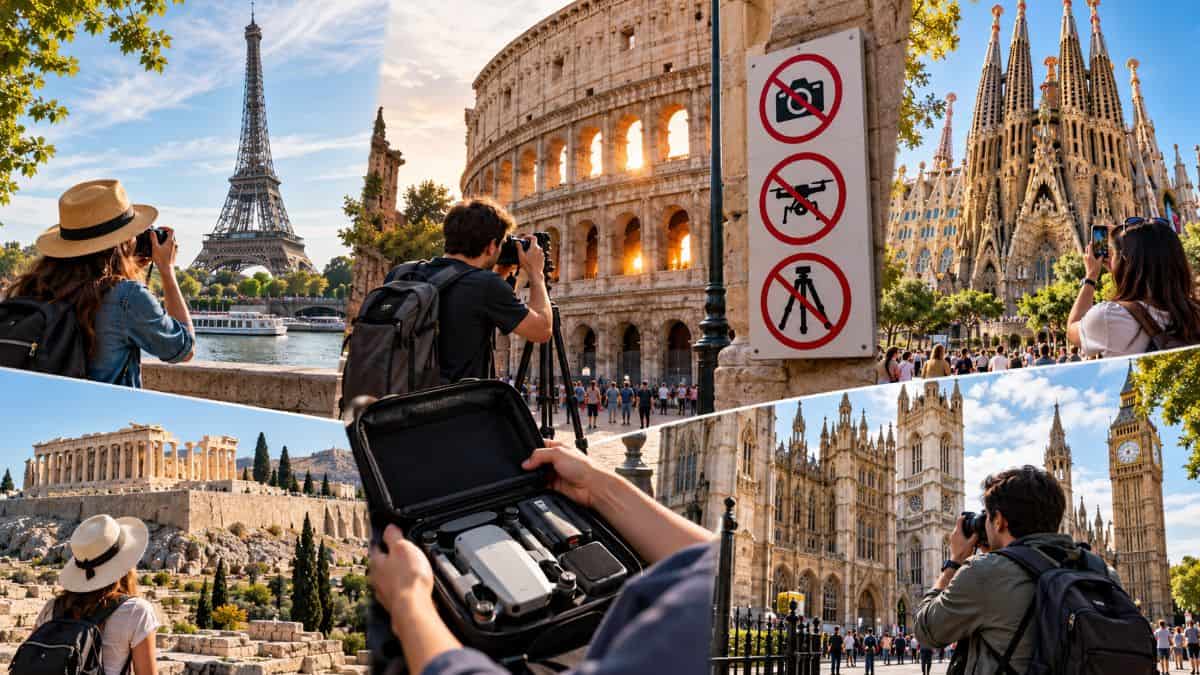
Europe’s most photographed landmarks present an increasingly complex planning challenge for travellers carrying drones, tripods and professional cameras. France, Italy, Spain, Greece and the United Kingdom apply different combinations of aviation restrictions, heritage protections, filming permits and attraction-specific photography policies. In Greece, drone operators must check designated airspace restrictions, while Italy’s Colosseum Archaeological Park prohibits professional equipment, including tripods, without formal authorisation. Paris requires advance approval for filming in many public locations, with longer lead times for larger productions. These distinctions matter as tourism expands: Spain welcomed 93.8 million international tourists in 2024, while Italy recorded 466.2 million tourist overnight stays. Photography restrictions in Europe can therefore influence itineraries, equipment choices and the cost of documenting a holiday.
Europe’s Photography Rules Demand Closer Attention
The assumption that a camera can be used freely wherever visitors can enter is increasingly unreliable. Travellers may photograph a monument from a public street yet face different conditions inside its grounds, within a museum or at a religious site. Drone operations introduce another layer, because aviation rules can prohibit flights even when ordinary photography remains permitted.
Advertisement
Advertisement
The distinction is especially important for travel creators, landscape photographers and visitors who plan detailed itineraries around sunrise views. A compact camera may present no difficulty, while a tripod, lighting rig or commercial filming crew can trigger additional requirements. Access to an attraction does not automatically confer permission to film professionally or operate a drone.
The five-country comparison reveals no single European photography policy. Instead, travellers encounter shared aviation standards across much of the European Union, national regulations, municipal permissions and rules established by individual heritage managers. Understanding which authority controls each activity is essential before booking timed tickets, hiring equipment or arranging a specialist photography tour.
Advertisement
Advertisement
Tourism Growth Raises the Stakes for Visitors
The scale of European tourism makes clear communication particularly important. Spain recorded 93.8 million international tourist arrivals in 2024, a 10.1% annual increase, according to its National Statistics Institute. Italy reported 466.2 million overnight stays in accommodation establishments that year, up 4.2% from 2023.
The United Kingdom also recorded substantial outbound travel. Its Office for National Statistics estimated 94.6 million visits abroad by UK residents in 2024, alongside £78.7 billion in expenditure. These figures demonstrate the scale of travel demand, although they do not measure photography-related incidents or prove that restrictions have increased.
Advertisement
Advertisement
| Official tourism indicator | Latest cited 2024 figure | Relevance to photography planning |
|---|---|---|
| Spain, international tourist arrivals | 93.8 million | High visitor volumes at popular attractions |
| Italy, accommodation overnight stays | 466.2 million | Greater need to plan visits around busy heritage sites |
| UK residents’ overseas visits | 94.6 million | Photography rules matter across outbound holiday itineraries |
| UK residents’ overseas expenditure | £78.7 billion | Travel planning involves broader costs beyond admission tickets |
These indicators provide context rather than direct evidence of stricter enforcement. Nevertheless, they illustrate why clear visitor guidance matters to destination managers and tourism businesses. Unanticipated equipment restrictions can disrupt carefully scheduled visits, particularly when travellers have limited time at major attractions.
France Separates Public Photography From Filming
France offers a useful case study in how permissions change according to location, equipment and production scale. Paris operates a dedicated filming-permission system for projects in public spaces managed by the city. Its procedures distinguish small, lightweight shoots from productions requiring broader coordination or access to controlled locations.
Under the city’s published guidance, eligible small crews of up to 10 people using lightweight equipment can submit an advance filming declaration for qualifying streets and bridges. Applications must generally arrive at least five business days beforehand. This route does not cover monuments, parks, gardens or interiors, which require the relevant filming authorisation.
For other qualifying productions, the city’s AGATE system requires applications at least 15 business days before filming. Some permissions may incur charges, depending on the location and use of public space. Iconic landmarks, including the Eiffel Tower and Louvre Museum, fall outside the general Paris Film application route and require direct contact with their respective managers.
Drone filming faces a more restrictive position in the capital. Paris states that drone filming is prohibited unless special permission has been granted by the police prefecture. Professional operators must follow the relevant authorisation process, including advance submission requirements.
For ordinary visitors, these provisions should not be confused with a universal ban on handheld holiday photography. The practical issue is whether a planned activity amounts to an organised production, involves restricted equipment or takes place on managed property. A traveller planning a commercial fashion shoot near a landmark should therefore arrange permissions separately from an ordinary sightseeing visit.
Advertisement
Advertisement
Italy Protects Archaeological Sites From Equipment Intrusion
Italy’s archaeological attractions illustrate why professional photography equipment deserves particular attention. The Colosseum Archaeological Park expressly prohibits professional optical and audio equipment, including tripods, cameras and microphones, without formal authorisation from its management. Its visitor regulations also prohibit selfie sticks.
This is a significant distinction for photographers who assume that a small tripod or compact video rig will be acceptable because it fits inside a day bag. Equipment restrictions can apply independently of a visitor’s ticket, and permission to enter the archaeological park does not automatically authorise a commercial production.
The policy also affects creators who plan scripted video sequences, interviews or footage requiring stable camera placement. They should contact the park before their visit rather than arrive expecting to negotiate access at the entrance. Rules can differ between archaeological attractions, museums and individual monuments, so permission at one site should never be treated as a precedent for another.
Italy’s wider heritage environment adds further complexity. A visitor photographing exterior architecture from a public street faces a different situation from a crew filming within a managed archaeological area. Commercial use, equipment, visitor circulation and conservation requirements can all influence the conditions imposed by the responsible authority.
For travellers visiting Rome, Pompeii or other major archaeological destinations, the most reliable approach is to check the official visitor regulations for every site. Where the intended shoot requires tripods, microphones or other professional equipment, written confirmation can prevent an avoidable change of plans.
Spain Requires Attention to Local Conditions
Spain combines nationally regulated drone operations with local management of attractions and public spaces. This means that permission to photograph an exterior does not establish permission to fly overhead, set up a tripod or conduct a commercial shoot nearby.
Advertisement
Advertisement
Barcelona provides a particularly useful setting for investigating these differences. Park Güell and the Sagrada Família attract visitors seeking architectural images, yet travellers should check the current conditions established by each attraction before bringing equipment beyond a standard handheld camera. Access rules, visitor-flow arrangements and permissions for organised productions may differ between locations.
The distinction between personal and commercial activity deserves emphasis. A tourist recording a short holiday clip is not necessarily undertaking the same activity as a production team using lighting, multiple cameras or equipment that occupies public space. However, social-media publication alone does not establish whether a permit is required; the specific rules of the site and the nature of the activity must be checked.
Spain’s wider drone framework also means operators must consider geographical restrictions, flight conditions and the requirements of the relevant aviation authority. Busy urban centres, airports and protected locations can present limitations even when a scenic viewpoint appears suitable for aerial photography.
Visitors should therefore plan separate checks for the attraction itself and the airspace above it. This is particularly important for itineraries that combine historic city centres, coastal viewpoints and archaeological sites within a short stay.
Greece Makes Drone Clearance a Pre-Trip Priority
Greece presents one of the clearest examples of why aerial photography requires advance research. The Hellenic Civil Aviation Authority instructs drone operators to check the Drone Aware Greece platform before every flight. Its map identifies geographical zones where operations may be restricted, prohibited or subject to prior approval.
Yellow and magenta zones can include areas around airports and archaeological sites. The applicable conditions depend on the location and proposed operation, so a drone’s small size does not guarantee unrestricted access. Where authorisation is available, operators should follow the authority’s application process and allow sufficient time for approval.
Advertisement
Advertisement
The authority’s guidance states that relevant flight-authorisation requests should be submitted at least five working days in advance where the operation is permitted subject to approval. Travellers should not interpret this as a guarantee of clearance within that period. Applications may require assessment by several authorities, and some locations may remain unavailable for the proposed activity.
Greece also applies a separate permission framework to filming at monuments, archaeological sites and museums under the Ministry of Culture. Its published instructions require applications for filming at individual sites to be sent to the competent antiquities authority. Applications involving UNESCO monuments or multiple locations follow a different administrative route.
For cases requiring consideration by the Central Archaeological Council, the ministry’s guidance specifies submission at least one month before filming. Supporting documents can include a film scenario, equipment details, crew information and declarations concerning compliance and fees. This is a production-planning requirement, not a universal one-month notice period for ordinary tourist photography.
The distinction matters for travellers arranging a documentary, branded campaign or multi-site cultural production. A holiday itinerary can accommodate spontaneous handheld photography, but a planned shoot across archaeological landmarks requires coordination well before arrival.
The United Kingdom Adds a Separate Regulatory Framework
The United Kingdom differs from France, Italy, Spain and Greece because it no longer operates within the European Union’s aviation regulatory system. Visitors cannot assume that compliance with an EU drone framework automatically settles every UK requirement. They must consult the UK’s Civil Aviation Authority and check the rules applying to the intended location and operation.
The broad principles of safe drone use remain familiar. Operators must follow applicable height limits, maintain the required visual contact and respect restrictions designed to protect people, aircraft, infrastructure and sensitive sites. A drone that is technically compliant with general operating rules may still be prohibited in a particular geographical zone.
Advertisement
Advertisement
Attractions impose a separate layer of conditions. Westminster Abbey, major museums, royal sites and managed parks may establish their own requirements for photography, video recording and professional equipment. Travellers should check the individual venue’s visitor policy, particularly when planning interior photography, filming during services or using equipment that could obstruct other visitors.
The practical difference is administrative rather than simply geographical. A visitor may need to consult national aviation guidance for a drone, the attraction’s management for interior photography and a local authority for a commercial shoot in public space. These permissions address different concerns and are not interchangeable.
For photographers moving between London and continental Europe, the safest strategy is to treat the UK as a separate regulatory jurisdiction. Rechecking official rules after crossing the Channel is more reliable than assuming that a previous country’s approval remains valid.
One European Drone Baseline, Different Local Boundaries
The European Union provides a shared starting point for drone operators in France, Italy, Spain and Greece. Under the European Union Aviation Safety Agency’s open-category framework, the general maximum flight height is 120 metres above the closest point of the Earth’s surface, subject to specified exceptions and operational conditions.
The open category also requires operators to maintain visual line of sight, follow the applicable subcategory rules and avoid flying over assemblies of people. The exact obligations depend on the drone’s classification, weight and intended operation. Some activities require authorisation under the more demanding specific category.
However, the shared framework does not make every European destination a permissive flying environment. National authorities can designate geographical zones for safety, security, environmental protection or other legitimate purposes. These zones may prohibit flights, impose conditions or require prior authorisation.
Advertisement
Advertisement
| Planning question | EU countries in this comparison | United Kingdom |
|---|---|---|
| General drone framework | EU/EASA rules apply, alongside national requirements | UK regulatory framework applies |
| General open-category height | Normally up to 120 metres, subject to exceptions | Check current UK Civil Aviation Authority rules |
| Flight near an iconic landmark | Check national geographical-zone information and local restrictions | Check UK geographical restrictions and local requirements |
| Drone filming for a production | Aviation compliance plus any site or filming permissions | Aviation compliance plus any site or filming permissions |
| Final pre-flight check | National authority’s official map and attraction management | UK Civil Aviation Authority guidance and relevant site management |
The crucial distinction is that aviation permission and filming permission are separate questions. An approved flight does not necessarily authorise commercial filming on protected property. Equally, a venue’s permission to record footage cannot override a legal flight restriction.
Religious and Heritage Sites Need Their Own Checks
Religious buildings and protected monuments introduce considerations that extend beyond camera equipment. Managers may seek to preserve quiet during services, protect sensitive interiors, maintain visitor circulation or prevent disruption to worshippers. Photography rules can therefore differ between a cathedral, an active monastery, a museum and an open archaeological site.
In Greece, official cultural guidance provides a formal route for filming and photography permissions at monuments, archaeological sites and museums. In Italy, the Colosseum Archaeological Park expressly controls professional equipment. In France, the city of Paris separates ordinary street activity from filming at monuments and other managed locations.
Spain and the UK also require visitors to consult the rules of individual attractions rather than assume that all heritage sites follow one national photography policy. The relevant restrictions may cover flash, tripods, video recording, ceremonies or commercial use. These conditions can change by venue and may differ between public areas and controlled interiors.
Travellers should also distinguish a restriction on photography from a restriction on publishing or commercially exploiting an image. A site may permit personal photographs while requiring separate permission for a commercial production or certain uses of protected heritage imagery. Where the planned use is unclear, visitors should seek written guidance from the relevant authority.
What Travellers Should Check Before Booking
Photography planning should begin before departure, especially when a trip centres on heritage landmarks or aerial views. Visitors carrying standard cameras should check the attraction’s photography policy, while anyone bringing a tripod, microphone or lighting equipment should verify whether the venue classifies it as professional equipment.
Advertisement
Advertisement
Drone operators should check official airspace maps for every intended flying location. They should also confirm registration, competency and insurance requirements where applicable. A sub-250-gram drone is not automatically exempt from geographical restrictions or attraction-specific conditions.
Commercial creators should contact the relevant site manager well ahead of travel. They should explain the intended use, crew size, equipment, filming dates and whether the production requires exclusive access or occupies public space. In Paris, the published application timetable can require five business days for qualifying small-shoot declarations or 15 business days for the broader AGATE permit route.
Visitors should retain written approvals and review the rules again shortly before arrival. Temporary restrictions, special events, conservation work and changes to visitor arrangements can affect access. Booking a timed ticket does not necessarily reserve permission to use restricted equipment.
| Traveller type | Main risk | Recommended preparation |
|---|---|---|
| Holiday photographer | Restricted interiors or equipment | Check the attraction’s visitor policy |
| Drone enthusiast | Prohibited or controlled airspace | Consult the official national flight map |
| Travel vlogger | Recording or tripod restrictions | Confirm video and equipment rules |
| Commercial photographer | Permit delays or location charges | Contact the site manager in advance |
| Documentary crew | Multiple authorities and production conditions | Submit a detailed plan well before travel |
Advertisement
