
Berlin Connects With Copenhagen and More as Europe Unleashes Major High-Speed Rail Drive for Seamless Travel

Published
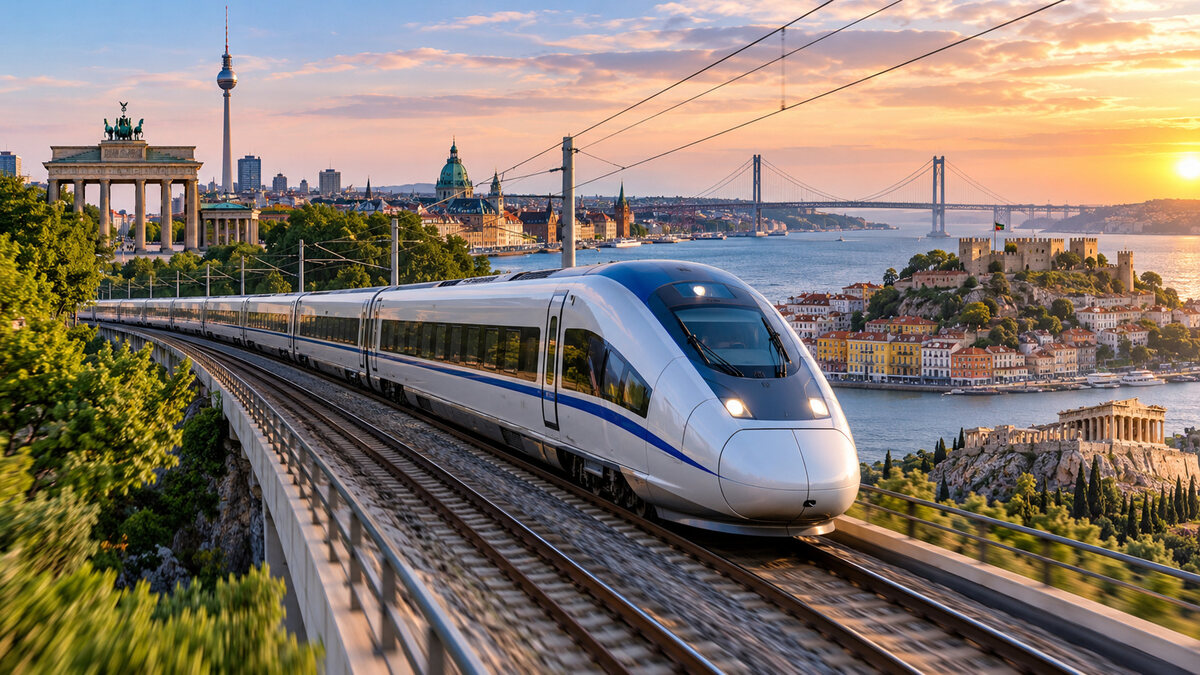
Europe’s rail map could undergo one of its biggest transformations in decades as the European Parliament’s Transport and Tourism Committee moves to accelerate high-speed rail development across the European Union, with faster journeys, more affordable fares, stronger regional connections and simpler cross-border ticketing at the centre of the initiative. The committee adopted its recommendations on 5 October 2026 by 34 votes in favour, none against and seven abstentions, building on the European Commission’s wider high-speed rail strategy targeting a faster and better-integrated network by 2040. For travellers, the changes could eventually reshape journeys between Berlin and Copenhagen, Lisbon and Madrid, Sofia and Athens, Paris and Rome, Vienna and Ljubljana, and the Baltic capitals, while opening more regional destinations to international tourism.
The committee vote does not immediately change train services or fares. It is a non-binding parliamentary initiative that must proceed through the European Parliament. However, it adds political momentum to a much wider programme already being developed through the Trans-European Transport Network, known as TEN-T, the European Commission’s High-Speed Rail Action Plan and proposed reforms to passenger booking and ticketing. For European tourism, the significance goes well beyond faster trains. The emerging strategy tackles three of the biggest barriers facing international rail travel: journey time, ticket price and fragmented booking systems.
Europe Wants a Rail Network That Goes Beyond Capital Cities
The central idea is a shift towards a network-first approach. Instead of concentrating investment almost entirely on headline connections between national capitals, the emerging model aims to connect high-speed lines with major regional cities, border regions, urban transport networks and conventional railway services. Visitors arriving by high-speed train would potentially have easier onward access to secondary destinations rather than being concentrated around Europe’s largest gateways. Regional trains, metros, buses and other public transport could become feeder networks for the main high-speed corridors.
The approach also fits the objectives of TEN-T, Europe’s strategic transport network connecting major urban nodes, ports, airports and border crossings. The European Commission‘s November 2025 high-speed rail plan calls for a well-functioning and faster European high-speed network by 2040, supported by accelerated infrastructure investment, a more competitive regulatory environment, stronger European rail-sector coordination and improved EU-level governance.
Advertisement
Advertisement
Berlin to Copenhagen Could Drop From Seven Hours to Four
Some of the proposed journey-time reductions illustrate how dramatically the European tourism map could change. The European Commission says passengers should be able to travel between Berlin and Copenhagen in around four hours by 2030, compared with approximately seven hours when its high-speed rail plan was announced.
Meanwhile, Sofia-Athens could fall to around six hours by 2035, cutting the journey by more than half. The Commission also expects new railway connections to enable stronger travel between the Baltic countries from 2030 and envisages passengers travelling from Paris to Lisbon through Madrid by 2035.
Advertisement
Advertisement
Major European Rail Corridors in Focus
| Route or Corridor | Current/Existing Context | EU Target or Direction | Target Period |
|---|---|---|---|
| Berlin–Copenhagen | Around 7 hours when EU plan announced | Around 4 hours | 2030 |
| Tallinn–Riga–Vilnius and wider Baltic corridor | Cross-border network still developing | Stronger integrated rail connectivity | From 2030 |
| Sofia–Athens | Around 13 hours 40 minutes | Around 6 hours | 2035 |
| Lisbon–Madrid–Paris | International connectivity remains incomplete | Paris-Lisbon travel via Madrid | 2035 |
| Paris–Rome | Long international rail journey | Faster corridor through infrastructure improvements | Longer-term network development |
| Vienna–Ljubljana | Conventional international connection | Faster connectivity through corridor upgrades | Phased development |
These figures should be understood as policy and infrastructure targets, not current guaranteed passenger timetables. Delivery depends on construction, national investment, interoperability, railway capacity and future operating decisions.
Lisbon and Madrid Could Gain From a Major Missing Rail Link
The Lisbon-Madrid corridor is particularly important from a tourism perspective. Portugal and Spain are two of Europe’s major visitor destinations, yet international railway connectivity between their capitals has remained comparatively weak. The Commission’s strategy envisages a much stronger Iberian connection that ultimately allows passengers to travel from Paris through Madrid to Lisbon by 2035. Improved connectivity could make combined Portugal-Spain itineraries substantially easier.
Travellers visiting Lisbon could continue towards Madrid and potentially onward to France without depending entirely on flights. Likewise, international tourists arriving in Spain could add Portugal to longer European itineraries more easily. This is precisely where high-speed rail could influence tourism geography. Faster cross-border trains do not simply compete with aircraft. They can encourage travellers to build journeys around several cities and countries.
Sofia and Athens Could Become a Six-Hour Rail Journey
South-eastern Europe is another area where journey times could change substantially. The European Commission says the journey between Sofia in Bulgaria and Athens in Greece could fall from roughly 13 hours and 40 minutes to six hours by 2035.
A reduction of more than 50% would significantly improve the practicality of travelling overland between the two capitals. From a tourism perspective, the corridor could help connect Central and Eastern European markets with Greece while giving international visitors more options for combining Balkan destinations. Regional connectivity will be critical. If high-speed corridors integrate effectively with conventional trains and local public transport, tourism benefits could spread beyond Athens and Sofia towards smaller destinations.
Baltic Tourism Could Gain a New Cross-Border Rail Backbone
The Baltic states are also central to the European strategy. The development of stronger standard-gauge railway infrastructure through Estonia, Latvia and Lithuania is intended to integrate the region more closely with the wider European railway system. The Commission expects new connections to make rail travel between the Baltic countries increasingly viable from 2030.
Advertisement
Advertisement
For tourism, this could encourage multi-destination journeys involving Tallinn, Riga and Vilnius, reducing dependence on buses, cars and short regional flights. Visitors could potentially arrive in one Baltic capital and travel through several countries by rail before continuing towards Poland and Central Europe.
Europe Faces a €345 Billion High-Speed Rail Investment Challenge
Turning these ambitions into physical infrastructure will be expensive. The European Commission estimated in June 2026 that completing the trans-European high-speed rail network by 2040 will require approximately €345 billion in infrastructure investment alone. An even more extensive scenario based on speeds of around 250 kilometres per hour by 2050 could push infrastructure requirements to approximately €546 billion.
Those numbers underline the scale of the challenge. High-speed rail requires far more than trains. Europe must finance tracks, bridges, tunnels, stations, power systems, digital signalling and major cross-border engineering works. The Commission has also confirmed that more than €100 billion from EU programmes has been allocated to rail infrastructure projects since 2014. Yet projects such as major Alpine tunnels and international fixed links demonstrate why future funding remains a central issue.
EU’s 2028–2034 Budget Becomes Critical to Rail Expansion
Attention is consequently turning towards Europe’s next long-term budget. The European Commission proposed a 2028–2034 Multiannual Financial Framework worth almost €2 trillion in July 2025. Cross-border transport infrastructure is among the areas expected to receive continued EU support.
MEPs are seeking adequate and dedicated transport funding while defending the importance of the Connecting Europe Facility, one of the EU’s principal mechanisms for financing strategic infrastructure. The current CEF programme for 2021–2027 has a total budget of €20.73 billion across transport, energy and digital infrastructure. The 2028–2034 funding negotiations will therefore be closely watched by the railway and tourism sectors because large cross-border projects frequently require financial commitments stretching across several years.
Cheaper Train Tickets Become Part of the Tourism Equation
Building faster lines will not automatically persuade travellers to use them. Affordability is becoming equally important. The TRAN recommendations call for governments and railway operators to consider accessible baseline fares, discounted ticket schemes and subscriptions that could make high-speed trains more competitive against cars and aircraft.
Advertisement
Advertisement
This has direct consequences for tourism. A four-hour railway journey between two major cities may be attractive, but travellers will still compare its cost against flights, coaches and private vehicles. Price transparency could therefore determine whether infrastructure investment actually translates into passenger growth. Lower and more predictable fares could be particularly important for families, students, younger travellers and visitors taking several train journeys during one European holiday.
One Journey and One Ticket Could Transform Cross-Border Rail
Europe is simultaneously attempting to tackle another long-standing frustration: buying international train tickets. In May 2026, the European Commission proposed a Passenger Package designed to simplify multimodal and cross-border travel. Its proposed system would allow passengers to find, compare and purchase services involving different railway operators as one ticket in a single transaction, using either independent ticketing platforms or railway operators’ systems.
The importance of this reform is substantial. A traveller crossing several European countries can currently encounter different railway companies, websites, booking rules and separate tickets. Under the Commission proposal, passengers using a qualifying single ticket across several operators would receive stronger protection if disruption causes a missed connection. Those protections are intended to include assistance, rerouting, reimbursement and compensation.
ERTMS Could Remove Another Invisible Border
Physical infrastructure is only part of Europe’s cross-border railway problem. Different national signalling systems have historically complicated international operations.
The wider European rail programme therefore depends heavily on the European Rail Traffic Management System, or ERTMS, which is intended to establish greater technical interoperability across national networks. Standardisation matters because a high-speed train crossing several countries must be able to operate safely and efficiently without unnecessary technical barriers.
Competition Could Put More High-Speed Trains on European Tracks
European policymakers are also looking at market conditions. Greater competition between railway operators could help increase frequencies, introduce new routes and put pressure on fares. The experiences of countries including Spain and Italy, where competing high-speed operators have entered important corridors, have increased policy interest in how open-access competition can expand passenger choice.
Advertisement
Advertisement
However, infrastructure capacity, track-access charges and terminal availability remain significant barriers. The European high-speed strategy therefore combines construction with regulatory reform. The objective is not merely to build tracks but to create conditions in which operators can actually provide commercially viable international services.
Why Europe’s Rail Transformation Matters for Tourism
Rail accounts for a very small proportion of European transport emissions compared with road and aviation. European Commission data for 2022 show rail accounted for approximately 0.3% of EU transport greenhouse-gas emissions, compared with 73.2% for road transport and 11.8% for civil aviation, including international aviation. That environmental difference explains why rail plays such an important role in Europe’s long-term transport strategy.
Faster Berlin-Copenhagen, Sofia-Athens and Iberian connections could turn journeys that are currently inconvenient into practical alternatives. Baltic integration could create new multi-country itineraries. Regional connections could push visitor spending beyond Europe’s most crowded capitals. The transition will not happen immediately. The TRAN committee recommendations remain non-binding, the Passenger Package still has to proceed through the EU legislative process, major infrastructure projects require years of construction, and the next EU budget remains subject to negotiation.
Yet the scale of the programme is becoming clearer. Europe is considering approximately €345 billion of infrastructure investment to complete its trans-European high-speed network by 2040, while simultaneously pursuing cheaper fares, interoperable ticketing, technical standardisation and stronger regional integration.
Advertisement
