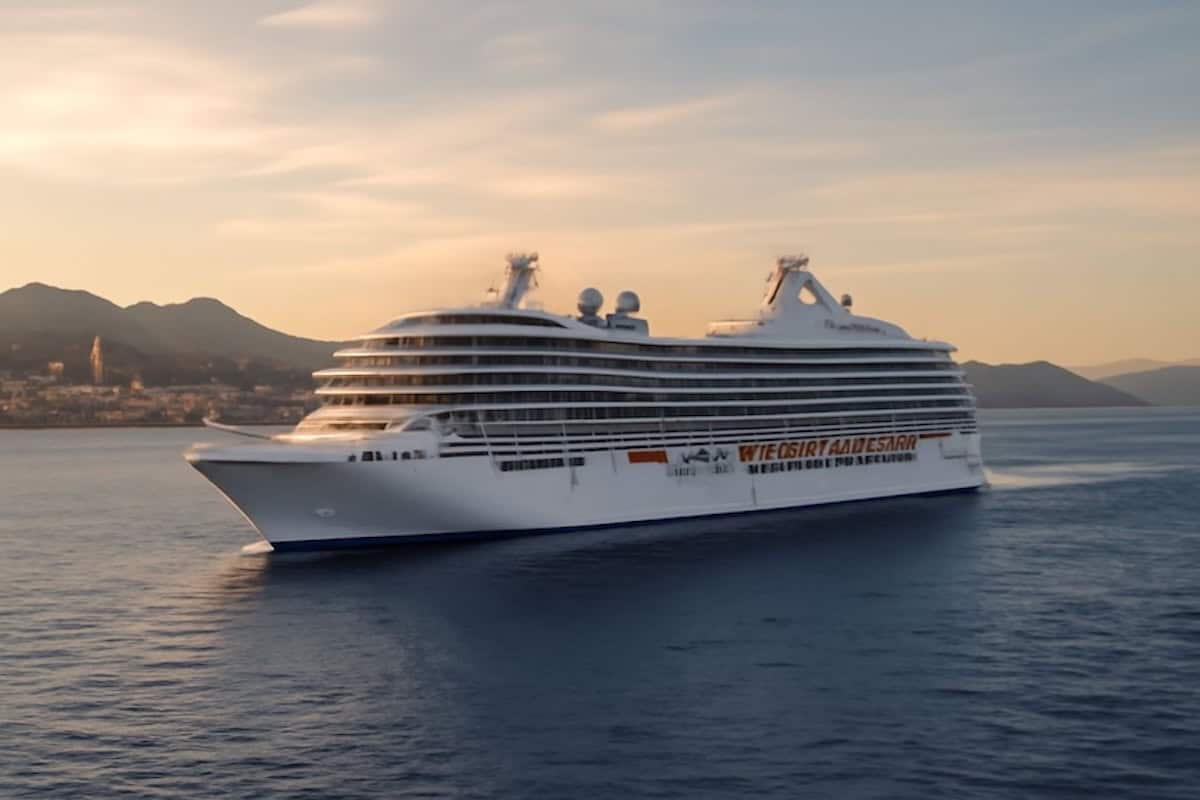
Image generated with Ai
The 25-year fleet transformation of MSC is reshaping how travellers experience cruise travel, from the Mediterranean to the Caribbean. Over the past 25 years, MSC has moved from smaller, established ships towards enormous modern vessels offering greater capacity, entertainment and onboard choices. Meanwhile, the Mediterranean and Caribbean remain important cruise regions for international travellers. This transformation also changes how passengers compare ships before booking their next journey. From older vessels to new mega-ships, MSC’s fleet reveals a remarkable story of growth. Travel And Tour World urges readers to read the entire story to discover how this 25-year fleet transformation is changing cruise travel from the Mediterranean to the Caribbean.
The MSC ships newest to oldest ranking gives travellers a useful way to compare the cruise line’s 23-ship fleet. MSC Cruises, founded in 1988, has expanded into a major global operator, with ships ranging from about 65,500 to 215,863 gross tons. Its itineraries cover the Caribbean, Europe, Asia, Alaska, South America and Africa.
Advertisement
MSC World America, launched in 2025, is the newest operating vessel in the ranking. It measures 215,863 gross tons, carries 6,762 passengers, and is 1,092 feet long with a 155-foot beam. It sails from Miami to the Eastern and Western Caribbean.
MSC Euribia followed in 2023 with 183,500 gross tons and capacity for 6,327 passengers. MSC highlights its advanced wastewater treatment technology. MSC World Europa entered service in 2022, carrying 6,762 passengers across 215,863 gross tons. It became MSC’s first LNG-powered ship.
Advertisement
Advertisement
MSC Seascape and MSC Seashore each measure 169,400 gross tons and accommodate 5,877 passengers. MSC Virtuosa, launched in 2021, carries 6,334 passengers and offers extensive family entertainment.
MSC Grandiosa and MSC Bellissima launched in 2019, while MSC Seaview, MSC Seaside and MSC Meraviglia followed between 2017 and 2018. These vessels generally provide larger accommodation capacities and extensive entertainment.
MSC Preziosa and MSC Divina launched in 2013 and 2012 respectively. MSC Magnifica arrived in 2010, followed by MSC Splendida in 2009. MSC Fantasia and MSC Poesia entered service in 2008, while MSC Orchestra and MSC Musica followed in 2007 and 2006.
The Lirica Class represents the oldest group. MSC Opera launched in 2004, MSC Lirica in 2003, MSC Sinfonia in 2002 and MSC Armonia in 2001.
Advertisement
Advertisement
MSC World Asia is scheduled for Mediterranean cruising from winter 2026. The ship will offer more than 10 pools and whirlpools, 40 bars and lounges, six children’s venues and four water slides.
For travellers, ship age is only one consideration. Destination, itinerary, onboard facilities, cabin preferences and budget should all influence the final choice. MSC’s fleet therefore offers options ranging from intimate older vessels to enormous modern ships.
The MSC ships newest to oldest comparison shows how dramatically MSC Cruises has expanded its fleet and passenger capacity. MSC’s official fleet currently lists 23 modern ships, with MSC World Asia entering Mediterranean service in December 2026 and MSC World Atlantic planned for 2027.
The fleet’s transformation is particularly visible when comparing older Lirica Class vessels with the newest World Class ships. MSC says its €11.6 billion investment programme for 2014–2026 supported the delivery of new Seaside, Meraviglia and World Class vessels. The company also enlarged and renewed its Lirica Class ships through the €200 million Renaissance Programme, completed by 2015.
| Year | Fleet development | Traveller significance |
|---|---|---|
| 2001 | MSC Armonia entered service | Oldest ship in the current historical comparison |
| 2002 | MSC Sinfonia | Continued Lirica-era expansion |
| 2003 | MSC Lirica | Strengthened MSC’s modern-era fleet |
| 2004 | MSC Opera | Expanded European cruise capacity |
| 2006 | MSC Musica | Larger passenger proposition |
| 2007 | MSC Orchestra | Further fleet growth |
| 2008 | MSC Poesia, MSC Fantasia | Bigger ships and broader itineraries |
| 2009 | MSC Splendida | Continued large-ship expansion |
| 2010 | MSC Magnifica | Added another Musica-generation vessel |
| 2012 | MSC Divina | Increased capacity and onboard facilities |
| 2013 | MSC Preziosa | Completed a major expansion phase |
| 2017 | MSC Meraviglia | Beginning of a new mega-ship generation |
| 2017 | MSC Seaside | Introduced the Seaside concept |
| 2018 | MSC Seaview | Expanded the Seaside platform |
| 2019 | MSC Bellissima, MSC Grandiosa | Major increase in passenger capacity |
| 2021 | MSC Virtuosa, MSC Seashore | Post-pandemic fleet expansion |
| 2022 | MSC Seascape, MSC World Europa | World Class era begins |
| 2023 | MSC Euribia | Further LNG-powered expansion |
| 2025 | MSC World America | New Caribbean-focused World Class ship |
| 2026 | MSC World Asia | Planned Mediterranean debut |
MSC’s own corporate history confirms that the Seaside EVO ships delivered in 2021 and 2023 have capacity for 5,646 guests, while the fifth Meraviglia vessel delivered in 2023 has capacity for 6,334.
The 2021 recovery year marked an important transition. MSC introduced MSC Virtuosa and MSC Seashore while cruise tourism gradually restarted following the pandemic disruption. Virtuosa has 181,541 gross tons, 6,334 guests, 2,421 cabins and 1,704 crew members.
MSC Seashore has 170,412 gross tons, 5,877 passengers, 2,270 cabins and 1,648 crew members.
MSC World Europa entered service in 2022 and represented a major increase in ship scale. The vessel has 215,863 gross tons, capacity for 6,762 passengers, 2,626 cabins and 2,138 crew members. MSC identifies it as the first LNG-powered ship in its World Class fleet.
Global cruise demand also recovered strongly. Royal Caribbean’s SEC filing estimates approximately 20 million global cruise guests in 2022, compared with 32 million in 2023 and approximately 36 million in 2024.
MSC Cruises carried more than four million guests across 22 ships during 2023, according to reporting on the company’s 2023 sustainability data. The same reporting states that MSC employed just under 50,000 crew members representing 144 nationalities.
MSC Euribia also joined the fleet in 2023. The ship introduced five pools, including a main pool measuring 1,700 square metres, seven dedicated children’s and teenagers’ rooms and more than 100 hours of live youth entertainment per cruise.
The wider cruise market reached approximately 36 million guests in 2024, according to Royal Caribbean’s SEC filing. CLIA separately reported 34.6 million cruise passengers for 2024 in its 2025 industry report. The different totals reflect differences in methodology and coverage.
MSC’s expansion therefore occurred alongside a rapidly recovering international cruise market. Caribbean, Bahamas and Bermuda itineraries accounted for 43% of global cruise passengers in 2024 according to CLIA.
MSC World America entered service in 2025, becoming the second World Class ship. MSC lists 216,638 gross tons, 6,764 guests, 2,614 cabins and 2,138 crew members. The ship measures 333 metres long, 47 metres wide and 77 metres high, with a maximum speed of 22.7 knots.
The ship is particularly significant for Caribbean travellers because MSC operates it from Miami.
MSC World Asia is planned to enter Mediterranean service in December 2026. MSC lists the vessel at 215,863 gross tons with capacity for 6,762 passengers, 2,626 cabins and 2,138 crew members. It measures 333.3 metres long, 47 metres wide and 77.15 metres high. Its maximum speed is 22.7 knots.
This represents a major shift from the approximately 65,000-tonne Lirica-era ships. MSC states that its Renaissance Programme enlarged and renewed those vessels to approximately 65,000 gross tons, with capacity exceeding 2,000 passengers.
| Ship | Entry year | Gross tonnage | Passenger capacity | Crew | Key travel angle |
|---|---|---|---|---|---|
| MSC Armonia | 2001 | ~65,000 after Renaissance | 2,000+ | — | Smaller-ship experience |
| MSC Poesia | 2008 | 92,627 | 3,223 | ~1,039 | Traditional large-ship cruising |
| MSC Virtuosa | 2021 | 181,541 | 6,334 | 1,704 | Family and entertainment |
| MSC Seashore | 2021 | 170,412 | 5,877 | 1,648 | Outdoor-focused cruising |
| MSC World Europa | 2022 | 215,863 | 6,762 | 2,138 | World Class experience |
| MSC Seascape | 2022 | 170,412 | 5,877 | 1,648 | Caribbean-focused choice |
| MSC Euribia | 2023 | — | — | — | LNG and family facilities |
| MSC World America | 2025 | 216,638 | 6,764 | 2,138 | Miami and Caribbean |
| MSC World Asia | 2026 | 215,863 | 6,762 | 2,138 | Mediterranean |
MSC confirms that MSC Poesia has 92,627 gross tons, 3,223 passenger capacity, about 1,039 crew members and 1,223 cabins.
A crucial point for accurate reporting is that MSC does not publicly provide a complete month-by-month passenger total for 2021, 2022, 2023, 2024 and 2025. Therefore, inserting invented monthly MSC passenger figures would be misleading.
Year MSC-specific publicly reported figure Wider cruise-market context 2021 No complete annual/monthly MSC total located Global cruising was still recovering 2022 No complete MSC annual total located ~20 million global cruise guests 2023 4+ million MSC guests ~32 million global cruise guests 2024 Complete MSC total not publicly disclosed in reviewed sources ~36 million global cruise guests 2025 Complete MSC total not publicly disclosed in reviewed sources 37.2 million global ocean-cruise passengers
The 2025 global figure of 37.2 million represents a 7.5% increase over 2024, according to CLIA reporting published in 2026.
The fleet data shows an unmistakable capacity shift. Older MSC vessels were designed around roughly 2,000-plus guests, while the newest World Class ships accommodate approximately 6,762 to 6,764 passengers.
For travellers, this means ship selection now matters almost as much as destination selection. Smaller vessels can offer a different atmosphere, while World Class ships provide substantially greater onboard capacity and facilities.
MSC’s growth also mirrors the wider recovery of international cruising. Global passenger volumes moved from approximately 20 million in 2022 to around 32 million in 2023 and roughly 36 million in 2024, before reaching 37.2 million in 2025.
The key lesson for cruise shoppers is simple: ship age alone should not determine a booking. Travellers should compare passenger capacity, itinerary, embarkation port, cabin category, onboard facilities and destination before choosing between MSC’s newest mega-ships and its established vessels.
The 25-year fleet transformation of MSC shows how dramatically cruise travel has evolved from the Mediterranean to the Caribbean. Older MSC ships offered a smaller cruising experience, while newer vessels accommodate more than 6,700 passengers and provide significantly broader onboard choices. This growth has given travellers more options across both the Mediterranean and Caribbean. However, ship age should not be the only consideration when planning a cruise. Itinerary, facilities, cabin choice, embarkation port and travel budget remain equally important. Ultimately, MSC’s 25-year transformation gives modern travellers greater choice and flexibility when selecting cruise travel between the Mediterranean and Caribbean.
Advertisement
Tags: caribbean cruises, cruise fleet growth, cruise travel, mediterranean cruises, MSC 25-year fleet transformation
Advertisement
Advertisement












Wednesday, September 2, 2026

Wednesday, September 2, 2026

Wednesday, September 2, 2026

Wednesday, September 2, 2026

Wednesday, September 2, 2026

Tuesday, September 1, 2026

Wednesday, September 2, 2026

Wednesday, September 2, 2026