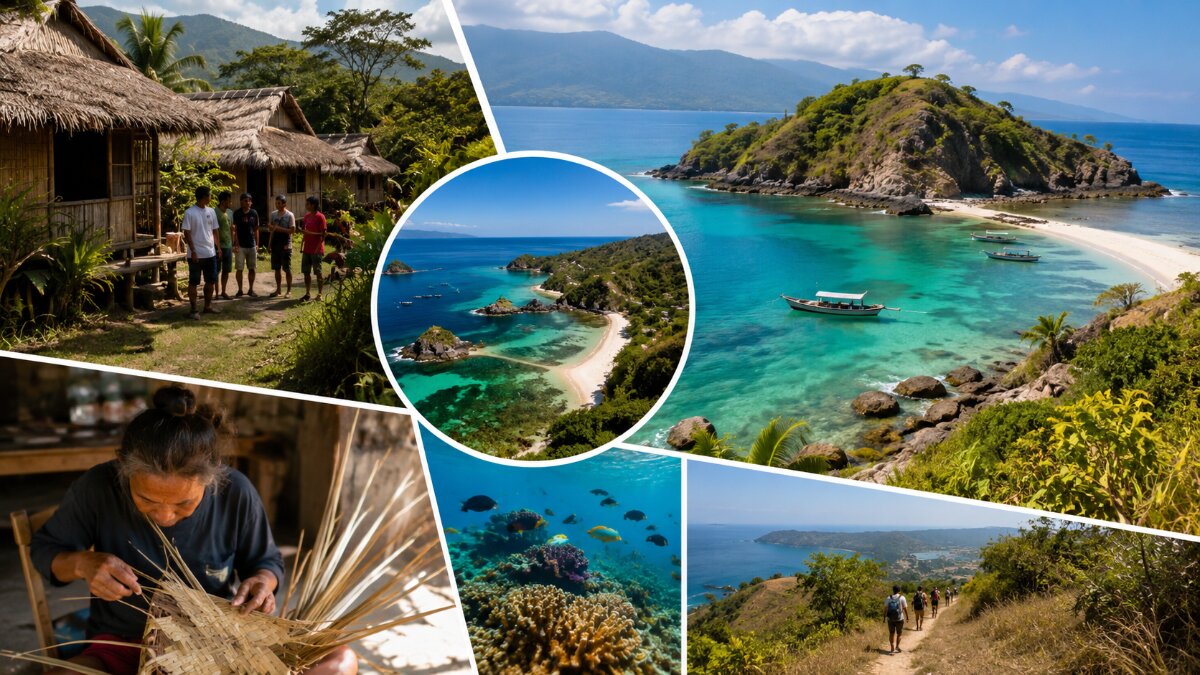
Image generated with Ai
Five additional community-tourism bungalows planned at Valu Sere have acquired far greater strategic importance since Timor-Leste announced them in April. Nino Konis Santana became the country’s first UNESCO Biosphere Reserve in June while UNESCO is simultaneously helping Timor-Leste develop its first World Heritage Tentative List around the archaeological rock-art sites of Tutuala. Jaco Island itself remains protected from development and overnight stays. This creates a potentially important tourism model: grow visitor expenditure and accommodation on the mainland while keeping the sacred island a controlled day-trip destination.
According to Timor-Leste’s Ministry of State Administration, government and municipal officials visited Valu Sere in Tutuala, Lautém Municipality, on 10 April 2026 to collect site information for five planned bungalow units. The proposed community-tourism development covers a 7,200-square-metre site. The official announcement described the visit as an initial data-gathering stage rather than the start of hotel operations.
The intended operating model is particularly significant for the travel trade. The government announcement states that, following completion, the accommodation is intended to be handed to the suku for management so that income can flow directly towards the local community. It also links the accommodation to easier exploration of Jaco Island, Valu Beach, villages, mountains and cultural heritage around Tutuala.
This is therefore not simply another five-room accommodation announcement. It potentially establishes a mechanism for capturing visitor expenditure outside a protected attraction that cannot itself accommodate overnight tourists.
Advertisement
Advertisement
That distinction has become more important since June.
Nino Konis Santana National Park was officially recognised as Timor-Leste’s first UNESCO Biosphere Reserve during the UNESCO Man and the Biosphere programme’s June 2026 session. The Government of Timor-Leste says the designation creates opportunities for sustainable tourism, scientific research, international cooperation and conservation.
UNESCO records a biosphere reserve covering 295,939 hectares, comprising 192,821 hectares of terrestrial area and 101,118 hectares of marine territory. Its recorded population is 13,884. The reserve contains 168 bird species, while its coral reefs shelter around 500 fish species.
For tourism businesses, those figures change the narrative around a seemingly modest bungalow development. Valu Sere now sits within the visitor economy of an internationally recognised conservation landscape rather than simply beside an isolated beach attraction.
Advertisement
Advertisement
| Official indicator | Latest verified position | Tourism significance |
|---|---|---|
| Planned Valu Sere accommodation | 5 additional bungalow units | Potential increase in community-controlled visitor capacity |
| Proposed development area | 7,200 sq m | Defined mainland tourism site at the Jaco gateway |
| UNESCO biosphere recognition | June 2026 | New international nature-tourism positioning |
| Biosphere reserve surface | 295,939 ha | Large integrated terrestrial and marine destination |
| Recorded biosphere population | 13,884 | Community livelihoods become central to tourism management |
| Bird species | 168 | Stronger birding and specialist ecotourism proposition |
| Coral-reef fish species | About 500 | Supports marine, snorkelling and biodiversity tourism |
| Jaco overnight accommodation | Not permitted | Visitor nights must be accommodated elsewhere |
| Timor-Leste World Heritage properties | 0 | Cultural heritage positioning remains at an early stage |
| Timor-Leste Tentative List sites | 0 currently recorded | Tutuala work represents a prospective pipeline, not UNESCO World Heritage status |
Sources: Government of Timor-Leste, Ministry of State Administration, Ministry of Tourism and Environment and UNESCO.
The official Timor-Leste tourism portal is explicit about Jaco Island’s operating model. The island is sacred, remains undeveloped and does not permit overnight stays. Visitors reach it by small boat from Valu Beach and visit during the day.
This turns mainland accommodation into more than a convenience.
Every traveller wishing to spend several days exploring Jaco, the national park, Tutuala, its cultural landscape and surrounding coastline needs accommodation away from Jaco itself. That effectively separates the attraction zone from the overnight spending zone.
Valu Sere is therefore positioned to capture accommodation, local transport, guiding and other tourism expenditure without requiring hotel construction on the island.
Importantly, the five planned units should not be described as the first accommodation at Valu Sere. Lautém Municipal Authority’s March 2026 visitor information already records lodging in Tutuala and specifically notes existing guesthouse and hospitality facilities at Valu-Sere. The new development is consequently better understood as additional community accommodation capacity.
That correction matters for B2B reporting because the story is an expansion and governance story, rather than the creation of a completely new hospitality destination.
An even more consequential development is unfolding around Tutuala’s cultural heritage.
According to UNESCO, work is under way to help Timor-Leste create its first World Heritage Tentative List, with the Archaeological Rock Art Sites of Tutuala in Nino Konis Santana National Park identified as the priority cultural heritage focus for the programme.
The programme includes workshops in Dili, a field visit to Nino Konis Santana National Park and technical work assessing the Tutuala rock-art sites against comparable heritage places. UNESCO’s project timetable provided for a second workshop reviewing the Tentative List documentation in August or September 2026, although exact dates were to be determined with Timor-Leste’s working team.
This is highly relevant as of 2 September.
Timor-Leste currently has zero properties inscribed on the World Heritage List and zero sites registered on its Tentative List, according to UNESCO’s current State Party record. Tutuala therefore has no World Heritage status today. The work represents an upstream heritage-development process whose eventual outcome remains uncertain.
Yet, from a tourism-development perspective, the direction matters.
Tutuala could increasingly combine biosphere tourism, marine excursions, sacred-island visitation and archaeological heritage within one geographically concentrated visitor economy. That creates a stronger rationale for carefully controlled mainland lodging than would exist for a beach stop alone.
Dili matters because it remains the principal international gateway and the official tourism portal identifies the journey to Jaco as a full-day drive east from Dili, through Baucau towards Tutuala, followed by onward four-wheel-drive and boat access from Valu Beach.
Lospalos matters as Lautém’s principal urban service centre. Lautém Municipal Authority documents public transport between Dili and Lospalos, while its accommodation directory lists multiple lodging options in both the Lospalos and Tutuala administrative areas.
International air access into Dili has also broadened. Timor-Leste’s official tourism portal, last verifying its international schedule on 11 August 2026, lists direct services from Darwin, Bali, Singapore, Kuala Lumpur and Xiamen. Based on the frequencies published by the portal, these schedules amount to 33 direct international flights per week, subject to airline and seasonal changes.Direct Dili market Published weekly frequency Strategic relevance Darwin 12 Short-haul Australian access Bali 14 Major regional tourism connection Kuala Lumpur 5 Wider Southeast Asian connectivity Singapore 1 International hub access Xiamen 1 Direct mainland China connection Published total 33 Broader feed into Timor-Leste itineraries
The government is simultaneously expanding Presidente Nicolau Lobato International Airport in Dili. In June, the Council of Ministers put the revised overall investment at approximately US$239 million, covering runway, taxiway, apron, control-tower, passenger-terminal and supporting infrastructure modernisation. A contract for the new passenger terminal had already been signed in February 2026.
For Lautém, however, greater international capacity only becomes commercially useful when travellers can reliably move from the capital to the eastern destinations they came to experience.
Timor-Leste’s 2025–2035 Blue Economy Policy places the bungalow project within a much broader economic strategy.
According to the government policy, tourism represented approximately 2 per cent of national GDP in 2024. International arrivals increased by 26 per cent, from 21,370 in 2023 to 26,912 in 2024. The National Tourism Policy’s 2030 ambition is substantially larger: 200,000 international tourists annually, US$150 million in annual tourism revenue and 15,000 direct jobs.
That means the policy challenge is not merely getting more visitors into Timor-Leste. It is increasing how much tourism value remains in local economies.
The Blue Economy framework specifically supports community-based tourism, homestays and environmentally responsible accommodation. It also identifies electricity, sanitation, telecommunications, roads and transport as necessary enabling infrastructure when tourism expands into new areas.
For Valu Sere, those requirements are commercially decisive. Five bungalows can create beds. They cannot by themselves deliver a bookable international product unless access reliability, utilities, waste management, operating standards, payment arrangements and local tourism services develop alongside them.
The strongest industry significance lies in the geographical separation of tourism pressure and tourism revenue.
Jaco can remain undeveloped and day-only. Valu Sere can potentially hold the overnight capacity. Tutuala can provide cultural experiences and guiding. Lospalos can function as a regional service point. Dili supplies international air access. This creates the foundations of a distributed tourism corridor rather than a conventional resort development concentrated directly on the main attraction.
That model fits unusually closely with Timor-Leste’s own blue-tourism policy, which prioritises community participation, low environmental impact, local economic development and eco-friendly accommodation.
It could also help prevent a familiar destination-development problem: visitors reaching a protected natural asset while most accommodation expenditure leaks elsewhere. If local management is implemented as envisaged, greater demand generated by UNESCO recognition could translate into locally retained room revenue instead.
But the model only works if capacity is matched to environmental limits. UNESCO recognition can increase visibility. World Heritage preparation can increase cultural interest. Neither removes the need for carrying-capacity management, waste controls, water security, protected-area rules or commercially reliable hospitality operations.
That is why the next official project documents could be more important than the original bungalow announcement.
As of 2 September 2026, the latest project-specific official announcement identified in this review remains the Ministry of State Administration’s 10 April site assessment.
That announcement confirms the five planned units, the 7,200-square-metre area, community-tourism purpose and intended suku management model. It does not specify a construction contract value, confirmed opening date, room inventory by bed count, published tariff, booking platform, contractor, detailed operating agreement or formula governing how future revenue would be distributed.
Travel sellers should therefore avoid marketing the new units as open, bookable or completed until those operational details are formally published.
The number of rooms is small. The strategic question is much larger. Timor-Leste now has its first UNESCO Biosphere Reserve, is working towards its first World Heritage Tentative List, is expanding Dili’s international airport and has a national policy explicitly favouring community-based, environmentally responsible tourism. Tutuala sits where those policy strands increasingly meet.
If the Valu Sere accommodation expansion proceeds with transparent community management and appropriate infrastructure, it could demonstrate how an emerging destination converts international recognition into local hospitality income without constructing accommodation on the protected attraction that creates the demand.
For travel companies that plan trips to places Timor-Leste could be more than just a quick trip to Jaco. It could be a journey that lasts nights focusing on nature and local culture. This trip would include stops, in Dili, Lospalos, Tutuala, Valu Beach, Nino Konis Santana and Jaco. The idea is to create a plan that is mostly focused on protecting the environment of building big hotels and resorts.
Advertisement
Advertisement
Advertisement












Wednesday, September 2, 2026

Wednesday, September 2, 2026

Wednesday, September 2, 2026

Wednesday, September 2, 2026

Wednesday, September 2, 2026

Tuesday, September 1, 2026

Wednesday, September 2, 2026

Wednesday, September 2, 2026