

UK Follows Singapore and Other Major Countries as Contactless Biometric eGates Make Airport Border Checks Up to 25% Faster

Published
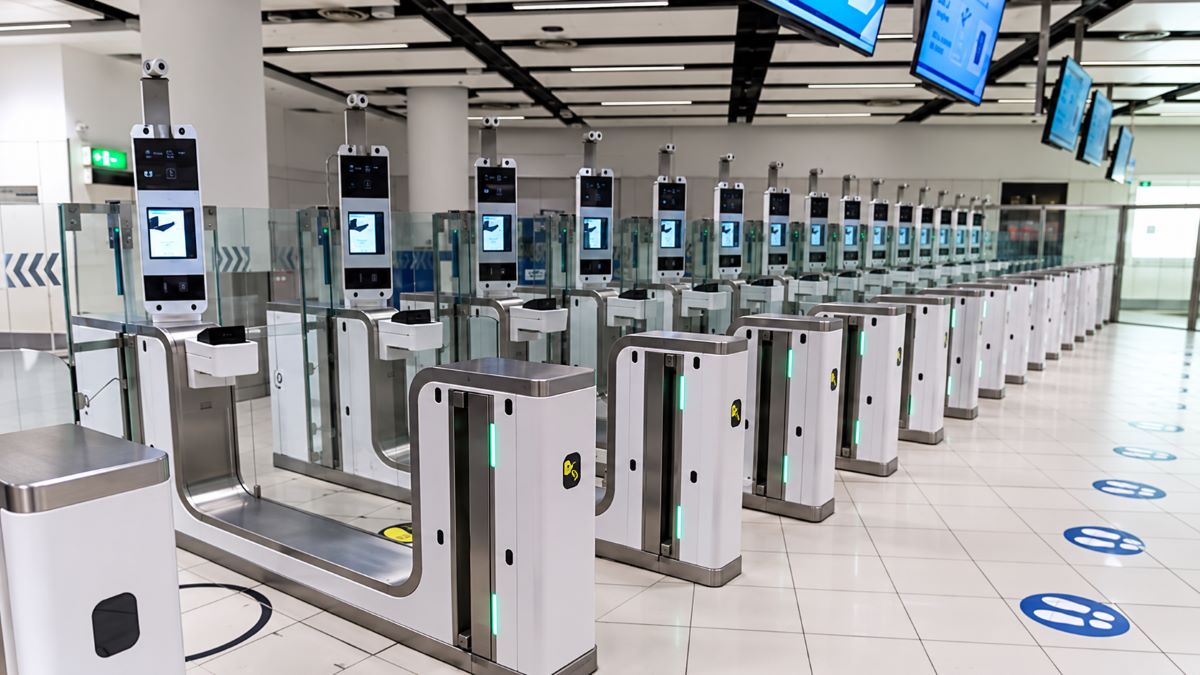
UK follows Singapore and other major countries as contactless biometric eGates reshape airport border checks and move international travel towards faster, lower-contact processing. This new system uses facial recognition and verified travel information to identify eligible passengers without requiring them to place a passport on the gate reader during a successful check. Travellers must still carry a valid passport and may be sent for extra verification when needed. The shift strengthens the UK’s wider digital border strategy and mirrors a global tourism trend towards smoother passenger journeys, shorter immigration friction and technology-led airport experiences across major international gateways and worldwide tourism.
UK Contactless eGates at a Glance: What Travellers Need to Know
Government testing shows the process can be up to 25% faster than using a passport on a conventional eGate. The rollout begins at East Midlands Airport before expanding across major UK gateways. For travellers, the bigger story is not simply a quicker gate.
| Traveller question | Current UK position |
|---|---|
| Do I scan my passport at a contactless eGate? | Normally no, when contactless verification succeeds |
| Can I travel without my passport? | No. A valid physical passport must still be carried |
| How much faster can it be? | Up to 25% faster in government testing |
| Where does it start? | East Midlands Airport |
| Who gets access first? | British citizens |
| Will foreign travellers eventually use it? | Other existing eGate-eligible nationalities are planned for later phases |
| When will rollout expand? | Contactless gates are expected across UK airports by early 2027 |
| What happens if facial verification fails? | Scan the passport or continue to a Border Force officer |
The distinction is essential. Britain is introducing passport-less processing at the eGate, not passport-free international travel.
How UK Biometric eGates Could Change Your Arrival Experience
The traditional eGate journey begins with the passport. Travellers open the document, position its photo page on the reader, wait for it to scan and then complete facial verification.
Advertisement
Advertisement
Contactless processing changes that sequence.
The passenger approaches the gate and has a live photograph taken. Border systems compare that image with verified identity and travel information. When the required security and immigration checks succeed, the gate opens without the traveller first placing the passport on the reader.
Advertisement
Advertisement
This seemingly small change targets a common source of friction. Passports can be positioned incorrectly, covers can interfere with readers and passengers unfamiliar with eGates often need several attempts.
Removing that interaction does more than save seconds. It reduces one physical decision passengers must make after leaving an aircraft.
Advertisement
Advertisement
Traveller insight: the most useful measure of the technology will ultimately not be the advertised speed of one gate transaction, but whether it reduces queues when several international flights arrive close together.
Heathrow, Gatwick, Manchester and More Are Next in the UK eGate Expansion
East Midlands is only the starting point.
The planned phased rollout covers Birmingham, Bristol, Cardiff, Edinburgh, Gatwick, Glasgow, Heathrow, London City, Luton, Manchester, Newcastle and Stansted, alongside East Midlands. Border Force expects contactless eGates to be available at UK airports by early 2027.
Britain already has more than 290 eGates across 15 air and rail ports, so the new technology is being introduced on top of a substantial automated-border network rather than created from scratch.
Advertisement
Advertisement
That existing infrastructure matters. Once the new process proves reliable at scale, its potential reach extends far beyond a technology trial at one airport.
Why 25% Faster Border Checks Could Matter During Peak UK Travel
Britain handled 136.8 million passenger arrivals in the year ending June 2026, 1% more than the previous year. Crucially, 88% arrived by air, making airports the most important environment for faster automated border processing.
The “up to 25% faster” figure should not be interpreted as a promise that every immigration queue will become 25% shorter. Queue length also depends on flight schedules, gate availability, passenger eligibility, staffing and how many travellers require additional checks.
The value is cumulative.
If more eligible passengers complete immigration with fewer physical actions, airports gain greater throughput from existing automated-border infrastructure. That becomes particularly valuable during school holidays, major events, Christmas and morning arrival banks dominated by long-haul flights.
For travellers, border capacity may matter more than raw gate speed.
Advertisement
Advertisement
Before You Fly to the UK: Five Steps That Still Matter
Contactless technology does not remove normal entry requirements. Travellers should still:
- Carry the physical passport used for the journey. Do not pack it in checked luggage.
- Check that any required UK ETA, eVisa or immigration permission is valid and linked to the correct travel details.
- Keep the passport accessible because the gate may request a scan.
- Remove sunglasses, hats or other items when requested so facial comparison can be completed efficiently.
- Follow Border Force instructions if redirected; an unsuccessful contactless transaction does not by itself mean entry has been refused.
This is perhaps the biggest practical misconception to avoid: a traveller who enters through a contactless gate still needs a passport.
Singapore Leads the Passport-Less Border Shift at Massive Scale
Singapore provides the strongest indication of where Britain’s technology could eventually lead.
Singapore’s Immigration & Checkpoints Authority operates token-less immigration clearance using facial and iris biometrics. Passport-less clearance is fully implemented at Changi Airport, Seletar Airport, Marina Bay Cruise Centre and Tanah Merah Ferry Terminal.
The scale sets Singapore apart.
In 2025, nearly 127 million travellers cleared Singapore immigration without producing their passports, a 270.2% increase from 2024. Foreign visitors have also been able to use automated lanes on arrival without prior enrolment since May 2024, while departing foreign travellers can use passport-less biometric clearance.
Advertisement
Advertisement
This makes Singapore more than an interesting comparison. It provides evidence that passport-less biometric immigration can work as everyday border infrastructure across very high passenger volumes.
UK vs Singapore, Dubai, US, Australia and Schengen: How the Systems Compare
| Destination | Main border technology | Physical passport at automated checkpoint? | Key traveller takeaway |
|---|---|---|---|
| UK | Facial comparison contactless eGate | Normally no when verification succeeds | Up to 25% faster |
| Singapore | Facial + iris biometric clearance | No for eligible passport-less journeys | Nearly 127m passport-less clearances in 2025 |
| Dubai/UAE | Facial + iris Smart Gates | Can be document-free for eligible registered travellers | Processing reported at roughly 5–9 seconds |
| United States | Global Entry Touchless Portals | Normally no; document may be requested | Restricted mainly to Global Entry members |
| Australia | SmartGate facial recognition | Yes on arrivals | Passport must first be inserted at a kiosk |
| Schengen/EU EES | Face + fingerprints + digital entry/exit record | Passport data remains integral | Biometric border management, not passport-less entry |
The table reveals an important global travel trend: “biometric” and “passport-less” are not the same thing.
Dubai and the US Show How Fast Touchless Borders Can Become
Dubai has long pushed automated immigration towards near-frictionless processing. Official Dubai Government information says biometric systems deployed across 122 Smart Gates use face and iris recognition, with eligible registered passengers completing passport-control procedures in approximately five to nine seconds.
The United States takes a different route through Global Entry Touchless Portals. Cameras automatically begin facial comparison when an eligible member approaches. A travel document is requested only when further verification is required.
Earlier deployment at Los Angeles International Airport demonstrated what biometrics can do for transaction speed. US Customs and Border Protection reported processing falling from about 45 seconds to less than six seconds for modernised Global Entry transactions — an improvement of nearly 90%.
The limitation is accessibility: Global Entry is a trusted-traveller programme, whereas Britain’s contactless programme is designed to expand through its mainstream eGate system.
Advertisement
Advertisement
Australia and EU EES Prove Facial Recognition Does Not Mean Passport-Free Travel
Australia demonstrates why terminology matters.
Australian SmartGates use facial recognition, but arrivals remain a two-step process. Travellers first insert the passport into a kiosk before moving to the SmartGate for facial identity confirmation.
Europe’s Entry/Exit System (EES) is different again. Fully operational at Schengen external borders since 10 April 2026, it records travel-document data, facial images, fingerprints and entry and exit information for applicable non-EU short-stay travellers. By August, it had recorded more than 150 million entries and exits.
EES digitises the border record. It does not eliminate passports from the traveller journey.
This distinction gives passengers a simple way to understand the rapidly changing landscape:
automated border ≠ biometric border ≠ contactless passport processing.
Advertisement
Advertisement
The Hidden Change Is Happening Before Travellers Even Reach Passport Control
Contactless eGates make more sense when seen alongside Britain’s wider digital border.
The UK granted 23.2 million Electronic Travel Authorisations in the year ending June 2026. US nationals accounted for 4.5 million, Germans 2.4 million and French nationals 2.2 million. EU, EEA and Swiss nationals represented 63% of ETA grants.
This reveals the deeper transformation.
Traditional immigration asked the traveller to present a document so the border could discover who they were. Increasingly, border authorities already hold authorised travel, immigration and identity information before arrival.
The eGate is becoming the place where the person is matched to that digital record.
That reversal — recognise the traveller, then validate the journey — may prove more consequential than the disappearance of the passport scanner itself.
Advertisement
Advertisement
What UK Contactless Biometric eGates Mean for the Future of Airport Travel
The UK follows Singapore and other major countries at a moment when airports are competing not only on routes, terminals and lounges, but on how quickly travellers can move through mandatory processes.
Singapore proves passport-less immigration can operate at vast scale. Dubai shows that biometric passport control can take seconds. The United States demonstrates the speed advantages within a trusted-traveller system. Australia and Schengen show that different digital-border models can modernise immigration without removing passports from the process.
Britain’s approach now brings contactless biometric processing into its mainstream eGate network.
For the passenger, success will be measured in simple terms: less document handling, fewer failed scans, smoother family journeys and shorter waits after landing.
The passport is not disappearing. What is disappearing, gradually, is the need to repeatedly prove identity by physically presenting it at every stage of the journey.
In conclusion, UK follows Singapore and other major countries as contactless biometric eGates make airport border checks up to 25% faster, driven by facial recognition, verified travel data and a wider shift towards digital borders. The change will reduce the amount of documents to be handled, facilitate the flow of the passengers and alleviate the congestion during rush hour. While travellers will still need to bring their passports, the message is clear: In most of the world’s main tourism hubs, immigration is increasingly contactless, automated and more efficient.
Advertisement
