
Malaysia’s Borneo Arts Festival in Labuan Opens New Cultural Tourism Opportunity for Longer Island Stays

Published
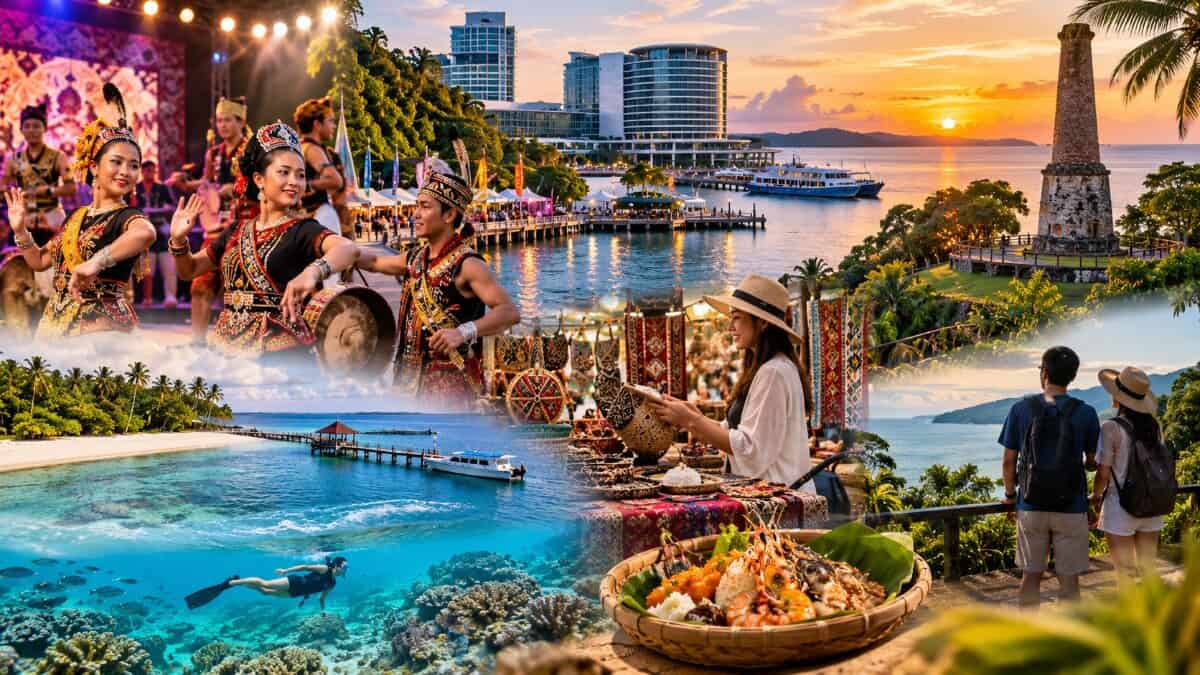
Image generated with Ai
Malaysia’s Borneo Arts Festival will return to Labuan from 25 to 27 September 2026, but the bigger tourism story is not simply festival attendance. Official statistics show Labuan’s excursionists grew 52.8 per cent in 2024, almost three times faster than overnight tourists, while average stay slipped to 2.84 nights. With Sabah and Sarawak supplying almost half of Labuan’s domestic overnight tourists and official air links connecting Kota Kinabalu and Miri with the island, the festival offers a timely test of whether cultural programming can convert short visits into higher-value stays.
Labuan’s Borneo Arts Festival Is Becoming a Test of Tourism Conversion
According to Tourism Malaysia, Borneo Arts Festival 2026 will take place at Financial Park in the Federal Territory of Labuan from 25 to 27 September. It is listed as the festival’s 13th edition, with Labuan Corporation as organiser, and is positioned around Borneo’s arts, culture, creativity and heritage.
That makes the event significant for cultural tourism. Yet the deeper issue for Malaysia’s visitor economy is whether a three-day cultural programme can influence how people use Labuan once they arrive.
Labuan already has visitor growth. What it needs to demonstrate is stronger conversion from brief visits into accommodation nights, meals, tours, attractions and other overnight tourism expenditure.
Advertisement
Advertisement
That distinction emerges clearly from Department of Statistics Malaysia data.
According to DOSM, Labuan received about 450,000 domestic visitors in 2024, up from approximately 330,000 in 2023. However, the strongest growth came from excursionists rather than overnight tourists.
Advertisement
Advertisement
Official Data Reveals the Real Labuan Tourism Challenge
| Labuan tourism indicator | 2023 | 2024 | Annual movement | Why it matters |
|---|---|---|---|---|
| Domestic visitors | 0.33 million | 0.45 million | +35.7% | Overall demand expanded strongly. |
| Excursionists | 0.17 million | 0.26 million | +52.8% | Same-day traffic is expanding considerably faster than overnight tourism. |
| Overnight tourists | 0.16 million | 0.19 million | +18.3% | Stay-generating demand grew, but much more slowly. |
| Domestic tourism receipts | About RM0.20 billion | About RM0.26 billion | +36.3% | Visitor growth is producing substantial economic value. |
| Average receipts per trip | RM521 | RM549 | Increase | Value per trip improved despite the length-of-stay weakness. |
| Average length of stay | 2.89 nights | 2.84 nights | Down 0.05 night | More traffic did not translate into a longer average visit. |
| Same-day trip receipts | — | — | +103.1% | Spending associated with short visits accelerated sharply. |
| Overnight trip receipts | — | — | +17.8% | Overnight economic growth lagged far behind same-day growth. |
The gap is striking. Using DOSM’s official growth rates, excursionist arrivals expanded about 2.9 times faster than overnight tourist arrivals, while growth in same-day receipts was about 5.8 times the rate recorded for overnight-trip receipts.
That is the information-gain opportunity surrounding Borneo Arts Festival 2026.
Advertisement
Advertisement
The question is no longer whether Labuan can attract people. The harder tourism-development question is whether it can persuade a greater share of them to sleep on the island and spend across multiple days.
Kota Kinabalu and Miri Matter Because Sabah and Sarawak Already Feed Labuan
The inclusion of Kota Kinabalu and Miri is not geographical decoration.
DOSM’s detailed Labuan statistics show that Sabah was the largest state of origin for domestic tourists visiting Labuan in 2024, accounting for 64,200 tourists. Sarawak ranked second with 27,300.
Together, the two states supplied approximately 91,500 of Labuan’s 194,100 domestic tourists, or roughly 47 per cent when calculated from the official figures.
Advertisement
Advertisement
The transport pattern reinforces that relationship.
Air transport accounted for 53.5 per cent of tourist trips to Labuan in 2024, ahead of water transport at 34.5 per cent and land transport at 12 per cent. This means aviation is not a peripheral element in Labuan tourism development. It is the island’s single largest recorded travel mode for domestic tourists.
According to Malaysia’s Ministry of Transport, the federal Rural Air Services route table identifies Kota Kinabalu–Labuan at 28 weekly frequencies and Miri–Labuan at 35 weekly frequencies in its network reference schedule.
Those figures require an important 2026 caveat. The federal page retains MASwings-era terminology and references the previous Public Service Obligation framework, so the published frequencies should not be treated as a guaranteed live September 2026 timetable.
AirBorneo took over the operation in 2026, and Sarawak’s Ministry of Transport records the transition to the airline’s MY flight codes from 14 January 2026 across 21 airports served in Sabah, Sarawak and Labuan. Travellers and sellers should therefore verify actual festival-period operating times directly before ticketing.
Why These Two Cities Fit the Exclusive Tourism Thesis
| Tourism node | Official connectivity evidence | Wider strategic relevance | Implication for Labuan |
|---|---|---|---|
| Kota Kinabalu, Sabah | Federal RAS reference lists 28 weekly Kota Kinabalu–Labuan frequencies. | BIMP-EAGA identifies Kota Kinabalu as both a tourism node and gateway node. | Potential Sabah gateway for festival extensions into Labuan. |
| Miri, Sarawak | Federal RAS reference lists 35 weekly Miri–Labuan frequencies. | BIMP-EAGA identifies Miri as a tourism node within the West Borneo Economic Corridor. | Gives Sarawak itineraries a logical Labuan extension point. |
| Labuan | More than half of domestic tourist trips used air transport in 2024. | BIMP-EAGA classifies Labuan itself as an important West Borneo tourism node. | Cultural events can be used as a reason to convert through-traffic into stays. |
This regional architecture matters because BIMP-EAGA’s official tourism strategy continues to identify stronger air, sea and land connectivity, tourism access infrastructure and multi-destination development as priorities. It also explicitly recognises the need to manage and develop cultural and heritage assets alongside connectivity.
Advertisement
Advertisement
Labuan, Kota Kinabalu and Miri therefore sit within an existing institutional tourism geography. Borneo Arts Festival creates a possible demand trigger within that geography.
The 2025 Festival Proved Footfall but Did Not Prove Overnight Conversion
Labuan Corporation’s official record for Borneo Arts Festival 2025 provides a useful benchmark.
The previous festival ran for five days from 13 November 2025 and recorded 40,000 visitors from within and outside Labuan. It included Borneo cultural programming and participation extending beyond the territory.
That 40,000 figure must be handled carefully.
It is an event attendance figure, not evidence of 40,000 unique tourists, 40,000 hotel guests or 40,000 incremental arrivals. The official record does not disaggregate local residents, repeat attendance, day visitors and overnight tourists.
That distinction is particularly important for B2B travel analysis.
Advertisement
Advertisement
A destination can generate a busy festival without necessarily maximising hotel nights. For 2026, the festival has moved into a three-day window, compared with the five-day 2025 programme. That shorter window could concentrate demand, but no official forecast currently establishes how many visitors will attend or how many will stay overnight.
Therefore, the most meaningful post-event metrics will be accommodation nights, average stay, transport flows and visitor expenditure rather than headline footfall alone.
Labuan Already Has Products That Can Turn Festival Attendance Into Extra Nights
The travel trade does not have to create every extension product from zero.
Tourism Malaysia’s current 2026 marketplace contains multiple Labuan experiences that could logically sit before or after Borneo Arts Festival.
| Officially listed Labuan product | Published duration | Current listed starting price | Longer-stay role |
|---|---|---|---|
| Big 4 Wreck Dive | 3 days, 2 nights | RM2,110 per person | Creates a substantial marine-tourism extension around the cultural event. |
| Patau-Patau 2 Water Village Homestay | 2 days, 1 night | RM90 per person | Adds community culture, local food and an overnight component. |
| Labuan Marine Park Island Hopping | 1 day | RM290 per person | Can add an additional activity day before departure. |
| Labuan Golf Package | 2D1N or 3D2N | From RM899 per person | Offers another multi-night niche product beyond arts and marine tourism. |
The packages are listed as valid through 31 December 2026, although prices and availability should be reconfirmed before sale.
This is where the September festival acquires commercial significance. Instead of selling a simple Friday-to-Sunday event visit, an operator could create an itinerary in which the festival becomes the anchor, with marine, community, heritage or leisure products extending the trip on either side.
Advertisement
Advertisement
That is precisely the conversion Labuan’s tourism statistics suggest is needed.
Exclusive Analysis Shows Labuan Should Measure Nights Rather Than Crowds
The most valuable new interpretation of the official data is that Labuan’s tourism constraint appears increasingly to be conversion rather than raw visitor generation.
The island added visitors rapidly in 2024. Excursionists increased 52.8 per cent. Same-day receipts more than doubled. Yet overnight tourists grew only 18.3 per cent and average stay slipped from 2.89 to 2.84 nights. At the same time, Sabah and Sarawak accounted for about 47 per cent of domestic overnight tourists, while aviation represented 53.5 per cent of tourist trips.
Put together, those separate official datasets suggest a very specific commercial opportunity.
Borneo Arts Festival should not be assessed solely by whether Financial Park looks busy. Its more strategic value would be demonstrated if travellers arriving through the wider Borneo network attach an extra night, marine excursion, homestay, dining experience or other bookable product to their visit.
The strongest industry benchmark after the festival would therefore be a conversion dashboard covering overnight share, hotel nights, length of stay, per-trip expenditure, route origin and pre/post-event package take-up.
Advertisement
Advertisement
No official source has yet published such a festival-specific measurement framework. That is precisely why the 2026 event provides a meaningful test case for Malaysia’s destination-dispersal strategy.
Visit Malaysia 2026 Raises the Stakes for Labuan
The festival also arrives during a strong national tourism cycle.
Malaysia recorded 290.1 million domestic visitors in 2025, up 11.5 per cent, while domestic tourism expenditure increased 13.6 per cent to RM121.3 billion. National average length of stay rose from 2.49 nights in 2024 to 2.56 nights in 2025.
The momentum continued into 2026.
According to DOSM’s latest quarterly domestic-tourism release available on 10 September, Malaysia registered 74.7 million domestic visitors during the first quarter of 2026, an increase of 7.2 per cent year on year. Spending reached RM34 billion, up 15.8 per cent. Domestic air passenger arrivals increased 9.6 per cent, while accommodation-sector revenue rose 15.4 per cent.
Internationally, Tourism Malaysia reported 21.2 million visitor arrivals during the first half of 2026, 2.5 per cent above the corresponding 2025 period. That is a national figure and does not establish Labuan’s share, but it shows the festival is taking place against a wider period of expanding Malaysian visitor demand.
Advertisement
Advertisement
Labuan has also been included directly in Visit Malaysia 2026 industry mobilisation. In February, Tourism Malaysia held a briefing in the territory for 120 tourism stakeholders, covering national tourism support mechanisms including tourism-promotion grants and an aviation and charter-sector grant. There is no official evidence that Borneo Arts Festival itself receives those grants, so the two should not be conflated.
What Travel Agents and Tour Operators Should Watch
- Sell nights, not simply festival entry: build arrivals before 25 September or departures after 27 September so culture becomes the anchor for a wider Labuan stay.
- Use Kota Kinabalu and Miri intelligently: both have direct institutional links with Labuan, while Sabah and Sarawak are already its two largest domestic overnight source states.
- Recheck live flights before ticketing: federal RAS frequencies are useful network-reference data but should not substitute for AirBorneo’s live September timetable.
- Pair culture with existing tourism inventory: marine-park excursions, wreck diving, community homestays and golf provide practical pre- and post-event extensions.
- Do not equate festival footfall with tourists: the 40,000 attendance figure from 2025 included visitors from within and outside Labuan and does not represent verified hotel guests.
- Watch the next DOSM release: the department currently schedules its next domestic-tourism update for 15 September 2026, only ten days before Borneo Arts Festival begins.
- Protect packages against operational changes: use flexible transport, accommodation and activity conditions because island itineraries depend heavily on air and sea connectivity.
- Track post-event conversion: hotel nights, average stay, tourist-versus-excursionist ratios and spend should matter more commercially than crowd size alone.
Labuan’s Bigger Opportunity Is to Become a Stay on the Borneo Journey
Borneo Arts Festival 2026 gives Malaysia more than another entry on its cultural calendar. It gives Labuan a measurable opportunity to test whether culture can change travel behaviour.
The island already receives growing visitor numbers. It already has strong source-market relationships with Sabah and Sarawak. It has air links with Kota Kinabalu and Miri, substantial reliance on aviation among tourists, established marine and cultural tourism inventory, and recognition within the wider BIMP-EAGA tourism corridor. What remains less developed is the bridge between arrival and overnight conversion.
If the festival in September can help travel sellers add accommodation nights and extra activities to regional trips Labuan could start taking on a new role in Borneo tourism. It could become more, than a place people pass through or visit for a short time. Instead it could be a stop that people plan on purpose adding culture and experiences to their -destination plans. That is the metric travel businesses should watch after 27 September.
Advertisement
