
Iran’s Ancient Jiroft: How a 5,000-Year-Old Civilization Is Pioneering Family Heritage Tourism

Updated
Published
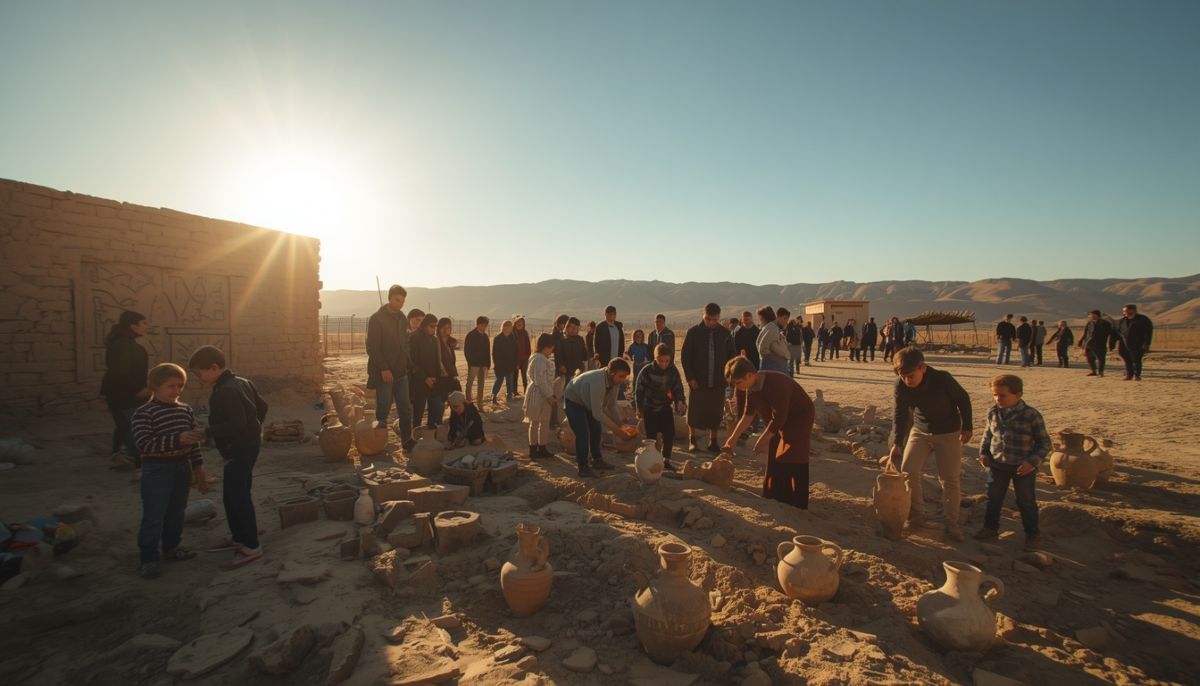
Image generated with Ai
New guardians are emerging for archaeological landscapes on the dry plains of Iran’s southeastern Kerman Province—not in university lecture halls but among young families. The event “Ancient Jiroft: Child and Family Tourism” was held at the Payandan tourism farm in Jiroft during the country’s Tourism Week, organized in cooperation with the Kerman General Directorate of Cultural Heritage, Tourism and Handicrafts (MCTH) alongside accredited regional child-development specialists. The event marked a pedagogical turn in heritage management; it changed ancient history from a passive museum object to an experiential and family-orientated conservation practice.
The Archaeological Weight of the Halil Rud Valley
The Jiroft civilization, flourishing along the Halil Rud river basin during the third millennium BCE (roughly 5,000 years ago), represents one of the ancient Near East’s most consequential discoveries. Excavations led by archaeologist Dr Yousef Majidzadeh under the auspices of the Iranian Center for Archaeological Research (ICAR)—documented extensively in his benchmark monograph Jiroft: The Earliest Oriental Civilization (2003)—revealed that Jiroft was not merely a peripheral settlement but an advanced urban society that rivalled early Mesopotamia and the Indus Valley.
The archaeological signature of the Halil Rud includes:
- Architectural Monumentality: The twin mounds of Konar Sandal (North and South) hold the remains of extensive mud-brick citadel platforms and ziggurat-like structures.
- Chlorite Artistry: Highly sophisticated stone carvings made from locally quarried chlorite depict complex iconography—master-of-animals motifs, intertwining serpents, and mythological architecture—traded as far as Sumer and Central Asia.
- Inscriptional Evidence: Distinctive geometric script inscribed on clay tablets suggests an early localized writing system running parallel to Proto-Elamite scripts.
| Cultural Sphere | Key Centres / Geography | Core Role in Network (~2500 BCE) | Primary Trade Goods Exchanged |
| Mesopotamia | Tigris–Euphrates Basin (Ur, Uruk) | Western demand hub and urban consumer | Imported carved chlorite, lapis lazuli, and exotic stones; exported textiles and grain |
| Jiroft / Halil Rud | Konar Sandal, Iranian Plateau | Central production, carving, and transshipment hub | Crafted intricate chlorite vessels; channelled lapis lazuli and raw minerals |
| Indus Valley | Harappa, Mohenjo-daro | Eastern maritime and overland trade partner | Carnelian beads, shell, copper, and tin; linked eastward to the Arabian Sea |
From Illicit Digs to Community Stewardship
The modern legacy of Jiroft is inextricably linked to the issue of site vulnerability. In the early 2000s, before systematic governmental excavations began, the cemetery sites around Konar Sandal experienced catastrophic looting, with thousands of unique chlorite vessels removed to private international collections.
Advertisement
Advertisement
While legal protections, site policing by the Cultural Heritage Protection Unit (Yegan-e Hefazat), and official excavations successfully stabilized the sites, long-term conservation requires local complicity and civic pride. The programme at Payandan tourism farm illustrates how MCTH authorities are turning to community-based educational initiatives as an active deterrent against future vandalism and looting.
When regional residents, particularly children, understand that these antiquities constitute shared human history rather than buried commodities, community preservation replaces indifference.
Advertisement
Advertisement
Key Inquiries in Archaeological Family Tourism
What makes the Jiroft civilization distinct from surrounding Bronze Age cultures?
Jiroft challenges the traditional mono-centric view that urban civilization began solely in the Fertile Crescent. Its combination of monumental civic architecture, advanced bronze metallurgy, distinct glyptic art, and early writing establishes south-central Iran as an independent cradle of urbanization with its own symbolic visual language.
How does experiential tourism differ from conventional museum curation?
Traditional heritage curation relies on visual observation through glass cases, which often disconnects non-academic visitors from the physical reality of history. The Jiroft programme paired site context with tactile workshops, basic pottery reproduction, and guided narrative sessions designed by early-education specialists, translating complex stratigraphy and material culture into tangible concepts.
Why target family units for archaeological preservation?
Early-childhood exposure to tangible cultural assets fosters long-term preservation ethics. Parents and children participating in joint heritage travel reinforce positive behaviours collectively, building intergenerational stewardship that institutional enforcement alone cannot achieve.
Pedagogical Impact and the Future of Heritage Travel
Contemporary developmental psychology has shown again and again that touch during critical developmental stages greatly enhances contextual memory and cultural empathy. Young participants become active custodians of history through clay work, exploration of the geological context of stone artefacts and the architectural rationale of mud-brick conservation.
Jiroft’s blending of agro-tourism venues and archaeological education provides a flexible model for vulnerable heritage areas globally in an era of sustainable travel that increasingly prioritises community preservation. The protection of the past is not about fences and scholarly papers; it is about rooting historical value in the living awareness of the generations to come.
Advertisement
