
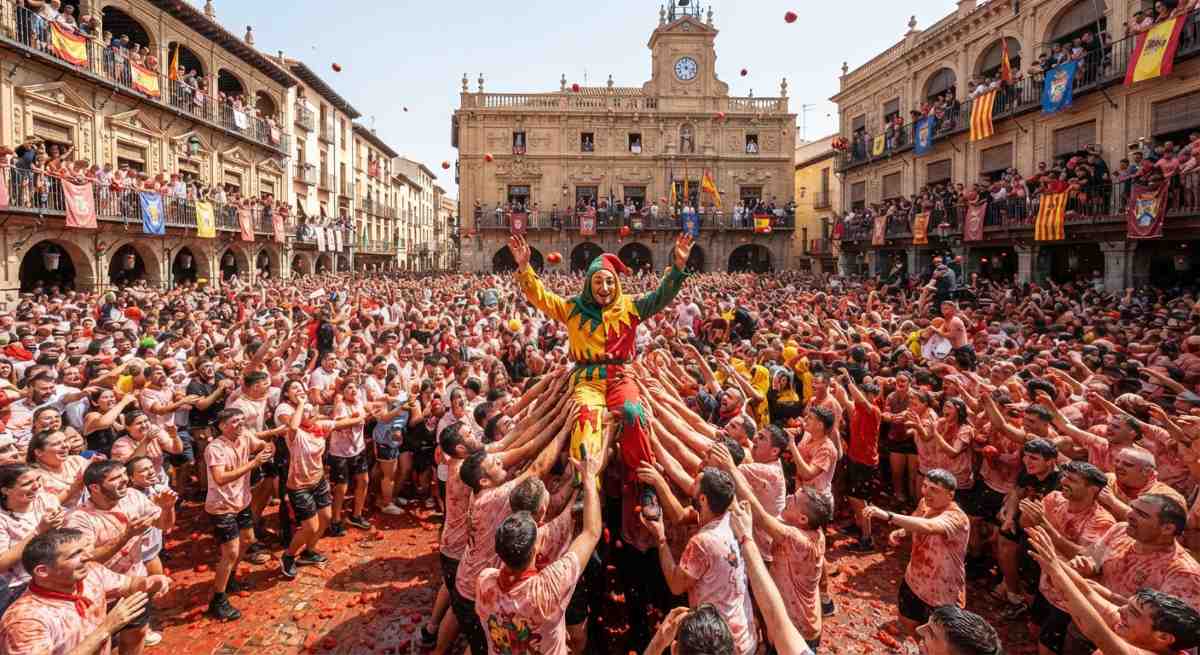
Image generated with Ai
The cultural heritage of Tarazona is deeply intertwined with the historic festival of the Cipotegato, an annual celebration held every twenty-seventh of August in the Spanish region of Aragon. Historical accounts suggest that the roots of this tradition stretch back several centuries, evolving from ancient local customs and medieval prisoner pardons into a renowned spectacle honoring the patron saint, Saint Atilano.
Central to the event is a figure dressed in a vibrant multi-colored harlequin suit of yellow, red, and green, wearing a traditional hooded mask. At precisely twelve o’clock noon, this central character emerges from the town hall to dash through the crowded streets while being relentlessly pelted with tomatoes by spectators. Over decades of administrative changes, the celebration has transitioned from an informal village gathering into an event officially recognized for its high tourist and cultural significance, drawing participants from across the globe.
The primary venue for the commencement of the festivities is Plaza de España, situated directly in front of the historic municipal building in Tarazona. Spectators and participants wishing to engage safely in the proceedings are advised to follow strict municipal guidelines. Protective eyewear, old clothing, and durable footwear are strongly recommended because thousands of kilograms of ripe tomatoes are hurled during the course of the run.
Access to the central square is heavily monitored by local security and event coordinators to prevent overcrowding in narrow corridors. Participants are instructed not to throw hard objects or unapproved items, and glass containers are strictly prohibited within the venue bounds. Adherence to crowd control barriers ensures that the central runner can complete the designated one-kilometer route safely before being elevated to the monument erected in honor of the character.
Advertisement
Advertisement
Reaching the destination during the peak festival window requires advance planning due to high volumes of regional traffic. Travelers commuting from major hubs like Zaragoza or Pamplona can utilize regional bus services, which typically increase frequency to accommodate festival-goers.
For those arriving via private automobile, designated parking zones are established on the outskirts of the historic center, as vehicular traffic is strictly barred from the inner lanes during active celebrations. Pedestrian pathways are clearly marked from peripheral parking areas into the main civic spaces. Rail connections to nearby towns require secondary bus transfers to complete the final leg of the journey into the municipality, prompting transport authorities to advise early departures on the morning of the event.
The staging of this traditional event generates significant economic momentum for the local hospitality, gastronomy, and retail sectors within the province of Zaragoza. Tourism boards note a sharp surge in hotel occupancy rates, vacation rentals, and restaurant bookings days prior to the August event.
Local businesses benefit from a concentrated influx of regional and international visitors, fostering sustainable cultural tourism. Furthermore, media coverage elevates the profile of regional heritage crafts, local culinary specialties, and artisanal products, creating long-term economic advantages that extend well beyond the single week of celebratory events.
Significant modern reforms distinguish contemporary celebrations from historical iterations. In past decades, crowd participation lacked formalized safety perimeters, and municipal oversight was minimal. Contemporary policies now enforce strict regulations regarding projectile safety, environmental clean-up protocols, and participant registration for the main role.
Notably, the selection process for the central runner transformed from an exclusionary practice into an egalitarian public lottery system open to all local citizens. Moreover, historical gender barriers were officially lifted, allowing female participants to assume the iconic role, reflecting a broader evolution toward inclusivity while preserving the foundational elements of the historic civic tradition.
Advertisement
Tags: Aragon, Cipotegato, cultural heritage, Festivals, spain
Advertisement
Advertisement













Saturday, September 5, 2026

Saturday, September 5, 2026

Saturday, September 5, 2026

Saturday, September 5, 2026

Saturday, September 5, 2026

Saturday, September 5, 2026