
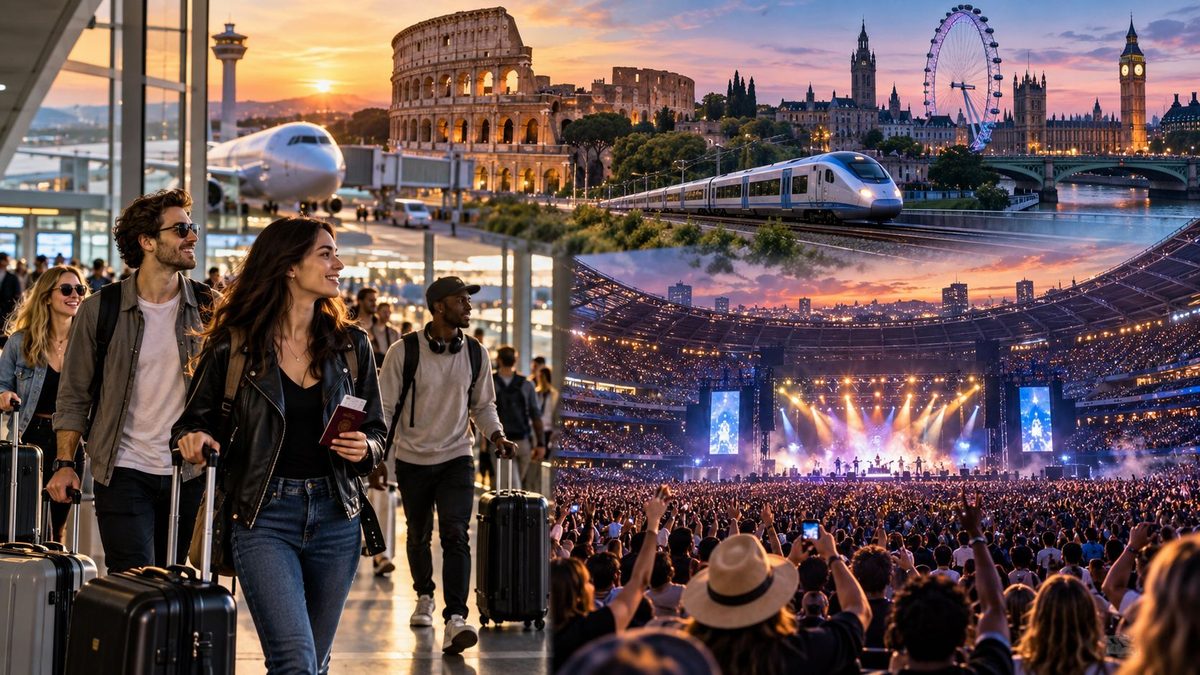
Image generated with Ai
For some travelers, live music has so much more value than entertainment for a single night. Concerts have the ability to drive cross border travel, even if domestic concert tickets get inflated. The recent journeys out of the country to attend concerts by Beyoncé, Kendrick Lamar, Bruno Mars, and Drake really show how travellers can arrange their vacations to include concerts. Live Nation reported that in 2025, they had 159 million concert-goers across the globe. This indicates how much broader the desire for live events has become.
For some fans, the relationship between music and travel has changed dramatically. The question is no longer simply where an artist performs, but which city offers the strongest combination of ticket value, destination appeal and live-event atmosphere. That shift sits behind the journeys of American concertgoers who have followed major artists across Europe and beyond.
Jason Galloway, an Atlanta-based operations manager, compared Kendrick Lamar ticket prices in the United States with the cost of travelling to Rome. The calculation surprised him because the concert ticket and airfare together appeared comparable with what he might have paid for tickets alone at home. He ultimately travelled to Rome and watched Lamar perform at Stadio Olimpico.
The decision illustrates a broader travel principle. A high-priced concert can become more attractive when travellers attach several experiences to the same expenditure. Instead of spending heavily on one evening, visitors can build a multi-day trip around the event while adding restaurants, museums, hotels, rail journeys and sightseeing.
Advertisement
Advertisement
Galloway extended that approach across several European cities. He paired Usher with Berlin, Kendrick Lamar with Rome and Beyoncé with London, effectively transforming a concert calendar into a personal international travel itinerary.
The numbers suggest that this behaviour is not confined to a small group of dedicated travellers. Live Nation reported 159 million fans attending its concerts worldwide during 2025, representing a 5% increase from the previous year. The company staged roughly 55,000 concerts during the year, demonstrating the enormous scale of the international live-event economy.
Live Nation also reported that its concerts generated $20.9 billion in revenue during 2025. Its global fan research found that nearly six in 10 respondents travel for live music annually, while the company estimated that fans travelled 40 billion miles for concerts during 2024.Indicator Latest reported figure Travel significance Live Nation concert attendance, 2025 159 million Demonstrates global live-event demand Annual attendance growth 5% Indicates continued expansion Live Nation concerts, 2025 About 55,000 Creates thousands of potential travel triggers Concert revenue, 2025 $20.9 billion Shows the commercial scale of touring Fans travelling for live music annually Nearly 6 in 10 Highlights tourism potential Global survey sample 40,000 people in 15 countries Provides international demand evidence Fan concert travel, 2024 40 billion miles Illustrates the geographical reach of live music
The momentum has continued into 2026. Live Nation reported 49 million concert fans globally during the second quarter, a 10% year-on-year increase. International attendance at stadiums, arenas and festivals rose by more than 20% during the quarter, reinforcing the importance of overseas markets.
For destinations, the implications extend beyond the venue itself. Concertgoers require flights, accommodation, local transport, food and attractions, meaning a major performance can generate spending across several tourism categories.
Europe has particularly strong conditions for music-led travel. Major cities sit within relatively short rail or air distances, while many destinations already possess extensive tourism infrastructure and internationally recognised attractions.
The wider tourism market provides useful context. EU accommodation establishments recorded almost 3.1 billion nights in 2025, according to Eurostat, with international visitor nights also increasing during the year. That creates a substantial tourism ecosystem capable of absorbing additional event-driven demand.
Italy recorded 476.9 million tourism nights in 2025, placing it among Europe’s largest tourism markets. Cities such as Rome and Milan therefore offer concert travellers a strong combination of international accessibility, accommodation capacity and cultural attractions.Destination Concert-trip advantage Wider travel proposition Rome Large stadium events and international artists Ancient heritage, museums and food Milan Major arena and stadium calendar Fashion, design and regional rail access London Extensive global touring calendar Museums, theatre, shopping and heritage Amsterdam Strong international concert market Museums, canals and rail connections Barcelona Major stadium and arena experiences Architecture, beaches and gastronomy Berlin Diverse international music scene Nightlife, history and cultural attractions
For travellers, the attraction is cumulative. A concert may justify the airfare, but the destination determines whether the overall journey feels worthwhile. Consequently, music can function as the initial purchase trigger while tourism becomes the larger experience.
Ticket price is only one part of the equation. Travellers interviewed about overseas shows repeatedly described differences in crowd behaviour, venue layouts and the atmosphere surrounding international performances.
Joseph Dexter, a Houston hospitality professional, recalled seeing Kendrick Lamar in Amsterdam. The atmosphere felt markedly more physical than many US concert experiences, with fans jumping, dancing and moshing around him.
That distinction can become part of the appeal. International touring exposes artists to audiences with different cultural habits and expectations, allowing familiar songs to feel surprisingly fresh when thousands of people sing them together on another continent.
Andrea Long, a Houston-based real estate broker, noticed another difference while attending Drake concerts in the United States and overseas. She described international audiences as more geographically diverse, with different accents and nationalities becoming part of the performance itself.
That creates an important travel insight. The audience becomes part of the destination experience, because travellers are participating in a temporary international community assembled around an artist.
The strongest examples often involve experiences outside the concert venue. Long travelled through Switzerland with her son before reaching Milan for a Bruno Mars performance, despite initially failing to secure a ticket through conventional online sales.
The journey itself had already included an outdoor lunch and her first high-speed train experience. Eventually, she found a ticket near the venue and watched Mars from roughly 10 rows away, turning an uncertain concert plan into an unexpected highlight.
The concert consequently became one component of a much larger memory. That pattern matters for destination marketers because event-led visitors can consume several tourism products during one trip.
A rail journey, restaurant visit or museum stop may become almost as memorable as the headline performance. The fixed concert date simply gives travellers a reason to make the journey.
The commercial implications extend across multiple tourism sectors. Hotels benefit when visitors stay overnight rather than return home after an event, while airlines can capture additional international demand around major tour dates. Rail operators can also benefit when travellers combine several European concert destinations.
Restaurants and attractions gain from visitors who have discretionary time before and after performances. Retailers, local transport operators and tour providers can likewise benefit from the additional visitor flow.Tourism sector Potential concert-related demand Key opportunity Airlines International and domestic event travel Additional multi-day bookings Hotels Overnight stays around concert dates Premium rooms and extended stays Rail City-to-city event travel Connections between tour destinations Restaurants Pre-show and post-show dining Event-focused demand Attractions Daytime activity before concerts Bundled destination experiences Retail Merchandise and leisure shopping Increased visitor spending Local transport Venue transfers and airport journeys Higher demand around events
Live Nation’s 2025 figures reinforce the wider commercial picture. Its venues hosted 65 million fans, while onsite spending at its amphitheatres increased by 6%, showing that visitor expenditure continues beyond admission fees.
Therefore, the economic opportunity does not stop when the opening act begins. The concert can act as a catalyst for an entire local visitor economy.
The financial argument requires caution because a cheaper overseas ticket does not automatically create a cheaper trip. Travellers must calculate airfare, accommodation, local transport, meals, insurance, exchange rates and entry requirements before deciding.
The most useful comparison is therefore the total trip cost against the total domestic concert cost. Travellers should compare equivalent ticket categories and include booking fees, resale premiums and currency-conversion costs.Cost category Domestic concert Overseas concert Concert ticket Primary expense Primary expense Airfare Usually minimal Potentially substantial Accommodation Optional Usually required Local transport Lower Higher Food and attractions Variable Additional destination spending Currency exposure Limited Exchange-rate risk Visa or entry authorisation Usually none May apply Trip duration Often one day Commonly several days Tourism value Primarily local Multiple destination experiences Planning complexity Lower Higher
Travellers should also examine the timing of flights and hotel rates. A seemingly inexpensive ticket can become costly if the traveller needs an extra night because of flight schedules or airport transfers.
The passport element introduces another layer of planning. Travellers must verify entry requirements according to nationality, destination and length of stay before purchasing non-refundable concert tickets.
For example, British travellers entering Italy must meet Schengen passport requirements and may generally visit visa-free for up to 90 days within a 180-day period for tourism and certain cultural activities. Requirements can change, so travellers should consult current government guidance before departure.
The UK also operates its own entry requirements for international visitors. Eligible visa-free visitors require an Electronic Travel Authorisation, with the government currently listing a £20 fee.
Official government guidance should always take precedence over social-media posts, ticketing forums and informal travel advice. Travellers should also check airline requirements because carriers can impose documentation checks before boarding.
Successful event travel begins before the ticket purchase. Travellers should first calculate the complete itinerary and compare several tour cities rather than choosing solely on ticket price.
Hotel availability deserves particular attention because major concerts can create sudden spikes in demand. Travellers should also examine flight schedules, airport transfers and local transport before committing to a venue.
For European itineraries, rail connections can offer another advantage. Travellers attending shows in multiple cities may combine flights with intercity trains instead of repeatedly flying.
Travel insurance can also provide useful protection for expensive international event trips. Policy wording should be checked carefully for cancellation, interruption and other relevant circumstances.
Most importantly, travellers should use official ticketing channels whenever possible. Secondary-market purchases can carry additional risks involving authenticity, inflated pricing and local consumer-protection rules.
The rise of event-led travel presents an opportunity for destinations seeking visitors beyond traditional peak periods. A major concert creates a fixed demand date, allowing hotels, restaurants and attractions to develop complementary experiences around it.
The model can also support destination diversification. Travellers who might never have considered a particular city can suddenly receive a compelling reason to visit.
Dexter’s Egypt journey demonstrates this principle particularly well. In 2024, he travelled to see electronic collective Keinemusik perform near the Great Pyramids of Giza, transforming an established landmark into an extraordinary concert setting.
He also used the trip to ride an ATV through the desert around sunset. The concert therefore did not merely occupy an evening during the holiday; it shaped how he experienced the destination.
The strongest international concert journeys share one feature. They do not treat the performance as the entire holiday, but instead use the artist as the reason to travel and the destination as the deeper experience.
That model reflects a wider shift towards experience-led travel. Consumers increasingly value moments that feel personal, scarce and difficult to reproduce, particularly when a major artist provides a fixed date around which an itinerary can be built.
A birthday Beyoncé performance in London, Jay-Z in Barcelona or Kendrick Lamar in Rome can become a permanent reference point. Years later, travellers may remember not only the performance, but the city, people and journey surrounding it.
For travellers, that creates a new calculation. The best concert ticket may not always be the one closest to home. Sometimes, the smarter purchase is the one that opens a passport, adds several days to the itinerary and turns one night of music into a much larger travel experience.
Concert tourism now sits at the intersection of live entertainment, aviation, accommodation and destination marketing. Industry data shows that international live-event demand remains significant, while European tourism infrastructure gives travellers considerable scope to combine concerts with longer holidays.
For travellers, however, the lesson remains practical. Compare the complete itinerary rather than focusing only on admission prices, and build sufficient time around the event to absorb unexpected disruption.
A destination concert works best when the journey offers genuine value beyond the stage. That might mean discovering Rome between show nights, travelling through Switzerland by rail, exploring London’s cultural districts or seeing the Pyramids beneath the desert sky.
The music starts the journey. The destination makes it unforgettable.
| Factor | Domestic concert trip | International concert trip |
|---|---|---|
| Primary motivation | Artist performance | Artist plus destination |
| Typical duration | One to two days | Three or more days |
| Passport requirement | Usually unnecessary | Generally required |
| Tourism spending | Concentrated locally | Spread across multiple sectors |
| Cultural exposure | Familiar environment | International setting |
| Transport options | Local or regional | Air, rail and local networks |
| Planning complexity | Relatively low | Higher |
| Memory potential | Concert-focused | Concert plus destination |
| Main financial risk | Ticket pricing | Total trip cost and currency movement |
| Best planning approach | Ticket-first | Destination-and-ticket comparison |
For the airline, hotel, and tour provider industries, creating tours that span numerous regions provide controlled peaks of high demand and business opportunities. Tour dates offer opportunities for packages, extended stays, and cross-city itineraries when businesses work together.
The opportunity is especially strong with cities that have existing infrastructure and assets. For example, a visitor comes for a single concert, and might stay several nights, visit other places, duck into local restaurants, and take off to the next destination.
Music unprecedentedly creates a travel opportunity for the visitor with the concert, but also keeps the visitor at the tour location with the offerings of the area.
Advertisement
Advertisement
Advertisement












Saturday, September 5, 2026

Saturday, September 5, 2026

Saturday, September 5, 2026
Saturday, September 5, 2026
Saturday, September 5, 2026

Saturday, September 5, 2026
Saturday, September 5, 2026
Saturday, September 5, 2026



