
Iceland Proposes New Golden Circle Tourist Fee From 2027 as Geysir, Gullfoss and Þingvellir Face Change

Published
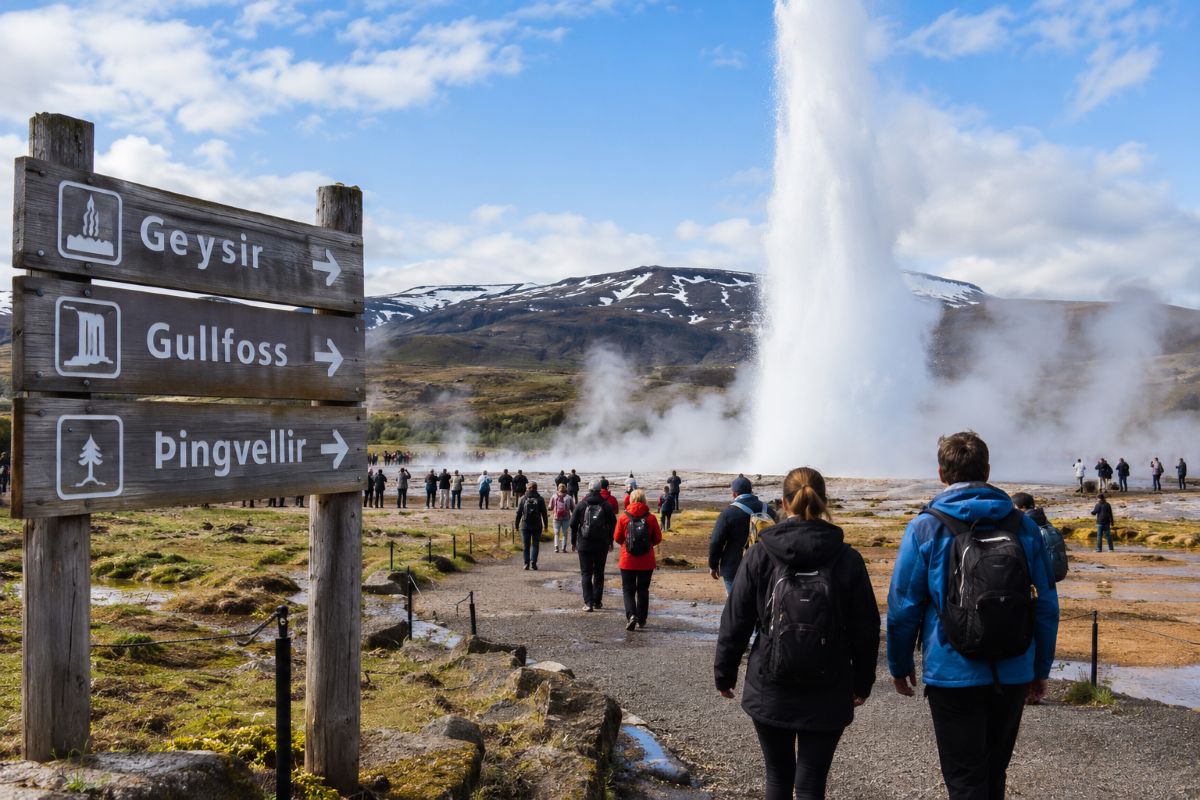
Image generated with Ai
Iceland Proposes New Golden Circle Tourist Fee From 2027 as Geysir, Gullfoss and Þingvellir Face Change because Iceland has proposed a new nature and infrastructure fee for visitors to its three busiest state-owned tourist attractions. If approved, eligible adults without Icelandic tax residence would pay ISK 4,500 from June to October or ISK 3,000 during the rest of the year. One electronic certificate would cover Geysir, Gullfoss and Þingvellir for one year. The proposed system aims to fund infrastructure, safety, visitor management and nature protection. However, the fee remains draft legislation and is not yet confirmed. Pasted markdown
Why is Iceland proposing a new Golden Circle tourist fee from 2027?
Iceland proposes a new Golden Circle tourist fee from 2027 as visitor pressure increases at three of the country’s busiest state-owned attractions: Geysir, Gullfoss and Þingvellir National Park. The proposal was submitted to Iceland’s public consultation system on 22 September 2026. It remains draft legislation and is therefore not yet a confirmed charge.
Advertisement
Advertisement
The proposed system would create a nature and infrastructure fee linked to access to the three attractions. The government says the objective is broader than collecting visitor revenue. It wants to improve safety, manage visitor flows, maintain infrastructure and support nature protection.
The proposal comes as Iceland continues to manage the impact of growing tourism on heavily visited natural sites. Geysir, Gullfoss and Þingvellir are particularly important because they form the core of the popular Golden Circle sightseeing route.
Advertisement
Advertisement
For travellers, the proposal could introduce a new cost. However, the government is also proposing one annual certificate covering all three sites rather than three separate entrance payments.
How much could eligible travellers pay under the proposed system?
Under the draft, visitors aged 18 or over without tax residence in Iceland would pay ISK 4,500 between 1 June and 30 October. The proposed charge would fall to ISK 3,000 from 1 November to 31 May.
Advertisement
Advertisement
| Proposed rule | Details |
|---|---|
| Proposed start | 1 May 2027 |
| Peak-season fee | ISK 4,500 |
| Lower-season fee | ISK 3,000 |
| Peak period | 1 June–30 October |
| Lower period | 1 November–31 May |
| Age threshold | 18 and over |
| Main exemption | People with Icelandic tax residence |
| Validity | One year |
| Sites covered | Geysir, Gullfoss and Þingvellir |
| Certificate | Electronic QR code |
The fee would not be based on nationality. The key distinction would be whether the person has tax residence in Iceland. Icelandic tax residents would not pay the proposed visitor charge.
The government also proposes an electronic certificate containing a QR code. Travel agencies and tour operators would be able to purchase certificates in advance for their customers.
Advertisement
Advertisement
Is the Golden Circle fee already confirmed for 2027?
No. This is one of the most important points for travellers and travel publishers.
Iceland has proposed the measure, but the legislation remains at the draft stage. The government has placed the proposal into consultation, and it must still proceed through Iceland’s legislative process.
Therefore, travellers should not yet treat ISK 4,500 as a confirmed mandatory payment.
The proposed implementation date is 1 May 2027. If the legislation passes in its current form, the new system would begin from that date.
Advertisement
Advertisement
This distinction also matters for headlines. It is more accurate to say Iceland “proposes”, “plans” or “could introduce” the fee than to state that the country has already imposed it.
The government is also working towards a wider legal framework for visitor charges at state-owned or state-managed tourist sites.
Why are Geysir, Gullfoss and Þingvellir at the centre of the proposal?
The three sites are described by the Icelandic government as the three most visited state-owned tourist attractions in the country.
Their popularity creates a direct management challenge.
Large numbers of visitors require roads, parking, walking paths, safety measures, visitor facilities and environmental management. Natural sites can also be vulnerable when visitor numbers increase faster than infrastructure capacity.
The proposed fee is therefore intended to connect visitor activity with the costs created by that activity.
Advertisement
Advertisement
The government lists infrastructure development, maintenance, safety, nature protection, visitor-pressure management and tourism-related government costs among the objectives.
This makes the proposal part of a broader tourism-management policy rather than simply a new entrance ticket.
For visitors, that could mean the additional payment contributes towards the quality and protection of the places they have come to see.
How much revenue could Iceland collect from the proposed charge?
The proposed fee could become a significant source of tourism-related funding.
The Icelandic government estimates that the system could generate approximately ISK 6–7 billion annually. For 2027, the expected amount is around ISK 5 billion, because the proposed system would begin on 1 May rather than at the start of the year.
The policy framework connects the revenue with:
Advertisement
Advertisement
- infrastructure development;
- infrastructure maintenance;
- visitor safety;
- conservation;
- tourism-related government costs;
- marketing;
- research.
This means the proposed charge is designed to create a dedicated funding mechanism for tourism management.
The financial scale is significant. If the annual estimate of ISK 6–7 billion is achieved, the fee could provide a substantial pool for maintaining and improving heavily visited natural attractions.
However, these are government estimates attached to the proposal. They should not be presented as confirmed revenue.
Will travellers still have to pay parking charges at Þingvellir?
The proposed legislation could change the way parking charges operate at some state-owned attractions.
Under the draft, parking charges would no longer be permitted at state-owned or state-managed sites where the new nature and infrastructure fee is collected. That means Þingvellir’s existing parking charges would no longer be collected under the proposal.
This could make the new system more understandable for visitors because the fee would effectively replace certain site-level charges.
Advertisement
Advertisement
However, travellers should not assume that every parking charge across the Golden Circle would disappear.
The proposal specifically relates to state-owned or state-managed areas. Privately operated facilities can have separate arrangements.
This distinction will remain important for visitors driving through the region, particularly those combining several attractions in one day.
Will one payment cover all three Golden Circle attractions?
Yes, under the proposal.
Rather than requiring separate payments at Geysir, Gullfoss and Þingvellir, the government proposes a single electronic certificate valid for one year.
That certificate would cover all three locations.
Advertisement
Advertisement
For a traveller visiting the entire Golden Circle, this could be more straightforward than paying individually at each attraction.
The system could also benefit repeat visitors. Someone returning to the three locations during the certificate’s validity period could use the same access certificate again.
Tour operators could also purchase certificates before their customers travel. This could simplify administration for organised excursions if the legislation is approved.
The annual structure therefore gives the proposal a different character from a conventional single-use attraction ticket.
Who would be exempt from the proposed fee?
The principal exemption would be based on Icelandic tax residence, rather than nationality.
People with tax residence in Iceland would not pay the proposed visitor fee because the government considers them already to contribute through taxation towards infrastructure and nature protection.
Advertisement
Advertisement
Visitors under 18 would also fall outside the proposed charge.
The system would therefore focus primarily on international adult visitors who do not have Icelandic tax residence.
However, eligible people would still need an electronic access certificate. An Icelandic resident would receive the certificate without paying the visitor charge.
For international families, the age exemption could reduce the total cost of a Golden Circle trip, although the final rules would depend on the legislation adopted.
How would Iceland enforce the proposed access system?
The government proposes giving the Icelandic Tourist Board responsibility for monitoring payments and access.
Officials would be able to request evidence of the electronic certificate, identification documents or other information needed to determine whether a person is liable for the charge.
Advertisement
Advertisement
The QR-code system is intended to make verification digital.
This could create a relatively straightforward process for visitors. Travellers would carry an electronic certificate rather than needing a paper ticket for each attraction.
Travel agencies and tour operators could also buy certificates ahead of time for customers.
The system is therefore designed to work with both independent travellers and organised tourism.
However, the precise operational arrangements will depend on the final legislation and implementation rules.
What could the proposed fee mean for Golden Circle travellers?
If approved in its current form, the proposed fee would become another cost that international visitors need to consider when planning an Iceland holiday from 1 May 2027.
Advertisement
Advertisement
For an eligible adult visiting during the peak period, the proposed charge would be ISK 4,500. During the lower season, it would be ISK 3,000.
The payment would cover three major attractions for one year.
That could be relatively straightforward for visitors already planning a Golden Circle tour. Instead of paying separate attraction charges, travellers would obtain one certificate.
The government argues that the revenue will help improve infrastructure, safety and nature protection.
For travellers, the proposal therefore combines an additional cost with a potential improvement in how popular natural sites are managed.
How could the proposal reshape Iceland’s wider tourism strategy?
The proposed Golden Circle fee represents a broader shift in how Iceland could finance tourism infrastructure.
Advertisement
Advertisement
The government wants a clear, sustainable, uniform and transparent system for charges at state-owned tourist attractions.
The approach links tourism revenue directly with the pressure created by visitors.
That is particularly relevant for Iceland because many of its most valuable tourism assets are natural landscapes rather than conventional ticketed attractions.
A sustainable funding model could help maintain paths, improve safety, manage visitor flows and protect sensitive environments.
The proposal also signals that Iceland is considering how visitors and the state can share the cost of managing tourism growth.
For the travel industry, the outcome could influence how Golden Circle tours are priced and packaged from 2027 onwards.
Advertisement
Advertisement
What should travellers know before planning an Iceland trip in 2027?
The most important message is simple: the fee is not yet final.
Travellers planning an Iceland trip for 2027 should monitor the government’s legislative process before calculating the final cost of a Golden Circle visit.
If approved as currently proposed, the key figures are:
| Traveller consideration | Proposed arrangement |
|---|---|
| Start date | 1 May 2027 |
| Summer fee | ISK 4,500 |
| Winter fee | ISK 3,000 |
| Covered sites | Geysir, Gullfoss, Þingvellir |
| Certificate validity | One year |
| Format | Electronic QR code |
| Eligible visitors | 18+ without Icelandic tax residence |
| Estimated annual revenue | ISK 6–7 billion |
| Estimated 2027 revenue | About ISK 5 billion |
Conclusion
Iceland Proposes New Golden Circle Tourist Fee From 2027 as Geysir, Gullfoss and Þingvellir Face Change because the government wants to create a sustainable funding system for infrastructure, safety, visitor management and nature protection at three of its busiest state-owned attractions. The proposed fee would cost eligible adults ISK 4,500 during June–October and ISK 3,000 during November–May, with one electronic certificate covering Geysir, Gullfoss and Þingvellir for a year. The proposal could generate ISK 6–7 billion annually, but it remains draft legislation and is not yet a confirmed tourist charge. If approved, the measure would mark a significant change in how Iceland manages tourism pressure at its most heavily visited natural attractions.
Comment from Anup Keshan, Founder and Editor-in-Chief of Travel And Tour World
“Iceland’s proposed nature and infrastructure fee reflects a growing challenge for destinations that depend heavily on natural attractions. Geysir, Gullfoss and Þingvellir are among the country’s most visited state-owned sites, so maintaining safety, infrastructure and environmental quality requires sustainable funding. The proposed one-year certificate is also more practical than three separate payments because it links the three attractions under one system. For travellers, the important point is that this remains a proposal, not a confirmed charge. If approved, the fee could give visitors a clearer contribution towards protecting the landscapes they come to experience, while helping Iceland manage tourism pressure in a more structured and sustainable way.”
Advertisement
