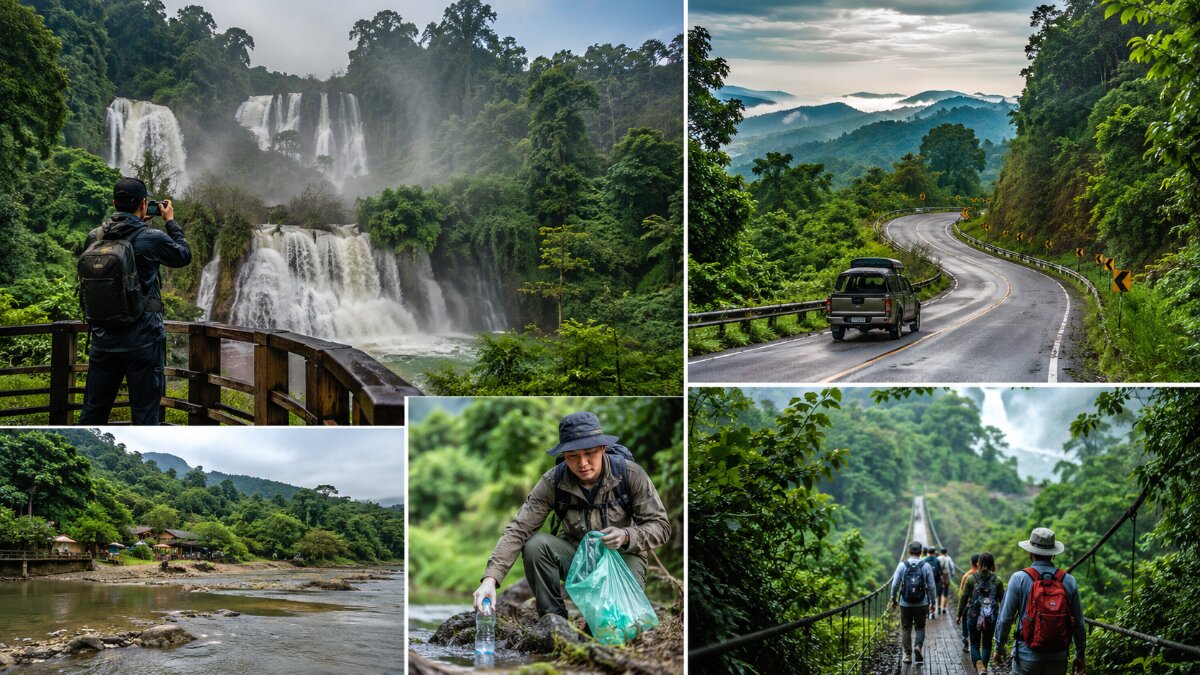
Image generated with Ai
Thailand’s Thi Lo Su Waterfall has entered its new visitor season after its scheduled 1 September reopening, but the more important travel story is the operating environment around it. Fresh heavy-rain forecasts for Tak, a mountainous 1,219-bend approach from Mae Sot, government road-maintenance planning and tighter conservation controls mean the reopening is best understood as a test of weather-responsive, safety-led tourism rather than a simple return of access. It also places one of Thailand’s promoted nature attractions directly inside the country’s wider Value over Volume tourism strategy.
Thailand’s Department of National Parks, Wildlife and Plant Conservation scheduled Thi Lo Su Waterfall in Umphang Wildlife Sanctuary to reopen to visitors on 1 September 2026 after its rainy-season recovery period. Before reopening, authorities prepared access routes, rehearsed safety procedures, positioned personnel at risk points and readied emergency rescue equipment. The department said the seasonal restriction allows forest and wildlife systems to recover while reducing exposure to hazards including flash floods and difficult transport conditions.
Advertisement
For travel businesses, however, 2 September changes the editorial focus. The Thai Meteorological Department is forecasting isolated heavy rain in Tak today. Its national forecast warns that accumulated rainfall can generate flash flooding, overflowing waterways and landslides around foothills and low-lying areas. A separate advisory issued on 2 September warns of heavy to very heavy rain across parts of northern Thailand during 4–7 September.
That makes Thi Lo Su a live example of a tourism product whose official reopening date does not automatically create a fixed operating environment. Access has to be treated dynamically. Tour operators need to combine sanctuary guidance, weather intelligence and road conditions immediately before departure.
Advertisement
Advertisement
| Operational factor | Verified position as of 2 September 2026 | Why it matters to travellers and the trade |
|---|---|---|
| Thi Lo Su access | Scheduled to resume from 1 September after seasonal recovery closure | The attraction has entered its new visitor season |
| Sanctuary preparation | Routes prepared, safety plans rehearsed, risk-point staffing arranged | Traveller confidence now depends on active operating controls |
| Emergency capability | Rescue equipment prepared for incidents | Important for a remote adventure product |
| Tak weather | Heavy rain possible on 2 September | Conditions may alter journey times and outdoor operations |
| 4–7 September outlook | Heavy to very heavy rain possible across parts of northern Thailand | Agents should avoid treating future departures as weather-independent |
| Environmental rules | Single-use plastic controls, wildlife protection and noise restrictions | Visitor behaviour is part of the operating model, not merely destination etiquette |
Official information from Umphang Municipality shows why transport deserves much greater attention in the reopening story. Travellers approaching Umphang from Tak city travel towards Mae Sot before joining Highway 1090. The municipality places the Tak-to-Mae Sot section at about 84 kilometres and the Mae Sot-to-Umphang section at around 164 kilometres.
The latter journey crosses mountains and valleys through 1,219 bends. Umphang Municipality estimates around two to three hours from Mae Sot by private vehicle and four to five hours by public transport. Highway 1090 is therefore not a minor final connection. It is a fundamental component of the Thi Lo Su tourism product.
Thailand’s Department of Highways separately identifies Highway 1090 as the Mae Sot–Umphang corridor and notes that it passes through Tak’s natural-tourism landscape. This direct institutional link establishes Mae Sot as a credible tourism gateway for the story rather than a loosely associated city.
The road also features in Thailand’s fiscal-year 2026 maintenance programme. Department of Highways records show a published 14.5 million baht asphalt repair and rehabilitation plan covering Highway 1090 between kilometre 101+680 and kilometre 105+305 on the Huai Nam Rin–Umphang section. Another official plan allocates 15 million baht for asphalt repairs across stretches between kilometre 78+860 and 85+590. These records establish government infrastructure investment along the approach corridor. They should not, however, be interpreted as evidence that those stretches are currently closed.
| Access element | Official detail | B2B tourism implication |
|---|---|---|
| Tak city to Mae Sot | About 84 km | Mae Sot functions as the transition point into the remote approach |
| Mae Sot to Umphang | About 164 km | Significant ground-transfer planning is required |
| Mountain bends | 1,219 | Journey comfort, vehicle choice and traveller suitability matter |
| Private vehicle estimate | Roughly 2–3 hours from Mae Sot | Weather can create schedule sensitivity |
| Public transport estimate | Roughly 4–5 hours | Tight same-day itineraries carry greater risk |
| Highway 1090 maintenance planning | Multiple FY2026 asphalt rehabilitation sections | Corridor resilience is a legitimate tourism-infrastructure consideration |
For wholesalers and destination management companies, this means Thi Lo Su should not be packaged like an attraction added casually to a northern Thailand itinerary. The journey itself requires operational space. Transfers need buffers. Outdoor activity timings need flexibility. Accommodation decisions in Umphang become more important because forcing the destination into an excessively compressed itinerary increases exposure to weather and road delays.
The most important strategic connection comes from the Tourism Authority of Thailand itself. Thi Lo Su was included among the destinations featured in TAT’s 2026 national tourism communications. The authority linked that campaign to moving travellers beyond heavily visited landmarks, increasing quality spending per trip and advancing its Value over Volume strategy.
That makes the waterfall more than an isolated protected-area attraction. Its reopening offers a practical case study of how Thailand’s national tourism policy works in a remote destination where unlimited visitor growth would be incompatible with conservation, transport realities and seasonal risk.
TAT’s broader 2026 strategy prioritises quality growth, meaningful travel, sustainability and wider economic benefits for communities. As of 2 June 2026, the authority reported more than 14 million international arrivals and around 679 billion baht in tourism revenue. Its updated outlook pointed to around 33 million international arrivals and approximately 2.65 trillion baht in combined tourism revenue during 2026.
The direction becomes even more relevant when looking ahead. TAT’s tourism framework announced on 24 August for 2027 targets at least 5 per cent revenue growth and a 60:40 visitor distribution between major and emerging destinations. The authority is seeking wider geographic distribution rather than concentrating tourism value only in established hubs.
Thi Lo Su is not identified in that announcement as one of the specific priority areas. However, its operating model clearly reflects the same policy logic: protect the experience, distribute spending, strengthen community benefits and make quality more important than sheer footfall.
This is where the reopening becomes particularly relevant to B2B travel professionals.
Traditional destination development often equates success with easier access and more visitors. Thi Lo Su presents the opposite commercial proposition. Its value partly comes from natural quality, remoteness and controlled access. The same characteristics that create operational friction also make the experience distinctive enough to command time, specialist planning and potentially greater local expenditure.
For Umphang, the opportunity is therefore not necessarily to remove every friction point. The more rational objective is to manage them safely. A traveller who needs an organised transfer, local accommodation, specialist nature activities and additional time in the district can distribute more economic value locally than a rapid sightseeing visitor. Yet that model succeeds only when transport reliability, safety communication and environmental management remain credible.
This distinction matters because Thailand is explicitly moving from pure volume metrics towards value, experience quality, sustainability and regional income distribution. Thi Lo Su provides a small but unusually clear test of whether those concepts can translate into commercially viable itineraries in remote nature destinations.
The reopening should consequently be viewed as a managed adventure-tourism restart, not simply the return of a photographic landmark.
According to the Department of National Parks, Wildlife and Plant Conservation, visitors must comply with sanctuary regulations covering single-use plastic waste, wildlife disturbance and excessive noise. The department expects the reopening to stimulate ecotourism in Umphang and Tak while supporting community income and conservation awareness.
Those rules fit another development occurring locally. Umphang Municipality reported in August that municipal personnel had been studying stronger waste-management and plastic-management approaches, including sorting, reuse and reducing accumulated waste. The initiative was intended to support improved local environmental management.
For tourism operators, sustainability therefore needs to be communicated before arrival. The relevant product information is no longer limited to what travellers can see at Thi Lo Su. It includes what they may bring, how they should behave and why conservation restrictions are integral to continued access.
The Thai Meteorological Department’s 2 September outlook deserves particular attention because Tak is specifically included among northern provinces facing isolated heavy rain today. During 4–7 September, the department expects conditions capable of producing flash flooding, overflows and landslides in vulnerable northern locations.
This does not mean Thi Lo Su is officially closed. No such conclusion should be drawn from the weather advisory alone. It does mean that a fixed reopening calendar must be supplemented by real-time operating checks.
The Department of National Parks advises prospective visitors to obtain current route and visitor-measure information directly from Umphang Wildlife Sanctuary. Its reopening notice provides the sanctuary contact number 088 427 5272.
For the trade, that creates a simple operational principle: reopening establishes eligibility to visit, while local conditions determine whether a specific departure should proceed as planned.
The long-term significance of the 2026 reopening is not about the waterfall but about everything, around it. Thailand is working to spread tourism value across the country while improving safety, sustainability and the quality of experience. Umphang offers a setting where all of these goals come together.
The route from Tak through Mae Sot into Umphang requires planning than mainstream Thai resort corridors. The wildlife sanctuary requires environmental discipline than an unrestricted attraction. The monsoon makes real-time risk assessment necessary. At the time precisely those limitations can support longer stays specialist operators, community expenditure and higher-value adventure itineraries.
If Thailand can preserve the quality of Thi Lo Su while making the journey reliable enough for responsible commercial distribution the destination could demonstrate how remote natural attractions contribute to tourism growth without being converted into high-volume visitor sites.
As of 2 September 2026 that is the important story behind the reopening. Thi Lo Su has returned,. Its real test is whether Thailand can turn controlled access, weather awareness, transport resilience and conservation into a stronger tourism product rather than treating those factors as obstacles, to growth.
Advertisement
Advertisement
Advertisement












Wednesday, September 2, 2026

Wednesday, September 2, 2026

Wednesday, September 2, 2026

Wednesday, September 2, 2026

Wednesday, September 2, 2026

Tuesday, September 1, 2026

Wednesday, September 2, 2026

Wednesday, September 2, 2026