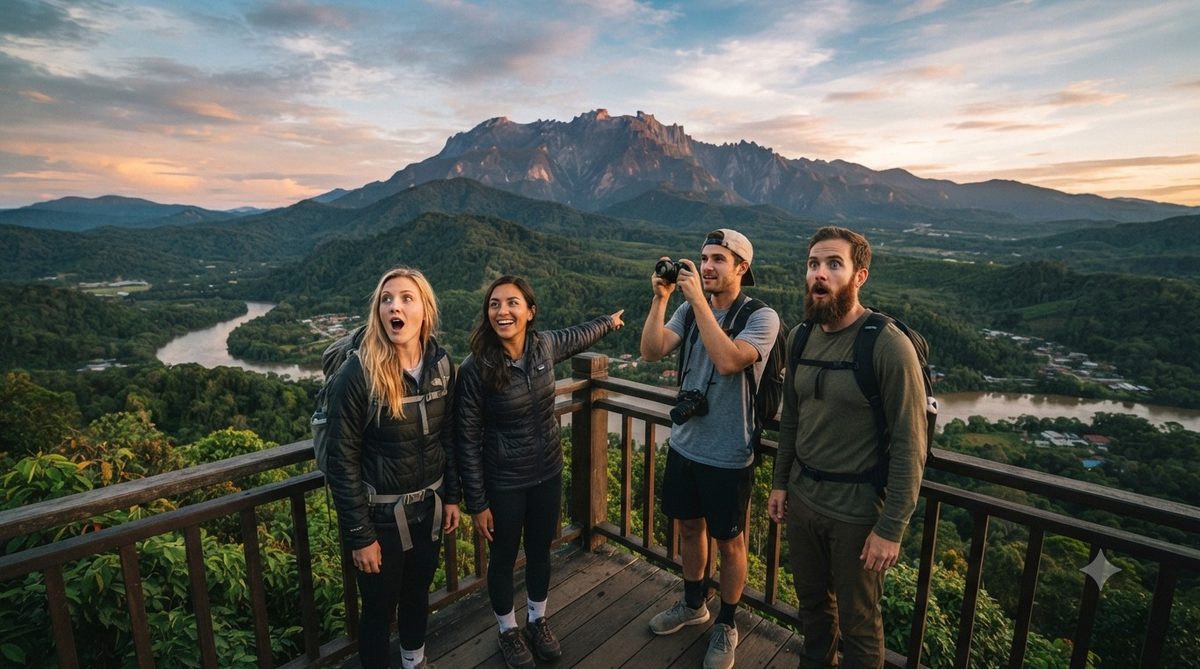
Image generated with Ai
The strategic initiative to boost US travel to Sabah marks a transformative era for the expanding tourism sector of Malaysia. Recently, the United States, alongside the Sabah Tourism Board, has actively encouraged citizens from major hubs like Los Angeles, Seattle, and New York to explore this pristine Bornean state. Historically, United States passport holders have accounted for an impressive seventy five to eighty percent of all North American arrivals in Malaysia. This robust demographic currently translates to an estimated fifteen thousand US visitor arrivals annually. Driven by highly ambitious government frameworks, regional authorities are targeting remarkable sixty percent growth today.
The relationship between North American tourists and the majestic landscapes of Malaysian Borneo has steadily evolved over the past several decades. Sabah, globally renowned for its unparalleled biodiversity, dense ancient rainforests, and world-class marine ecosystems, was once considered a highly niche destination strictly reserved for seasoned biological researchers, dedicated conservationists, and intrepid explorers. However, contemporary official statistics and shifting global travel paradigms reveal a highly dynamic transformation. The modern narrative surrounding US travel to Sabah highlights a transition from specialised eco-tourism to mainstream, high-value adventure travel [1].
For years, the Malaysian government has worked meticulously to position Sabah as the crown jewel of Southeast Asian eco-tourism. These long-term structural efforts have yielded impressive dividends across the trans-Pacific travel corridor. Visitors from the United States have historically demonstrated a profound appreciation for destinations that prioritise ecological conservation and authentic indigenous cultural heritage. Consequently, Sabah’s stringent environmental policies and well-preserved natural habitats align perfectly with the discerning preferences of the North American market. As global travel continues its robust post-pandemic recovery, the historical footprint of American travellers in Borneo provides a vital foundation for the ambitious growth targets set by official tourism ministries for the coming years.
When analysing official demographic data provided by the Department of Statistics Malaysia and regional tourism boards, a highly revealing pattern emerges regarding North American arrivals. Historically, United States passport holders have consistently accounted for an overwhelming 75 to 80 per cent of all North American arrivals in Malaysia. The remaining 20 to 25 per cent is predominantly composed of Canadian citizens [1]. This overwhelming demographic dominance fundamentally shapes the strategic marketing frameworks deployed by the Sabah Tourism Board and the Ministry of Tourism, Arts and Culture (MOTAC).
Advertisement
Advertisement
This 75 to 80 per cent market share translates to approximately 15,000 verified US visitor arrivals in recent annual cycles [1]. While 15,000 arrivals may initially appear modest when compared to mass-market tourism figures from neighbouring Southeast Asian nations, the true value of these arrivals lies in their exceptionally high economic yield. Data consistently indicates that travellers from the United States exhibit significantly longer average lengths of stay and possess considerably higher daily expenditure rates. These affluent tourists frequently engage in premium activities, such as extended wildlife safaris, luxury diving excursions, and private guided summits of Mount Kinabalu.
Maintaining and expanding this dominant US market share is an absolute economic priority for regional policymakers. The baseline of 15,000 annual visitors serves as the foundational metric against which all future growth is measured. As the state prepares for Visit Malaysia Year 2026, statistical forecasts models constructed by government economists suggest that the North American market possesses the highest elasticity for rapid, sustainable growth, provided that logistical and aviation barriers continue to be systematically dismantled.
The geographical dispersion of US tourists visiting Sabah reveals fascinating insights into the evolving preferences of the American outbound travel market. Official government reports and airline passenger data indicate that citizens originating from major metropolitan hubs—specifically Los Angeles, Seattle, and New York—constitute the vast majority of these high-yield visitors [1]. The prominence of these three specific cities is far from coincidental; it is the direct result of targeted airline connectivity, demographic predispositions, and intensive regional marketing campaigns.
Los Angeles and Seattle, situated strategically along the US West Coast, serve as the primary aviation gateways across the Pacific Ocean. The populations in these coastal hubs possess a strong cultural affinity for outdoor recreation, environmental sustainability, and oceanic exploration. Seattle’s robust community of tech-oriented eco-travellers and Los Angeles’s affluent adventure-seekers view Sabah as an ultimate bucket-list destination. The proximity to trans-Pacific flight routes makes Borneo a highly accessible exotic getaway for these demographics.
Conversely, the influx of tourists from New York highlights the growing demand among East Coast urbanites for profound escapism. New Yorkers, seeking refuge from the relentless pace of metropolitan life, are increasingly drawn to Sabah’s tranquil rainforest retreats and pristine marine parks. By strategically targeting these three distinct economic powerhouses, Malaysian tourism authorities are successfully tapping into some of the most lucrative outbound markets in the Western Hemisphere, ensuring a steady stream of high-value tourism capital into the state.
The strategic push to elevate US travel to Sabah has recently been characterised by a series of highly coordinated official developments. The Sabah Tourism Board, operating under the auspices of the state Ministry of Tourism, Culture and Environment, has aggressively intensified its international outreach programmes. Recognising the sheer economic potential of the American market, the board has implemented highly targeted digital marketing campaigns, established new partnerships with major US-based travel consortia, and participated extensively in premier North American travel trade exhibitions.
A critical component of these latest official developments is the deliberate shift towards high-value, low-impact tourism. The government has officially decreed that Sabah will not pursue unsustainable mass tourism, which could irreversibly damage its fragile ecosystems. Instead, the focus remains resolutely on attracting conscientious travellers who respect local environmental regulations. Official delegations from Sabah have actively engaged with travel agencies in Los Angeles, Seattle, and New York to educate trade professionals on the state’s unique selling propositions.
As of August 2026, the most significant government announcement regarding trans-Pacific tourism is the highly ambitious mandate to increase US visitor arrivals by a staggering 60 per cent [1]. Elevating the baseline of 15,000 annual US visitors to a projected target of 24,000 requires unprecedented levels of inter-governmental coordination, infrastructure development, and aviation expansion. This 60 per cent growth target is a meticulously calculated objective embedded within the broader framework of the Visit Malaysia Year 2026 campaign.
The Ministry of Tourism, Arts and Culture (MOTAC) has publicly endorsed this initiative, recognising that an influx of high-yielding US tourists is essential for accelerating Malaysia’s post-pandemic economic recovery. To achieve this monumental 60 per cent surge, government officials have announced a suite of supportive policies, including enhanced promotional funding for the North American market, the streamlining of digital entry protocols, and the active solicitation of new international flight routes. This target underscores a profound confidence in Sabah’s inherent global appeal.
The primary logistical hurdle traditionally impeding US travel to Sabah has been the geographical distance and the necessity for multiple aviation transfers. However, recent developments in trans-Pacific connectivity are rapidly dismantling these barriers. While direct non-stop flights between the US mainland and Kota Kinabalu International Airport (BKI) remain a future aspiration, the efficiency of connecting routes via major Asian aviation hubs has improved dramatically, facilitating smoother journeys for American citizens.
Travellers departing from Los Angeles and Seattle now benefit from highly synchronised transit options through gateway cities such as Taipei, Hong Kong, Tokyo, and Singapore. Leading international carriers, frequently operating under official bilateral aviation agreements, have strategically aligned their schedules to minimise layover durations for passengers bound for Sabah. The Malaysian government is actively engaging in high-level dialogues with international airlines to incentivise the establishment of more direct charter flights linking North American hubs directly to Borneo.
The facilitation of seamless cross-border mobility is a cornerstone of Malaysia’s official tourism strategy. The policy implications surrounding the influx of American tourists are overwhelmingly positive, driven by a mutual desire to foster stronger bilateral relations. Currently, United States passport holders enjoy visa-free entry into Malaysia for social and tourism purposes, typically granted for up to 90 days upon arrival. This highly accommodating visa policy significantly reduces bureaucratic friction.
Recent policy updates have further modernised the arrival experience. The implementation of the Malaysia Digital Arrival Card (MDAC), which US citizens are required to complete prior to their journey, has drastically streamlined immigration clearance at Kota Kinabalu International Airport. By embracing sophisticated biometric technology and digital pre-clearance systems, Malaysian border authorities ensure that the first impression of US tourists is one of efficiency and welcoming hospitality, reflecting a profound governmental commitment to the 60 per cent growth target.
The projected 60 per cent increase in US travel to Sabah is sending powerful ripples throughout the local hospitality and tourism industry. American tourists, particularly those originating from affluent centres like New York and Los Angeles, exhibit a pronounced preference for luxury eco-tourism. This demographic demands a highly specific product: world-class comfort seamlessly integrated with authentic, sustainable environmental immersion.
In direct response to this anticipated demand, the Sabah tourism industry is undergoing a significant qualitative upgrade. There has been a noticeable surge in the development and refurbishment of five-star eco-lodges, premium boutique resorts, and exclusive jungle retreats situated in ecologically sensitive zones. Local industry stakeholders are investing heavily in upgrading their service standards, ensuring that tour guides possess impeccable English proficiency and a deep, scientifically accurate knowledge of local biodiversity, thereby elevating Sabah into a globally competitive luxury eco-destination.
The economic implications of increasing US visitor arrivals by 60 per cent are profoundly significant for the state of Sabah and the broader Malaysian economy. Tourism is a critical pillar of Sabah’s GDP, and the deliberate targeting of the North American market is primarily an economic strategy designed to maximise foreign exchange earnings. The historical strength of the United States Dollar (USD) against the Malaysian Ringgit (MYR) provides a highly favourable exchange rate for American tourists.
Official government economic models indicate that the multiplier effect of the American tourist dollar is exceptionally high. Expenditure by US visitors permeates deeply into the local economy, benefiting a wide spectrum of stakeholders ranging from luxury hotel operators and private aviation charter companies to local artisans, independent transport providers, and rural agricultural suppliers. By achieving the target of an expanded US visitor base, the state anticipates a substantial injection of foreign direct revenue.
The impact of heightened US interest in Sabah extends far beyond traditional leisure tourism; it significantly influences the business and public sectors. The Meetings, Incentives, Conferences, and Exhibitions (MICE) sector is currently experiencing a notable renaissance, driven by American multinational corporations seeking unique, exotic locales for corporate retreats, team-building exercises, and international conferences. Sabah’s world-class convention facilities, combined with its unparalleled natural backdrop, make it an attractive alternative to traditional Asian MICE hubs.
From a public impact perspective, the increased presence of American tourists fosters invaluable cross-cultural exchanges. These interactions promote mutual understanding and dismantle geographical prejudices, strengthening the people-to-people ties between the United States and Malaysia. Furthermore, the heightened international scrutiny that accompanies an influx of American tourists serves as a powerful catalyst for local authorities to maintain impeccable public health standards, municipal cleanliness, and robust public safety infrastructure.
Beyond macroeconomic revenue figures, the strategic expansion of US travel to Sabah carries profound socio-economic implications for the indigenous communities that inhabit the region. The state government has officially championed Community-Based Tourism (CBT) as a primary mechanism for rural poverty alleviation. As discerning American tourists increasingly seek authentic cultural interactions, rural Sabahan villages are uniquely positioned to benefit from this demographic shift.
The influx of North American visitors directly stimulates job creation in remote areas, providing sustainable livelihoods that do not rely on environmentally extractive industries. Local residents are increasingly finding gainful employment as specialised wildlife spotters, cultural interpreters, and eco-lodge managers. The government’s official policy mandates that a significant portion of tourism revenue generated in rural areas must remain within those communities, translating directly into the empowerment and economic upliftment of Sabah’s diverse indigenous populations.
No comprehensive analysis of the surge in American tourism to Sabah is complete without examining the primary geographical assets driving this demand. Mount Kinabalu, a towering UNESCO Global Geopark standing at 4,095 metres, is a colossal magnet for American adventure tourists. The stringent government quotas regulating daily climbing permits ensure that the mountain retains its pristine ecology while creating an atmosphere of exclusivity that highly appeals to the North American market.
Similarly, Sipadan Island remains an undisputed global mecca for scuba divers. Renowned for its breathtaking pelagic marine life, Sipadan is consistently ranked among the top dive sites on the planet. The Malaysian government’s strict conservation policies, which completely prohibit overnight stays on the island and strictly limit daily diving permits, resonate deeply with environmentally conscious American tourists from cities like Seattle and Los Angeles. These iconic natural assets form the cornerstone of Sabah’s appeal to the US market.
While Mount Kinabalu and Sipadan command global headlines, the Kinabatangan River is rapidly emerging as a critical driver of US tourism to Sabah. As Malaysia’s second-longest river, it sustains one of the most concentrated and diverse wildlife ecosystems in Southeast Asia. For American tourists—particularly wildlife photographers, ornithologists, and nature enthusiasts—the Kinabatangan offers unparalleled opportunities to observe endemic species in their natural habitats.
Cruising the Kinabatangan provides visitors with the rare chance to spot the iconic Bornean orangutan, the highly endangered proboscis monkey, and the elusive Borneo pygmy elephant. The Sabah Wildlife Department closely monitors and regulates river tourism to ensure minimal disruption to animal behaviour. American tourists consistently demonstrate a willingness to pay premium rates for guided ecological tours that strictly adhere to these official conservation guidelines.
The ambitious target to increase US visitor arrivals by 60 per cent must be meticulously balanced against Sabah’s paramount commitment to environmental conservation. The state government, operating through the Sabah Parks authority and the Wildlife Department, has implemented some of the most rigorous environmental protection frameworks in Southeast Asia. These official policies are not viewed as impediments to tourism growth; rather, they are recognised as the very foundation of Sabah’s appeal to the American market.
US tourists, influenced by a strong domestic culture of environmental awareness, actively seek destinations that demonstrate a verifiable commitment to sustainability. They are highly supportive of official mechanisms such as national park entrance fees, marine conservation levies, and carbon offset programmes. The funds generated from these American tourists are directly channelled back into anti-poaching patrols, reef rehabilitation projects, and rainforest reforestation initiatives, creating a symbiotic relationship between tourism and ecology.
A critical factor influencing the flow of American tourists to any international destination is the official guidance provided by the United States Department of State. The Malaysian government works in close, continuous collaboration with the US Embassy in Kuala Lumpur to ensure the absolute safety and security of all visiting American citizens. The robust security apparatus deployed by state commands has been highly effective in maintaining peace and stability across the region.
Current official US travel advisories accurately reflect the comprehensive security measures implemented by Malaysian authorities. The overwhelming majority of Sabah, including the vital tourism hubs of Kota Kinabalu, Mount Kinabalu, and the interior rainforests, remains completely safe for international travel. The proactive communication of these official security facts is essential for maintaining consumer confidence in target cities like New York and Los Angeles, ensuring safety concerns do not impede the targeted 60 per cent growth.
The surge in US travel to Sabah is not occurring in a vacuum; it is actively supported by high-level diplomatic initiatives. The United States Embassy in Malaysia frequently engages in bilateral programmes designed to promote cultural exchange, environmental cooperation, and educational tourism. These official collaborations serve to raise Sabah’s profile among influential American policymakers, academic institutions, and non-governmental organisations.
Recent joint initiatives have focused heavily on marine conservation and sustainable forestry management. By aligning US federal conservation grants with Sabahan state environmental objectives, these diplomatic efforts create a highly visible narrative of shared values. This positive diplomatic framing translates directly into increased tourism demand, as American citizens feel a sense of national pride and ethical alignment when choosing Sabah as their holiday destination.
Accurate data collection and rigorous statistical analysis are fundamental to the success of Sabah’s tourism strategy. The Department of Statistics Malaysia, in conjunction with the research division of the Sabah Tourism Board, conducts comprehensive tracking of international arrival demographics, expenditure patterns, and spatial distribution. This official data is indispensable for verifying the current baseline of 15,000 US visitors and for accurately measuring progress toward the 60 per cent growth mandate.
These official statistics allow policymakers to deploy resources with maximum efficiency. By analysing the specific travel patterns of tourists originating from Los Angeles, Seattle, and New York, authorities can fine-tune their digital marketing campaigns, optimise airline route subsidies, and accurately forecast future infrastructure requirements. The commitment to data-driven governance ensures that the expansion of the US tourism market in Sabah is managed systematically, sustainably, and transparently.
To successfully orchestrate a 60 per cent increase in US travel to Sabah, state tourism authorities have revolutionised their promotional strategies. Traditional marketing paradigms have been entirely superseded by highly sophisticated, data-driven digital campaigns. The Sabah Tourism Board utilises advanced demographic targeting to deliver high-definition promotional content directly to the digital feeds of prospective travellers in key US metropolitan areas.
Furthermore, physical presence at premier North American travel trade exhibitions remains an official priority. Delegations from Sabah regularly feature prominently at major industry events across the United States, engaging directly with influential travel agents, luxury tour operators, and prominent travel media. These official engagements are crucial for educating the American travel trade on Sabah’s sophisticated eco-tourism products.
Looking beyond the immediate targets of Visit Malaysia Year 2026, official expert projections paint a highly optimistic picture for the future of US travel to Sabah. Leading tourism economists and state planners project that the North American market will become an increasingly vital pillar of Sabah’s long-term economic sustainability. As global awareness of climate change and biodiversity loss intensifies, destinations that can verifiably demonstrate successful environmental stewardship will command an ever-increasing premium.
Official long-term strategies, extending towards 2030, focus on further solidifying Sabah’s reputation as the global gold standard for sustainable eco-tourism. Plans are currently underway to expand protected marine areas, introduce electric vehicle infrastructure within national parks, and completely eliminate single-use plastics from the hospitality supply chain. These forward-thinking, officially mandated environmental policies will ensure that Sabah remains deeply aligned with the evolving ethical priorities of the American traveller.
Advertisement
Advertisement
Advertisement











Wednesday, September 2, 2026
Wednesday, September 2, 2026
Wednesday, September 2, 2026
Wednesday, September 2, 2026
Wednesday, September 2, 2026
Tuesday, September 1, 2026
Wednesday, September 2, 2026
Wednesday, September 2, 2026



