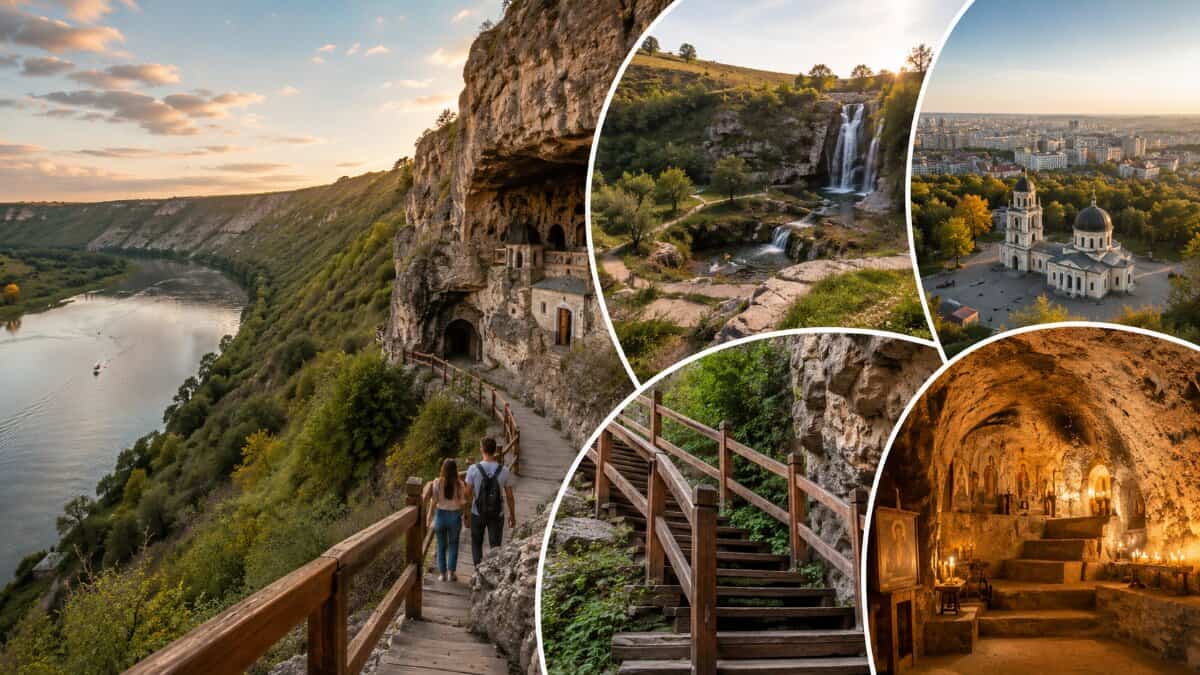
Image generated with Ai
Moldova is advancing a heritage-sensitive access project at the Țipova rock-hewn monastery in Rezina District, strengthening the tourism potential of one of the country’s most distinctive Dniester attractions. The staircase restoration entered implementation in August 2026 with European Union financing and UNDP support, while Moldova’s latest official statistics show foreign accommodation demand rising sharply but remaining heavily concentrated in Chișinău. The strategic opportunity is therefore larger than safer access: a better-prepared Țipova could help tour operators build longer regional itineraries, distribute visitor expenditure and support Moldova’s expanding rural and cultural tourism economy.
The latest development at Țipova concerns physical visitor access rather than a new cave opening.
Advertisement
According to the National Museum of Ethnography and Natural History, the project to improve the staircase leading towards the rock-hewn monastery entered its implementation stage on 2 August 2026. It forms part of the European Union-funded Confidence Building Measures Programme implemented by UNDP Moldova.
The museum states that the intervention is intended to make access to the area’s historical and natural monuments safer while protecting the authenticity of the heritage site.
Advertisement
The project addresses a particularly sensitive part of the visitor journey. The original stairs were constructed by monks at the beginning of the nineteenth century from broken stone and connected the church on the plateau with the rock-hewn churches below.
Because stone matching the characteristics of the historic material could not readily be obtained, the restoration programme adopted a temporary solution using solid oak sections. Existing authentic stone elements are being preserved and left visible rather than removed.
Earlier museum documentation from March 2026 identified 16 sections of the route requiring intervention. The stated purpose was to improve safe visitor movement towards the historic and natural monuments of the complex.
For travellers, this distinction is important. The work concerns the access route. It should not be described as evidence that every underground chamber, gallery or cave associated with the wider Țipova complex has newly opened to unrestricted tourism.
Advertisement
Advertisement
The strongest tourism angle is the way the intervention fits into a longer chain of infrastructure improvements around Țipova.
UNDP reported in September 2023 that six information boards and tourist signs had been installed across the Țipova, Saharna and Iagorlîc nature reserves. An ecotourism information centre was also established close to Țipova Monastery, while ten guides from both banks of the Dniester were certified through the wider tourism programme.
Road connectivity had already received substantial investment.
According to Moldova’s Regional Development Agency Centre, the L165 road project modernised 20 kilometres of public roads and rehabilitated 15 culverts, improving access for six settlements in Rezina District, including Țipova. Final reception of the works took place on 26 November 2024. The agency specifically identified Țipova Monastery among the tourism assets benefiting from the improved connection.
Taken together, these measures create a clearer visitor-access chain: improved regional roads, destination signage, local tourism information and now a heritage-sensitive pedestrian intervention towards the monastery.Tourism infrastructure Verified official development Visitor relevance L165 regional road 20 km modernised Improves regional road connectivity Road structures 15 culverts rehabilitated Supports more reliable access Tourism orientation Six information boards and signs installed across three reserves Improves navigation and trail awareness Visitor services Ecotourism information centre near Țipova Monastery Adds destination information Guiding capacity Ten guides certified across both Dniester banks Supports interpreted tourism Monastery approach Intervention planned across 16 route sections Targets safer pedestrian access August 2026 status Staircase project entered implementation Latest physical visitor-access milestone
Sources: National Museum of Ethnography and Natural History, UNDP Moldova and Regional Development Agency Centre
Țipova is a village in Rezina District, rather than a city itself.
Moldova’s National Tourism Office places Țipova Monastery 42 kilometres south of the city of Rezina on its official cultural tourism route connected with Stephen the Great. The same route also incorporates Chișinău, creating a wider cultural itinerary linking the capital with heritage sites elsewhere in Moldova.
The monastery sits on the right bank of the Dniester River and is carved into a high limestone cliff. Official tourism information describes a complex containing three rock-hewn churches dating across the eleventh to eighteenth centuries and more than 20 interconnected rooms, tunnels and galleries. The surrounding visitor landscape also includes the Răușorul Țipova waterfalls.
These characteristics allow Țipova to operate across several tourism segments simultaneously: cultural tourism, religious travel, hiking, nature tourism and rural experiences.
That mix becomes more commercially important as access improves.
The newest national statistics explain why developing destinations beyond the capital matters.
According to the National Bureau of Statistics, Moldova’s registered accommodation establishments received 257,300 tourists during January to June 2026, an increase of 15.8% compared with the same period in 2025.
Of those visitors, 159,600 were non-residents, representing 62% of accommodated tourists. Foreign accommodation numbers rose 24.7% year on year, significantly faster than the overall market.
Yet the distribution remains highly concentrated.
Chișinău municipality accounted for 75.2% of all accommodated tourists nationally during the six-month period. Moldova’s Central development region, which includes Rezina District, accounted for 14.7%.
This is the central commercial opportunity surrounding Țipova.
Moldova is attracting more international accommodation demand, but much of that demand remains centred on the capital. More visitor-ready regional attractions could help tour operators convert a capital-focused trip into a broader Moldova itinerary.
Another important indicator is the difference between growth in guests and growth in nights.
Moldova recorded 679,900 overnight stays in registered accommodation during the first half of 2026, up only 4.6% year on year. Non-resident travellers generated 279,600 of those nights.
Average stay across accommodation establishments declined from 3.9 days in the first half of 2025 to 3.6 days in 2026. For non-residents, average stay declined from 3.0 days to 2.8 days.Moldova accommodation indicator H1 2026 Year-on-year position Total accommodated tourists 257,300 +15.8% Resident tourists 97,700 +3.6% Non-resident tourists 159,600 +24.7% Overnight stays 679,900 +4.6% Non-resident overnight stays 279,600 +10.9% Average stay overall 3.6 days Down from 3.9 Average non-resident stay 2.8 days Down from 3.0 Chișinău share of accommodated tourists 75.2% Dominant national share Tourist and agritourism pension guests 31,000 +10.9%
Source: National Bureau of Statistics of Moldova
The figures suggest that Moldova’s next challenge is not simply attracting visitors. It is creating sufficient destination depth to retain them for additional nights.
Țipova can contribute to that objective if improved access is matched by accommodation, guiding, food, transport and complementary regional experiences.
There is also room for greater rural tourism conversion.
The National Bureau of Statistics recorded 31,000 guests in tourist and agritourism pensions during January–June 2026, 10.9% more than a year earlier.
Accommodation capacity in this category increased 12%, but the net occupancy index for tourist and agritourism pensions stood at just 16.6%.
Moldova’s official cross-border gastronomic route already lists tourism businesses in the Rezina area, including accommodation in Țipova and nearby Lalova. This demonstrates that the destination is not operating solely as an isolated monument; components of a regional visitor economy already exist around it.
For the trade, this opens the possibility of moving from a simple out-and-back excursion towards combinations involving heritage, countryside, local food and overnight accommodation.
Travel-agency data add another commercial signal.
Moldovan agencies and tour operators handled 38,600 inbound foreign visitors during January–June 2026, up 4.2% year on year. Inbound tourism receipts reached MDL 43.9 million, increasing 25.4%.
Leisure, recreation and holiday travel represented 97% of inbound visitors handled by agencies and tour operators.
Domestic tourism also expanded. Agencies served 49,800 domestic visitors, an increase of 11.1%.
The combination matters for destinations such as Țipova because it provides two potential demand streams: international visitors seeking distinctive heritage and Moldovan residents exploring their own country.
The access project also arrives shortly after Moldova adopted a new national tourism programme.
On 24 June 2026, the government approved Tourism 2029 for the period 2026–2029.
According to Moldova’s Ministry of Economic Development and Digitalisation, the programme has an implementation budget of MDL 618.2 million and is expected to support the creation of around 5,000 jobs. It prioritises tourism infrastructure, workforce development, digital promotion, rural tourism and better use of the country’s cultural, natural and wine heritage.
The government reported that Moldova recorded more than 600,000 visitors and tourism revenues exceeding MDL 5 billion in 2025.
The Țipova staircase itself should not be described as a Tourism 2029-funded project. Its official financing comes through the EU Confidence Building Measures Programme implemented by UNDP.
However, the development fits the broader national direction: turning cultural and natural heritage into better-prepared tourism products capable of producing economic value outside the capital.
The information gain for tour operators is not that Moldova has discovered a new cave attraction. Țipova has long been part of the country’s heritage landscape.
What has changed is the surrounding visitor-readiness story.
Road improvements, tourism signs, an information centre, guide development and the August 2026 staircase project collectively reduce several practical weaknesses associated with packaging a remote heritage attraction.
That does not eliminate operating risk. Țipova remains a cliff-side, pedestrian destination with natural terrain and historically sensitive infrastructure.
Travel sellers should therefore avoid presenting improved access as equivalent to universal accessibility.
Moldova enters the second half of 2026 with strong accommodation growth, rapidly expanding foreign demand and a new national tourism strategy.
Its challenge is increasingly one of conversion and distribution.
Non-resident accommodation grew 24.7% in the first half, yet average foreign stays slipped to 2.8 days and 75.2% of all accommodated tourists remained concentrated in Chișinău.
That makes Țipova strategically relevant.
The August access project alone will not transform Rezina into a major international tourism hub. But combined with completed road investment, established visitor signage, guiding infrastructure, rural hospitality and the extraordinary cultural landscape of the Dniester, it strengthens the foundations for more sophisticated regional products.
For Moldova’s tourism industry, the bigger opportunity is therefore not simply bringing more travellers down the staircase.
It is giving them a credible reason to travel beyond Chișinău, remain longer and spend more of their journey in Moldova’s regions.
Advertisement
Advertisement
Advertisement











Wednesday, September 2, 2026

Tuesday, September 1, 2026

Wednesday, September 2, 2026

Wednesday, September 2, 2026

Tuesday, September 1, 2026

Tuesday, September 1, 2026

Wednesday, September 2, 2026

Tuesday, September 1, 2026