
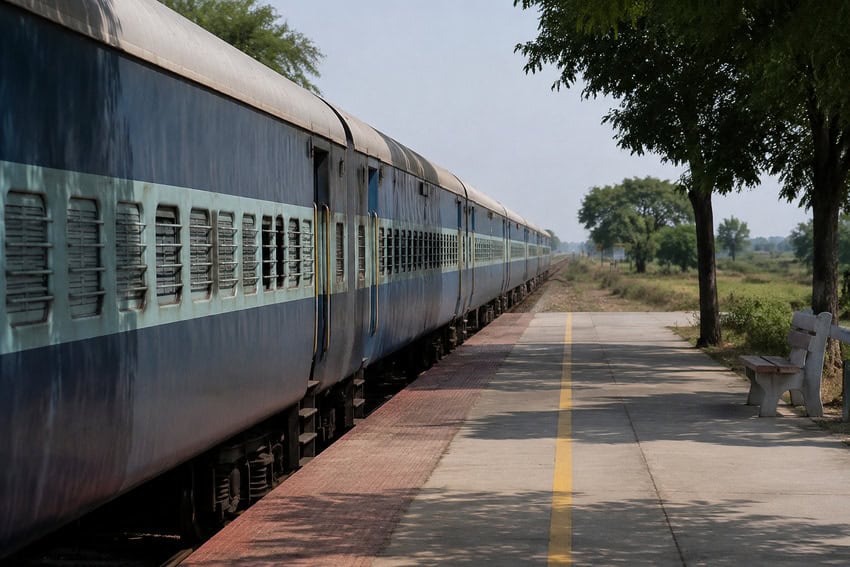
Image generated with Ai
Indian Railways has expanded its halt network across Haryana and Rajasthan by adding new stoppages for four trains at key intermediate stations, with the aim of providing direct train access to passengers in small towns and rural areas. The decision has been driven by rising local travel demand and the need to reduce dependency on distant major stations for boarding long-distance and passenger services. By introducing halts at stations such as Patuwas Meharana, Hansi, and Bijainagar, the railways are improving first-point access to the network and making inter-state and regional travel more convenient for communities located away from major railway hubs.
The move comes after a detailed assessment of passenger demand patterns and route feasibility. Railway planners have been focusing on identifying stations where additional halts can meaningfully reduce travel gaps without disturbing the overall punctuality or efficiency of train operations. The latest revision fits into that framework, particularly across corridors where passengers currently depend on distant major stations to board long-route services.
The changes involve services running through the Rewari–Bhiwani section in Haryana and the Ajmer–Chanderiya stretch in Rajasthan, both of which act as important connectors between regional population centres and larger national rail networks.
In Haryana, the 54085/54086 Delhi–Satrod Passenger train has been assigned a new halt at Patuwas Meharana railway station on the Rewari–Bhiwani route. This section carries a mix of passenger and express trains, but several smaller stations along the line have historically seen limited stoppage coverage.
Advertisement
Advertisement
For residents in and around Patuwas Meharana, this development is expected to reduce reliance on nearby boarding points such as Jharili and Charkhi Dadri. Until now, many passengers had to cover additional road distance before reaching a station where the train was available. The new stop is likely to simplify daily travel routines, particularly for commuters who depend on short-distance rail services for work, education, and local business travel.
The impact is expected to be most visible among regular travellers who rely on predictable, low-cost transport options. By reducing the need for feeder travel to larger stations, the halt improves overall accessibility for villages and semi-urban settlements in the surrounding belt.
Further north in Haryana, Hansi railway station has been included as a scheduled stop for two major long-distance trains—the Agartala–Ferozpur Express and the Bikaner–Haridwar Express. Both services connect regions spread across the country, linking eastern, northern, and western parts of India through long inter-state corridors.
Previously, passengers from Hansi often had to travel to larger nearby stations such as Hisar or Bhiwani City to board these trains. This additional travel step created inconvenience, particularly for long-distance passengers carrying luggage or travelling with families. The revised stoppage plan eliminates that dependency and brings direct access to national routes from Hansi itself.
Advertisement
Advertisement
The inclusion of these halts significantly broadens travel options from the region. The Agartala–Ferozpur Express connects the far eastern region with Punjab, while the Bikaner–Haridwar Express links western Rajasthan with Uttarakhand, serving both tourism and pilgrimage traffic along with routine inter-state movement. With direct stoppages, Hansi is now better integrated into these wider travel networks.
In Rajasthan, Bijainagar railway station has been approved as a new halt for the 12981/12982 Jaipur–Asarva Express, a train operating on a key route between Rajasthan and Gujarat. The Ajmer–Chanderiya section, where Bijainagar is located, is a strategically important line handling both passenger and express traffic.
Passengers from Bijainagar and surrounding areas have traditionally relied on larger stations such as Nasirabad or Bhilwara to access this service. These stations are located at a considerable distance for many travellers, often requiring additional road travel before beginning rail journeys. The new stoppage brings the service closer to local users and reduces dependence on distant hubs.
The change is expected to be particularly useful for passengers engaged in cross-border movement between Rajasthan and Gujarat. Traders, students, and professionals frequently travelling between the two states stand to benefit from improved convenience and reduced travel time. The Jaipur–Asarva Express already functions as an important inter-state link, and the additional halt strengthens its accessibility footprint in central Rajasthan.
Across all four trains, the underlying objective remains consistent: improving last-mile rail connectivity by integrating smaller stations into long-distance travel networks wherever operationally feasible. Indian Railways has increasingly adopted this approach in response to growing demand from semi-urban and rural regions that are situated away from major junctions.
Before approving new stoppages, railway authorities typically evaluate station capacity, passenger usage trends, scheduling impact, and corridor load. The selected stations in this case were identified as suitable points where additional halts could be introduced without affecting overall service reliability.
The wider pattern points to a slow but steady reconfiguration of rail access, where services are no longer centred only around major junctions. Instead, the network is being adjusted to better reflect dispersed settlement patterns, bringing smaller towns and peripheral stations into the reach of long-distance routes that were once largely inaccessible to them.
For travellers, the impact is direct and quickly noticeable, improving everyday access and reducing the effort required to reach boarding points. Reduced travel to access boarding stations lowers both time and cost burdens. It also simplifies journey planning, particularly in regions where alternative transport options may be limited or expensive. For long-distance travellers, the changes reduce dependency on multiple transfers or road links before reaching a train.
While the number of trains affected in this update is limited, the localized impact is expected to be substantial. In regions where rail remains the primary mode of affordable long-distance transport, even a small addition of stoppages can significantly reshape daily travel patterns.
Indian Railways has expanded its halt network across Haryana and Rajasthan by adding new stoppages for four trains, aiming to improve direct rail access for passengers in small towns and rural areas by reducing dependence on distant major stations.
The latest revision highlights the continuing effort to refine rail connectivity in line with on-ground demand. As passenger movement patterns evolve, similar adjustments are expected to remain a regular feature of operational planning, gradually expanding the accessibility of India’s rail network across smaller and emerging stations.
Advertisement
Tags: haryana, Indian Railways, Railway News, Travel News
Advertisement
Advertisement













Sunday, September 6, 2026

Sunday, September 6, 2026

Sunday, September 6, 2026

Sunday, September 6, 2026

Sunday, September 6, 2026

Saturday, September 5, 2026

Sunday, September 6, 2026

Sunday, September 6, 2026



