
Switzerland, Italy and More Countries Summer Road Trips Face Hours of Delays as Gotthard Tunnel Bottleneck Struggles with Peak Holiday Traffic, Alpine Congestion, Cross-Border Travel Rush and Overseas Holidaymakers

Published
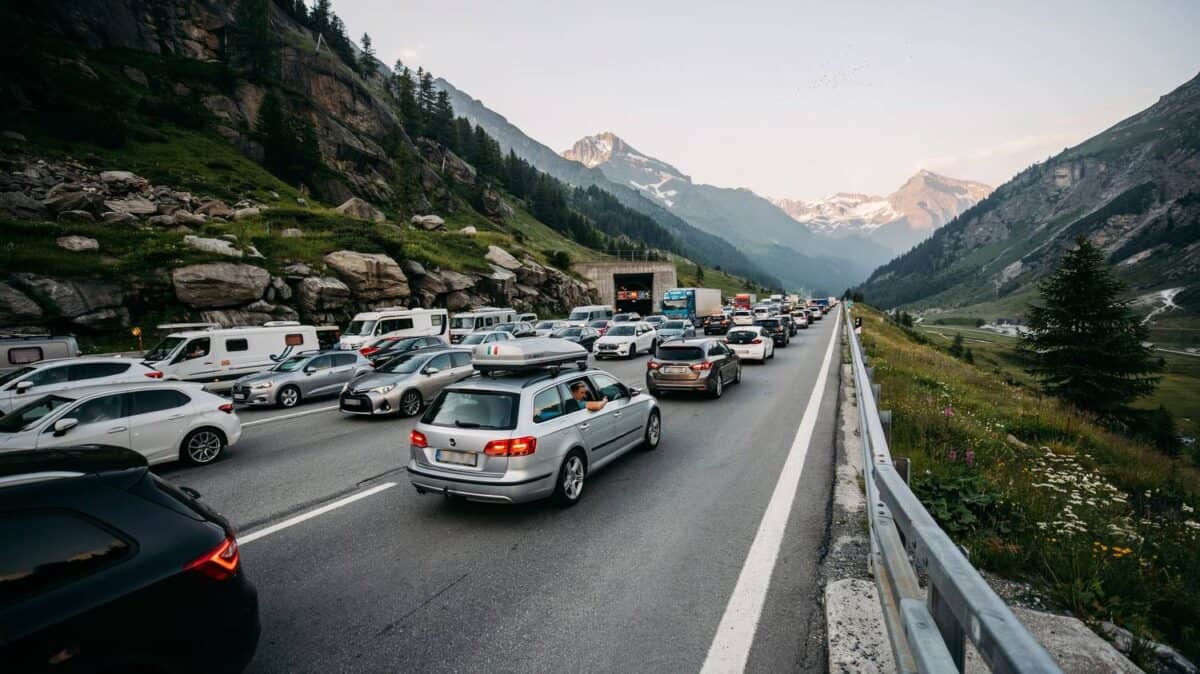
Image generated with Ai
Switzerland, Italy, and several other countries, are facing increased summer road trip disruptions as holiday traffic worsens with Gotthard Tunnel traffic delays. The Gotthard Tunnel bottleneck is causing major cross-border travel delays, hours of delays, and Alpine road congestion, in one of Europe’s most traveled North-South roadways. This traffic affects holiday travelers, families, and drivers who are considering changing their travel plans to Italy by delaying their trip, taking a different route, or getting ready for much longer delays.
Why Summer Travelers in Switzerland Are AffecteD By Gotthard Tunnel Delays
The Gotthard Road Tunnel is an important transport route through the Swiss Alps that links Northern and Southern Europe, connecting Göschenen in Uri and Airolo in Ticino.
Advertisement
Advertisement
The route is popular with travelers from Switzerland, Germany, France, Belgium, the Netherlands and various other European nations. It is used to reach Northern Italy and the Italian lakes, Tuscany, the Adriatic Coast and Mediterranean holiday destinations.
The tunnel is about 17 kilometers long and accommodates bi-directional traffic in a single tube. This means that there is only one lane in each direction.
Advertisement
Advertisement
Because of these design limitations, the tunnel is sensitive to fluctuations in traffic volume.
Advertisement
Advertisement
Peak Season Tunnel Traffic
It is important to understand that the tunnel’s traffic issues are not caused solely by the design of the tunnel. Long queues can occur without collisions, mechanical breakdowns or emergency procedures.
During busy holiday periods there is a greater volume of traffic, the tunnel can accommodate and traffic control systems are engaged to manage the volume of traffic to ensure the safety of the travelers in the tunnel.
This means that travelers can easily see jammed traffic either at the Northern Göschenen Portal or the Southern Airolo Portal, while at the same time traffic is flowing in the tunnel.
Advertisement
Advertisement
High congestion generally occurs during:
- Friday afternoon and Saturday leaving south
- Sunday returning north in the late afternoon and evening
- School holiday changeover weekends
- Public holidays and extended weekends
- When several European countries start holidays at the same time
- Poor weather that causes travelers to go to southern destinations
Leaving one or two hours later can cause a different experience.
Advertisement
Advertisement
Gotthard Tunnel Traffic Delays Affect More Than Switzerland and Italy
Even though bottlenecking is in Switzerland, the impacts go through European road tourism.
People driving from Germany and countries even farther north use Switzerland to drive the most direct route to Italy. As the tunnel gets congested, travelers can miss their hotel check in times, lose their ferry, and are late to return their cars to the rental company. They can even miss their overnight rest stops along the way.
The Gotthard route, which runs through Northern Switzerland, Ticino, and the Po Valley in Italy, is considered a major route for trade and travel in and out of Switzerland.
Country-wise Travel Impact
| Country | Link to the Gotthard Route | Expected effect on Travel |
|---|---|---|
| Switzerland | The tunnel connects Uri to Ticino on the A2 Corridor | South Swiss destinations, such as Lugano and Bellinzona, may be affected by delays. |
| Italy | Major destination of travel across the Alps | Delays of travel to Milan and other Northern Italian destinations may be expected. |
| Germany | Major source of traffic to Italy across the Alps | Families may cause additional road congestion as they travel for the school holidays. |
| France | Some eastern French may travel to Italy via the Swiss Alps | Travel delays are likely for eastern French itineraries to Italy and Ticino, Switzerland. |
| Netherlands | Many long-distance travelers via central Europe | Families may need to plan on additional overnight stops, or a delayed travel schedule. |
| Belgium | Travel to Italy from Belgium passes through Switzerland | Delays may affect travel to Italy across the Gotthard Route. |
| Austria | Travelers compare the Swiss Alps and Austrian routes | Travelers may prefer the Swiss route, which can cause congestion that is also experienced on |
| the Austrian route. |
This is all related to road travel. The Gotthard disruptions are not connected to air travel.
Advertisement
Advertisement
Why a Tunnel Bottleneck is Inevitable Even Without an Incident

Image generated with Ai
The Gotthard Road Tunnel was built in 1980 and is constructed as a two-way road system. This system, combined with its age and the safety requirements, determines how freely the traffic can move within the tunnel. ([Federal Roads Office][3])
Heavy traffic means less space. The tunnel also contains international traffic which includes cars, campervans, coaches and commercial vehicles.
Because the tunnel is designed to handle a limited amount of traffic, a rapid increase in the holiday traffic can overwhelm the system and cause a backup in the queue.
Several other factors contribute to an even greater backlog.
- Traffic and safety related roadblocks
- Work zone traffic control
- Road closures for maintenance and repairs
- Accidents
- Adverse weather
- Caravans and campervans
- Freight traffic mixed with leisure vehicles
Travelers who rely on the tunnel for a timely trip should not assume an open tunnel means a free driving experience.
Advertisement
Advertisement
Road Travel in Switzerland and Italy Suffers From Insufficient System Capacity

Image generated with Ai
The Gotthard route is one of the most congested routes in Switzerland.
Swiss statistics support the Gotthard route as the most congested route in the passenger transport network.
The strategic importance of this route is also supported by the freight data. Swiss Road stats also show that the Gotthard and San Bernardino routes are the most congested routes in road freight across the Alps.
Peak periods leave no slack in the system due to the combination of freight traffic, domestic traffic, and international holiday travel.
The outcomes of impacting tourism include:
Advertisement
Advertisement
- Later check-in times at hotels
- Lost restaurant or attraction bookings
- Longer travel times with children
- More fuel consumed
- More fatigue to the driver
- Missed ferry departures
- Forced overnight stays
- Stresses on different Alpine routes
These impacts show that the Gotthard Tunnel traffic delays are a tourism problem, not a local Swiss traffic problem.
Second Gotthard Tube Will Not Eliminate the Problem Instantly
Switzerland is constructing a second tube to the Gotthard road tunnel, but drivers should not assume that this will bring an instant solution.
According to the official plan, the new tube will become operational in 2030. After that, extensive maintenance will be conducted on the existing tunnel.
Before the end of 2033, both tunnels will have the capability to operate at the same time, but each will allow only one traffic lane per direction. This will not expand the traffic capacity of the tunnel.
The purpose of this is to allow for the renovation of the existing tube, while keeping the road connection from the north to the south open.
Advertisement
Advertisement
Construction will begin in 2026 on the first tunnel to remove asbestos in the service and infrastructure gallery. This will enable a complete renovation after that.
This Will Move the Project Forward
On 29 April 2026, a significant target was reached with the second tube project.
After almost a year of tunneling, Alessandra, the northern tunnel boring machine, reached the chamber near the northern fault zone.
The southern counterpart, Paulina, resumed tunneling in May 2026 after the completion of necessary technical and geological modifications.
In spite of the constructive news, the situation for travelers in 2026 remains unchanged during the summer peak period.
Advertisement
Advertisement
Can Drivers Sidestep Congestion in the Gotthard Tunnel?
There are ways to bypass congestion, but all detours face restrictions.
Gotthard Pass
When the pass is open for all private traffic and the weather allows it, travelers can take the mountain pass. The pass connects Andermatt and Airolo but sits at elevation over 2,100 metres.
This route is also the most scenic but does include hairpin turns and steep gradients. People who are uncomfortable with driving in the mountains, driving during the winter, or driving with a large caravan should reconsider using this route.
San Bernardino Route
A principal alternative in the east of Switzerland is the combination of the A13 and the San Bernardino Tunnel.
For travelers who can make the decision to redirect sooner, this option is available. However, it is often a longer route and can also cause congestion when large numbers of motorists divert from the Gotthard.
Advertisement
Advertisement
Simplon and Great St Bernard Routes
Travelers in the west of Switzerland may also consider the Simplon or Great St Bernard routes.
Rightfully, the Federal Council of Switzerland has classified the Great St Bernard, Simplon, and San Bernardino as alternative Alpine routes when the Gotthard is inaccessible.
However, diversions would be more logically based on the full journey rather than the queue length, since a longer route can take the same amount of time or mote than remaining on the A2.
What Travellers Should Do
Drivers must make preparations before entering central Switzerland because option s become limited as you approach the tunnel.
- Consult official traffic conditions before you leave and then again before you reach Lucerne, Altdorf or Bellinzona.
- Travel as early in the day as possible or try to be on the road late in the day.
- Avoid travelling southbound on Saturday and northbound on Sunday.
- Check the weather and the distance and any restrictions on your vehicle before considering an alternative route.
- Have supplies of drinking water, food, and any necessary medicine.
- Keep your gas tank or the battery on your electric vehicle at a safe level.
- Plan your rests when you know you are about to join an extremely long queue that is not moving.
- **Let your Hotel know if you will be delayed. **
- Do not use the emergency lane or local roads unless you see an official sign that says it is allowed.
Road travel and it’s congestion does not give an automatic right to any of the following; rebooking, compensation, or refunds unlike air travel. Each of your bookings must be checked carefully for their terms.
Advertisement
Advertisement
Why Travellers Need to Know This Before Starting Their Journey
The Gotthard is not an ordinary tunnel. It is a strategic alpine crossing and it has limited capacity. The demand is high all season long.
A traveler who checks the situation ahead of time has options; they can change their departure time, choose a different crossing, or book an overnight stop. Travelers who enter the queue unprepared will have limited options.
The important thing to remember is, Gotthard Tunnel congestion can cause major delays even if the route is fully functional and open to use.
Frequently Asked Questions
What causes the delays at Gotthard Tunnel?
Advertisement
Advertisement
Long delays are caused by the one-lane twin direction system and the controlled entry of cars. Delays can be aggravated by holiday and weekend traffic, freight delays, road incidents, and high weekend traffic.
When is the best time to travel through the Gotthard Tunnel?
The Gotthard Tunnel is less congested during early weekday mornings and late weekday evenings. Travelers should try to avoid the busy peak departure periods of Saturdays and the return traffic to Northern Switzerland on Sundays.
Will the Second Gotthard Tunnel Eliminate the Congestion?
No. The second tube is scheduled to go into operation in 2030, with the original tunnel undergoing renovations soon after. Even with both tubes in operation, traffic capacity will not increase since only one lane in each direction will be implemented.
Author’s Observation
The Gotthard Bottleneck illustrates the challenging balance between road safety, tourism demand, and constrained Alpine infrastructure. The delays can be frustrating for travelers, but the protective measures are for those using the road inside the long, confined tunnel. Users can alleviate the delays by checking the information, avoiding the known peak times, and considering the Gotthard as a part of the road trip planning, rather than a typical section of the motorway.
Advertisement
Advertisement
Be sure to check the official traffic updates, consider alternate routes, and leave plenty of time to account for potential delays in the Gotthard Tunnel when planning your summer road trip to and from Italy through Switzerland.
Advertisement
