
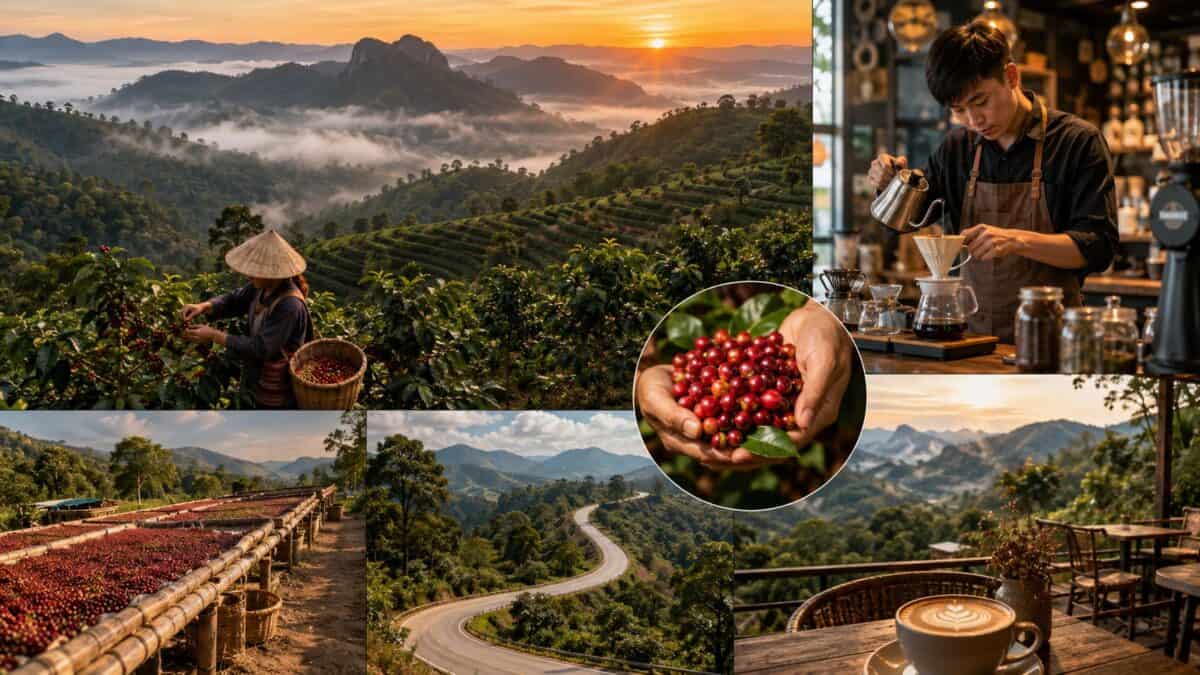
Image generated with Ai
For many years travellers have linked Chiang Mai with its gilded temples, lively night markets and mountains veiled in mist. Nowadays, though, the city’s coffee tourism is gradually altering this image by providing visitors with an in-depth experience of highland farming, specialty roasting, Indigenous heritage and sustainable life in the countryside. Instead of treating coffee as just a stop-off at an urban café, northern Thailand has created a closely linked system which enables tourists to follow every step of the production process—from the shaded Arabica plantations in the nearby hills to the roasteries in the city that enjoy international recognition. Since experiential travel is becoming more popular all over the world, Chiang Mai is now drawing in an increasing number of people who are looking for genuine encounters with agriculture as well as its cultural attractions. Because of its close location to the mountain areas where coffee is grown, the city offers one of the shortest farm-to-cup travel routes in Southeast Asia and allows visitors to taste beans that have been freshly harvested and locally roasted and are rarely available outside the region.
This development is part of a wider change taking place in Thailand’s tourism sector, with experiences initiated by local communities now being just as important as the country’s famous attractions. Coffee has taken on the role of a cultural ambassador and at the same time acts as an economic promoter, helping to sustain life in rural areas and at the same time prompting tourists to visit districts outside of Chiang Mai’s old town. The combination of high-altitude Arabica farming, ethical sourcing, indigenous entrepreneurship and a creative café culture has resulted in an experience that attracts both food enthusiasts, digital nomads, photographers and visitors who are concerned about sustainability. Rather than just drinking coffee, tourists are now more likely to take part in the harvesting, roasting, cupping and discussions with the farmers, which is why Chiang Mai has become one of Asia’s most interesting destinations for immersive agricultural tourism.
Coffee cultivation in Thailand has undergone remarkable transformation over the past several decades. While southern Thailand is traditionally associated with Robusta production, the cooler elevations of Northern Thailand—including Chiang Mai Province—have become synonymous with high-quality Arabica cultivation. Supported by favourable elevations, mild temperatures and fertile mountain landscapes, these highland regions now produce beans prized for their floral aromas, citrus brightness and balanced acidity. Thailand’s long-term efforts to encourage sustainable highland agriculture have also diversified rural economies, creating opportunities for tourism alongside farming.
Unlike many coffee-producing destinations where farms remain distant from tourism infrastructure, Chiang Mai offers an unusually integrated experience. Within a relatively short drive from the Old City, visitors can reach plantations, processing stations and roasting facilities before returning to internationally acclaimed cafés the same day. This accessibility has helped establish the province as one of Southeast Asia’s most attractive destinations for coffee-focused travel.
Advertisement
Advertisement
| Tourism Element | Visitor Experience | Travel Value |
|---|---|---|
| Highland coffee farms | Plantation walks, harvesting, processing demonstrations | Authentic agricultural tourism |
| Artisan roasteries | Bean roasting and tasting sessions | Educational experiences |
| Specialty cafés | Single-origin brews and signature drinks | Urban coffee culture |
| Community enterprises | Direct interaction with growers | Responsible tourism |
| Mountain villages | Local food, homestays and cultural immersion | Extended rural itineraries |
The geography surrounding Chiang Mai provides an exceptional foundation for specialty coffee production. Many plantations are situated between approximately 1,000 and 1,500 metres above sea level, where cooler temperatures slow bean maturation. This longer growing period allows cherries to develop greater complexity, contributing to flavour characteristics that increasingly attract specialty buyers and discerning travellers alike.
Mountain roads winding through forested landscapes introduce visitors to coffee-growing communities that remain largely absent from mainstream tourism itineraries. These journeys often combine panoramic viewpoints, waterfalls, traditional villages and agricultural experiences, creating multidimensional travel rather than a single farm visit.
Among the districts helping shape Chiang Mai’s coffee identity, Doi Saket stands out for its accessibility and mature farm-tourism infrastructure. Located east of Chiang Mai city, the district combines rolling hills with established coffee plantations that welcome visitors interested in learning about cultivation, processing and roasting.
One of the area’s recognised attractions is Nine One Coffee Organic Farm, which has promoted integrated coffee production since the late 1990s. Visitors can observe cultivation techniques, explore plantations and understand how beans move from cherry to roasted coffee while enjoying a tranquil natural setting. Farm cafés surrounded by forests and streams further reinforce the area’s appeal as a slow-travel destination rather than simply a commercial attraction.
What distinguishes Chiang Mai from many agricultural destinations is the seamless connection between rural production and urban consumption.
Instead of exporting the entire experience, much of the value remains within the province. Travellers often begin their mornings exploring historic temples before spending afternoons discovering award-winning cafés where baristas showcase locally sourced beans through espresso, pour-over and experimental brewing techniques.
Neighbourhoods such as Nimman have become synonymous with contemporary coffee culture, while cafés throughout the Old City increasingly highlight traceable origins and seasonal Thai coffees. Rather than relying solely on imported beans, many establishments celebrate local harvests, allowing visitors to taste distinctive flavour profiles originating only hours away.
Coffee tourism in Chiang Mai extends beyond flavour into community development.
One of the province’s most influential examples is Akha Ama Coffee, founded with the objective of creating sustainable opportunities for Akha farming communities in Northern Thailand. The enterprise has developed direct relationships with growers while promoting environmentally responsible cultivation and equitable market access.
For travellers, this transforms a simple café visit into an opportunity to understand the broader social journey behind every cup. Instead of viewing coffee merely as a beverage, visitors gain insight into how Indigenous knowledge, agroforestry and ethical sourcing intersect with contemporary tourism experiences. Community-focused enterprises have also strengthened Chiang Mai’s reputation among travellers seeking meaningful local engagement rather than conventional sightseeing alone.
| Destination | Character | Best For |
|---|---|---|
| Doi Saket | Organic coffee farms and plantation tours | Farm experiences |
| Nimman District | Contemporary specialty cafés | Urban coffee exploration |
| Old City | Historic cafés with local beans | Culture and coffee walks |
| Mountain villages | Community-based coffee cultivation | Responsible travel |
| Highland plantations | Harvest and processing experiences | Educational tourism |
One of Chiang Mai’s strongest advantages lies in geography rather than scale.
Unlike imported specialty coffees that often travel thousands of kilometres before roasting, beans grown in Northern Thailand can move rapidly from plantation to local roastery. Shorter supply chains help preserve freshness while allowing roasters greater control over quality and seasonal releases. Coffee specialists increasingly view this proximity as one of Chiang Mai’s defining strengths, particularly as demand grows for traceable, single-origin coffees with transparent production stories.
This close relationship between growers, processors, roasters and cafés has also encouraged experimentation with fermentation techniques, processing methods and flavour development, giving repeat visitors fresh experiences across different harvest seasons.
North of Chiang Mai city, Chiang Dao introduces travellers to a dramatically different coffee landscape where towering limestone mountains, cool forests and remote villages combine to create one of Northern Thailand’s most rewarding agritourism experiences. Dominated by the country’s third-highest peak, Doi Chiang Dao, the district’s altitude and cooler microclimate have encouraged the cultivation of premium Arabica beans alongside traditional agricultural practices.
For travellers, Chiang Dao represents more than another coffee stop. Plantation visits are frequently combined with cave exploration, birdwatching, forest trails and local markets, creating itineraries that appeal equally to adventure seekers and culinary travellers. The district’s relatively quieter tourism profile also allows visitors to experience slower-paced rural life, often accompanied by conversations with growers who explain how altitude, rainfall and careful harvesting influence the final cup.
Unlike heavily commercialised coffee destinations elsewhere in Asia, Chiang Dao retains a strong sense of place where agriculture remains the principal livelihood and tourism complements rather than replaces local traditions.
Further north-west, Mae Taeng demonstrates how coffee tourism can integrate seamlessly with outdoor recreation. Traditionally known for its rivers, elephant conservation centres and mountain scenery, the district has increasingly become part of Northern Thailand’s broader coffee trail.
Travellers frequently combine plantation visits with cycling routes, scenic drives and eco-lodges, extending the economic benefits of tourism across multiple sectors. The district’s coffee farms provide opportunities to observe cultivation techniques while introducing visitors to shade-grown production systems that coexist with native vegetation.
The growing popularity of multi-experience travel has strengthened Mae Taeng’s appeal, particularly among international visitors seeking longer stays rather than day excursions. Coffee has therefore become an additional reason to explore landscapes already recognised for their ecological richness.
While many visitors remain concentrated around Chiang Mai city, Mae Chaem offers an opportunity to discover one of Northern Thailand’s quieter coffee landscapes.
Nestled amid mountain valleys and traditional farming communities, the district presents a slower rhythm of travel where plantations coexist with terraced rice fields and forest ecosystems. The relative absence of large-scale commercial tourism allows visitors to engage more directly with producers, gaining insights into harvesting seasons, bean selection and post-harvest processing.
For photographers and slow travellers, Mae Chaem also delivers spectacular panoramic landscapes throughout the cooler months, making coffee exploration part of a broader rural discovery rather than an isolated attraction.
Although located in a neighbouring province, Doi Chang and other renowned coffee-producing areas in Chiang Rai frequently complement Chiang Mai itineraries, creating a wider Northern Thailand coffee circuit.
Doi Chang has earned international recognition for producing high-quality Arabica cultivated at elevations exceeding 1,000 metres. Its reputation has helped elevate Thailand’s standing within the global specialty coffee industry, encouraging travellers to extend their journeys beyond Chiang Mai for a more comprehensive understanding of the country’s coffee landscape.
Rather than viewing the two provinces as competitors, many tour operators increasingly present them as complementary destinations connected by mountain roads, Indigenous communities and evolving specialty coffee culture.
| Destination | Distinctive Character | Typical Visitor Experience | Ideal Travel Style |
|---|---|---|---|
| Chiang Dao | High-altitude landscapes beneath limestone mountains | Plantation visits, cafés, hiking | Nature and photography |
| Mae Taeng | River valleys and coffee farms | Eco-lodges, coffee tasting, cycling | Adventure travel |
| Mae Chaem | Remote agricultural communities | Farm immersion, local cuisine | Slow travel |
| Doi Saket | Accessible plantations near Chiang Mai | Roasting demonstrations, farm cafés | First-time visitors |
| Doi Chang (Chiang Rai) | Internationally recognised Arabica region | Coffee estates and cupping experiences | Extended Northern Thailand itinerary |
Modern coffee tourism has evolved far beyond plantation sightseeing. In Chiang Mai, visitors increasingly participate in interactive experiences that reveal the complexity behind specialty coffee production.
Seasonal visitors arriving during harvest periods may observe ripe cherries being hand-picked before following beans through pulping, fermentation, washing and drying. Outside the harvest season, farms often demonstrate roasting techniques, explain grading systems and organise guided tasting sessions that compare different processing methods.
These educational experiences have become particularly attractive to younger travellers who increasingly value skills-based tourism alongside conventional sightseeing.
| Production Stage | Typical Period | Traveller Experience |
|---|---|---|
| Flowering | February–April (weather dependent) | Plantation landscapes and photography |
| Cherry Development | Mid-year | Farm interpretation and cultivation tours |
| Harvest | Generally November–February, varying by altitude | Cherry picking demonstrations |
| Processing | Harvest months | Washing, drying and fermentation displays |
| Roasting and Cupping | Year-round | Coffee appreciation workshops |
Perhaps the strongest differentiator within Chiang Mai coffee tourism is its growing emphasis on sustainability.
Many highland farms continue to adopt shade-grown cultivation systems that preserve forest cover while supporting biodiversity. Unlike intensive monoculture farming, these approaches encourage coffee plants to coexist with native trees, improving soil quality and reducing environmental stress.
Responsible tourism has further strengthened these efforts by generating supplementary income through guided visits, educational workshops and direct sales. Instead of relying exclusively on commodity coffee prices, many growers now diversify their revenue through visitor experiences, helping improve economic resilience.
This model aligns with broader international travel trends where visitors increasingly seek authentic experiences that deliver measurable benefits to local communities rather than simply consuming destinations.
Coffee cultivation has contributed to significant socio-economic change across parts of Northern Thailand.
Community enterprises increasingly encourage younger generations to remain in rural areas by combining agriculture with hospitality, entrepreneurship and tourism services. Cafés operated by farming families, roasting workshops and farm stays have created additional employment while preserving agricultural knowledge that might otherwise disappear.
Visitors benefit from richer cultural interactions, while communities gain greater value from every kilogram of coffee produced.
Rather than exporting raw beans alone, destinations increasingly retain more economic activity locally through roasting, hospitality and tourism experiences.
| Tourism Activity | Community Benefit | Visitor Value |
|---|---|---|
| Guided plantation tours | Additional household income | Authentic learning |
| Farm cafés | Local employment | Fresh regional cuisine |
| Homestays | Diversified rural economy | Cultural immersion |
| Coffee workshops | Skills development | Interactive experiences |
| Direct coffee sales | Higher producer returns | Traceable specialty coffee |
Chiang Mai has long ranked among Asia’s preferred destinations for location-independent professionals. The growth of specialty coffee has strengthened that reputation by creating work-friendly cafés that combine reliable connectivity with locally roasted coffee and creative atmospheres.
This convergence has expanded the visitor profile beyond traditional holidaymakers. Long-stay travellers increasingly explore plantations during weekends while spending weekdays in cafés serving beans sourced from nearby mountains.
The result is a tourism ecosystem where coffee supports hospitality, accommodation, gastronomy and creative industries simultaneously.
Global tourism has steadily shifted towards experiences that encourage active participation rather than passive observation. Coffee tourism reflects this broader transition by inviting travellers to engage directly with landscapes, farming practices and local communities.
Instead of purchasing packaged souvenirs, visitors increasingly return home with practical knowledge of roasting techniques, brewing methods and the environmental factors influencing flavour profiles.
This educational dimension extends the value of travel beyond the destination itself, reinforcing Chiang Mai’s position as a place where learning becomes part of every itinerary.
The province’s coffee landscape therefore represents far more than a collection of cafés. It has evolved into a connected network of mountain communities, specialty producers and tourism experiences that continue to redefine Northern Thailand’s visitor economy while offering travellers one of Southeast Asia’s most authentic bean-to-cup journeys.
The cooler months between November and February generally offer the most rewarding conditions for exploring Northern Thailand’s coffee landscapes. This period coincides with the coffee harvest across many high-altitude plantations, while comfortable daytime temperatures make farm visits, scenic drives and outdoor café experiences particularly enjoyable. Travellers visiting outside the harvest season can still enjoy roasting workshops, cupping sessions, plantation walks and specialty cafés throughout the year.Travel Objective Recommended Time Highlights Coffee harvest experiences November–February Cherry picking, processing demonstrations Scenic mountain drives November–February Cool weather and clear skies Café exploration Year-round Seasonal brews and single-origin tastings Photography November–January Morning mist and mountain panoramas
The rise of Chiang Mai Coffee Tourism mirrors a wider shift across global travel, where visitors increasingly favour immersive experiences over conventional sightseeing. Countries such as Colombia, Costa Rica and Ethiopia have successfully positioned coffee as a tourism asset, and Northern Thailand is steadily following a similar path with its distinctive highland identity.
Unlike several established coffee destinations that primarily focus on plantation tours, Chiang Mai combines historic heritage, mountain adventures, wellness retreats, artisan gastronomy and specialty coffee within a single destination. This diversity enables visitors to extend their stays while distributing tourism benefits across both urban businesses and rural communities.
For Thailand’s visitor economy, coffee tourism also complements national strategies promoting sustainable, community-based and high-value travel. As international demand grows for traceable food experiences and regenerative tourism, Chiang Mai is well placed to strengthen its reputation as one of Asia’s most authentic bean-to-cup destinations.
Coffee in Northern Thailand has grown to be so much more than just an agricultural product; it has become a means of accessing the mountainous areas, the indigenous cultures, the artisanal crafts and the idea of responsible travel. If tourists are visiting an organic farm in Doi Saket, spending time listening to the growers in Chiang Dao, sipping a hand-brewed single origin in Nimman or continuing on to the well-known estates in Chiang Rai, each cup provides a greater insight into the people and the landscapes of the region.
Since travellers are still looking for genuine experiences which involve sustainability, education and an understanding of local culture, Chiang Mai Coffee Tourism is one of the most impressive evergreen tourist activities in Southeast Asia and it continues to reward curiosity long after the last sip has been taken.
Chiang Mai combines high-altitude Arabica coffee farms, award-winning specialty cafés, mountain communities and sustainable agritourism experiences, allowing visitors to enjoy everything from plantation tours and coffee tastings to roasting workshops and cultural immersion within a single destination.
The ideal period is November to February, when many coffee-growing areas enter the harvest season and Northern Thailand enjoys cool, pleasant weather. However, specialty cafés, roasting experiences and coffee farm visits are available throughout the year.
Popular coffee destinations include Doi Saket, Chiang Dao, Mae Taeng and Mae Chaem, while many travellers also extend their journey to Doi Chang in neighbouring Chiang Rai, one of Thailand’s most recognised Arabica-producing regions.
Visitors can explore coffee plantations, learn about cultivation and processing, watch roasting demonstrations, participate in cupping sessions, enjoy farm-to-cup tastings, meet local growers and discover boutique cafés serving locally sourced single-origin coffee.
Coffee tourism generates additional income through guided farm tours, cafés, homestays and direct coffee sales. It also encourages sustainable farming practices, strengthens community enterprises and helps preserve traditional knowledge among highland farming communities.
Yes. Coffee experiences are often combined with mountain scenery, waterfalls, hiking trails, local cuisine, artisan markets, wellness retreats and cultural attractions, making the region appealing to nature lovers, photographers, food enthusiasts and slow travellers alike.
A three- to five-day itinerary allows travellers to balance specialty café exploration in the city with visits to mountain plantations, nearby villages and scenic destinations while experiencing Northern Thailand’s broader cultural and natural attractions.
Unlike many destinations that focus solely on plantations, Chiang Mai offers a complete bean-to-cup ecosystem, where highland coffee farms, artisan roasteries, contemporary café culture and community-led tourism are all located within easy travelling distance, creating one of Asia’s most accessible and immersive coffee travel experiences.
Advertisement
Advertisement
Advertisement













Sunday, September 6, 2026

Sunday, September 6, 2026

Sunday, September 6, 2026

Sunday, September 6, 2026

Saturday, September 5, 2026

Saturday, September 5, 2026

Sunday, September 6, 2026

Sunday, September 6, 2026



