
Italy Art Tourism Meets a Ticking Clock With Just 30 Minutes Inside Florence Brancacci Chapel

Published
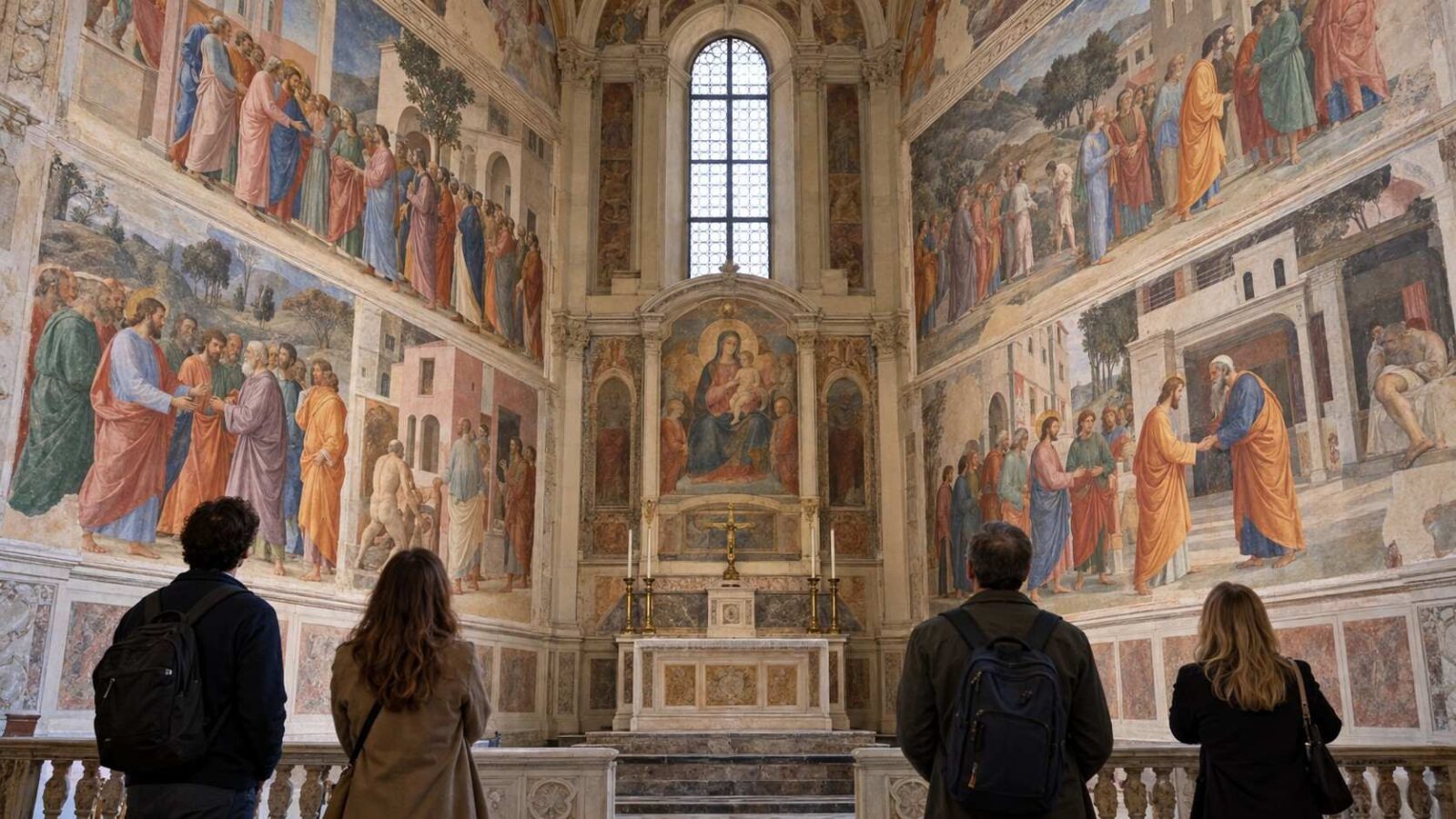
Image generated with Ai
Visitors to Florence can currently only see the Brancacci Chapel frescoes for 30 minutes, according to the local municipality. For tourists interested in the arts, figuring out where to go in advance is part of the trip. As of September 30, 2026, several Italian language travel sites reported restrictive entry to the chapel. Capacity limits, however, change based on the travel site. In January of this year, the site also reported the museum would extend its offerings beyond the Brancacci Chapel. Because of the extension, visitors can see more of the site and take their time with the Brancacci Chapel rather than rushing through to see other sites.
A short visit with a substantial story
Brancacci Chapel belongs to the Santa Maria del Carmine complex at Piazza del Carmine 14. Its frescoes bring together work by Masolino, Masaccio and Filippino Lippi, allowing visitors to compare different approaches to painting within one space.
Advertisement
Advertisement
FeelFlorence dates the decoration’s beginnings to around 1423 and completion to around 1485. The principal narrative follows the life of Saint Peter, alongside scenes associated with Original Sin.
Masolino’s elegant figures retain links to late Gothic art. Masaccio gives people greater physical weight and places them within carefully organised space, while Lippi’s later contribution works with the existing cycle.
Advertisement
Advertisement
That contrast gives the visit a clear purpose. Instead of trying to absorb every detail, travellers can look for changes in expression, bodies and architectural settings.
What the published entry rules actually say
The municipal opening and ticket page states a maximum chapel stay of 30 minutes. Both that page and FeelFlorence currently identify a ten-person limit.
Advertisement
Advertisement
However, a separate MUS.E visit-planning page describes admissions every twenty minutes for up to thirty people. An entry interval is not necessarily the same thing as an individual viewing allowance.
The sources do not explain this discrepancy clearly enough to attribute it to scaffolding, restoration equipment or a particular conservation phase. Travellers and group organisers should confirm the arrangements attached to their actual reservation.
Advertisement
Advertisement
| Detail | Published guidance |
|---|---|
| Chapel viewing allowance | Maximum 30 minutes on municipal pages |
| Capacity | Ten on municipal and FeelFlorence pages; thirty on a MUS.E planning page |
| Standard admission | €15 |
| Usual closure | Tuesday |
| Sunday opening | 13.00–17.00 |
| Entrance | Museum route at Piazza del Carmine 14 |
No announcement reviewed establishes that the viewing limit is newly introduced. The practical story is how to plan around an existing condition, rather than a new restriction on Florence tourism.
A three-step preparation checklist
Preparation can begin before the timed visit. Tuscany’s official tourism portal identifies Masaccio’s Expulsion from the Garden of Eden and The Tribute Money on the left wall as key examples of his approach.
- Before arrival, identify the two paintings and read a short explanation of their subjects.
- Inside, give each scene sustained attention, looking at expression, physical presence and spatial relationships.
- Compare those qualities with work by Masolino and Lippi, then return to whichever detail interests you most.
For a thirty-minute allowance, a suggested personal plan is five minutes taking in the room, fifteen studying the two works and ten comparing other scenes. This is an editorial suggestion, not an official route or a promise of uninterrupted viewing.
Follow staff instructions and adjust the plan to the conditions on the day. Background reading should help visitors look more closely, rather than turn the experience into another checklist to finish.
Advertisement
Advertisement
The 2026 addition beyond the chapel
A useful recent development changes the wider visit. In an announcement dated 30 January 2026, Fondazione MUS.E said Sala della Colonna would open permanently to the public from 1 February as part of the Brancacci Chapel and Carmine cloister route.
Previously accessible only occasionally, the room displays detached frescoes and preparatory drawings connected with the complex. These include sinopie, drawings on plaster used in the preparation of frescoes.
The announcement identifies works associated with Pietro Nelli, Fra Filippo Lippi and Gherardo Starnina, alongside preparatory material connected with Masolino.
This addition offers a way to continue exploring after the chapel encounter. The thirty-minute restriction should not be mistaken for a complete description of everything the museum route offers.
Conservation is continuing care
The paintings’ survival reflects repeated intervention, not a single successful restoration. Municipal historical material records that the chapel survived the 1771 fire that destroyed much of the church, although heat affected its frescoes.
On 28 May 2024, Italy’s National Research Council presented results from diagnostic investigations and restoration work. The project involved municipal conservation specialists, heritage authorities, research institutes and the Opificio delle Pietre Dure, with support from Friends of Florence and the Jay Pritzker Foundation.
Advertisement
Advertisement
The findings pointed towards planned maintenance and documented an interactive three-dimensional application intended to improve understanding and access.
That work provides important context for heritage tourism. It does not establish that the current thirty-minute rule was introduced because of a specific technical finding.
Growing tourism makes accurate advice more valuable
Florence’s wider visitor economy remains substantial. A municipal release dated 4 June 2026 reported more than 4.7 million accommodation arrivals and 11.5 million overnight stays during 2025.
Compiled by Centro Studi Turistici using Regional Tourism Observatory statistics, the figures represented increases of 10.2% and 11.1%, respectively, against 2024.
These are accommodation measures, not chapel attendance. They cannot establish how many people visited Brancacci Chapel, how much revenue it earned or whether its viewing rule affected employment.
For hotels and tour operators, the immediate opportunity is better information. Explain the reservation conditions before guests arrive, place longer historical introductions outside the chapel and avoid selling the experience as unlimited viewing.
Advertisement
Advertisement
Accessibility and entrance planning
FeelFlorence describes wheelchair access through the cloister using a lift and identifies accessible toilets at ground level. It also lists tailored activities for visitors with specific sensory or other support needs.
Contact the museum before booking to discuss assistance and interpretation. Physical access and the arrangements for a timed visit should both be confirmed.
The church and chapel have separate entrances. Visitors should follow the museum route rather than assume entry to Santa Maria del Carmine automatically includes the frescoes.
Traveller FAQs
Do visitors have only thirty minutes for the entire complex?
The published maximum applies to the chapel. The wider route includes other spaces; confirm their access conditions when booking.
How many people can enter together?
Official pages differ between ten and thirty. Ask the museum to confirm your booked slot, especially when organising a group.
Can wheelchair users enter the chapel?
Yes. FeelFlorence describes lift access from the cloister; discuss any assistance requirements before arrival.
Advertisement
Advertisement
Making the limited viewing time count
Visiting the Brancacci Chapel is a rewarding experience, even before you set foot inside. You can read two paintings outside and confirm your reservation all while leaving space for the rest of the museum. 2026 is the year that the Sala della Colonna is expected to open to the public. This may incentivize even more visitors to journey beyond the walls of the chapel. Although the chapel staff is very friendly, signage would also be very useful. The constraints on capacity are not consistent and the reasons for these constraints are not always clear. Having previous knowledge on these constraints would allow visitors to plan their time accordingly. This time could be spent admiring the frescoes instead of being spent figuring out the constraints. This is the ultimate goal of the project.
Official sources
Comune di Firenze visiting rules: https://cultura.comune.firenze.it/pagina/musei-civici-fiorentini-cappella-brancacci-santa-maria-del-carmine/orari-e-biglietti
Fondazione MUS.E route expansion, 30 January 2026: https://musefirenze.it/la-sala-della-colonna-si-svela-nuovi-capolavori-nel-cuore-del-carmine/
CNR conservation findings, 28 May 2024: https://www.cnr.it/it/nota-stampa/n-12732/cappella-brancacci-presentati-risultati-ed-esperienze-fra-indagini-diagnostiche-e-intervento-di-restauro
Advertisement
