
Salem Goes Head-to-Head With Orlando and Other American Hotspots as Halloween 2026 Travel Sparks a Fierce Fight for Gen Z Visitors

Published
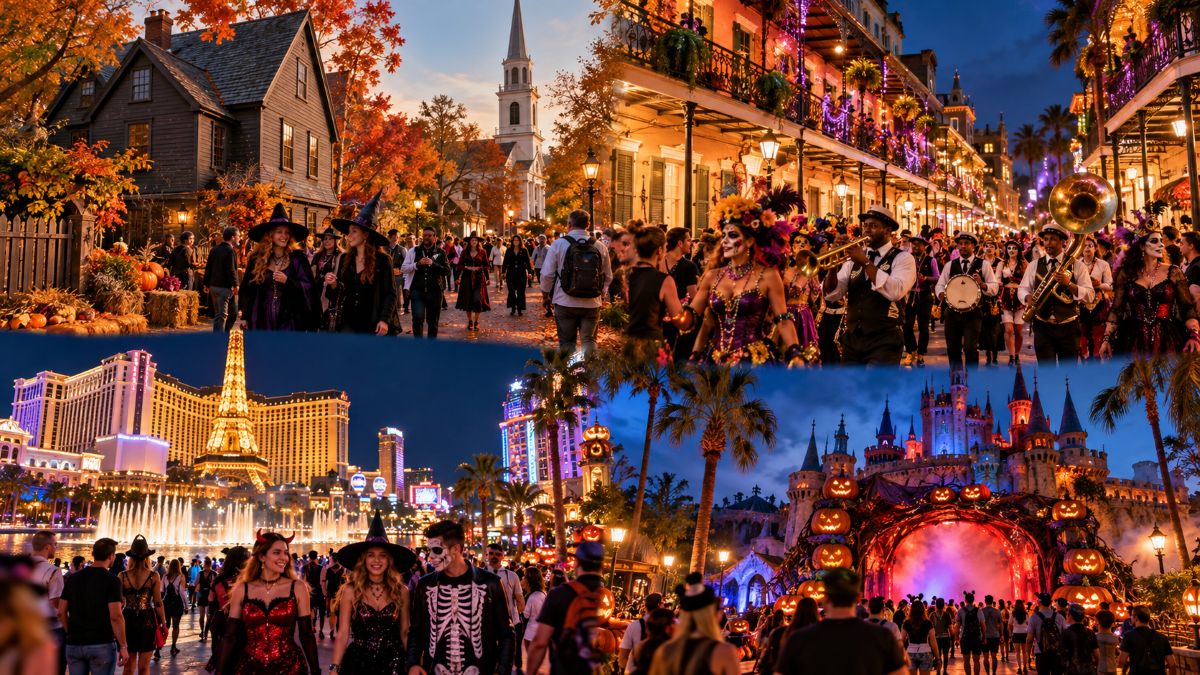
Halloween 2026 is emerging as a major opportunity for US tourism, with Gen Z accommodation searches rising almost 45% year on year, according to Airbnb’s 6 October report. Overall Halloween-weekend stay searches increased nearly 15%, while Halloween-themed wishlists climbed almost 60%. With Halloween falling on Saturday, 31 October, Salem, New Orleans, Las Vegas and Orlando offer contrasting experiences for travellers planning autumn escapes. Their competition highlights a wider industry question: can a single-night celebration generate longer stays, stronger accommodation demand and greater visitor spending? The answer depends on hotel prices, attraction costs, event schedules and whether search interest translates into completed bookings.
A Saturday Halloween Changes the Travel Equation
The timing of Halloween creates an important commercial opportunity in 2026. A Saturday celebration allows travellers to arrive on Friday, enjoy the main festivities, and leave on Sunday without taking additional annual leave. However, this calendar advantage also complicates comparisons with previous years, when Halloween fell on different weekdays.
Airbnb reported that searches for Halloween-weekend stays increased nearly 15% year on year. Gen Z searches rose almost 45%, while wishlists with Halloween-inspired titles increased nearly 60%. Wishlists containing the word “witch” also climbed almost 15%, indicating growing interest in accommodation and experiences built around seasonal themes.
These figures measure activity on Airbnb rather than completed trips across the US travel market. They do not establish a corresponding increase in arrivals, overnight stays or visitor expenditure. Nevertheless, the sharper increase among younger users gives tourism operators a reason to examine themed accommodation, group travel and bookable experiences.
Advertisement
Advertisement
The research opportunity lies in determining whether Halloween is becoming a multi-day tourism product rather than simply an evening of costumes and parties. That requires evidence from hotel rates, event admissions, visitor numbers and average length of stay. A comparison of four destinations provides a useful starting point.
Four Cities Offer Four Distinct Halloween Economies
The following comparison identifies the strongest differentiators and the practical questions travellers should investigate before booking.
Advertisement
Advertisement
| Destination | Main attraction | Confirmed 2026 seasonal detail | Best suited to |
|---|---|---|---|
| Salem, Massachusetts | Witch-trial heritage and autumn festivities | Month-long Haunted Happenings; 400-drone show on 31 October at 10pm | History enthusiasts and festival visitors |
| New Orleans, Louisiana | Ghost tours, parades and nightlife | Krewe of BOO! on 24 October; Halloween events through 31 October | Culture seekers and nightlife travellers |
| Las Vegas, Nevada | Immersive horror and entertainment | Las Vegas Party Pass, 29 October–1 November | Groups and nightlife enthusiasts |
| Orlando, Florida | Theme-park horror and family attractions | Halloween Horror Nights on selected nights, 28 August–1 November | Theme-park visitors and longer-stay travellers |
The four cities appeal to different travel motivations, making a single overall winner difficult to establish. Salem concentrates on historic identity, New Orleans blends cultural traditions with entertainment, Las Vegas prioritises immersive experiences, and Orlando combines ticketed attractions with wider holiday infrastructure.
For readers, the distinction matters because the cheapest room is not necessarily the cheapest trip. A useful comparison must account for the entire itinerary, including local transport, attraction admission, food, accommodation fees and the number of nights required.
Salem Turns Witch-Trial Heritage Into a Month-Long Draw
Salem has the strongest historical association with Halloween among the four destinations. The city’s Haunted Happenings programme runs throughout October, combining family activities, live entertainment, seasonal markets and attractions connected with its witch-trial history. Destination Salem says the celebration draws more than one million visitors from around the world.
The 2026 edition carries additional significance because Salem marks its 400th anniversary. A planned display involving 400 drones will illuminate the sky above the North River at 10pm on Saturday, 31 October. The anniversary adds a distinct local-history angle to the city’s established seasonal programme.
Salem’s appeal extends beyond themed attractions. The National Park Service identifies the Witch House as the only building in Salem directly associated with the 1692 witchcraft trials. The city’s maritime heritage, historic districts and Peabody Essex Museum also offer visitors alternatives to Halloween entertainment.
Accommodation prices remain a critical consideration. AirROI’s analysis of Salem short-term rentals reported median Friday and Saturday nightly rates of $490 in October 2025, compared with $371 in September. That represented an increase of approximately 32%, although the figures cover October weekends generally rather than Halloween weekend alone.
Advertisement
Advertisement
The same analysis reported October weekend medians of $405 for studios and one-bedroom properties, $537 for two-bedroom properties, and $708 for homes with three or more bedrooms. These historical figures illustrate how property size can change the economics of a group trip. They do not establish Salem’s actual median rate for October 2026.
Visitors should consider travelling by commuter rail from Boston rather than driving into Salem’s centre. Destination Salem warns that October traffic becomes heavy and parking remains severely limited, particularly on weekends. It also advises visitors to anticipate extensive downtown road closures on Halloween, beginning no later than noon under the published plan.
New Orleans Extends the Celebration Through Culture
New Orleans offers a different proposition, with Halloween embedded in its wider calendar of parades, music, historic neighbourhoods and evening entertainment. The official Krewe of BOO! parade is scheduled for Saturday, 24 October 2026, at 6.30pm, following a route through the French Quarter towards the Warehouse District. The organisers describe the event as free to watch and suitable for families.
The wider calendar extends into Halloween weekend. Official tourism listings include Halloween New Orleans events from 30 October to 1 November, alongside the city’s Halloween activities on 31 October. A Día de los Muertos festival is also listed for 1 November at Lafayette Square, offering visitors another cultural event immediately after Halloween.
This event density creates a practical reason to investigate longer stays. Travellers can potentially combine the parade, ghost tours, restaurants, music and post-Halloween cultural programming within one itinerary. However, a packed calendar demonstrates opportunity rather than proof that visitors actually book more nights.
Accommodation research should compare the French Quarter and Warehouse District with properties farther from the principal events. Travellers should also examine cancellation terms and transport arrangements before booking, especially when an itinerary depends on several ticketed activities.
Advertisement
Advertisement
For tourism businesses, New Orleans illustrates how Halloween can reinforce an existing cultural destination instead of operating as an isolated festival. Restaurants, tour operators, entertainment venues and accommodation providers can all feature in the visitor journey. The economic benefit depends on actual spending, visitor volumes and the proportion of expenditure retained by local businesses.
Las Vegas Sells Immersive Scares and Late Nights
Las Vegas approaches Halloween through entertainment, nightlife and immersive horror. The official tourism authority’s October 2026 guide highlights Universal Horror Unleashed at AREA15, family-friendly seasonal events and several ticketed Halloween experiences. This breadth allows visitors to construct different itineraries around their budgets and interests.
The Las Vegas Party Pass is scheduled to run from 29 October to 1 November. Participating nightlife venues include OMNIA, Hakkasan, TAO, JEWEL and Marquee, according to the tourism authority’s guide. The Sin City Halloween Ball is also scheduled for 31 October at Virgin Hotels Las Vegas. Visitors should verify admission rules, participating venues and individual event conditions before purchasing passes.
Las Vegas has an advantage that differs from Salem’s seasonal identity. Its restaurants, shows, casinos and entertainment attractions operate beyond Halloween, allowing visitors to combine the occasion with a wider city break. Yet this flexibility makes total-trip comparisons particularly important.
A low headline room rate may not translate into a lower final bill once resort fees, transport, dining and entertainment tickets enter the calculation. Travellers should compare the full price of each itinerary and check whether a multi-venue pass genuinely covers the events they intend to attend.
The destination also provides an opportunity to investigate how entertainment spending differs from historical or festival-led tourism. A robust study would compare the share of the visitor budget devoted to accommodation, ticketed experiences, nightlife and food. Without comparable expenditure data, it would be premature to declare Las Vegas the highest-spending Halloween destination.
Advertisement
Advertisement
Orlando Makes Ticketed Attractions the Main Event
Orlando introduces a theme-park model in which Halloween operates across a longer seasonal window. Universal Orlando’s Halloween Horror Nights runs on selected nights from 28 August to 1 November 2026. The event marks its 35th year with ten haunted houses, scare zones, live entertainment and themed food and merchandise.
The extended schedule gives travellers more flexibility than a festival concentrated around 31 October. Visitors can select an event date, combine it with other theme-park attractions and build a longer holiday around their interests. Nevertheless, Halloween Horror Nights requires separate admission, and its intense horror format is not recommended for children under 13 by the organiser.
Orlando’s strength lies in the number of attractions visitors can combine within one destination. That makes it particularly relevant to families, groups and travellers seeking several days of entertainment rather than a single Halloween party. It also raises the importance of comparing ticket costs and park schedules alongside accommodation.
A useful visitor budget should separate the hotel bill from theme-park admission and other paid experiences. Travellers should check the dates of each attraction before booking flights, since not every seasonal event operates every day.
For researchers, Orlando tests whether a longer operating season and multiple paid attractions encourage longer stays. The answer requires average-night data and completed booking records rather than the event calendar alone.
Accommodation Prices Need a Fairer Comparison
The available price indicators reveal why travellers should avoid ranking these cities using isolated nightly rates. The figures below come from different datasets and periods, so they provide context rather than a definitive 2026 price league table.
Advertisement
Advertisement
| Destination | Available accommodation evidence | Limitation |
|---|---|---|
| Salem | October 2025 short-term rental weekend median of $490 per night | Not specific to Halloween weekend |
| New Orleans | Broad hotel-price averages are available, but a consistent Halloween-weekend quote is needed | Not directly comparable with Salem rental data |
| Las Vegas | October hotel-price averages provide a seasonal baseline | Do not isolate Halloween dates or total trip costs |
| Orlando | A September 2026 snapshot reported a $145 median all-in nightly rate across 12 hotels for 30 October–1 November | Small sample, not a citywide average |
A stronger investigation would compare two adults staying from 30 October to 1 November, then repeat the calculation for a three-night stay from 29 October to 1 November. Researchers should collect several hotel quotes per destination and record the room category, cancellation policy, taxes and mandatory fees.
Short-term rentals deserve a separate comparison because group size can substantially alter the cost per traveller. A four-person group sharing a suitable property may face a different budget from four people booking separate hotel rooms. However, cleaning fees, service charges, minimum-night rules and local restrictions must also enter the calculation.
The most useful result would be a total cost per person, rather than a headline nightly rate. That figure would allow readers to assess which destination delivers the strongest experience within their budget.
What Would Prove a Longer-Stay Boom?
Airbnb’s search figures provide a strong news peg, but they cannot establish whether Halloween travel is generating more overnight stays. A rigorous assessment needs accommodation occupancy, average length of stay, attraction attendance and tourism expenditure from comparable periods. Age-segmented booking data would be particularly valuable for testing the Gen Z trend.
The research should also compare 2026 with earlier Halloween seasons while accounting for the weekday. Since Halloween falls on Saturday in 2026, the potential for a Friday-to-Sunday getaway differs from years when the date falls midweek. A fair comparison should therefore examine both Halloween weekend and the wider October period.
| Indicator | What it measures | Best evidence |
|---|---|---|
| Accommodation searches | Early-stage travel interest | Airbnb’s year-on-year search data |
| Completed bookings | Conversion from interest to travel | Booking or accommodation-provider data |
| Average length of stay | Whether visitors extend their trips | Hotel and short-term rental records |
| Visitor spending | Economic value generated by trips | Tourism authority or government expenditure studies |
| Attraction attendance | Demand for seasonal experiences | Official organiser attendance figures |
| Cost per traveller | Affordability of the complete itinerary | Standardised hotel, ticket and transport prices |
These indicators would help distinguish a marketing-driven surge in interest from a durable shift in travel behaviour. They would also clarify whether the economic gains reach accommodation providers, independent businesses, attractions and local transport operators.
Advertisement
Advertisement
Practical Planning Can Reduce Halloween Costs
Visitors planning a Halloween getaway should begin with the event schedule rather than choosing accommodation solely by its advertised price. Salem travellers should examine commuter rail options and road closures, while New Orleans visitors should plan around the 24 October parade and their preferred Halloween events. In Las Vegas, the key considerations include venue access, age restrictions and the final cost of nightlife packages.
Orlando visitors should secure admission for their chosen Halloween Horror Nights date before building the rest of their itinerary. Those travelling with children should review attraction intensity and age guidance, particularly for separately ticketed horror events. Across all four cities, flexible cancellation terms can offer protection if plans change, although they may increase the initial price.
A longer stay is not automatically better value. Travellers should compare the cost of an additional hotel night with the attractions, meals and experiences it makes possible. For groups, sharing accommodation may reduce the per-person rate, but only after all fees are included.
The broader lesson is that seasonal travel requires budgeting for the complete experience. The strongest destination choice depends on individual priorities, not simply which city attracts the most online attention.
A Lasting Halloween Travel Boom or a Saturday-Driven Surge?
Halloween 2026 presents a compelling test for the US tourism industry, but its Saturday timing complicates the interpretation of rising travel demand. With 31 October falling on a weekend, travellers can plan Friday-to-Sunday getaways without taking additional annual leave, potentially boosting accommodation searches, hotel occupancy and spending across Salem, New Orleans, Las Vegas and Orlando. Airbnb reported on 6 October that Halloween-weekend stay searches rose nearly 15% year on year, while Gen Z searches climbed almost 45%. However, these figures measure search interest rather than completed bookings, making historical comparisons essential to determine whether the increase reflects a lasting shift towards experience-led travel or a temporary calendar advantage.
The investigation should compare several Halloween seasons, accounting for the weekday, event schedules, accommodation prices and average length of stay. If demand rises consistently across years with different calendar patterns, the evidence for a structural tourism trend becomes stronger. Conversely, if the increase concentrates around Saturday Halloweens, the 2026 surge may partly reflect travellers taking advantage of a convenient weekend.
Advertisement
Advertisement
| Halloween year | Day of the week | Potential travel pattern | What researchers should investigate |
|---|---|---|---|
| 2022 | Monday | Weekend celebrations fell before Halloween | Whether travellers arrived the preceding weekend or concentrated trips around 31 October |
| 2023 | Tuesday | A midweek date potentially fragmented leisure trips | Whether searches and occupancy peaked on the nearest weekend or Halloween night |
| 2024 | Thursday | Opportunities for Thursday-to-Sunday breaks | Whether demand extended across multiple nights |
| 2025 | Friday | A natural three-day weekend opportunity | Whether accommodation demand and average stay duration increased |
| 2026 | Saturday | Strong potential for Friday-to-Sunday getaways | Whether higher searches translate into bookings, occupancy and spending |
| 2027 | Sunday | A weekend date, but with a different departure pattern | Whether demand concentrates on Saturday night or extends into Sunday |
The table identifies calendar conditions, not verified historical booking outcomes. Researchers must obtain comparable data before drawing conclusions about actual demand.
The Four Indicators That Will Reveal the Real Trend
| Indicator | Evidence of a lasting shift | Evidence of a calendar-driven spike |
|---|---|---|
| Search interest | Halloween-related searches increase across several years, including midweek dates | Growth is disproportionately strong when Halloween falls on Friday or Saturday |
| Hotel occupancy | Occupancy strengthens across October, not merely the final weekend | Occupancy peaks sharply around convenient weekend dates |
| Average length of stay | Travellers consistently add nights for festivals, attractions and cultural experiences | Most bookings remain concentrated around one or two nights |
| Accommodation prices | Seasonal premiums persist across different calendar configurations | The premium rises mainly when Halloween creates a convenient weekend break |
The four destinations provide a useful comparison because their attractions operate on different schedules. Salem’s month-long Haunted Happenings programme and Orlando’s extended Halloween Horror Nights season offer reasons to visit beyond 31 October. New Orleans combines parades, ghost tours and nightlife, while Las Vegas can draw visitors through ticketed entertainment and themed parties. Comparing the destinations could reveal whether longer event calendars help sustain demand independently of Halloween’s weekday.
For a robust analysis, researchers should compare equivalent booking windows, measure accommodation prices against ordinary October weekends, and examine occupancy and average stay duration over several years. They should also distinguish search dates from travel dates, since early planning can raise search activity well before visitors commit to bookings.
The decisive question is whether Halloween demand extends beyond the convenient weekend. If searches, occupancy, spending and length of stay continue to rise across different calendar patterns, 2026 could form part of a broader experience-led travel trend. If the gains remain concentrated around Saturday celebrations, the stronger explanation may be a temporary scheduling advantage rather than a fundamental transformation in American Halloween tourism.
Halloween’s Next Test Is Economic Value
The 2026 figures establish a clear increase in Halloween-related accommodation interest, with Gen Z searches rising almost 45% and overall weekend searches increasing nearly 15%. Salem’s month-long programme, New Orleans’ cultural calendar, Las Vegas’ nightlife and Orlando’s extended theme-park season offer four distinct ways to convert that interest into visitor activity. However, search growth alone cannot demonstrate higher arrivals, longer stays or increased tourism receipts.
The next stage of the investigation should compare identical accommodation dates, full-trip budgets and average lengths of stay. It should also test whether younger travellers complete bookings and spend across several days. Until those figures become available, Halloween 2026 offers a compelling case study in experience-led tourism, rather than definitive proof of a new travel-economy boom.
Advertisement
