
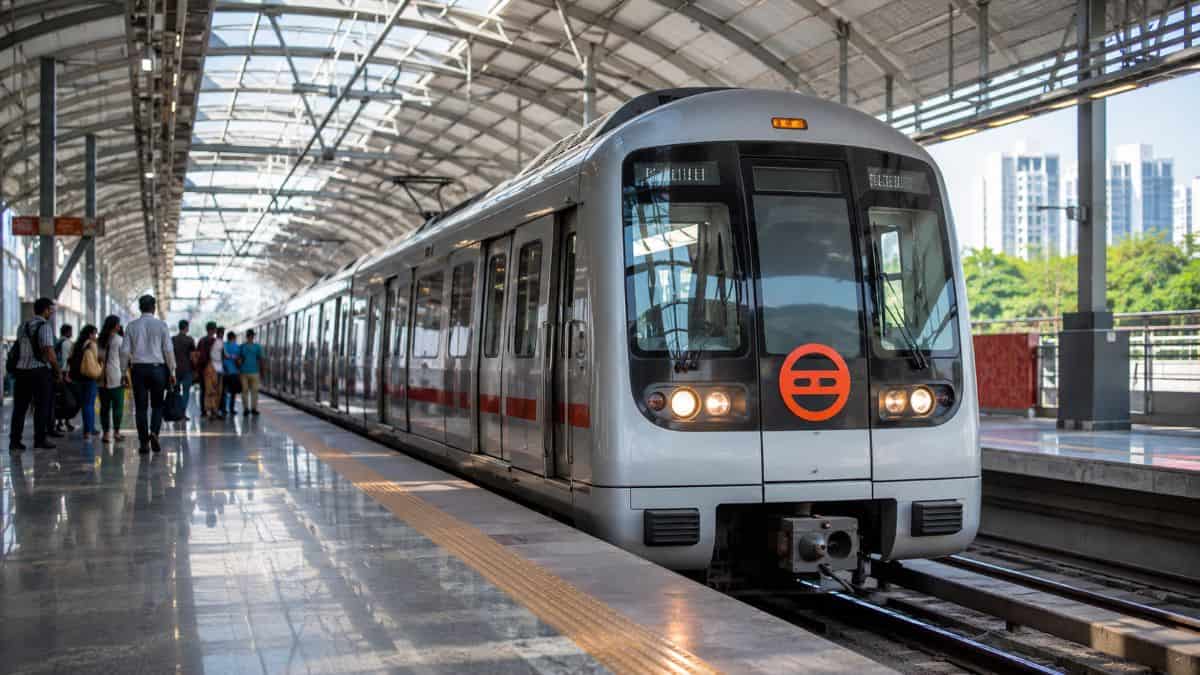
Image generated with Ai
Delhi Metro Rail Corporation’s (DMRC) 2026 train punctuality rate of 99.95% further consolidated DMRC’s standing as one of the most reliable urban rail systems in the world. DMRC has a strict definition of punctuality. A train reaches its destination within 59 seconds of its scheduled time; DMRC classifies that train as being delayed. The media reports of this achievement have discussed the performance and punctuality of the system resulting from the network’s growth and shorter train headway intervals as DMRC begins to implement more driverless trains.
Reliability has made the Delhi Metro the backbone of movement within the urban core of Delhi and the National Capital Region (NCR). From its opening in 2002 with a 8.4 km corridor, the DMRC has experienced rapid growth due to a large passenger demand, increasing from 8.4 km to 416 km of continuous metro coverage and 303 operational stations. DMRC has become a critical link in the NCR’s transport infrastructure.
The 99.95% figure represents an exceptionally high level of operational consistency. DMRC’s strict definition means the measurement is based on trains reaching their terminal stations within 59 seconds of schedule, providing a demanding benchmark for punctuality.
The achievement is significant because Delhi Metro operates at a scale far greater than the system that opened in 2002. Its growth has required the operator to manage additional trains, stations, interchanges, passenger flows and increasingly complex operating patterns without allowing reliability to deteriorate.
Advertisement
The latest performance has also prompted comparisons with major international metro systems. However, such comparisons should be treated carefully because metro operators can use different definitions and thresholds for punctuality. The strength of Delhi’s result lies particularly in the strictness of the delay criterion used by DMRC.
Reliability is not limited to trains arriving on schedule. Frequency also affects how easily visitors and residents can move through a major metropolitan area.
On the busiest Delhi Metro corridors, train headways have fallen to approximately 2 minutes and 18 seconds. Shorter intervals can reduce waiting times and help absorb heavy passenger demand, particularly during peak travel periods.
For tourism, this has practical importance. Delhi’s Metro connects visitors with major commercial areas, cultural districts, historic attractions and transport hubs, allowing travellers to build itineraries around predictable journey times rather than relying exclusively on congested city roads.
A further indicator of operational performance is the Mean Distance Between Failures, or MDBF. DMRC has reported an MDBF of 2.72 million car-kilometres, a measure used to indicate how far metro rolling stock can travel before a service-affecting failure.
The figure is important because a high punctuality rate is more meaningful when supported by dependable rolling stock, maintenance systems and operational controls. Together, these factors influence whether passengers can rely on the network throughout the day.
DMRC’s participation in international metro benchmarking through the Community of Metros, known as COMET, has also placed the organisation within a global peer group of major urban rail operators. The network has reportedly remained among the top performers for reliability under a two-minute delay criterion.
| Performance area | Reported figure | Travel significance |
|---|---|---|
| Train punctuality in 2026 | 99.95% | Supports predictable journeys |
| Delay threshold | More than 59 seconds | Indicates a strict punctuality standard |
| Mean Distance Between Failures | 2.72 million car-km | Reflects rolling-stock reliability |
| Busiest-corridor headway | 2 minutes 18 seconds | Reduces passenger waiting |
| Delhi-NCR metro network | About 416 km | Expands access across the region |
| Stations across wider network | 303 | Strengthens interchange and destination access |
| Average daily passenger journeys | About 64.06 lakh | Demonstrates extensive usage |
The network figures are consistent with recent DMRC information describing Delhi-NCR’s approximately 416-kilometre metro system and 303 stations.
Delhi Metro has also become a major example of automated urban rail operations in India. Around 29% of the network is reported to operate under Unattended Train Operation, or UTO.
Driverless operation can support precise train movements, consistent service intervals and efficient use of railway infrastructure when combined with appropriate signalling, control and safety systems. For a high-density city such as Delhi, automation can therefore form part of a broader strategy for increasing capacity while maintaining operational consistency.
The expansion of automated services also reflects the changing character of Delhi Metro. The system is no longer simply a conventional urban railway; it has developed into a technology-intensive transport network designed to handle substantial passenger volumes across a large metropolitan region.
Delhi Metro began passenger operations in December 2002 with an 8.4-kilometre Shahdara-Tis Hazari corridor containing six stations. Its subsequent expansion has transformed mobility across Delhi and neighbouring parts of the NCR.
In March 2026, the opening of new sections helped bring the Delhi Metro network to around 416 kilometres and 303 stations across the wider NCR system. The Pink Line also became a circular route following the opening of the Majlis Park-Maujpur-Babarpur section, creating another significant interchange and connectivity milestone.
Passenger demand has grown alongside this infrastructure. DMRC recorded 235.8 crore passenger journeys during 2025, with the Delhi-NCR network accounting for a substantial share of India’s metro usage.
For international and domestic visitors, dependable metro operations can influence how efficiently a Delhi itinerary can be planned. Attractions spread across central Delhi, Old Delhi, South Delhi and adjoining NCR destinations can be linked through the extensive metro network, while interchange stations provide alternatives when road traffic becomes slow.
The importance extends beyond tourism. Daily commuters, airport passengers, business travellers and residents depend on predictable rail services to manage journeys across one of India’s busiest urban regions.
Delhi Metro’s 99.95% punctuality therefore represents more than an operational statistic. It demonstrates how scale, technology, maintenance and service management can work together to support a metropolitan transport system.
Delhi Metro’s 2026 punctuality performance places reliability at the centre of its continuing expansion. Its combination of near-perfect punctuality, high failure resistance, shorter headways and increasing automation demonstrates the operational demands of running a major metro system while passenger volumes continue to rise.
As Delhi and the wider NCR continue developing as major business and tourism destinations, dependable public transport will remain central to the visitor experience. The latest performance suggests that Delhi Metro’s role is evolving from a city transport service into one of the region’s most important foundations for accessible, efficient and predictable urban travel.
What is Delhi Metro’s punctuality rate in 2026?
Delhi Metro has recorded a reported punctuality rate of 99.95% in 2026.
How does DMRC define a delayed train?
Under the reported DMRC benchmark, a train is considered delayed when it reaches its destination station more than 59 seconds behind schedule.
Why is Delhi Metro’s punctuality important for travellers?
High punctuality makes it easier for visitors and commuters to plan journeys between attractions, transport hubs, business districts and residential areas.
How large is the Delhi-NCR Metro network?
The wider Delhi-NCR metro network is approximately 416 kilometres long and includes around 303 stations.
When did Delhi Metro begin operations?
Delhi Metro began passenger operations in December 2002 with an 8.4-kilometre corridor between Shahdara and Tis Hazari.
What is the reported Delhi Metro headway on busy corridors?
Train intervals on the busiest corridors can be as short as approximately 2 minutes and 18 seconds.
What does MDBF mean in metro operations?
Mean Distance Between Failures measures the average distance trains travel before a service-affecting failure occurs.
What is Delhi Metro’s reported MDBF?
DMRC has reported a Mean Distance Between Failures of 2.72 million car-kilometres.
Does Delhi Metro operate driverless trains?
Yes. Around 29% of the network is reported to operate under Unattended Train Operation.
Why does Delhi Metro matter to tourism in Delhi?
Its extensive network provides visitors with a reliable way to reach major attractions and transport hubs while reducing dependence on road traffic.
Advertisement
Advertisement
Advertisement













Saturday, September 5, 2026

Saturday, September 5, 2026

Saturday, September 5, 2026

Saturday, September 5, 2026

Saturday, September 5, 2026

Saturday, September 5, 2026