
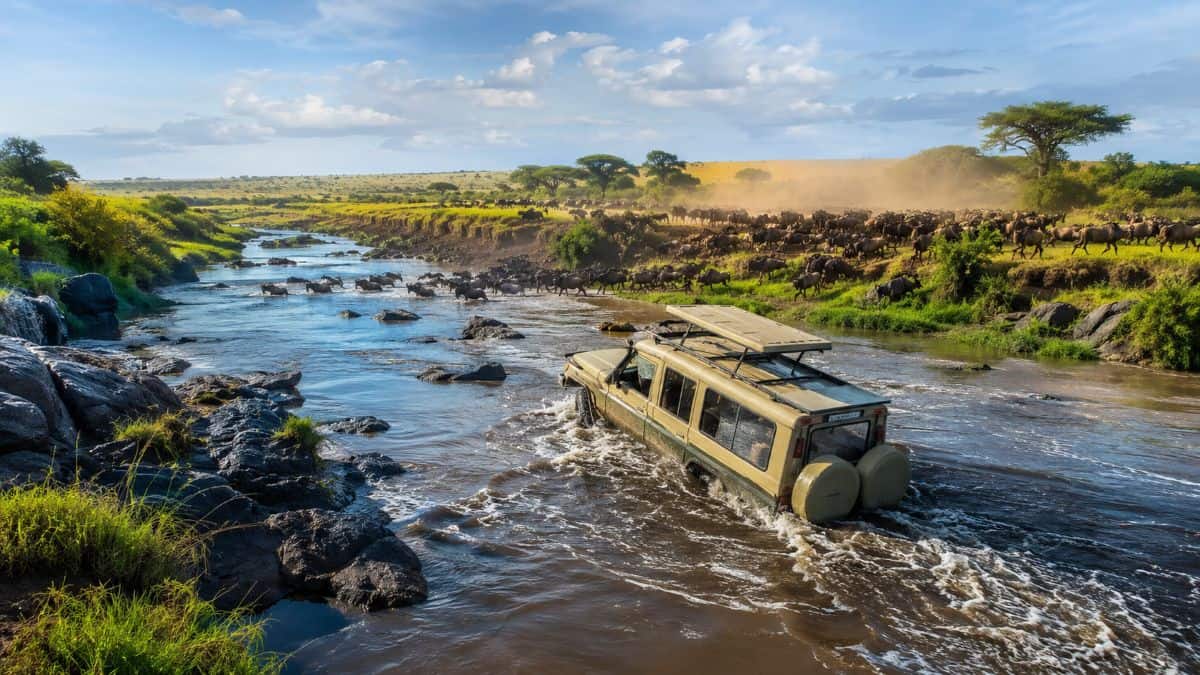
Image generated with Ai
Tanzania’s Serengeti National Park has launched an investigation after a safari vehicle carrying four Swiss tourists and a guide plunged into a river during the annual Great Migration, raising renewed attention around visitor safety in one of Africa’s most sought-after wildlife destinations. The incident occurred on August 30 in the Kogatende Nyumbu crossing area, where large numbers of wildebeest and other wildlife gather during the migration season. Although the circumstances remain under investigation, the accident has highlighted the importance of strict driving procedures and safety measures in challenging safari environments.
The vehicle was operated by a local safari company, and the four tourists and driver were reported to have escaped physical injury. The travellers were subsequently able to continue their planned itinerary and travelled onwards to Zanzibar. Authorities have not yet established what caused the vehicle to leave its intended route and enter the river. Investigators are expected to establish the sequence of events, while the safari industry continues to emphasise responsible operations during one of Tanzania’s busiest wildlife-viewing periods. The incident is significant for international travellers because the Serengeti attracts visitors specifically to experience dramatic river crossings, making careful management of vehicles and viewing areas essential to maintaining a safe and sustainable tourism environment.
Advertisement
The accident took place on August 30 at the Kogatende Nyumbu crossing area in the northern Serengeti. The location is associated with the Great Migration, when enormous herds move through the ecosystem in search of grazing and water.
The circumstances surrounding the plunge have not yet been conclusively established. Authorities are examining what happened before the vehicle entered the river, while the safari operator has indicated that it is awaiting the relevant investigation before drawing conclusions.
Advertisement
This approach is particularly important from a travel-safety perspective. Establishing the facts rather than speculating about the cause allows investigators to determine whether road conditions, vehicle positioning, driving decisions, environmental factors or another circumstance contributed to the incident.
Despite the seriousness of the accident, the four Swiss visitors and their guide were reported to have avoided physical injuries. The tourists continued with their holiday plans and travelled to Zanzibar afterwards.
For international travellers, the outcome provides an important distinction between an accident occurring in a challenging wildlife environment and the broader question of destination safety. The Serengeti remains a major safari destination, but wildlife areas naturally involve terrain, weather, animals and road conditions that differ considerably from conventional urban tourism.
The incident also demonstrates why visitors should select experienced safari operators and follow guidance from professional guides and park authorities throughout their journeys.
Advertisement
Advertisement
The Great Migration creates extraordinary opportunities for wildlife tourism, but it can also generate demanding operating conditions. Vehicles may travel across uneven tracks and operate close to rivers and wildlife-viewing areas as guides attempt to provide guests with safe and responsible viewing opportunities.
The main safety considerations include:Safari Safety Factor Importance For Travellers Vehicle positioning Helps maintain stability near rivers and uneven terrain Driver experience Supports appropriate decisions in challenging conditions Park regulations Establishes operating standards within protected areas Guide communication Helps passengers respond quickly to safety instructions River-crossing areas Require particular caution because of terrain and wildlife activity Vehicle condition Supports reliable operation during extended safari journeys
For visitors planning a Serengeti safari, these considerations should form part of the decision-making process when choosing an operator and itinerary.
Tanzania’s national parks authority has emphasised that drivers, visitors and safari companies must comply strictly with established park regulations and safety procedures while investigations continue.
The warning underscores the shared responsibility involved in wildlife tourism. Safari operators are responsible for professional conduct and appropriate vehicle operation, while visitors must follow instructions from guides and respect restrictions within protected areas.
Authorities have also indicated that negligence or failure to observe established procedures can have serious and potentially avoidable consequences. Such reminders are particularly relevant during peak wildlife periods, when safari traffic can increase around highly popular viewing locations.
The Serengeti is one of Tanzania’s most internationally recognised tourism destinations, with the Great Migration serving as a major attraction for visitors from Europe, North America, Asia and other international markets.
The spectacle combines enormous wildlife movements with some of Africa’s most distinctive landscapes. The northern Serengeti, including the Kogatende area, is particularly associated with seasonal migration activity and dramatic river crossings.
For travellers, however, the appeal of witnessing these events comes with the need to understand that safari tourism takes place in a natural environment rather than a controlled attraction. Conditions can change quickly, and responsible tourism depends on professional guiding, adherence to park regulations and careful interaction with wildlife and terrain.
The accident is likely to reinforce discussions around responsible safari management, particularly at locations where large numbers of vehicles and visitors gather during migration periods.
A professional safari experience involves more than reaching a wildlife-viewing location. Operators must balance visitor expectations with environmental protection, wildlife welfare and passenger safety. Guides also have an important role in explaining local conditions and ensuring travellers understand appropriate behaviour.
The investigation should therefore provide useful information for the wider tourism sector. Any findings could help operators strengthen procedures and reinforce safety practices around riverbanks, crossings and other challenging areas.
Travellers should not interpret one accident as evidence that the Serengeti is unsuitable for tourism. Instead, the incident reinforces the importance of informed travel planning and responsible safari choices.
Visitors can reduce avoidable risks by selecting reputable operators, listening carefully to professional guides, remaining inside designated areas and following park regulations. Travellers should also recognise that wildlife encounters cannot be completely controlled and that safari conditions can differ from expectations based on photographs or promotional material.
The reported absence of physical injuries among the tourists and their ability to continue their itinerary is reassuring. Nevertheless, the investigation remains important because understanding precisely what happened can help prevent similar incidents.
The Serengeti’s Great Migration remains one of the world’s most compelling wildlife experiences, attracting travellers who want to witness one of nature’s largest seasonal movements. The vehicle accident in the Kogatende area has nevertheless placed safety procedures firmly back in focus.
Until investigators establish the exact circumstances, speculation should be avoided. The immediate priority is determining what happened and whether any operational or environmental factors contributed to the plunge.
For Tanzania’s tourism industry, the incident also demonstrates why high-quality safari operations must combine memorable wildlife experiences with disciplined safety practices. Maintaining that balance will remain essential as international demand for Serengeti travel continues.
1. What happened in the Serengeti safari accident?
A safari vehicle carrying four Swiss tourists and a guide plunged into a river in the Kogatende area of Tanzania’s Serengeti National Park.
2. When did the accident occur?
The incident occurred on August 30, 2026, in the Kogatende Nyumbu crossing area.
3. Were the Swiss tourists injured?
The four tourists were reported not to have suffered physical injuries.
4. Was the safari guide injured?
The available information states that the driver also escaped physical injury.
5. What happened to the tourists after the accident?
They continued their planned itinerary and subsequently travelled to Zanzibar.
6. Why is the area important for tourism?
Kogatende is located in the northern Serengeti and is associated with the annual Great Migration and seasonal wildlife-viewing opportunities.
7. Has the cause of the accident been established?
No. Investigations are continuing to determine the circumstances that led to the vehicle entering the river.
8. Why are safety rules important during the Great Migration?
High wildlife activity, uneven terrain, river areas and increased visitor numbers can create demanding conditions for safari operations.
9. What should travellers consider when booking a Serengeti safari?
Travellers should consider the operator’s experience, safety practices, professional guides, vehicle standards and compliance with park regulations.
10. Does the accident mean travellers should avoid the Serengeti?
Not necessarily. The incident highlights the importance of responsible safari operations and following established safety procedures rather than indicating that the destination as a whole should be avoided.
Advertisement
Advertisement
Advertisement













Thursday, September 3, 2026

Thursday, September 3, 2026

Thursday, September 3, 2026

Thursday, September 3, 2026

Thursday, September 3, 2026

Wednesday, September 2, 2026

Thursday, September 3, 2026

Thursday, September 3, 2026


