
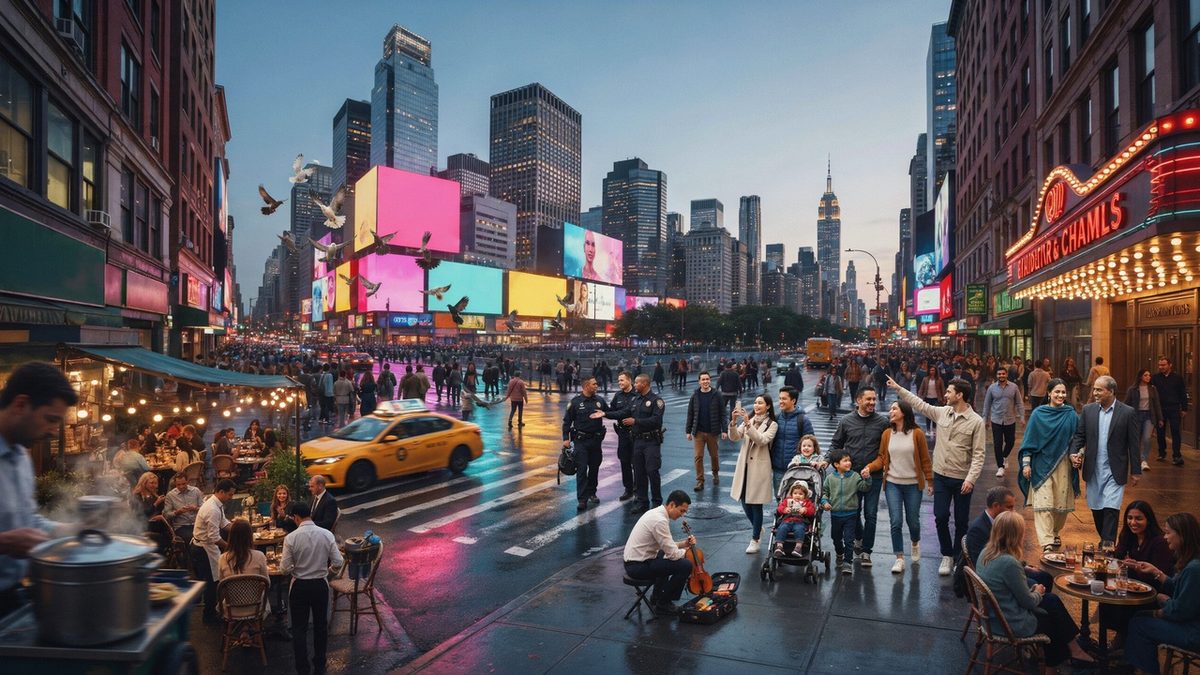
Image generated with Ai
New York is becoming safer as crime, shootings and murders fall sharply in 2026, strengthening confidence for residents, workers and visitors while giving tourism a fresh public-safety boost.
New York is reporting another major step forward on public safety, with crime, shootings and murders continuing to fall across the state in 2026. The latest figures show that 28 police departments involved in the Gun Involved Violence Elimination (GIVE) initiative recorded a 7 per cent decline in index crime and a striking 48 per cent fall in murder between January and May.
Advertisement
Meanwhile, New York City has recorded its safest summer on record for shooting incidents, shooting victims and murders. These improvements matter beyond policing. For travellers, tourism businesses and international visitors, safer streets can strengthen confidence, support urban exploration and reinforce New York’s appeal.
New York is reporting another major step forward on public safety, with crime, shootings and murders continuing to fall across the state in 2026. The latest figures show that 28 police departments involved in the Gun Involved Violence Elimination (GIVE) initiative recorded a 7 per cent decline in index crime and a striking 48 per cent fall in murder between January and May.
Advertisement
At the same time, New York City has recorded its safest summer on record for shooting incidents, shooting victims and murders. The development has significance not only for residents but also for the wider travel and tourism economy, where perceptions of safety can influence destination choice, visitor confidence and spending.
ignificant reductions in index and violent crime so far in 2026. The 28 police departments participating in the state’s Gun Involved Violence Elimination (GIVE) initiative reported a 7 percent index crime decline and 48 percent drop in murders during the first five months of 2026, the lowest of any year since 2017. Meanwhile, New York City experienced its safest summer on record so far for shooting incidents, shooting victims and murders, including 6.6 percent reduction in major crime.
According to figures released by Governor Kathy Hochul, the 28 police departments participating in the state’s GIVE initiative reported 29,654 index crimes during the first five months of 2026.
That represented a 7 per cent decrease from the 31,752 offences recorded during the same period in 2025.
Advertisement
Advertisement
The decline was not limited to overall index crime. Participating departments also recorded 4,617 violent crimes between January and May, down 1 per cent from 4,644 a year earlier.
The sharpest movement came in murder.
There were 41 murders reported across the 28 GIVE agencies during the first five months of 2026, representing a 48 per cent reduction. The state said this was the lowest number recorded during the January-to-May period in any year since 2017.
Robbery also fell substantially, declining 17 per cent to 830 reported offences.
Property crime dropped by 8 per cent, with motor vehicle theft, burglary and larceny all contributing to the reduction.
Taken together, the figures indicate a broad-based improvement rather than a decline concentrated in one category of crime.
The state’s GIVE programme is focused on communities and police departments dealing with shootings, firearm-related violence and associated violent crime.
Eleven participating police departments reported double-digit percentage reductions in index crime.
They were Elmira, Greece, Hempstead, Jamestown, Kingston, Newburgh, Poughkeepsie, Rochester, Spring Valley, Suffolk County and Utica.
Nine departments also recorded double-digit reductions in violent crime. They were Elmira, Greece, Hempstead, Ithaca, Kingston, Lackawanna, Newburgh, Poughkeepsie and Watertown.
The programme is administered by the New York State Division of Criminal Justice Services (DCJS). Its support includes funding for personnel, overtime, technology and equipment, alongside specialised training and technical assistance.
The strategy is designed to help participating agencies focus resources on shootings, shooting deaths and firearm-related violent crime.
Governor Kathy Hochul said public safety remained a central priority and attributed the continued improvements to substantial investment, policing and targeted intervention.
The governor said New York had invested nearly $4 billion in public safety and argued that the resulting reductions in shootings, murders and major crime demonstrated the value of those investments.
New York City’s latest figures are particularly significant.
Between 1 June and 31 August 2026, the city recorded 195 shooting incidents, 249 shooting victims and 66 murders.
According to the figures cited by the state, each represented the lowest total recorded for that summer period in New York Police Department history.
The 195 shooting incidents were 32 fewer than the previous record low of 227, which was recorded in 2025.
Shooting victims also reached a new low. The 249 victims recorded during summer 2026 were 44 fewer than the previous record low of 293, set in 2018.
Murders fell to 66, which was 12 below the previous record low of 78 recorded in 2017.
The figures mark an eight-month stretch of record-low shooting incidents, shooting victims and murders in New York City, according to the state announcement.
For a city that attracts millions of domestic and international visitors each year, sustained improvements in public safety can have an important reputational effect.
The improvement extends beyond gun violence.
New York City recorded 10,276 major-crime offences in August 2026, compared with 11,000 in August 2025. That represented a 6.6 per cent decline.
The Bronx recorded the largest year-to-date reduction among the city’s boroughs, with major crime down 11.9 per cent.
That broader reduction is relevant to the visitor economy because travellers experience destinations through streets, transport hubs, entertainment districts, shopping areas, restaurants and public spaces.
A fall in major crime does not mean that every neighbourhood or travel situation is risk-free. Nor does it eliminate the need for visitors to take sensible precautions.
However, sustained citywide improvements can contribute to a more favourable environment for tourism, hospitality, retail and other visitor-facing businesses.
Safety is one of the most practical considerations in destination decision-making.
Visitors may choose where to stay, which neighbourhoods to explore and how late to remain outside partly according to their perception of local security.
For New York, that relationship is particularly important because the city’s tourism proposition depends heavily on movement through public spaces.
Times Square, Central Park, Broadway, museums, restaurants, shopping districts, sports venues and neighbourhood attractions all require visitors to move around the city rather than remain inside a resort-style property.
Consequently, improvements in public safety can support a more confident visitor experience.
The impact is also relevant to the wider travel industry.
Hotels benefit when visitors feel comfortable extending stays. Restaurants and entertainment venues benefit when people are willing to spend more time outside their accommodation. Retailers can benefit from increased pedestrian activity, while attractions can gain from stronger visitor confidence.
These are indirect effects rather than an automatic consequence of falling crime. Tourism performance is influenced by many other variables, including airfares, hotel prices, exchange rates, consumer confidence, weather, major events and international travel demand.
Nevertheless, public safety remains an important foundation for a successful urban destination.
The latest results also highlight the role of targeted public-safety strategies.
The GIVE initiative does not simply provide general funding. Its resources are directed towards police departments dealing with firearm-related violence, with personnel, overtime, equipment, technology, training and technical assistance forming part of the approach.
Rossana Rosado, Commissioner of the New York State Division of Criminal Justice Services, said the sustained declines meant fewer lives lost and fewer people victimised.
She also pointed to the role of local law-enforcement partners and investment in strategies, technology and training.
From an operational perspective, the data suggest that the combination of focused policing, technology, training and local implementation is producing measurable results in participating communities.
However, the figures should be interpreted carefully. A year-on-year decline is evidence of improvement during the period measured; it is not proof that crime will continue falling indefinitely.
Maintaining those gains requires continued investment, effective policing, community engagement, accurate data collection and attention to emerging crime patterns.
For travellers planning a New York trip, the latest numbers provide a positive backdrop.
Visitors can reasonably view the record-low shooting and murder figures as encouraging indicators of the city’s broader public-safety direction.
At the same time, normal urban travel precautions remain appropriate.
Travellers should stay aware of their surroundings, safeguard valuables, use reputable transport options and check local guidance when exploring unfamiliar areas, particularly late at night.
The most important point is balance.
New York’s latest crime figures offer evidence of substantial improvement, but they should not be interpreted as a guarantee of complete safety.
Instead, they provide a data-backed indication that several serious crime measures are moving in a positive direction.
For the travel industry, that distinction matters. Credible safety improvements are more valuable than exaggerated claims because visitor confidence is built on reliable information.
New York remains one of the world’s most recognisable urban destinations, and its tourism appeal is built around scale, culture, entertainment, food, shopping and major events.
A safer environment can reinforce all of those attractions.
The latest figures show progress across multiple areas: GIVE communities recorded fewer index crimes, violent crime edged lower, murders dropped sharply, robbery declined and property crime also fell.
New York City, meanwhile, recorded historic summer lows for shootings, shooting victims and murders while major crime declined 6.6 per cent in August.
The challenge now is sustaining that progress.
If the downward trend continues, the benefits could extend well beyond policing statistics. A safer-feeling city can encourage residents and visitors to use public spaces more confidently, support hospitality and entertainment businesses, and strengthen New York’s position as a competitive global tourism destination.
New York’s latest public-safety figures present a notably positive picture for 2026. Across the 28 GIVE police departments, index crime fell 7 per cent and murder dropped 48 per cent during the first five months of the year. Robbery declined 17 per cent, while property crime fell 8 per cent.
New York City delivered another significant milestone during the summer. From June through August, shooting incidents, shooting victims and murders all reached their lowest levels for that period in NYPD history. Major crime also fell 6.6 per cent in August.
For tourism, the message is straightforward: safety remains a crucial part of destination confidence. Falling crime does not remove every risk, but sustained improvements can make a large, complex city feel more accessible and reassuring to visitors. With continued investment and effective local policing, New York’s improving safety profile could become another advantage for its tourism economy.
“New York’s latest safety figures are encouraging news for residents, businesses and the global travel community. A destination’s strength is not defined only by its attractions, hotels or connectivity; visitors also want to feel confident while exploring its streets and neighbourhoods. The sharp fall in murders, shootings and major crime provides an important positive signal for New York’s tourism ecosystem. These results also demonstrate how sustained investment, targeted policing, technology and local partnerships can create measurable change. For international travellers, this progress can strengthen confidence in experiencing New York’s culture, entertainment, hospitality, shopping and iconic attractions while supporting the city’s continued position as a leading global destination.”Anup Kumar Keshan says
The main cause behind New York’s improving crime picture is a combination of sustained public-safety investment, targeted policing, specialised training, technology and focused intervention in communities facing firearm-related violence. The answer is visible in the numbers: GIVE agencies recorded a 7 per cent decline in index crime and a 48 per cent fall in murder during the first five months of 2026, while New York City posted record-low summer shooting incidents, victims and murders. The reason this matters to tourism is simple. Visitors value confidence when moving through a major city. Continued safety improvements can therefore strengthen New York’s reputation, support hospitality businesses and encourage wider visitor activity.
New York is ending the summer with a powerful public-safety message: crime is falling, shootings are declining and murders have reached historic lows in several key measurements. The 28 police departments participating in the GIVE initiative recorded a 7 per cent drop in index crime and a remarkable 48 per cent reduction in murder between January and May 2026. New York City delivered similarly striking results, recording only 195 shooting incidents, 249 shooting victims and 66 murders from June through August, each a record low for that period. Major crime also declined 6.6 per cent in August. The progress is important for the travel industry because perceptions of safety influence how visitors experience and evaluate major destinations. While travellers should continue taking normal urban precautions, sustained improvements can enhance confidence in New York’s streets, attractions, restaurants, entertainment districts and neighbourhoods. Continued investment will be critical to preserving this momentum.
Advertisement
Tags: New York, New York City, New York crime, Tourism, Travel Safety
Advertisement
Advertisement













Thursday, September 3, 2026

Thursday, September 3, 2026

Thursday, September 3, 2026

Thursday, September 3, 2026

Wednesday, September 2, 2026

Thursday, September 3, 2026

Thursday, September 3, 2026