
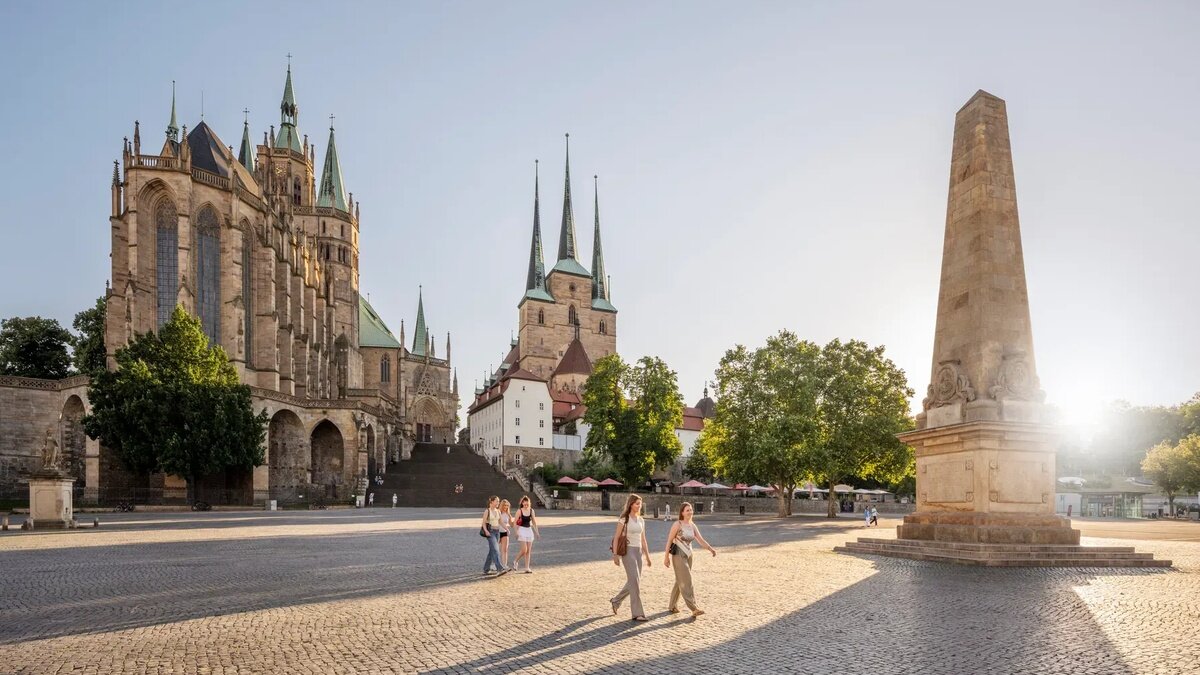
Image generated with Ai
Germany’s September tourism push in Thuringia is more than a trade showcase. The latest official data show international overnight stays in Thuringia fell 2.3% in the first half of 2026 while Germany’s foreign overnights rose 0.5%. Erfurt will host about 60 international buyers from 14 European source markets on 20–23 September, and participating suppliers must support English-language information and booking. On 28 September, Bad Blankenburg will publicly present Tourism Strategy Thuringia 2035 before workshops across six implementation fields, creating a trade-to-strategy sequence focused on converting product readiness into inbound growth.
The most important development for tourism buyers is not simply that Germany is holding another destination workshop. Newly published official statistics reveal a divergence between Thuringia’s international performance and Germany’s wider inbound market, giving the September programme a much sharper commercial context.
According to the Thüringer Landesamt für Statistik, Thuringian accommodation businesses and campsites recorded 4,566,902 overnight stays during the first half of 2026, up only 0.1% year on year. Arrivals fell 0.8% to 1,756,660. The weakness was considerably more pronounced in the international segment: arrivals by foreign guests declined 3.9% to 96,257, while their overnight stays fell 2.3% to 235,731. The figures are provisional.
Germany as a whole moved in the opposite direction. According to Destatis, accommodation establishments nationwide registered 223.8 million overnight stays in the first half of 2026, a record for the period and 0.3% above the previous year. International travellers accounted for 36.4 million overnight stays, representing 0.5% growth.
Advertisement
Advertisement
| Official tourism indicator | First half 2026 | Year-on-year movement | Why it matters |
|---|---|---|---|
| Thuringia total arrivals | 1,756,660 | -0.8% | Overall visitor growth remains subdued |
| Thuringia total overnight stays | 4,566,902 | +0.1% | Accommodation demand is broadly flat |
| Thuringia international arrivals | 96,257 | -3.9% | Foreign demand is weakening faster than total demand |
| Thuringia international overnight stays | 235,731 | -2.3% | Directly strengthens the case for international distribution work |
| Erfurt arrivals | 292,141 | +2.2% | State capital is outperforming the broader arrival trend |
| Erfurt overnight stays | 528,534 | +4.9% | Erfurt recorded a comparatively stronger first half |
| Germany international overnight stays | 36.4 million | +0.5% | National inbound demand grew while Thuringia’s declined |
The contrast is significant. Thuringia is not confronting a collapse in tourism. Total overnight demand remained almost unchanged. The challenge is narrower: international tourism is losing momentum at a time when Germany’s overall foreign visitor market is still expanding.
That makes the Thuringia Travel Summit less a conventional promotional exercise and more a potential distribution intervention.
According to the German National Tourist Board, the Thuringia Travel Summit will run from 20 to 23 September 2026 in Erfurt, with around 60 buyers from tour operators across 14 European source markets expected to participate.
The latest official list covers Denmark, Switzerland, the Netherlands, Belgium, the United Kingdom, Croatia, Romania, Serbia, the Czech Republic, Austria, Spain, Italy, France and Poland.
Advertisement
Advertisement
The commercial centre of the programme is a workshop at Peterskirche in Erfurt, where 40 tourism businesses and organisations from Thuringia are scheduled to present their products. Buyers will also encounter tourism experiences through excursions covering cultural heritage, landscapes and regional products rather than receiving destination information solely in a conventional meeting environment.
This distinction matters for tour operators. International destination growth depends not simply on awareness, but on whether hotels, attractions, experiences, transport components and destination organisations can be assembled into products that overseas distributors can actually sell.
The summit therefore places the commercial transaction layer of destination development under unusual scrutiny.
There is also an important fact-checking point for publishers and travel companies.
Earlier material issued by Thüringer Tourismus GmbH in April anticipated around 70 international travel decision-makers from ten European countries. The newer GNTB announcement issued on 2 September 2026 gives the updated expectation of around 60 international buyers representing 14 source markets.Publication stage Buyer expectation Geographic reach April 2026 Thuringia planning material About 70 decision-makers 10 European countries 2 September 2026 GNTB update About 60 buyers 14 European source markets
For current publication, the 60 buyers and 14 markets figure is the latest official figure.
The change does not indicate weaker or stronger business prospects by itself. It does show that the geographical composition of the programme has broadened since the earlier planning stage.
One of the most consequential details sits not in the headline announcement but in the official participation conditions for Thuringian tourism suppliers.
According to Thüringer Tourismus GmbH’s event rules, participating organisations may promote only offers based in Thuringia, and those offers must be relevant to international visitors. Suppliers must provide product information in English and must ensure that booking and delivery of the experience can also take place in English where relevant. The conference language itself is English.Supplier requirement Commercial implication Tourism offer must be located in Thuringia Keeps buyer discussions focused on regional conversion Product must be relevant to international visitors Filters participation towards export-ready tourism inventory Information must be available in English Reduces a basic international sales barrier Booking must be possible in English where relevant Moves the conversation from inspiration towards conversion Experience must be deliverable in English where relevant Addresses the traveller experience after the sale Conference language is English Creates a common working language between suppliers and buyers
This is arguably the most important B2B tourism angle.
A destination can spend heavily on overseas visibility while still losing potential bookings if the final product cannot be explained, reserved or experienced easily by foreign travellers. Thuringia’s participation criteria effectively push suppliers further down the international customer journey.
For travel agents and tour operators, that offers a more practical signal than destination branding alone. Products appearing at the summit should already have passed basic requirements relating to international relevance and English-language accessibility.
That does not guarantee contracts, distribution agreements or new packages. It does, however, reduce several operational barriers that can prevent smaller regional products from entering international itineraries.
The second stage of Thuringia’s September tourism cycle will take place in Bad Blankenburg.
According to the official Tourismusnetzwerk Thüringen, the Thüringer Tourismustage will run on 28 and 29 September 2026 at the Landessportschule Bad Blankenburg. The programme will include the public presentation of Tourism Strategy Thuringia 2035, followed by implementation workshops.
The workshops are organised around six development fields:Tourism Strategy 2035 development field Relevance to international growth Product Determines whether regional experiences can become competitive itineraries Businesses Addresses the supplier base delivering tourism services Digitalisation Influences discoverability, data quality and booking processes Financing and organisation Shapes destination-management capacity and investment Marketing Determines how demand is created in domestic and overseas markets Mobility Affects the traveller’s ability to move beyond established gateways
This sequence creates an unusually useful lens through which to assess Thuringia’s tourism policy.
Erfurt is about market access and buyer conversion. Bad Blankenburg is about the structural conditions that determine whether those commercial opportunities can be supported over the longer term.
The strategy process itself predates the summit. Thuringia began developing the successor to Tourism Strategy 2025 through consultation involving tourism stakeholders, with work covering subjects including sustainability, digitalisation, financing, skilled-labour pressures, accessibility and mobility.
September therefore brings two previously separate tourism functions into close chronological proximity: international distribution and long-term destination management.
Bad Blankenburg will also host the Thüringer Tourismuspreis 2026 on 28 September.
Official tourism-network data show the competition received 110 proposals, of which 92 valid applications remained after duplicates were removed. Three nominees were selected in each of four categories. The four eventual winners will each receive €5,000 plus a marketing cooperation package.
The awards matter to the wider September tourism story because they place product quality, digital innovation and destination experiences alongside the new strategy process.
For international distribution, this creates a useful pipeline: suppliers are being exposed to overseas buyers in Erfurt, while product innovation and future policy are being addressed at state level in Bad Blankenburg.
The September programme also supports a credible regional tourism dispersal interpretation, but it needs precise wording.
No official source states that Germany is taking buyers away from Berlin or Bavaria, nor that Thuringia is intended to replace those established destinations.
What the official programme does show is that international buyers will be taken beyond a single city through excursions covering Thuringian heritage, landscapes, castles, palaces, cuisine, arts, crafts and other regional tourism products.
That makes distribution beyond Germany’s best-known visitor gateways a reasonable analytical outcome, but not an officially announced substitution strategy.
The more defensible tourism story is therefore that Germany is attempting to increase the international commercial visibility of a state that remains far smaller in inbound tourism terms than Germany’s major foreign-visitor centres.
For travellers, the immediate effect will not be a new visa, flight route or transport entitlement. Nor have new consumer packages resulting from the summit yet been confirmed.
The potential benefit lies further upstream.
If European operators convert the September meetings into contracted programmes, travellers could eventually encounter more bookable Thuringia itineraries, regional cultural products, nature experiences and English-supported visitor services through established travel-distribution channels.
That distinction is crucial. The summit is not itself the tourism outcome. The measurable outcome will be whether participating buyers subsequently programme, package or sell the products they encounter.
The newest statistics make that conversion particularly important because Thuringia’s international demand is presently moving below the national trajectory.
The significance of September 2026 will ultimately depend on what happens after the events finish.
Thuringia entered the year with a substantial long-term achievement: according to the GNTB, international overnight stays reached around 544,000 in 2025 and were 86% higher than at German reunification. Yet the latest half-year figures reveal a short-term reversal, with foreign arrivals and overnight stays both declining even as Germany’s international accommodation market continued to expand.
That tension gives the Erfurt summit and Bad Blankenburg strategy programme greater significance than a standard destination-marketing calendar would suggest.
Erfurt will test whether internationally prepared Thuringian tourism businesses can convert exposure into distribution relationships. Bad Blankenburg will then place the state’s next strategic framework before the industry and begin practical work across the structural fields that determine competitiveness.
For Germany’s tourism industry, Thuringia could therefore become a useful case study in a wider challenge facing mature destinations: how to move international demand deeper into regional economies by improving not simply promotion, but actual product readiness, bookability, mobility and commercial distribution.
Advertisement
Advertisement
Advertisement













Saturday, September 5, 2026

Saturday, September 5, 2026

Saturday, September 5, 2026

Saturday, September 5, 2026

Saturday, September 5, 2026

Saturday, September 5, 2026

Saturday, September 5, 2026

Saturday, September 5, 2026



