
Saudi Arabia Blocks Houthi Missile Salvo as France Deploys Air Defences to Yanbu Oil Terminal

Updated
Published
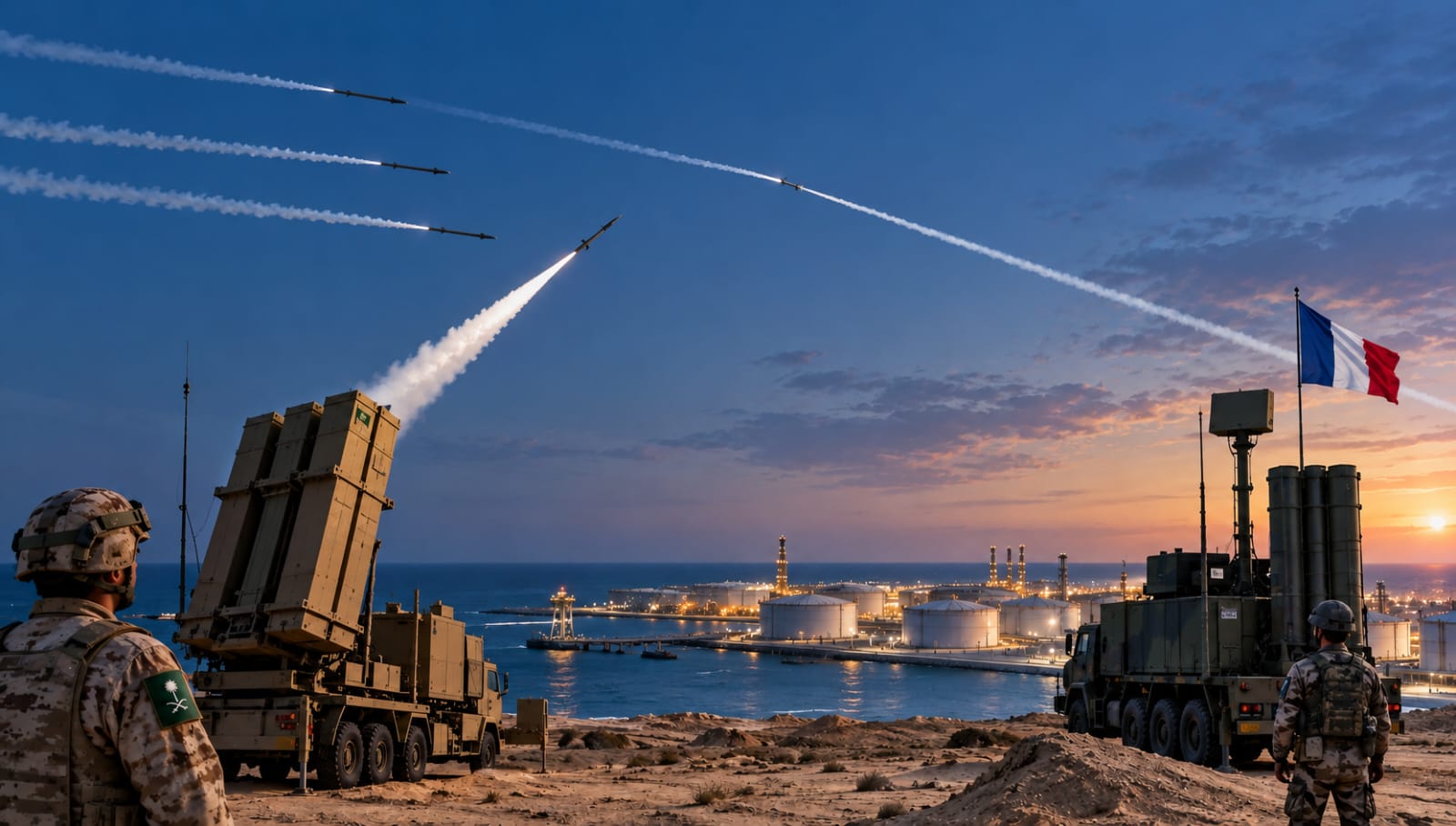
Image generated with Ai
Saudi Arabia intercepts a salvo of Houthi ballistic missiles today and France sends a priority mission to deploy sophisticated air defense systems at the Yanbu oil terminal. Markets across Europe have been thrown into turmoil as a result of this surprise military action, with widespread panic spreading throughout the Middle East. Army patrols have been placed on maximum alert around key installations to protect against further jihadist attacks, with allied nations rushing military equipment to the region to protect key export facilities from aerial assault. Finally, states are now forced to address the implications of such a bold attack taking place.
Saudi Arabia has shot down six missiles, part of a barrage fired by Yemeni Houthi rebels targeting crucial infrastructure sites, including the Red Sea oil hub of Yanbu, and the city of Taif. In response to this aggression, international defenses, including military interventions by France, and strategic consultations by the Mecca joint Defence Agreement have intervened.
Why did Houthi rebels launch coordinated missile strikes targeting Yanbu and Taif?
The recent coordinated missile barrage represents a calculated attempt by Yemen’s Houthi movement to cripple critical Saudi energy infrastructure and exert maximum economic pressure. By targeting the strategic Red Sea port of Yanbu, which houses massive Saudi Aramco refining and export facilities, the rebel forces aimed to disrupt global petroleum supply chains. This attack directly challenges the security of alternative energy transport routes while testing the operational limits of Saudi Arabia’s integrated air defense network. Saudi air defense forces successfully intercepted all six ballistic missiles, preventing catastrophic structural damage and ensuring that international crude shipments continued flowing without immediate interruption. These hostile cross-border incursions highlight the persistent vulnerability of Gulf energy installations to long-range projectile technology provided by external regional actors.
“This shocking escalation underscores the profound fragility of global energy infrastructure and maritime security in the Middle East. When militant groups aggressively target critical refining facilities and shipping lanes, the shockwaves instantly ripple across international markets, threatening worldwide economic stability. It is entirely clear that regional defense frameworks must evolve rapidly to deter hostile cross-border projectiles. Furthermore, proactive international interventions and cooperative security agreements remain absolutely vital for safeguarding vital trade corridors against persistent threats. Ultimately, long-term peace relies heavily on decisive diplomatic resolution and robust military deterrence along volatile maritime borders.”
Advertisement
Advertisement
— Anup Kumar Keshan, Founder and Editor-in-Chief, Travel And Tour World
How is international military intervention reshaping the security landscape in the Red Sea?
France has dramatically altered the regional security paradigm by announcing a direct deployment of military personnel, advanced radar networks, and air defense systems to safeguard the Yanbu oil terminal. French authorities have emphasized that this protective mission remains strictly defensive in nature, designed to shield vital global economic assets rather than engage in offensive combat operations. This European military commitment underscores how vital Red Sea shipping lanes and processing hubs have become to international energy stability amid persistent maritime blockades. Western capitals are increasingly concerned that unchecked aerial assaults could trigger severe global economic shocks and unprecedented spikes in crude oil pricing. Consequently, foreign military assets are rapidly integrating with local defense frameworks to establish a multi-layered shield around critical Saudi infrastructure.
Advertisement
Advertisement
For official updates and diplomatic statements regarding regional security policies, consult the Saudi Ministry of Foreign Affairs.
What role does the Mecca Joint Defence Agreement play in countering these threats?
Saudi Arabia is actively galvanizing its regional alliances by engaging Turkey and Pakistan through the newly formalized Mecca Joint Defence Agreement to strengthen collective deterrence. The participating nations are swiftly organizing high-level military talks to operationalize the pact’s mutual defense mechanisms and coordinate strategic responses to ongoing cross-border aggressions. This trilateral framework treats an armed attack against any member state as a collective security threat, thereby establishing a formidable regional deterrent against future Houthi provocations. Diplomatic representatives have strongly condemned the deliberate targeting of civilian areas and economic hubs while reaffirming Riyadh’s inherent right to self-defence under international law. Ultimately, this emerging defense architecture provides Saudi Arabia with robust diplomatic and technical backing as ground and air tensions escalate across the southern border.
| Category | Details / Target | Strategic Response & Impact |
| Primary Infrastructure Targets | Yanbu Oil Terminal, Saudi Aramco Refining Hub, and Taif | Houthi rebels launched a coordinated six-missile salvo to disrupt vital petroleum export lines and test local air defenses. |
| Secondary Alert Zones | Mecca, Jeddah, Tabuk, and Riyadh | Activation of widespread security alerts and air defense interceptions as projectiles reached deep into western and central Saudi territory. |
| International Defense (France) | Yanbu Energy Infrastructure | Paris deployed active military personnel, advanced radar, and air defense assets to safeguard critical global energy processing assets. |
| Trilateral Framework | Mecca Joint Defence Agreement (Saudi Arabia, Turkey, Pakistan) | Formalized a collective security pact treating an attack on one as an attack on all, triggering high-level military coordination talks. |
| Maritime & Ground Escalation | Bab al-Mandeb Strait & Southern Border | Houthi naval blockades prompted intense counter-offensives inside Yemen by Saudi-backed government forces supported by coalition airstrikes. |
The Houthi rebels fired this missile salvo at a time when they feel that a large-scale attack on the Saudi Arabian blocks and oil shipments going out through the Yanbu oil terminal will have the best effect. They are targeting critical refining infrastructure to inflict the maximum damage and create economic pressure. France was involved in the battle because European powers were concerned that global economic activity may be severely impacted by an interruption of supply chains. The large-scale missile salvo by Houthi rebels is therefore a result of the naval blockades and territorial conflicts in the strategically important Bab al-Mandeb strait.
To conclude, it can be stated that the aggressive missile salvo by Houthi rebels has changed the geopolitical situation in the Middle East region. As Saudi Arabia is blocking further attacks and France is securing the important oil terminal against further assaults, everything depends on how international coalitions and strong military presence will react to this new development.
Advertisement
