

China Redefines Luxury Train Travel With Jinxiu Tianfu’s 16-Day Xinjiang Journey Featuring Song Dynasty Elegance and Personalised Butler Service

Published
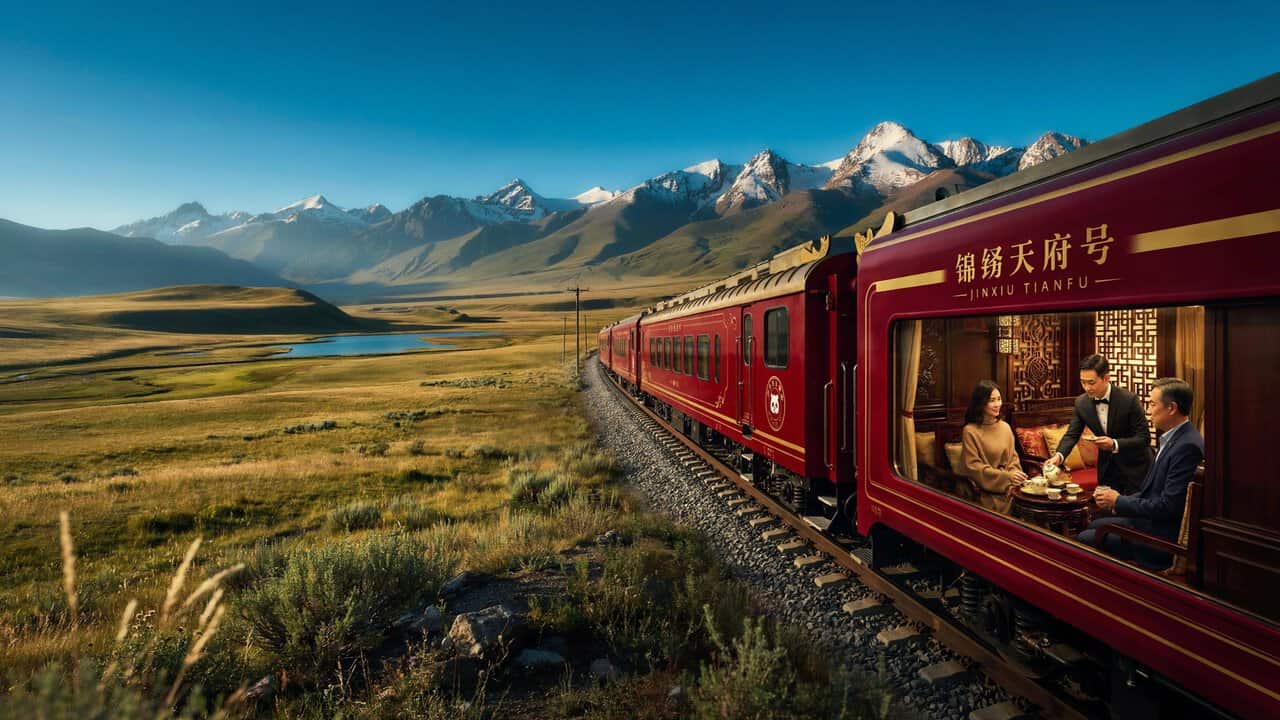
China’s luxury rail tourism sector is gaining attention through the Jinxiu Tianfu, an 18-carriage sightseeing train offering a 16-day, 15-night journey across northern and southern Xinjiang. Operated by Panda Roam as part of the Chengdu Panda Train series, the service combines Song Dynasty-inspired interiors, private passenger accommodation and personalised butler assistance. A travel account published on 12 October 2026 by Malaysian tourism executive Leesan describes a September journey beginning at Chengdu’s Anjing Station and ending at Chengdu West Railway Station. The experience highlights how China is developing rail holidays that combine cultural identity, onboard hospitality and organised destination visits.
What Makes China’s Jinxiu Tianfu Luxury Train Different From Conventional Rail Travel?
The Jinxiu Tianfu has been developed as a luxury sightseeing train rather than a conventional passenger service focused primarily on reaching a destination.
Its travel concept combines onboard accommodation, cultural design, personalised hospitality and organised excursions.
The train forms part of the Chengdu Panda Train series and is operated by Panda Roam, whose director, Liu Na, has been associated with the development of the concept.
Advertisement
Advertisement
Unlike standard intercity trains, where passengers usually purchase transport between two stations, the Jinxiu Tianfu is designed around an extended holiday experience.
The 16-day, 15-night itinerary described in the October 2026 account covers destinations across northern and southern Xinjiang.
Advertisement
Advertisement
Passengers spend nights aboard the train and participate in organised sightseeing activities when it stops at destinations along the journey.
The approach allows the railway experience itself to become an important part of the holiday.
Advertisement
Advertisement
Rather than treating the train as a means of travelling between hotels, the service integrates accommodation, transport and guided tourism into one journey.
Key Details of the Jinxiu Tianfu Luxury Train
| Category | Reported Information |
|---|---|
| Train name | Jinxiu Tianfu |
| Country | China |
| Train series | Chengdu Panda Train |
| Operator | Panda Roam |
| Operator representative | Liu Na |
| Journey duration | 16 days and 15 nights |
| Region explored | Northern and southern Xinjiang |
| Starting station in reported journey | Anjing Station, Chengdu |
| Ending station in reported journey | Chengdu West Railway Station |
| Number of carriages | 18 |
| Interior inspiration | Song Dynasty aesthetics |
| Accommodation | Passenger rooms and suites |
| Hospitality | Personalised butler service |
| Reported journey distance | 10,488 kilometres |
| Travel account published | 12 October 2026 |
The 10,488-kilometre distance was recorded on a certificate presented at the end of the reported journey.
It should not automatically be interpreted as the distance covered by every Jinxiu Tianfu itinerary, since routes and operating arrangements may vary.
How Does the Jinxiu Tianfu Bring Traditional Chinese Culture Into Luxury Rail Tourism?
One of the train’s distinguishing characteristics is its interior design, which draws inspiration from China’s Song Dynasty.
Advertisement
Advertisement
The Song Dynasty, which lasted from 960 to 1279, is associated with important developments in Chinese art, literature, architecture and aesthetic culture.
The Jinxiu Tianfu incorporates design influences intended to create a restrained and distinctly Chinese atmosphere.
The 18 carriages use visual elements that emphasise balance, simplicity and carefully arranged interior spaces.
In his published account, Leesan highlighted the train’s use of traditional design principles, particularly the sense of restraint and uncluttered space.
This approach contrasts with some luxury hospitality interiors that rely on elaborate decoration or highly conspicuous displays of wealth.
For international travellers, the design offers an opportunity to encounter elements of Chinese cultural identity while moving through the country’s landscapes.
Advertisement
Advertisement
The train therefore functions as more than a mobile hotel.
Its interior environment contributes to the cultural experience that the operator is seeking to create.
However, the available account does not provide a complete technical description of carriage materials, interior dimensions or design specifications.
Those details should not be assumed.
What Accommodation and Facilities Are Available on the Jinxiu Tianfu?
The Jinxiu Tianfu offers passenger rooms and suites designed for extended journeys.
The accommodation forms part of the train’s luxury travel concept, allowing passengers to remain aboard during overnight travel between destinations.
Advertisement
Advertisement
This arrangement can reduce the need for repeated hotel changes during a multi-stop itinerary.
For travellers exploring a geographically extensive region such as Xinjiang, the convenience of sleeping aboard the train can be an important consideration.
The service also provides personalised hospitality through onboard butlers.
However, the available October 2026 travel account does not specify the number of suites, accommodation categories, room dimensions, passenger capacity or individual cabin prices.
It also does not establish whether all rooms provide identical facilities.
Accommodation and Service Features
| Feature | Reported Details |
|---|---|
| Passenger accommodation | Rooms and suites |
| Interior design | Song Dynasty-inspired |
| Overnight travel | Part of the 16-day itinerary |
| Butler service | Available aboard the train |
| Personalised assistance | Reported during the journey |
| Guided excursions | Included in the described travel experience |
| Wheelchair assistance | One-to-one support reported for a passenger |
| Exact cabin categories | Not specified in the source |
| Published fares | Not provided in the source |
Prospective passengers should confirm accommodation arrangements directly with the operator before booking.
Advertisement
Advertisement
A luxury classification does not necessarily mean that every cabin offers the same amenities or that all optional services are included in the advertised fare.
Why Is Xinjiang an Important Destination for China’s Luxury Rail Tourism?
Xinjiang is one of China’s largest and most geographically diverse regions.
Located in the country’s northwest, it is known for extensive landscapes, mountain environments, desert regions and a variety of cultural traditions.
The scale of the region makes transport planning an important part of a holiday.
Travellers exploring several destinations may face lengthy road journeys, particularly when moving between widely separated locations.
The Jinxiu Tianfu’s itinerary is designed to address part of this challenge by combining overnight rail travel with daytime sightseeing.
Advertisement
Advertisement
According to Leesan’s account, travelling by train allowed passengers to sleep while moving between destinations and continue exploring after arriving at the next stop.
This contrasts with itineraries that require several hours of coach travel during the day.
The advantage is not necessarily faster transport in every situation.
Instead, the train changes how travel time is used.
Passengers can spend part of the journey resting aboard rather than remaining seated on a road vehicle for extended periods.
Northern and Southern Xinjiang Offer Different Travel Experiences
The reported itinerary covered both northern and southern Xinjiang.
Advertisement
Advertisement
These areas are associated with different landscapes, cultural environments and travel experiences.
Northern Xinjiang is widely recognised for mountain scenery, grasslands, lakes and forested landscapes.
Southern Xinjiang includes desert environments, oasis settlements and destinations associated with the historical Silk Road.
A journey incorporating both regions can therefore introduce travellers to contrasting geographical and cultural settings.
However, the published account does not provide a complete station-by-station itinerary or confirm every destination visited.
It would be misleading to present particular attractions as guaranteed stops without an official programme.
Advertisement
Advertisement
How Does Personalised Butler Service Shape the Jinxiu Tianfu Experience?
The train’s hospitality service is one of the strongest themes in the October 2026 travel account.
Leesan described interactions with Katherine Zhang, identified as the train’s chief butler, and other members of the onboard team.
The service went beyond routine cabin assistance.
According to the account, staff became familiar with passengers’ names and preferences during the extended journey.
Such details can be significant in luxury tourism because passengers spend several days interacting with the same hospitality team.
A personalised approach may help create continuity and familiarity during a long itinerary.
Advertisement
Advertisement
The account also described the coordination of onboard and land-based services.
Staff were reportedly sent ahead to inspect facilities and prepare refreshment arrangements before passengers arrived at certain destinations.
These preparations included checking restaurants and public washrooms used during excursions.
The report stated that cleaning personnel were sometimes deployed where necessary.
These observations come from one traveller’s experience and should not be interpreted as a guarantee that every departure includes identical arrangements.
Nevertheless, they illustrate the service model described by the operator and experienced during the reported journey.
Advertisement
Advertisement
How Does the Train Support Travellers With Mobility Requirements?
One of the most notable examples in Leesan’s account involved a fellow passenger who used a wheelchair.
According to the report, the Jinxiu Tianfu team assigned a dedicated personal butler to assist the traveller throughout sightseeing activities.
The arrangement provided individual support during excursions away from the train.
For passengers with mobility requirements, assistance can influence whether a multi-destination holiday is practical and comfortable.
However, personal assistance should not be confused with comprehensive accessibility certification.
The report does not provide technical details about wheelchair-accessible cabins, door widths, lifts, boarding arrangements or step-free access at every station.
Advertisement
Advertisement
Nor does it confirm that the same level of assistance is automatically included for every passenger with accessibility needs.
Travellers requiring mobility support should discuss their circumstances with the operator before booking.
Accessibility Questions Worth Confirming
- Whether the selected cabin is suitable for the passenger’s mobility requirements.
- How boarding and disembarkation are managed.
- Whether accessible washroom facilities are available.
- What assistance is provided during sightseeing excursions.
- Whether additional support must be requested in advance.
- Which destinations may involve steps, uneven ground or restricted access.
The reported one-to-one assistance demonstrates a positive individual experience, but detailed accessibility arrangements require direct confirmation.
How Does Overnight Rail Travel Change the Experience of Exploring Xinjiang?
The Jinxiu Tianfu’s 16-day itinerary demonstrates a different approach to long-distance sightseeing.
Traditional multi-destination holidays may involve repeated hotel check-ins, packing, road transfers and travel between attractions.
A luxury train can consolidate some of these activities by providing accommodation and transport within the same vehicle.
Advertisement
Advertisement
During the reported journey, passengers travelled overnight and explored destinations during the day.
This arrangement can allow travellers to use daytime hours for sightseeing rather than spending substantial portions of the day on long-distance transfers.
It also creates continuity because passengers return to familiar accommodation after excursions.
For some travellers, that may be particularly attractive during an extended holiday.
However, overnight rail travel does not eliminate all transfers.
Excursions may still require coaches or other vehicles to reach attractions away from railway stations.
Advertisement
Advertisement
The experience therefore depends on how effectively the operator coordinates railway movements with land-based activities.
The Jinxiu Tianfu account suggests that this coordination was an important part of the service.
What Role Does Panda Roam Play in China’s Luxury Railway Development?
Panda Roam operates the Jinxiu Tianfu as part of the Chengdu Panda Train series.
Liu Na, identified as the company’s director, has been associated with developing the train’s tourism concept.
The approach combines Chinese cultural design, luxury accommodation and organised sightseeing.
The service reflects a broader opportunity within China’s tourism industry to develop rail holidays that appeal to travellers seeking experiences beyond conventional transport.
Advertisement
Advertisement
China already has an extensive railway network, including high-speed and conventional services.
Luxury sightseeing trains occupy a different market segment.
Their appeal depends less on reaching a destination quickly and more on the overall journey, including accommodation, hospitality and cultural experiences.
Leesan’s account compared the emerging Chinese luxury train sector with established international rail experiences.
However, the article represents a personal assessment rather than an independent ranking of global luxury trains.
It does not establish that the Jinxiu Tianfu is objectively superior to competing services.
Advertisement
Advertisement
The more significant development is the emergence of a Chinese luxury rail product with a distinct cultural identity.
How Does Jinxiu Tianfu Compare With Established International Luxury Trains?
Luxury railway tourism is already established in several international markets.
Examples include Australia’s The Ghan and the Eastern & Oriental Express in Southeast Asia.
These services are associated with extended rail journeys, onboard hospitality and distinctive destination experiences.
The Jinxiu Tianfu enters this market with an emphasis on Chinese design and travel through Xinjiang.
Luxury Rail Tourism Comparison
| Train | Main Region | Distinctive Travel Focus |
|---|---|---|
| Jinxiu Tianfu | China | Xinjiang exploration and Chinese cultural design |
| The Ghan | Australia | Long-distance travel through Australia’s interior |
| Eastern & Oriental Express | Southeast Asia | Luxury rail journeys through regional landscapes |
| Trans-Siberian Railway | Russia | Long-distance railway travel across Russia |
These services differ in their routes, operating models, accommodation and pricing.
Advertisement
Advertisement
The Trans-Siberian Railway is primarily a railway route rather than a single luxury train product, although premium tourism services have historically operated on parts of the network.
The comparison therefore illustrates different forms of long-distance railway travel rather than establishing an equivalent product category.
For travellers, the most useful comparison involves the actual itinerary, accommodation, included excursions, accessibility and total journey cost.
Why This Matters
The Jinxiu Tianfu illustrates how China is developing tourism experiences that use railway transport as part of the attraction rather than simply as a means of reaching destinations.
Its 16-day Xinjiang itinerary combines accommodation, cultural design, personalised service and organised sightseeing.
For international travellers, the concept offers an alternative to road-based multi-destination holidays.
Advertisement
Advertisement
For China’s tourism industry, the service demonstrates how traditional cultural influences can be incorporated into contemporary premium travel products.
The train’s Song Dynasty-inspired interiors provide a distinctive identity, while its hospitality arrangements highlight the importance of personalised experiences.
However, the published account does not include independently verified passenger satisfaction data, annual visitor figures or commercial performance statistics.
The wider economic impact of the service therefore cannot be quantified from the available information.
Its immediate significance lies in the development of a luxury rail experience that combines long-distance travel with Chinese cultural presentation.
What Travellers Should Know
Travellers considering the Jinxiu Tianfu should understand that the reported 16-day, 15-night journey represents a particular itinerary described in September 2026.
Advertisement
Advertisement
The account does not establish that every departure follows the same route or includes identical services.
Before Booking
- Train: Jinxiu Tianfu, part of the Chengdu Panda Train series.
- Operator: Panda Roam.
- Reported itinerary: 16 days and 15 nights across northern and southern Xinjiang.
- Starting point: Anjing Station, Chengdu, for the reported journey.
- Ending point: Chengdu West Railway Station.
- Accommodation: Passenger rooms and suites.
- Hospitality: Butler service and organised sightseeing assistance.
- Accessibility: Confirm individual requirements directly with the operator.
- Prices: Not provided in the available account.
- Departure dates: Must be verified against the operator’s current programme.
- Travel documents: International visitors should check applicable Chinese entry requirements.
Passengers should also clarify which meals, excursions, transfers and optional services are included in their booking.
What Should International Visitors Consider Before Travelling to Xinjiang?
Xinjiang’s geographical scale makes itinerary planning particularly important.
A journey covering northern and southern areas may involve substantial distances between destinations.
Travellers should review the programme carefully to understand how much time is spent aboard the train and how much is allocated to sightseeing.
Seasonal conditions may also influence the travel experience.
Advertisement
Advertisement
Different parts of Xinjiang experience varying temperatures and weather conditions, making appropriate clothing and preparation important.
International visitors should check current entry requirements, passport validity and any travel arrangements applicable to their nationality.
They should also review insurance coverage, medical requirements and accessibility arrangements.
The published travel account does not provide a complete list of included excursions, so travellers should request the official itinerary before making payment.
Frequently Asked Questions
1. What is the Jinxiu Tianfu luxury train in China?
The Jinxiu Tianfu is a luxury sightseeing train operated by Panda Roam as part of the Chengdu Panda Train series. It combines Song Dynasty-inspired interiors, passenger accommodation, personalised butler service and organised sightseeing experiences.
2. How long is the Jinxiu Tianfu journey through Xinjiang?
The journey described in the October 2026 travel account lasted 16 days and 15 nights, covering destinations across northern and southern Xinjiang. Other departure itineraries should be confirmed directly with the operator.
Advertisement
Advertisement
3. Where does the Jinxiu Tianfu train journey begin and end?
The reported September 2026 journey began at Anjing Station in Chengdu and concluded at Chengdu West Railway Station. These locations refer to that particular itinerary.
4. Does the Jinxiu Tianfu provide private suites and butler service?
The train offers passenger rooms and suites, together with personalised onboard hospitality. The reported journey included butler assistance and support during sightseeing excursions. Exact cabin categories and service inclusions should be confirmed before booking.
5. How much does the Jinxiu Tianfu luxury train cost?
The supplied travel account does not provide verified ticket prices. Fares may depend on the departure, accommodation category and included services. Travellers should request current pricing and booking conditions from the operator.
China’s Jinxiu Tianfu Shows How Cultural Identity and Personalised Hospitality Can Shape Luxury Rail Travel
The Jinxiu Tianfu represents an emerging approach to luxury railway tourism in China, combining long-distance sightseeing with cultural design and personalised hospitality.
Its reported 16-day, 15-night journey across northern and southern Xinjiang demonstrates how extended rail holidays can bring together accommodation, transport and organised excursions.
The train’s 18 carriages, Song Dynasty-inspired interiors and individualised service arrangements distinguish it from conventional passenger rail travel.
Advertisement
Advertisement
The September 2026 journey described by Malaysian tourism executive Leesan also highlighted the importance of practical details, including advance preparation for excursions and assistance for passengers with mobility requirements.
The reported 10,488-kilometre journey ended at Chengdu West Railway Station, where passengers received commemorative certificates.
Although the account reflects one traveller’s experience rather than an independently audited assessment, it provides insight into the service model being developed by Panda Roam.
For international visitors interested in exploring China’s vast landscapes through an extended rail holiday, the Jinxiu Tianfu offers a distinctive concept. Its broader significance lies in demonstrating how cultural identity, attentive hospitality and carefully organised travel can become central
Advertisement
