
Berlin Shoulder Season Emerges as a Quieter Window for Museums, Kreuzberg and Neukölln in Germany

Published
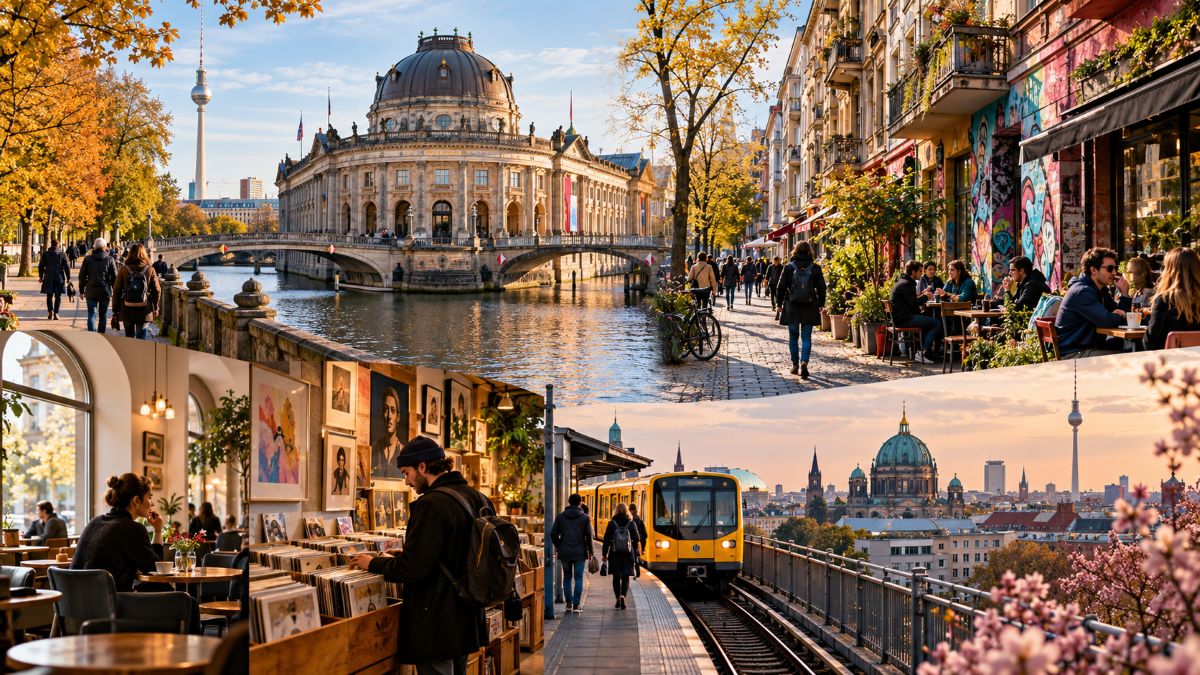
Image generated with Ai
Berlin may be at its most revealing between the major visitor peaks, when tourism remains substantial but the city’s cultural machinery feels less compressed. In 2025, Berlin welcomed 12.4 million guests and recorded 29.4 million overnight stays, yet monthly demand varied sharply across the year. July generated 1.15 million visitors and 2.92 million overnight stays, while February recorded 857,046 visitors and 1.99 million overnight stays. September still attracted 1.09 million visitors, proving that the quieter periods remain commercially significant.
The figures challenge the conventional idea of a simple “busy season” and “off-season”. Berlin remains a year-round cultural destination, with 13.8 million museum, exhibition and memorial visits in 2025. The opportunity for travellers is therefore not merely fewer people, but a different rhythm for exploring museums, galleries, neighbourhoods, food and independent culture.
Advertisement
Advertisement
The Numbers Reveal Berlin’s Seasonal Rhythm
Berlin’s tourism market is enormous, but its annual flow is not evenly distributed. Official statistics show that visitor arrivals reached their highest levels in May, June and July 2025, before easing through August, September and October. January and February remained the softest months, although both still generated substantial visitor volumes.
The distinction becomes clearer when comparing monthly overnight stays. July reached nearly 2.92 million, while February stood at approximately 1.99 million. That represents a difference of roughly 47 per cent, although February cannot simply be treated as representative of every shoulder-season month. September generated 2.58 million overnight stays, placing it much closer to the summer peak.
Advertisement
Advertisement
| Month | 2025 Visitors | 2025 Overnight Stays |
|---|---|---|
| January | 751,979 | 1,724,267 |
| February | 857,046 | 1,985,540 |
| March | 985,962 | 2,278,178 |
| April | 1,023,180 | 2,551,751 |
| May | 1,150,423 | 2,711,068 |
| June | 1,171,372 | 2,689,621 |
| July | 1,152,264 | 2,917,685 |
| August | 1,010,074 | 2,631,895 |
| September | 1,088,919 | 2,577,661 |
| October | 1,119,880 | 2,709,352 |
| November | 1,052,488 | 2,329,794 |
| December | 1,011,621 | 2,336,479 |
This creates a useful distinction for travellers. September, October, March, April and November are not empty periods; they are commercially active months with meaningful cultural and hospitality activity. Meanwhile, January and February provide the clearest reduction in tourism intensity.
Advertisement
Advertisement
A City That Does Not Shut Down
Berlin’s cultural offer makes seasonality particularly interesting. State-funded museums, exhibition spaces and memorial institutions attracted around 13.8 million visits in 2025, maintaining a high level despite budget pressures and changing travel patterns.
The city’s cultural ecosystem is also remarkably broad. In 2025, the Deutsches Technikmuseum attracted 691,143 visitors, while the Topographie des Terrors recorded 1.58 million. Smaller institutions also continued building audiences, including the Werkbundarchiv – Museum der Dinge with 15,228 visitors and the Bauhaus-Archiv’s interim site with 111,269.
That matters because a quieter Berlin does not mean a reduced Berlin. The cultural calendar remains substantial even when visitor volumes soften, allowing travellers to substitute frantic attraction-hopping with deeper cultural encounters.
The 2025 museum rankings reinforce this breadth. The Humboldt Forum, Topographie des Terrors, Berlin Wall Memorial, Museum für Naturkunde and Deutsches Technikmuseum were among the city’s most visited institutions.
For visitors, this creates a practical advantage. A day can begin with a major institution before moving towards a smaller gallery, independent shop or neighbourhood café without requiring every hour to revolve around a headline attraction.
Advertisement
Advertisement
The Shoulder Season Is More Than Fewer Queues
The strongest case for travelling between peak periods is not simply shorter queues. It is the possibility of recovering unstructured time.
Berlin’s latest Quality Monitor provides an important clue. The 2025/26 study surveyed around 1,500 visitors and found that the leading reasons for visiting were sights at 60 per cent, art and culture at 55 per cent, and the diversity and quality of the city’s offer at 51 per cent.
The same research shows that visitors do more than sightsee. Restaurant and café visits, walking and wandering are among the most common activities after visiting attractions. That makes an unhurried neighbourhood itinerary particularly relevant to how people already experience Berlin.
The result is a different travel proposition. Instead of asking how many landmarks can fit into one day, travellers can ask how much of Berlin can be absorbed between them.
From Museum Island to Neighbourhood Berlin
The geography of Berlin’s tourism also strengthens the case for looking beyond the central core. Mitte accounted for around 13.6 million overnight stays in 2025, compared with approximately 4.4 million in Charlottenburg-Wilmersdorf and 4.2 million in Friedrichshain-Kreuzberg.
Advertisement
Advertisement
That concentration does not mean visitors should avoid Mitte. Instead, it highlights the opportunity to combine the city’s most famous cultural quarter with districts that have developed their own visitor economies.
Friedrichshain-Kreuzberg recorded around 1.7 million overnight guests in 2025. The district has 82 accommodation establishments and roughly 20,000 beds, with an average annual accommodation occupancy of around 60 per cent. Visitors stayed for an average 2.5 days.
The district’s tourism strategy also emphasises city-compatible travel. Its “fair.kiez” campaign has promoted sustainable tourism since 2015, reflecting a wider shift from concentrating visitors around famous landmarks towards strengthening neighbourhood experiences.
Neukölln offers another layer. Its parks, galleries, independent businesses, food scene and residential streets create a more dispersed urban experience. The point is not that these districts are secret. Rather, they demonstrate how Berlin’s visitor economy extends beyond its postcard geography.
Berlin’s Tourism Strategy Is Changing
This neighbourhood emphasis is not accidental. Berlin is increasingly trying to manage tourism as an urban system rather than simply maximise visitor numbers.
Advertisement
Advertisement
visitBerlin’s current strategy explicitly focuses on strengthening neighbourhoods, protecting quality of life and distributing visitor flows. Its 2026 programme includes cooperation with Berlin’s twelve districts to highlight local attractions and spread tourism more broadly.
That policy direction gives shoulder-season travel a wider significance. Travellers who explore beyond the most concentrated attractions can contribute to a broader visitor economy, although the available data does not establish that shoulder-season visitors automatically create better economic outcomes.
Berlin’s approach also incorporates data-based visitor management. visitBerlin is developing visitor-flow measurement using mobility data and operates a tourism data hub containing roughly 240,000 records.
For travellers, the implication is straightforward. A more distributed itinerary increasingly aligns with the destination’s own approach to managing tourism.
The Economic Case Needs More Nuance
It is tempting to describe quieter months as automatically cheaper. That would oversimplify the evidence.
Advertisement
Advertisement
Berlin’s 2025 tourism performance shows that demand remains considerable outside summer. October generated 1.12 million visitors and 2.71 million overnight stays, while November still recorded more than one million visitors and 2.33 million overnight stays.
Hotel prices, therefore, cannot be assumed to collapse simply because summer has ended. Business travel, exhibitions, conferences, concerts and major events can generate powerful pockets of demand.
The practical lesson is to compare specific dates rather than seasons in the abstract.
| Travel period | Visitor intensity | Cultural offer | Traveller consideration |
|---|---|---|---|
| January–February | Lower | Strong indoor offer | Weather and daylight |
| March–April | Moderate | Strong | Good balance for culture |
| May–July | Highest | Very strong | Outdoor life and events |
| August | High but easing | Strong | Summer atmosphere |
| September–October | Moderate-high | Very strong | Strong city-break window |
| November | Moderate | Strong indoor offer | Shorter days |
| December | Moderate | Seasonal activity | Christmas demand can lift prices |
This table is a travel-planning framework, not a guarantee of crowd levels at individual attractions.
A More Sustainable Way to Move
The case for travelling outside peak periods also intersects with Berlin’s evolving sustainability strategy. In September 2026, Berlin moved to third place in the Global Destination Sustainability Index, achieving an overall score of 85 per cent. The city had ranked fourth in 2025.
Advertisement
Advertisement
The sustainability discussion extends beyond environmental credentials. Berlin’s model increasingly considers visitor distribution, accessibility, resident acceptance and the economic contribution of tourism.
A 2024 representative survey of more than 3,000 Berlin residents found that 82 per cent did not feel restricted or disturbed by visitors. Meanwhile, 67 per cent welcomed tourism-related tax revenue and 64 per cent recognised tourism’s role in creating jobs.
That does not mean tourism pressure has disappeared. Instead, it demonstrates why how visitors move through the city matters alongside how many arrive.
Rail Makes the Slower Journey Easier
Transport patterns also support the idea of a less frantic city break. Berlin’s latest visitor research found that rail accounted for 43 per cent of international arrivals, compared with 30 per cent arriving by air.
That is significant for European travellers considering a slower urban journey. Berlin is increasingly accessible by direct international rail services, while the city itself offers extensive public transport connections between central attractions and neighbourhood districts.
Advertisement
Advertisement
The shift also changes the psychology of the trip. A rail arrival can make Berlin feel like part of a European journey rather than merely an isolated weekend destination.
For travellers arriving by air, the same principle applies once inside the city. Building an itinerary around rail, U-Bahn, tram, walking and cycling can reduce the need for rigid point-to-point sightseeing.
What Travellers Should Actually Do
The most useful shoulder-season strategy is not to remove famous attractions. It is to leave deliberate space around them.
A traveller could reserve one major museum appointment in the morning, then move towards Kreuzberg without pre-booking every subsequent hour. An afternoon could unfold through a gallery, café, record shop, market or park before dinner in Neukölln.
The value lies in the sequencing rather than the individual stops. Berlin rewards itineraries that have structure at the beginning and flexibility at the end.
Advertisement
Advertisement
Travellers should still check exhibition schedules, weekly closing days, seasonal opening hours and advance-ticket requirements. Major exhibitions can create their own demand peaks regardless of the wider month.
Berlin Still Has Its Summer Advantages
A credible assessment must acknowledge what shoulder-season travel gives up. Berlin’s warmer months bring longer daylight, outdoor swimming, beer gardens, open-air performances, festivals and a different relationship with the city’s parks and waterways.
Therefore, there is no universal “best” month. A traveller prioritising outdoor life may value summer conditions, while someone focused on museums, galleries, architecture, food and neighbourhood exploration may place greater value on the periods outside the main peak.
The data supports that distinction. Berlin is not a seasonal destination in the conventional resort sense; it is a year-round metropolitan destination whose intensity changes from month to month. visitBerlin itself describes January and February as lower-demand months while noting that overnight stays remain relatively evenly distributed across the year.
The City Between Its Peaks
Berlin’s tourism figures tell a more nuanced story than the familiar summer-versus-winter divide. The city received 12.4 million guests in 2025, yet monthly demand shifted considerably while museums, galleries, restaurants and neighbourhood businesses continued operating throughout the year.
Advertisement
Advertisement
For travellers, that creates an intriguing proposition. The reward of visiting between the peaks is not necessarily cheaper travel or empty streets, but more room to choose how the city is experienced.
The strongest itinerary may therefore begin with Berlin’s great institutions and end somewhere less predictable. A museum can lead to Kreuzberg, a gallery can lead to Neukölln, and an afternoon without reservations can reveal more than another item on a checklist. Berlin’s shoulder periods offer the conditions for that style of travel, while its latest tourism strategy increasingly encourages wider neighbourhood discovery.
Advertisement
