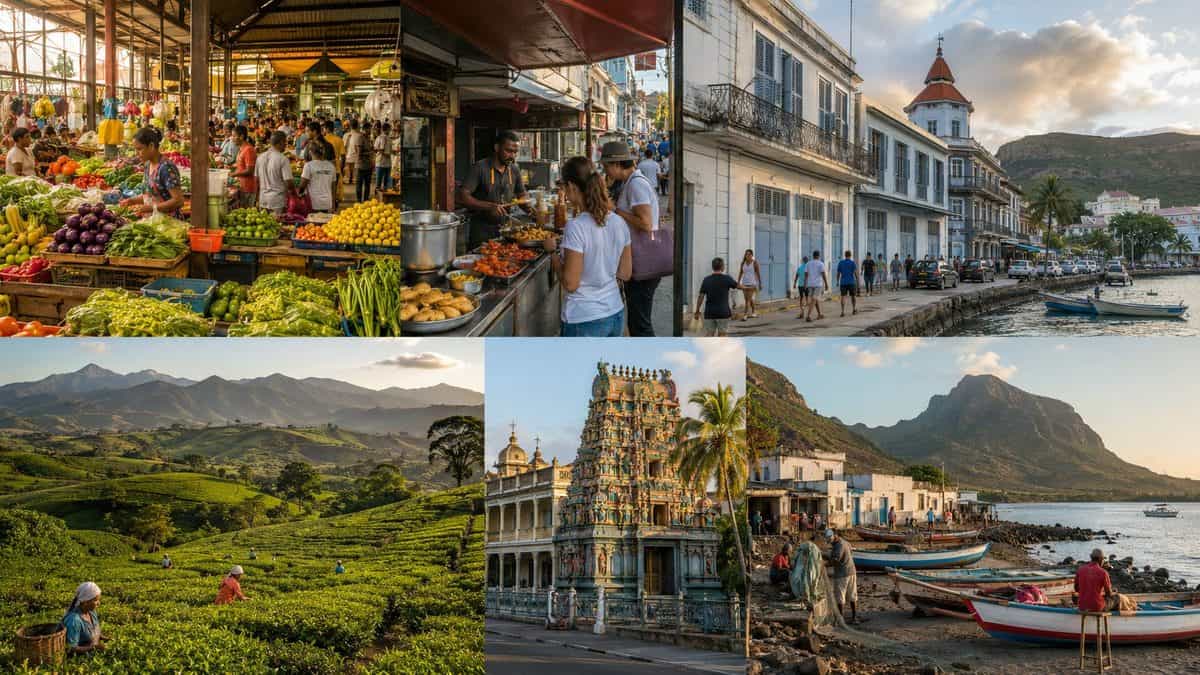
Image generated with Ai
Mauritius now has a new kind of tourism because its resort coastline isn’t as interesting for many visitors as they look beyond it. A better way to see Mauritius is to look at the markets, heritage towns, village life, food, tea country, and the landscapes of the island from the center. Government statistics report 1.436 million people visited Mauritius in 2025, an increase of 3.9% compared to 2024. Indian tourists visited Mauritius in 2025 more than any other year, totaling 75,808 at a 33.5% increase. The average of money spent on one night of travel and stay was Rs6,600 for the first half of 2025. With these statistics, there’s room to grow Mauritius tourism because the demand is high for travel experiences beyond the resorts.
Mauritius has long been marketed through a familiar visual language. Turquoise lagoons, luxury hotels, catamarans and palm-fringed beaches dominate its international image. Yet the island’s tourism strategy increasingly recognises the value of a broader product mix, including cultural tourism, eco-tourism, wellness and other experiences. The Tourism Ministry’s stated mission includes broadening the tourism portfolio and making leisure experiences more accessible.
Advertisement
That shift matters because Mauritius is not simply a beach destination. It is a compact island shaped by African, Indian, European and Asian influences. Its streets, food traditions, religious landmarks and agricultural landscapes reveal that history more vividly than a resort can.
The latest spending data also strengthen the case for dispersing visitor activity. In the first half of 2025, tourists staying in hotels spent an average Rs10,700 per night. Those using non-hotel accommodation averaged Rs1,900. Package travellers also spent substantially more per night than non-package visitors.
Advertisement
For the traveller, that does not mean abandoning the resort. Instead, it means building a Mauritius itinerary around several layers of the island.Indicator 2024 2025 Change Tourist arrivals 1,382,177 1,436,250 +3.9% Air tourist arrivals 1,348,400 1,411,791 +4.7% Sea tourist arrivals 33,777 24,459 -27.6% Indian arrivals 56,788 75,808 +33.5% Average stay 11.4 nights Latest annual figure varies by release —
Port Louis Central Market provides one of the easiest introductions to everyday Mauritius. The market is not merely a tourist attraction. It functions as a shopping and food hub where residents buy produce, snacks and household goods.
The experience becomes more rewarding when visitors treat the market as a living place rather than a photography stop. Tropical fruit, vegetables, spices, street food and local drinks create a sensory introduction to the island’s culinary culture. Dholl puri, samosas and alouda are among the foods associated with the market environment.
Travellers should also explore the surrounding streets. Port Louis places the market near Chinatown and the Caudan waterfront, allowing visitors to move between different architectural and cultural layers within a relatively compact area.
The practical lesson is simple. Visit early, eat locally and allow time to wander. The market works best as the beginning of a city morning rather than a rushed excursion between resort activities.
Mahébourg deserves a different kind of attention because it offers historical context without the intensity of a conventional capital-city visit. The town sits beside the south-eastern coast and carries strong links to Mauritius’ colonial and maritime past.
Its National History Museum occupies Château Gheude, also known as Maison Robillard. The building dates to around 1772 and stands within a park of roughly 12 acres beside the River La Chaux. The museum traces Mauritius’ history through successive Dutch, French and British periods.
That makes Mahébourg particularly useful for travellers who want to understand the island before interpreting its modern cultural landscape. Historical objects, maps, paintings and maritime archaeological material provide context that beaches alone cannot supply.
A slower visit can combine the museum with a walk through town and time near the waterfront. The attraction is not a single landmark. It is the relationship between history, streetscape and coastal life.
Mauritius’ food culture is one of the clearest expressions of its mixed heritage. A traveller can encounter Indian-inspired breads and curries, Chinese influences, Creole cooking and European techniques within the same journey.
The smarter approach is to look beyond formal hotel dining. Dholl puri, farata, gato pima and rougaille provide entry points into everyday Mauritian food culture. Street stalls, small eateries and markets can offer a more revealing experience than a carefully designed resort menu.
That distinction also has an economic dimension. Local dining spreads visitor spending beyond large accommodation businesses and introduces travellers to smaller operators. The country’s tourism authorities explicitly identify local entrepreneurs, artisans and cultural practitioners as important participants in the wider tourism value chain.
Travellers should still exercise judgement over hygiene and food handling. Busy establishments with strong local patronage can often provide useful signals, but no single rule guarantees quality.
Mauritius’ multicultural character is not a decorative backdrop. It is central to the island’s history.
Religious buildings, festivals, music, food and community traditions reflect centuries of migration and cultural exchange. The National Heritage Fund maintains inventories covering intangible traditions including Sega Tipik Morisien and Geet Gawai, demonstrating the depth of the island’s recognised cultural heritage.
Visitors can approach this landscape through temples, churches, mosques, shrines and cultural institutions. However, the experience requires restraint. Places of worship remain active community spaces, not simply tourist attractions.
Dress modestly where appropriate, follow photography restrictions and observe local behaviour before taking photographs. The best cultural encounter is one where the visitor remains an observer rather than turning a living tradition into a performance.
The island’s interior changes the visual grammar of a Mauritius holiday. Sugar-cane fields, mountain silhouettes, forests and villages replace the uninterrupted coastal panorama.
This is where a road journey becomes an experience in its own right. Rather than measuring the day by the number of attractions visited, travellers can use inland routes to connect different parts of the island.
The approach also counters one of the most common planning mistakes: treating Mauritius as a collection of isolated resort excursions. A scenic drive can connect food, heritage, agriculture and landscape in one continuous day.
The wider tourism policy supports this diversification. Mauritius officially aims to develop products beyond traditional leisure, including eco-tourism and cultural tourism.
Mauritius has no shortage of spectacular beaches. Yet travellers do not always need another famous viewpoint.
A quieter coastal experience can involve walking, watching fishing activity, exploring a village waterfront or simply spending time beside the lagoon without scheduling several excursions.
The important distinction is that “quiet” does not mean “secret”. Promoting fragile or residential locations as undiscovered secrets can create precisely the crowding that travellers hoped to avoid.
Instead, choose less heavily marketed areas and behave as a guest. Avoid obstructing residents, respect private property and take litter away. The reward is often a more relaxed coastal encounter.
Tea provides one of the island’s most distinctive alternatives to the beach itinerary. The official tourism platform describes the Tea Route as a journey through Domaine des Aubineaux, Bois Chéri and Saint Aubin, combining plantations, heritage, gardens, museums and tea tasting.
Bois Chéri is particularly associated with Mauritius’ tea-producing history. The experience introduces travellers to agriculture and landscape rather than simply sightseeing.
For visitors staying several days, tea country works especially well as an inland counterpoint to the coast. It also offers a different understanding of Mauritius’ economy and environment.
The route demonstrates why local experiences work best when they are connected. A plantation visit, village stop and meal can become a coherent story about the island rather than three unrelated attractions.
Village exploration requires more sensitivity than visiting a museum or viewpoint. The objective should never be to treat residents as part of the scenery.
Instead, travellers can slow down, observe architecture, support a local café, visit legitimate community businesses and understand how daily life differs from resort districts. This approach produces a less polished but often more memorable picture of Mauritius.
It also aligns with the country’s broader ambition for inclusive tourism. The Tourism Ministry has stated that economic opportunities should extend beyond traditional hospitality and reach smaller entrepreneurs and cultural practitioners.
The most useful rule is therefore straightforward: spend locally without intruding locally.
There is another Mauritius after the day trips finish.
Evenings can shift the traveller’s focus towards local restaurants, waterfront walks, neighbourhood cafés and community life. This matters because a resort-heavy itinerary can unintentionally compress the island into daytime sightseeing.
An evening outside the hotel also changes the economics of the trip. Instead of concentrating almost every transaction inside accommodation, visitors can distribute spending among restaurants, small businesses and cultural venues.
Travellers should plan transport carefully, particularly outside major urban areas. Public transport options and operating hours vary, while driving after consuming alcohol should never be considered an option.
Perhaps the most valuable local experience is also the least spectacular: stop trying to see everything.
Mauritius is geographically compact, yet its landscapes and communities change markedly across the island. A traveller who spends several hours in one district can notice details that disappear during a rapid attraction-hopping itinerary.
This matters commercially as well as experientially. Mauritius recorded 15.42 million tourist nights in 2024, with an average stay of 11.4 nights. That gives many visitors enough time to build a more nuanced itinerary rather than concentrating every day around organised excursions.
A longer stay also allows flexibility around weather, transport and local opening times. Instead of filling every day, travellers can leave space for discoveries that were never in the original plan.
Travellers looking for context should also consider Mauritius’ two UNESCO World Heritage properties: Aapravasi Ghat and Le Morne Cultural Landscape. UNESCO lists both as cultural World Heritage properties.
Aapravasi Ghat in Port Louis is particularly significant for understanding Mauritius’ demographic history. UNESCO records that almost half a million indentured labourers arrived from India between 1834 and 1920, with Mauritius becoming an important centre of the wider indentured-labour diaspora.
Le Morne adds another dimension through its association with freedom, resistance and the history of enslaved people. Together, the two sites demonstrate why Mauritius cannot be reduced to its tropical scenery.Experience Best value for travellers Suggested time Port Louis market Food and everyday life 2–3 hours Mahébourg History and town character Half day Local food trail Cuisine and culture 2–4 hours Cultural sites Heritage understanding 2–3 hours Inland drive Landscapes and villages Full day Tea Route Agriculture and heritage Half/full day Village visit Everyday life 2–4 hours Quieter coastline Slow travel Half day Evening outside resort Local dining and atmosphere 3–4 hours UNESCO heritage Historical context Half day
Mauritius’ tourism numbers show a destination that continues to attract substantial international demand. Tourist arrivals rose from 1.382 million in 2024 to 1.436 million in 2025, while the country’s accommodation and food-service sector was expected to expand alongside tourism activity.
That growth creates both opportunity and pressure. More visitors can support restaurants, guides, artisans, transport providers and cultural enterprises. However, greater dispersal requires responsible visitor behaviour and careful management of sensitive sites.
The Tourism Authority explicitly has a mandate to encourage sustainable development and responsible tourism activity while preserving the integrity of the destination.
For travellers, that means choosing experiences that create genuine local value rather than simply chasing novelty. A meal from a small business, a heritage visit, a village walk or a locally guided excursion can make a holiday economically broader and culturally deeper.
Most memorable experiences during local Mauritius adventures usually do not involve finding hidden places. It is about finding your own perspective on things you pass by everyday.
A market has so much more to offer than some food. A village offers calm instead of a coastal line. Tea country offers a view of agriculture. The history you can find behind a rusty old door.
For a tourist destination that gets over 1.4 million visitors per year, local Mauritius tourism needs to be unique. They do not want visitors neglecting their beaches or resorts. They want visitors to see the country beyond.
The strongest itinerary then, leaves ample room for curiosity. Spend less time collecting tourist attractions, and more time discovering the spaces between where the island is. This is where Mauritius evolves into a destination beyond a postcard.
Advertisement
Tags: Mauritius culture, Mauritius itinerary, Mauritius local experiences, mauritius tourism, Mauritius Travel
Advertisement
Advertisement











Wednesday, September 2, 2026
Tuesday, September 1, 2026

Wednesday, September 2, 2026
Wednesday, September 2, 2026
Tuesday, September 1, 2026
Tuesday, September 1, 2026

Wednesday, September 2, 2026

Tuesday, September 1, 2026



