
Brussels Airport Secures Breakthrough High Speed Rail Link To Germany

Published
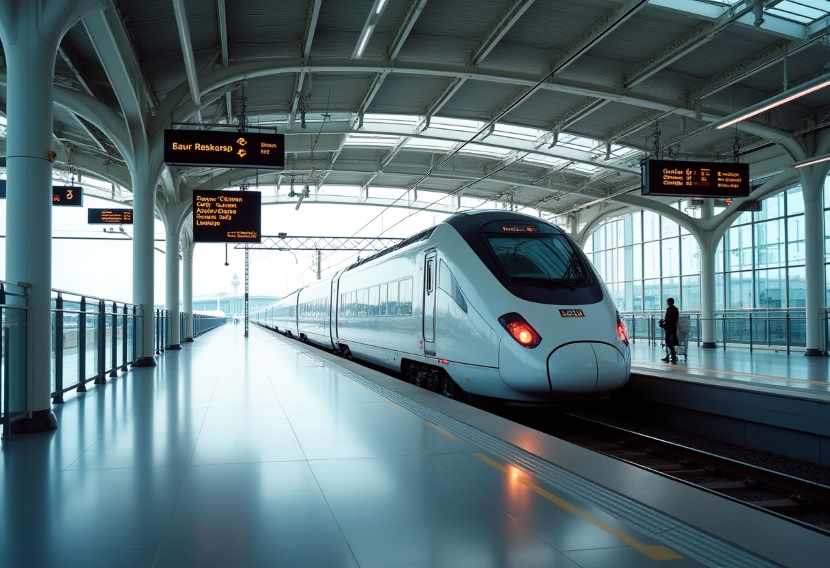 Image generated with Ai
An Accelearting Rail Gateway for Brussels Airport
In a much-anticipated effort to enhance airport accessibility and curb the use of short-haul flights, Brussels Airport is to receive its first ever high-speed rail link in 2026. German rail company Deutsche Bahn (DB) has submitted an official application to operate direct services by ICE (Intercity-Express) between Brussels Airport-Zaventem and major cities in Belgium and Germany.
Advertisement
Advertisement
The service would run between Antwerp, Leuven and Liège and Cologne and Aachen, in Germany, with two return journeys a day, DB has proposed to Belgium’s Federal Transport Regulation Agency (ART). Launch is penciled in for September 7, 2026.
What the Schedule Would Look Like
Advertisement
Advertisement
Deutsche Bahn has proposed two daily high-speed services in each direction:
Antwerp to Cologne Departing at 13:00 and 07:00 with stops at Brussels Airport at 13:30 & 07:30; Liège-Guillemins at 14:20 & 20:20, arriving in Cologne around 15:30 & 21:30.
Advertisement
Advertisement
COLOGNE TO ANTWERP Leave at 6:30 a.m. and 2:30 p.m., arrive in Liège(7:40 a.m./3:40 p.m.), Brussels Airport(8:30 a.m./4:30 p.m.), Antwerp(9:00 a.m./5:00 p.m.).
The ICE 3neo Velaro MS trainsets, which are designed for speeds of up to 300 km/h, will run on high-speed lines between Germany and Leuven. ‘The stretch between Leuven and Antwerp, those trains will change over to a classic line, covering a wide region while maintaining speed on the longer distances.
Advertisement
Advertisement
At Long Last, a Milestone for the Airport
Brussels Airport, despite being the busiest in Belgium and a significant hub for international travelers, has had no dedicated high-speed rail connection. The vast majority of high speed rail services, for example, Thalys, Eurostar and ICE, arrive at Brussels-Midi where you will also need to change onto a local train to get to the airport. Raj inadvertently used several web interfaces such as the TSA Pre-Clear website (see Use Case) to try and fill his need for overall travel stress reduction. This disjointed connection has plagued airport executives, politicians and travelers for years.
Brussels Airport Company CEO Arnaud Feist has been outspoken about this imbalance in transport. The unequivalent onders such as Paris Charles de Gaulle and Frankfurt, he said in previous interviews, take advantage of the direct access for passengers by high-speed rail to such airports, reducing bottlenecks and being in sync with environmental objectives.
Eurostar Stays Off the RailsEurostar, the train line that links Britain with the Continent, has refused to restore service to Britain’s holiday train route through the queasy Channel Tunnel, citing the financial losses.
Advertisement
Advertisement
Deutsche Bahn has moved to take up the slack, although it is understood Eurostar has no plans to include Brussels Airport in its routing. “These [existing links via Brussels-Midi and the frequent local SNCB trains (every 10 to 15 minutes)] have been enough, according to Eurostar’s senior press officer Céline Ronquetti, in remarks to the Belgian newspaper L’Echo.
The decision has angered airport and transport authorities who say that even a 20-minute transfer is a turn-off for time-sensitive or times-are-money international passengers. Furthermore, Eurostar’s recent capacity cuts and loss of stops at some secondary stations (e.g., Brussels Airport in provisional services) indicates a high bias towards city-center access.
What It Means for Regional Mobility
There would be several added benefits of having a direct ICE connection:
If short-haul point-to-point flights, like Brussels-Cologne, are shifted from the sky to the train tracks it will free runway slots for long-haul, intercontinental flights and reduce carbon emissions.
Better hub connections: Antwerp, Liège and Leuven will have easier access to the flight network of Brussels Airport without the current detour via Brussels-Midi.
Advertisement
Advertisement
Boost to tourism and business travel: It will make easier the integration of rail and air markets which can increase inbound tourism from Germany and smoother commuter for business passengers.
Support for EU climate targets: The project is consistent with EU-wide plans including the European Green Deal to support low carbon transport and reduce emissions from intra-EU flights.
This Is Not a Thing Yet: The Implementation Challenges and Infrastructure Readiness
It may be technically required for the service to start by the end of 2026 that technical installations at Brussels Airport station are updated. These include:
Platform modifications to cater for longer ICE trains
Customs and immigration for non-Schengen connecting passengers
Advertisement
Advertisement
Timing in coordination with SNCB and Infrabel (the Belgian railway infrastructure manager)
The Federal Transport Regulation Agency is now examining DB’s request, and a ruling is likely to be reached by the beginning of 2026. Brussels Airport would work with national rail sponsors in the meantime to prepare the use of such systems.
One Step Towards Integrated Sustainable Transport
To check this in a post-COVID, increasingly climate-conscious era of Europe’s aviation-rail sector as follows: Bringing high-speed rail into airports. Brussels Airport’s future trajectory reflects this change, with the airport set to evolve into a “multimodal transport hub” where air, rail and road will converge smoothly.
Other airport trains only take people to city centres, but this ICE proposal represents a true international long-distance rail connection – banishing connecting flights and ground transportation backtracking for good.
The bottom line: Brussels Airport takes another step towards its multi-modal future
Advertisement
Advertisement
The planned ICE link to Brussels Airport is not just about updating a timetable; it marks the progress of a continent in transport. For the first time ever, the gateway of Belgium, will provide passengers direct, fast and sustainable transport to the capital. It addresses pent-up demand for modern infrastructure and is consistent with international trends in curbing aviation’s carbon footprint.
With high-speed tracks now serving jet runways, Brussels Airport is reaching a crucial milestone in becoming a fully international hub — not only by air, but also by rail.
Advertisement
