
Germany Marks a Historic Lufthansa Milestone as First Airbus A350-1000 Rolls Out With Giant Anniversary Crane Design and Signals New Chapter in Global Aviation

Published
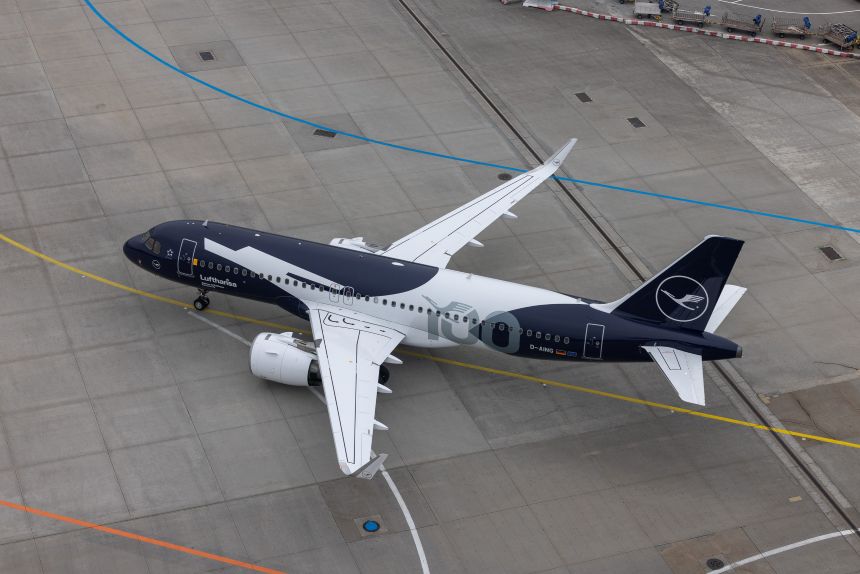
Image generated with Ai
Lufthansa has revealed its first Airbus A350-1000 after the aircraft received a striking blue-and-white centenary livery at Airbus’s Toulouse plant. Registered D-AIFA and set to be named “Deutschland”, the jet is due to move to Munich in autumn 2026 after test flights, cabin completion and final acceptance. It will also become the 700th Airbus aircraft delivered to the Lufthansa Group.
Lufthansa has taken a major visual and operational step towards introducing the largest member of the Airbus A350 family into its mainline fleet. The first A350-1000 has emerged from painting in Toulouse wearing a deep-blue anniversary design dominated by an oversized white crane, the number “100” and the dates “1926 | 2026”. However, the aircraft is not yet ready for passenger service. Airbus and Lufthansa must complete test flights, interior work and the formal acceptance process before the jet transfers to Munich during autumn 2026.
Advertisement
Advertisement
The arrival carries more weight than a routine fleet addition. D-AIFA will become Lufthansa’s seventh aircraft in the centenary colour scheme, the airline’s first A350-1000 and the 700th Airbus delivered to the wider Lufthansa Group. It will carry the name “Deutschland”, although the formal naming ceremony will take place later. With four cabin classes and 300 seats in Lufthansa’s selected configuration, the widebody will connect the airline’s history with its long-term programme of fleet renewal, premium cabin investment and more efficient intercontinental flying.
A First Look at Lufthansa’s Largest A350
The newly painted aircraft provides the clearest view yet of Lufthansa’s future flagship twin-engine jet. According to the official Lufthansa announcement, the Toulouse paint team used 432 litres of blue paint and 246 litres of white paint. The giant crane stretches across the fuselage, while the anniversary dates and “100” marking make the aircraft instantly recognisable. Lufthansa has kept the design clean rather than filling it with smaller commemorative graphics. D-AIFA remains in the production and delivery process, so its completed exterior should not be confused with its formal entry into the fleet.
Advertisement
Advertisement
Why D-AIFA Will Not Carry Passengers Immediately
Painting marks only one stage in the delivery programme for a new long-haul aircraft. Lufthansa says D-AIFA must still complete several test flights, further cabin work and a final acceptance inspection. These steps allow Airbus and the airline to verify that the aircraft, its systems and its passenger areas meet the agreed technical standards. The jet will then transfer from Toulouse to Munich. Lufthansa has confirmed an autumn 2026 timeframe, but it has not announced an exact handover date, inaugural flight or first destination. Travellers should therefore treat early route claims as speculation unless Lufthansa publishes them through its timetable or official newsroom.
The Deutschland Name Adds National Symbolism
Lufthansa has assigned the registration D-AIFA to the aircraft and plans to name it “Deutschland”. The choice gives the first A350-1000 a ceremonial role beyond normal fleet operations. Lufthansa has a long tradition of naming aircraft after German cities, states and national references, helping individual jets gain a recognisable identity. The airline has confirmed that the official naming event will happen later, so the title is planned even though the ceremony has not taken place. Combined with the anniversary design and enlarged crane, the name turns D-AIFA into a highly visible representation of Lufthansa’s German heritage during its centenary year.
Advertisement
Advertisement
A 700th Airbus Delivery Marks a Rare Milestone
D-AIFA is scheduled to become the 700th Airbus aircraft delivered to the Lufthansa Group. The milestone reflects one of the aviation industry’s longest and largest manufacturer-airline relationships. Lufthansa and Airbus marked 50 years of partnership in June 2026, tracing their connection to the delivery of Lufthansa’s first A300 in 1976. The Group has since operated aircraft from every major Airbus family, including the A220, A300, A320, A330, A340, A350 and A380. The official Airbus-Lufthansa partnership announcement places the new jet within a broader relationship covering operations, maintenance, technology and aircraft development.
Seven Metres Longer with Four Travel Classes
At 73.8 metres, the A350-1000 is seven metres longer than the A350-900 already used by Lufthansa. Airbus positions the type as a large widebody for high-capacity, long-range operations. Although standard layouts can hold considerably more passengers, Lufthansa has selected a 300-seat configuration across First Class, Business Class, Premium Economy and Economy Class. This lower-density arrangement points towards a strong premium focus rather than maximum seating. The longer fuselage gives the airline more room to balance high-value cabins with economy capacity. It may also help Lufthansa replace older aircraft on routes where substantial capacity remains necessary but operating efficiency must improve.
Premium Travel Sits at the Centre of the Plan
The four-class layout keeps First Class at the top of Lufthansa’s long-haul offer. The airline has not yet published a complete seat map for D-AIFA, so the exact number of seats in each cabin remains unconfirmed. However, Lufthansa’s wider Allegris cabin programme has already introduced redesigned products across Economy, Premium Economy, Business and First Class on selected A350-900 flights. The A350-1000 will support the same strategic direction by combining a modern widebody platform with stronger premium differentiation. Until Lufthansa releases aircraft-specific details, reports should separate the confirmed 300-seat, four-class layout from assumptions about individual seat designs or suite configurations.
Munich Gains Another Important Long-Haul Aircraft
Lufthansa plans to transfer the aircraft to Munich, reinforcing the airport’s role as a major base for the airline’s modern long-haul fleet. Munich already supports substantial A350 operations and the rollout of the Allegris cabin. Locating the first A350-1000 there should allow Lufthansa to integrate the type alongside existing A350 expertise, trained crews, engineering support and established operating procedures. The first route has not been announced, so the immediate network effect remains unclear. Nevertheless, the aircraft’s capacity and premium configuration suggest that it will eventually serve strategically important intercontinental markets with strong business traffic, connecting demand and high-value leisure travel.
Fifteen A350-1000s Will Arrive by 2030
Lufthansa Group has ordered 15 A350-1000 aircraft for delivery through 2030. The commitment increased from ten to 15 after the Group added five more jets in December 2024. D-AIFA is therefore the opening aircraft in a multi-year programme, not a one-off flagship. The order supports a wider strategy to introduce newer long-haul aircraft, simplify the fleet and reduce reliance on ageing types. Airbus confirmed in May 2026 that Lufthansa Group’s total A350-family orders had reached 75 aircraft, including the 15 A350-1000s. As deliveries continue, the larger variant should become increasingly important to capacity planning, premium growth and operating-cost management.
Efficiency Drives the Fleet Renewal Business Case
The A350-1000 combines a lightweight airframe, advanced aerodynamics and Rolls-Royce Trent XWB engines. Airbus says the A350 family can reduce fuel burn and carbon dioxide emissions by about 25 per cent compared with previous-generation aircraft. Actual results vary by route, payload, cabin layout and the aircraft being replaced, but the comparison explains the commercial appeal of the type. Lufthansa’s fleet modernisation strategy links new aircraft with lower fuel use, reduced emissions and improved economics. Passengers also gain a quieter cabin, modern air-management systems and cabin-pressure characteristics designed to make long journeys more comfortable.
Advertisement
Advertisement
Seven Aircraft Now Carry the Anniversary Design
The first A350-1000 will become the seventh Lufthansa aircraft wearing the blue centenary scheme. The operational anniversary fleet already includes an A350-900, an A380, a Boeing 787-9, a Boeing 747-8 and two A320neo aircraft. Together, they carry the anniversary identity across short-, medium- and long-haul services. Lufthansa’s broader 100 years of Lufthansa programme commemorates the founding of the first “Luft Hansa” on 6 January 1926 and its maiden flight on 6 April that year. The special fleet therefore links historic dates and branding with aircraft intended to shape the airline’s next phase of operations.
What the New Jet Means for Travellers
For passengers, the immediate development remains visual rather than operational because routes and booking dates have not been released. Once delivered, the A350-1000 should provide Lufthansa with greater long-haul capacity, four cabin classes and a newer platform for its premium strategy. Its arrival may support the gradual retirement or reduced use of older aircraft, although Lufthansa has not linked D-AIFA to a specific replacement. Travellers planning future journeys from Munich should monitor the airline’s official schedule for the first confirmed service. The verified facts remain the autumn transfer, 300-seat layout, “Deutschland” name, seven-aircraft anniversary fleet and D-AIFA’s role as the Group’s 700th Airbus delivery.
A Centennial Symbol with Long-Term Commercial Value
D-AIFA brings together Lufthansa’s centenary, its 50-year relationship with Airbus and its move towards a younger long-haul fleet. The special livery will attract public attention, but the aircraft’s lasting significance lies in the wider programme behind it. It begins a 15-aircraft A350-1000 rollout that can reshape capacity, premium seating and fleet economics through 2030. Before that happens, Airbus and Lufthansa must complete testing, cabin work and acceptance, while Lufthansa must announce the jet’s inaugural route. Until then, the first A350-1000 remains a powerful symbol of the airline’s next era rather than an aircraft already carrying paying passengers.
Advertisement
