
Otherwander Soho Unveils Gen Z Hotel Design in London as Travellers Trade Room Size for Location and Comfort

Published
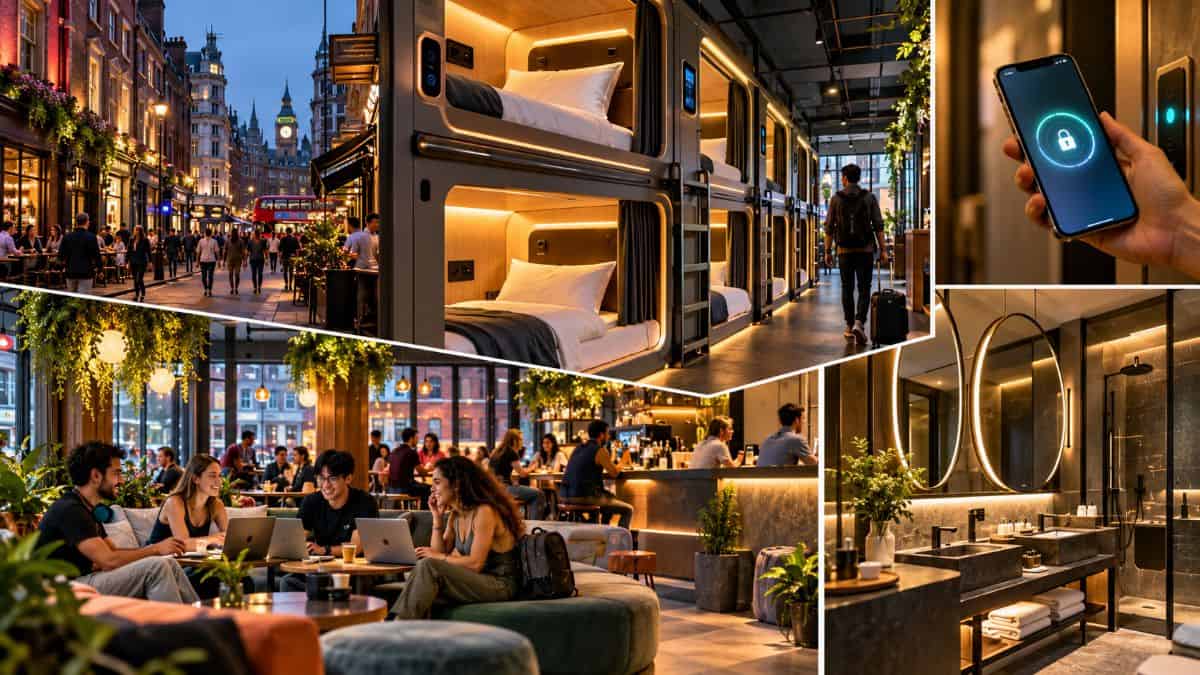
Image generated with Ai
London is becoming a testing ground for a new generation of hotel design, with Gen Z Hotel Design moving beyond low-cost accommodation. Otherwander Soho, a futuristic pod hotel near Oxford Street, is built around digital access, private sleeping pods, communal spaces and premium touches. Its model reflects changing expectations among younger travellers, who increasingly prioritise location, comfort, design and experiences over room size. A Booking.com survey found that 84% of US travellers aged 18 to 34 would splurge on location. Another 86% would spend more for greater comfort. The shift matters for London, where strong accommodation demand continues to support new formats and investment.
London Becomes A Design Laboratory
Otherwander Soho sits in the heart of London’s Soho, steps from Oxford Street. The property replaces conventional hotel rooms with compact sleeping pods called “nests”. It combines private sleeping space with shared bathrooms and communal areas known as “huddles”.
Advertisement
Advertisement
The concept deliberately removes amenities that many younger guests may consider unnecessary. There are no conventional minibars or televisions inside the nests. Instead, the hotel concentrates its investment on sleep quality, privacy, digital convenience and social space.
That distinction is important for the wider hotel industry. The model does not simply compete through lower prices. Instead, it attempts to redefine what travellers receive for their money.
Advertisement
Advertisement
Fredrik Korallus, chief executive of Otherwander Soho, said the concept targets a “Gen Z psychographic” rather than a strict age group. The distinction recognises that digital habits, visual preferences and attitudes towards value can extend beyond people born within a particular generation.
The hotel’s design comes from London-based studio SODA. Its interiors draw on Soho’s identity while using lighting, colour and spatial design to create a futuristic atmosphere.
Advertisement
Advertisement
For travellers, the proposition is straightforward. Spend less on unused room space while retaining central location, privacy and comfort.
Young Travellers Are Spending Differently
The latest consumer research challenges the idea that younger travellers simply want the cheapest possible hotel. Booking.com’s August 2026 US research instead points towards a more complicated definition of value.
Advertisement
Advertisement
Among American travellers aged 18 to 34, 84% would pay more for well-located accommodation. Meanwhile, 86% would pay more for accommodation offering greater comfort.
The wider findings reinforce that distinction. About 90% considered comfort and convenience important when assessing the value of a trip. Around 91% considered balancing quality and price important.
| Traveller Priority | Share Of US Travellers Aged 18–34 |
|---|---|
| Willing To Spend More For Better Location | 84% |
| Willing To Spend More For Greater Comfort | 86% |
| Consider Comfort And Convenience Important | 90% |
| Consider Quality And Price Balance Important | 91% |
| Want To Stay Within Budget | 85% |
| Value Memorable Experiences | 90% |
These figures suggest that affordability does not mean minimal spending at every stage. Instead, travellers increasingly appear willing to concentrate spending on features that directly affect their trip.
Location is one example. A centrally positioned hotel can reduce transport time and simplify access to attractions, restaurants, nightlife and business districts.
Advertisement
Advertisement
Comfort is another. A smaller room can remain attractive if the bed, ventilation, temperature control, acoustics and privacy perform well.
This creates a different equation for hotel operators. The winning proposition may not be the largest room or the lowest rate. It may be the property that removes unnecessary costs while protecting the elements guests value most.
The Digital Stay Starts Before Arrival
Otherwander also pushes technology into almost every stage of the guest journey. Guests complete the check-in process online before arriving.
They then receive a QR-enabled Wanderpass that can be added to their phone wallet. The digital key provides access to the hotel and the individual sleeping pod.
That approach removes the traditional reception interaction. It also gives travellers greater control over arrival times and access.
The technology reflects a longer-running hospitality trend. A 2019 University of Nevada, Las Vegas study found that guest-facing technology influenced Generation Z hotel selection. The research also found willingness among respondents to pay more for properties offering such technology.
Advertisement
Advertisement
However, technology alone does not explain the appeal. Convenience is the real product.
Travellers increasingly expect fast booking, mobile access, reliable connectivity and straightforward information. The best digital systems therefore disappear into the journey rather than becoming attractions themselves.
This distinction will become increasingly important as hotels introduce artificial intelligence, mobile keys and automated services. Guests may welcome technology when it solves friction, but novelty alone is unlikely to compensate for poor service.
Compact Rooms Can Protect The Budget
The Otherwander model also reflects a fundamental change in the economics of urban accommodation.
A traveller visiting London may spend most waking hours outside the hotel. They might visit museums during the morning, explore markets in the afternoon and attend theatre or nightlife events later.
Under that pattern, a large bedroom can represent considerable unused capacity.
Advertisement
Advertisement
A compact sleeping pod changes the calculation. It gives the traveller a private sleeping environment while shifting other activities into communal spaces or the city itself.
The model can therefore appeal to travellers who want central accommodation without paying entirely for conventional hotel-room space.
Yet the approach has clear limits. Travellers with large luggage, families or longer stays may prefer conventional rooms. Guests who require private bathrooms may also find pod accommodation less suitable.
| Feature | Traditional City Hotel | Pod-Style Model |
|---|---|---|
| Private Sleeping Area | Usually Yes | Yes |
| Private Bathroom | Usually Available | Shared At Otherwander |
| Central Location | Often Higher Cost | Core Value Proposition |
| Communal Space | Varies | Central To Concept |
| Digital Check-In | Increasingly Common | Core Journey |
| Room Size | Larger | Compact |
| Social Interaction | Usually Optional | Encouraged In Huddles |
| Technology | Property Dependent | Central To Stay |
| Value Strategy | Room-Based | Location And Experience-Based |
The table also highlights why travellers should compare accommodation by total experience rather than headline price.
A cheaper room far outside central London may require additional Underground, rail or taxi costs. A compact central property could therefore produce a different overall value proposition.
London’s Hotel Market Has Room For Reinvention
The wider market provides a useful backdrop for the experiment.
Advertisement
Advertisement
VisitBritain reported that England’s hotel occupancy reached 82% in August 2026, matching August 2025. Year-to-date occupancy stood at 77%, compared with 78% during the same period in 2025.
At the same time, RevPAR rose 8% year-on-year in August to £135. Average daily rates increased 7% to £165.
The figures indicate a market where accommodation demand remains substantial, even as operators navigate pricing pressure and changing traveller behaviour.
London also has an unusually large accommodation ecosystem. A 2026 London government report found that the capital welcomed around 36 million overnight visitors in 2024.
Those visitors generated approximately 154 million nights and around £20 billion in total visitor spending.
The same report updated London’s long-term accommodation outlook through 2050. That makes the emergence of alternative formats relevant beyond a single hotel opening.
Advertisement
Advertisement
The capital needs accommodation capable of serving different budgets, trip purposes and traveller expectations. Pod hotels represent one potential response to that demand.
Experiences Now Shape Hotel Value
The rise of compact hotels also connects with a broader transformation in travel spending.
Young travellers frequently divide their budgets between accommodation and experiences. They may accept a smaller room if the saving helps fund restaurants, concerts, attractions, excursions or nightlife.
That behaviour changes the role of the hotel.
The property becomes less of a destination and more of a strategic base for exploring the city. Location consequently becomes a critical product feature.
London is particularly suited to this model. Visitors can access major cultural attractions, shopping districts, theatres and neighbourhoods through an extensive public transport network.
Advertisement
Advertisement
The official VisitLondon visitor guide also positions the capital around attractions, theatre, dining, transport and accommodation. For travellers choosing compact accommodation, that wider city ecosystem becomes part of the value equation.
Sustainability Adds Another Layer
The model also intersects with sustainability.
Otherwander says it has reduced plastic use and provides filtered water stations. Its smaller spatial footprint also raises questions about how accommodation can use urban space more efficiently.
However, smaller rooms should not automatically be described as sustainable. Environmental performance depends on construction materials, energy consumption, ventilation, water use, cleaning practices and building efficiency.
Travellers should therefore distinguish genuine operational sustainability from design language.
The broader market is moving towards more transparent sustainability standards. Hotels increasingly promote environmental credentials, while travellers face a growing number of labels and claims.
Advertisement
Advertisement
For operators, measurable performance will matter more than futuristic aesthetics.
Privacy Remains The Critical Test
The biggest challenge for pod hotels may not be technology or design. It may be privacy.
Shared bathrooms can work well for some travellers but remain unacceptable for others. Similarly, communal lounges can encourage social interaction without replacing the need for quiet private space.
Otherwander attempts to address that tension through sound dampening, blackout conditions, individual temperature controls and filtered air inside the nests.
Those details reveal an important principle for the sector. Compact does not have to mean uncomfortable.
Hotel operators must therefore treat sleep quality as a core product rather than an afterthought.
Advertisement
Advertisement
Ventilation, noise control, luggage storage, security and bathroom privacy can determine whether a futuristic concept succeeds after the novelty disappears.
What This Means For Travellers
Travellers considering pod accommodation should assess the entire stay rather than simply comparing nightly rates.
Location should come first. A central property may save both time and transport costs, particularly for short city breaks.
The second consideration should be sleep quality. Guests should check pod dimensions, ventilation, sound insulation, bedding and blackout arrangements before booking.
Bathroom arrangements also require attention. Shared facilities can offer excellent standards, but travellers should understand exactly what is private and what is communal.
Digital access deserves scrutiny too. Travellers should keep their phones charged and understand the property’s contingency procedure if a digital key fails.
Advertisement
Advertisement
| Before Booking | What Travellers Should Check |
|---|---|
| Location | Walking distance to key attractions and transport |
| Room Format | Pod dimensions and available storage |
| Privacy | Curtains, doors and acoustic protection |
| Bathroom | Shared or private facilities |
| Technology | Digital key and mobile requirements |
| Sleep | Blackout, ventilation and noise control |
| Social Areas | Availability of communal work and lounge space |
| Total Cost | Accommodation plus transport and other fees |
| Sustainability | Specific environmental measures |
| Support | Human assistance when technology fails |
Travellers planning London stays can also use VisitBritain for broader tourism research and destination information. Official guidance remains useful when comparing accommodation trends with wider visitor demand.
The Hotel Room Is Being Repriced
The significance of Otherwander Soho extends beyond its individual design.
The property represents a growing industry question: what does a traveller actually need from a hotel room?
For some guests, the answer remains a spacious room, private bathroom and extensive facilities. For others, the answer is a secure sleeping pod in a central location, strong connectivity and an attractive communal environment.
Neither model is likely to replace the other.
Instead, the hotel market is becoming more segmented. Luxury travellers continue to pay for space and service. Families often need conventional room configurations. Business travellers may prioritise desks and facilities. Meanwhile, younger urban travellers can accept a different accommodation equation.
Advertisement
Advertisement
The emerging opportunity lies between hostels and conventional hotels.
That space combines privacy with community, technology with human support, and affordability with design. It also reflects a broader movement towards paying for what matters rather than paying for everything.
London provides an especially strong environment for that experiment because accommodation competes directly with an enormous range of experiences outside the hotel.
A New Generation Wants More Choice
The future of urban accommodation may therefore become less about making rooms smaller and more about making stays smarter.
Otherwander Soho demonstrates one interpretation of that future. Its pods, digital access, communal areas and design-led interiors respond to several priorities identified in recent Gen Z travel research. Gen Z Hotel Design increasingly appears to centre on control, convenience, comfort and experience rather than technology for its own sake.
For travellers, the development offers another accommodation choice in one of the world’s most expensive and dynamic hotel markets. For the industry, it provides a useful test of whether compact accommodation can deliver premium perceptions without premium room sizes.
The most important lesson is simple. Younger travellers are not necessarily demanding cheaper hotels. They are demanding better value, and that distinction could shape hotel design well beyond London.
Advertisement
