

France Connects With Germany and More in a Massive Cross-Border Rail Expansion Network as Europe Pushes One Journey One Ticket in 2026

Published
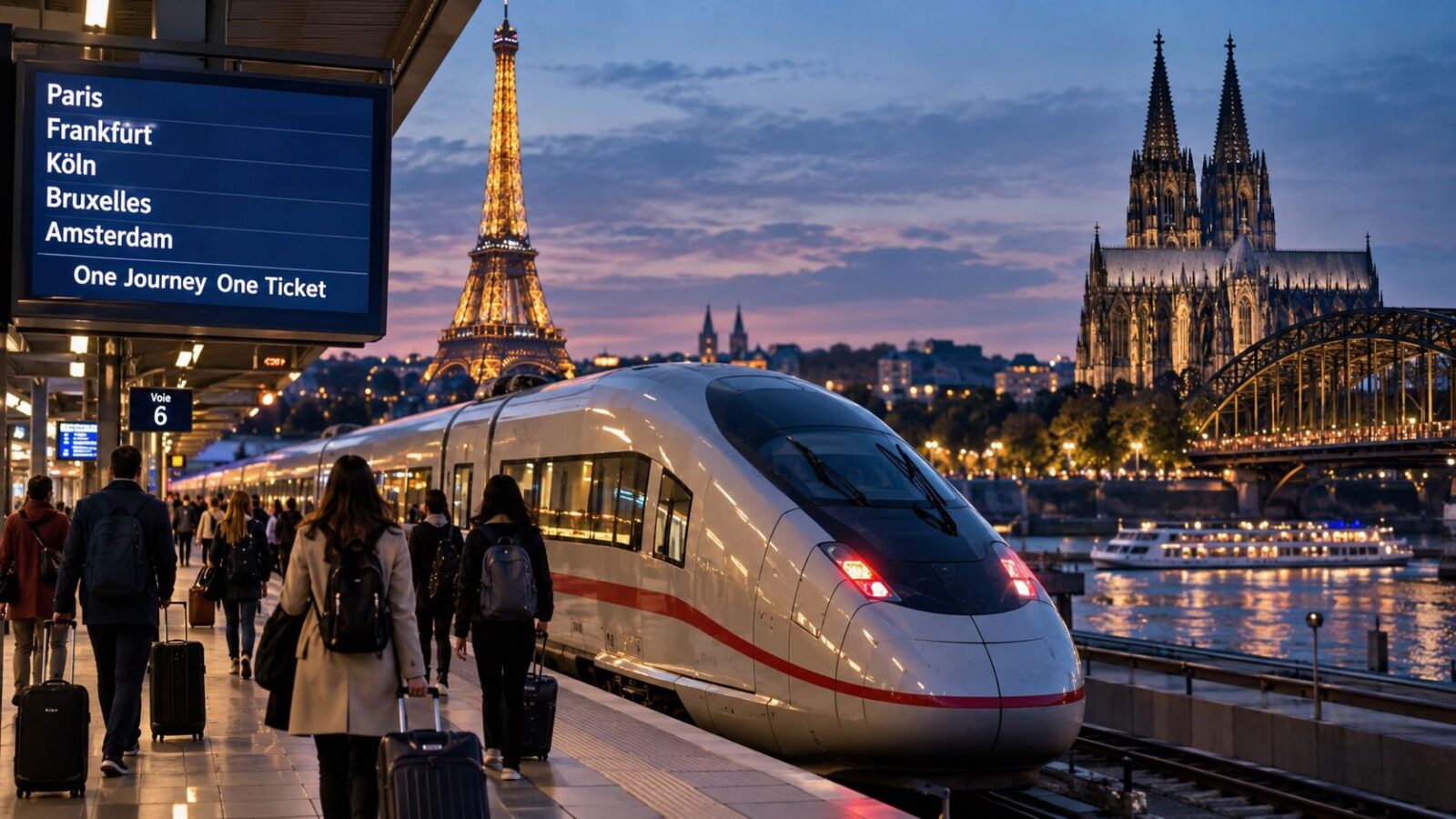
France connects with Germany and more countries throughout Europe in a massive cross-border rail expansion network as Europe pushes One Journey One Ticket in 2026, driven by new routes, sleeper trains, high-speed links and simpler international booking.
The shift is not simply about opening individual routes. It is about making international rail feel like a single European travel network. New daytime trains, revived sleeper services, high-speed infrastructure and major projects such as Rail Baltica are expanding the physical network. At the same time, Europe is trying to fix one of international rail’s biggest weaknesses: fragmented booking systems and uncertainty over passenger rights when several operators are involved.
The 2026 passenger package is designed to make it easier for travellers to find, compare and buy services involving different rail companies as one journey, ideally within a single transaction, while strengthening protection across the complete itinerary. That could prove just as important to tourism as faster trains because complexity remains one of the strongest barriers to choosing rail for multi-country holidays.
France and Germany Combine High-Speed Rail With the Return of the Paris–Berlin Sleeper
France and Germany are becoming one of the clearest examples of Europe’s new cross-border rail model because travellers can increasingly choose between fast daytime services and overnight trains.
Advertisement
Advertisement
The revived Paris–Berlin European Sleeper gives passengers a direct overnight alternative between two of Europe’s biggest tourism capitals. Published fares for the Paris–Berlin service can start at around €79.99 one way per person in a shared Classic compartment, while private Classic compartments can start from approximately €279.99, depending on the date, availability and accommodation type.
The sleeper’s appeal is not simply price. An overnight journey can replace part of the time and cost associated with a hotel stay while bringing passengers directly into central Berlin the following morning.
Advertisement
Advertisement
Paris–Berlin Ticket Snapshot
| Service | Indicative Starting Fare | Travel Style |
|---|---|---|
| Shared Classic sleeper | From €79.99 | Shared overnight compartment |
| Private Classic compartment | From about €279.99 | Private overnight space |
| Budget category | Variable | Basic overnight travel |
| Comfort categories | Higher variable fares | More private and comfortable sleeping options |
Prices are dynamic and can increase substantially during weekends, holidays and peak travel periods.
Paris–Munich Shows How Daytime High-Speed Rail Complements the Sleeper Network
France and Germany’s cross-border network extends well beyond Paris–Berlin. Paris–Munich is already an important daytime rail corridor linking France with southern Germany through TGV INOUI and ICE services.
Advertisement
Advertisement
One-way second-class fares can vary considerably according to travel date and availability. Indicative prices may range from approximately €90 to €139 on selected departures, although cheaper or more expensive options can appear depending on booking conditions.
The route strengthens southern Germany’s connections with France and also creates opportunities for onward journeys towards Austria, Switzerland, Czechia and other Central European destinations.
| Paris–Munich | Indicative Information |
|---|---|
| Main operators | TGV INOUI and ICE |
| Indicative fares | About €90–€139 on selected services |
| Travel style | High-speed daytime journey |
| Main tourism value | Direct France–southern Germany connectivity |
| Wider opportunity | Onward travel into Central Europe |
This is where the One Journey One Ticket concept becomes especially important. The easier it becomes to combine Paris–Munich with onward journeys, the more realistic it becomes for travellers to build multi-country rail holidays rather than separate city breaks.
One Journey One Ticket Could Remove the Biggest Friction From European Rail Travel
The biggest problem facing European rail has often not been the tracks. It has been the booking process.
Advertisement
Advertisement
A traveller may need to search several operator websites, compare different fare systems and purchase multiple tickets for what is effectively one continuous journey. If the first train is delayed and the traveller misses an onward service, passenger rights can become difficult to understand.
The One Journey One Ticket concept is intended to simplify that experience.
| Current Problem | Proposed Passenger Experience |
|---|---|
| Multiple operator websites | More integrated booking |
| Separate tickets | Combined journey purchase |
| Difficult fare comparison | Clearer comparison |
| Uncertain missed-connection protection | Stronger rights across eligible journeys |
| Fragmented planning | Simpler international itineraries |
For tourism, the psychological impact could be substantial. A route involving three or four countries feels much easier when it appears as one journey instead of several disconnected railway transactions.
Sweden and Norway Turn Malmö–Gothenburg–Oslo Into a Scandinavian Tourism Spine
Northern Europe is also seeing an important improvement in cross-border rail.
The direct Malmö–Gothenburg–Oslo service creates a straightforward link between southern Sweden, Sweden’s west coast and the Norwegian capital.
The full Malmö–Oslo trip takes approximately six and a half hours, depending on the departure, and gives travellers a much simpler alternative to fragmented rail and bus combinations.
Advertisement
Advertisement
Malmö–Oslo Travel Snapshot
| Feature | Detail |
|---|---|
| Main route | Malmö–Gothenburg–Oslo |
| Approximate journey | About 6.5 hours |
| Travel type | Direct daytime train |
| Pricing | Dynamic according to date and availability |
| Tourism advantage | Connects several Scandinavian destinations without changing trains |
Unlike routes with fixed promotional fares, ticket prices on this service vary significantly by date and demand. It is therefore more accurate to describe the service as dynamically priced rather than quote one permanent minimum fare.
The wider tourism value is considerable because Malmö can connect travellers towards Copenhagen and continental Europe, while Oslo opens the door to wider Norwegian travel.
A visitor could potentially build a rail itinerary running from Germany into Denmark, Sweden and Norway without relying on short-haul flights.
Denmark, Germany and Czechia Build a Three-Country Daytime Rail Experience
The Copenhagen–Berlin–Prague corridor is one of the most important examples of practical European rail integration.
It connects Denmark, Germany and Czechia in one continuous journey and makes it easier for travellers to combine three major tourism capitals.
Indicative starting fares from Copenhagen can be around:
Advertisement
Advertisement
| Route | Indicative Starting Fare |
|---|---|
| Copenhagen–Hamburg | From about DKK 221 |
| Copenhagen–Berlin | From about DKK 456 |
| Copenhagen–Prague | From about DKK 510 |
These fares are subject to availability and should be treated as starting prices rather than guaranteed rates.
The biggest tourism advantage is simplicity. Copenhagen, Berlin and Prague are already powerful city-break destinations, but a direct train makes them easier to combine within one journey.
Instead of buying three separate holidays, travellers can increasingly think of the route as a single rail-based European itinerary.
France’s Rail Connections Become Part of a Wider Continental Web
France’s role in the expansion goes far beyond Germany.
Paris already operates as one of Europe’s most important rail hubs, connecting travellers towards Belgium, the Netherlands, Switzerland, Luxembourg, Spain, Germany and the United Kingdom.
The One Journey One Ticket concept could make those links significantly more useful for international tourists.
Advertisement
Advertisement
Travellers could increasingly build itineraries such as:
Paris → Berlin → Prague → Vienna
or
Paris → Brussels → Amsterdam
without treating every new border as an entirely separate booking exercise.
This changes the role of rail within tourism.
Advertisement
Advertisement
The train is no longer simply transportation between two cities. It becomes the framework around which the holiday is designed.
The Paris–Berlin Sleeper Shows Why Night Trains Are Returning
The return of the Paris–Berlin sleeper is significant because night trains solve a different problem from high-speed rail.
High-speed trains compete by reducing journey time.
Night trains compete by making better use of time.
Travellers can leave one city in the evening, sleep during the journey and arrive in another the next morning.
This can appeal to:
Advertisement
Advertisement
- Slow-travel tourists
- Rail enthusiasts
- Families
- Multi-city travellers
- Visitors seeking alternatives to short-haul flights
- Travellers wanting city-centre to city-centre journeys
Night trains can also alter the economics of travel because passengers may avoid an additional hotel night while preserving daytime hours for sightseeing.
Interrail Travellers Still Need to Watch Reservation Charges
Rail passes remain attractive for multi-country European journeys, but travellers should remember that many premium trains still require additional reservations.
For European Sleeper services, reservation costs can vary by accommodation type.
| Accommodation | Indicative Reservation Cost |
|---|---|
| Budget | About €11–€21 |
| Classic shared compartment | About €64–€74 |
| Classic private compartment | About €229–€269 |
| Comfort triple | About €79–€99 |
| Comfort double | About €119–€139 |
| Comfort single | About €149–€169 |
This matters because a One Journey One Ticket system will need to communicate not only base fares but also reservations and supplements clearly.
A traveller needs to know the true total cost of the complete journey, not simply whether a rail pass is accepted.
Serbia and Hungary Extend Europe’s High-Speed Ambitions Southeast
The Belgrade–Budapest corridor represents an important attempt to integrate Central and Southeastern Europe more closely.
Advertisement
Advertisement
The tourism potential is strong because Budapest is already one of Central Europe’s major city-break destinations, while Belgrade is growing as a cultural, nightlife and regional tourism centre.
A faster and more reliable connection could support:
- Twin-city tourism
- Balkan rail holidays
- Central European itineraries
- Business travel
- Better connections towards Western Europe
At this stage, however, it is better not to quote a fixed future ticket price because the full commercial structure of the cross-border service remains dependent on operational arrangements.
| Belgrade–Budapest | Current Position |
|---|---|
| Corridor | Serbia–Hungary |
| Infrastructure | Major modernisation |
| Tourism opportunity | Strong twin-city potential |
| Ticket pricing | Not appropriate to treat as fixed yet |
| Main benefit | Better Balkan–Central Europe connectivity |
This corridor shows why ticketing reform alone is not enough.
Europe also needs compatible infrastructure, signalling, timetables and border procedures.
Rail Baltica Could Transform Baltic Tourism
Rail Baltica is one of the most ambitious rail projects in Europe.
Advertisement
Advertisement
It is designed to connect Lithuania, Latvia and Estonia with Poland and the wider European standard-gauge network.
The project could eventually transform travel between Vilnius, Riga and Tallinn, making it easier for visitors to treat the Baltic region as one connected tourism corridor.
Rail Baltica’s Potential Tourism Impact
| Change | Tourism Benefit |
|---|---|
| Vilnius–Riga–Tallinn connectivity | Easier multi-capital trips |
| Connection with Poland | Better access from Central Europe |
| European standard gauge | Stronger network integration |
| New and upgraded stations | Improved visitor gateways |
| Tallinn connections | Potential links with Helsinki ferry travel |
| Faster regional movement | More viable short-break combinations |
Passenger fares should not yet be presented as established because the full network remains under development.
The important point is what the system could eventually make possible: a traveller could potentially move from Poland through Lithuania, Latvia and Estonia as part of one coherent international journey.
Ticket Prices Will Be Central to the Success of One Journey One Ticket
A seamless European railway system cannot depend only on physical connectivity.
Price transparency will matter just as much.
Advertisement
Advertisement
Rail fares can vary according to:
- Booking date
- Travel day
- Departure time
- Demand
- Class
- Accommodation type
- Refundability
- Operator
- Reservation requirements
That creates a complicated pricing environment.
A Paris–Berlin sleeper can begin below €100 in shared accommodation, while private rooms may cost several hundred euros.
Paris–Munich daytime fares can shift sharply between travel dates.
Copenhagen–Prague prices can also rise depending on availability.
The One Journey One Ticket concept will therefore be most valuable if it helps travellers compare total journey cost, not merely individual segments.
Advertisement
Advertisement
What Travellers Could Pay on Key Cross-Border Routes
| Route | Indicative Fare | Status |
|---|---|---|
| Paris–Berlin sleeper | From about €79.99 | Operating |
| Paris–Berlin private sleeper | From about €279.99 | Operating |
| Paris–Munich | Roughly €90–€139 on selected services | Operating |
| Copenhagen–Hamburg | From about DKK 221 | Operating |
| Copenhagen–Berlin | From about DKK 456 | Operating |
| Copenhagen–Prague | From about DKK 510 | Operating |
| Malmö–Gothenburg–Oslo | Dynamic pricing | Operating |
| Belgrade–Budapest | No stable through fare to quote yet | Developing |
| Rail Baltica | No regular through passenger fare yet | Under development |
These should be treated as indicative or starting fares, not guaranteed prices.
European railway operators increasingly use dynamic pricing, meaning passengers may pay significantly more during weekends, holidays, peak summer periods or when booking close to departure.
Booking Early Could Become the Key to Affordable Cross-Border Rail Travel
The expansion of European rail creates more travel opportunities, but it does not automatically guarantee low prices.
Travellers seeking better fares generally benefit from:
- Booking early
- Travelling outside peak periods
- Remaining flexible with departure times
- Comparing classes
- Checking sleeper accommodation types
- Understanding rail-pass supplements
- Avoiding last-minute reservations where possible
This is important because price can be just as decisive as speed.
A truly effective One Journey One Ticket system should ideally help travellers balance price, time, comfort and passenger protection across the whole itinerary.
Advertisement
Advertisement
Cross-Border Rail Could Redirect Tourism Towards Smaller European Cities
The benefits of rail integration will not necessarily remain concentrated in Paris, Berlin, Copenhagen, Prague or Oslo.
Intermediate destinations also stand to gain.
A direct international train gives smaller cities greater visibility and makes stopovers easier.
That can increase spending on:
- Hotels
- Restaurants
- Museums
- Local transport
- Retail
- Attractions
- Regional tours
Rail corridors can therefore transform what was previously a transit point into a genuine tourism destination.
This could become one of the most important economic effects of Europe’s railway expansion.
Advertisement
Advertisement
Europe Is Trying to Make Rail Compete on Convenience, Not Only Speed
For many travellers, the real comparison between rail and aviation is no longer simply journey time.
It is the total travel experience.
Rail offers several structural advantages:
- Central-city stations
- Less airport transfer time
- Fewer airport procedures
- Greater freedom during the journey
- Easier city-centre arrival
- More practical multi-stop itineraries
Its long-standing weakness has been fragmented booking.
If Europe can make ticketing as simple as the physical journey, rail becomes far more competitive.
One Journey One Ticket Could Reshape the European Multi-Country Holiday
The biggest impact may ultimately be psychological.
Advertisement
Advertisement
A journey requiring four tickets and three booking websites feels complicated.
The same route presented as one journey with one ticket feels manageable.
A traveller could potentially build an itinerary such as:
Paris → Berlin → Prague → Copenhagen → Malmö → Oslo
without treating every border as a new transport problem.
That is the deeper promise behind One Journey One Ticket.
Advertisement
Advertisement
It is not simply about selling rail tickets differently.
It is about making Europe feel smaller, more connected and easier to explore.
Europe’s Rail Expansion Is Becoming a Tourism Network Rather Than a Collection of Routes
France’s stronger connections with Germany are only one part of a much wider transformation.
The Paris–Berlin sleeper reconnects two major capitals overnight. Sweden and Norway are strengthening Scandinavian rail. Copenhagen, Berlin and Prague are becoming easier to combine. Serbia and Hungary are building a stronger Central and Southeastern European corridor. Rail Baltica is creating an entirely new north-south transport structure across the Baltic region.
Above these individual developments sits the One Journey One Ticket vision.
The ambition is increasingly clear: tracks, operators, booking systems, prices and passenger rights all need to work together if European rail is to function as a genuine continental tourism product.
Advertisement
Advertisement
Europe already has the cities and railway infrastructure.
What it has often lacked is simplicity.
In 2026, that is becoming the real transformation. Europe’s next railway revolution may not be defined only by faster trains, but by the point at which crossing multiple countries finally becomes simple to understand, easy to book and transparent in price.
France connects with Germany and more countries throughout Europe in a massive cross-border rail expansion network as Europe pushes One Journey One Ticket in 2026, driven by new routes, sleeper trains, faster links and simpler booking.
In conclusion, France connects with Germany and more countries throughout Europe in a massive cross-border rail expansion network as Europe pushes One Journey One Ticket in 2026, driven by new daytime routes, revived sleeper trains, high-speed links, simpler booking and stronger passenger protection across international journeys.
Advertisement
