
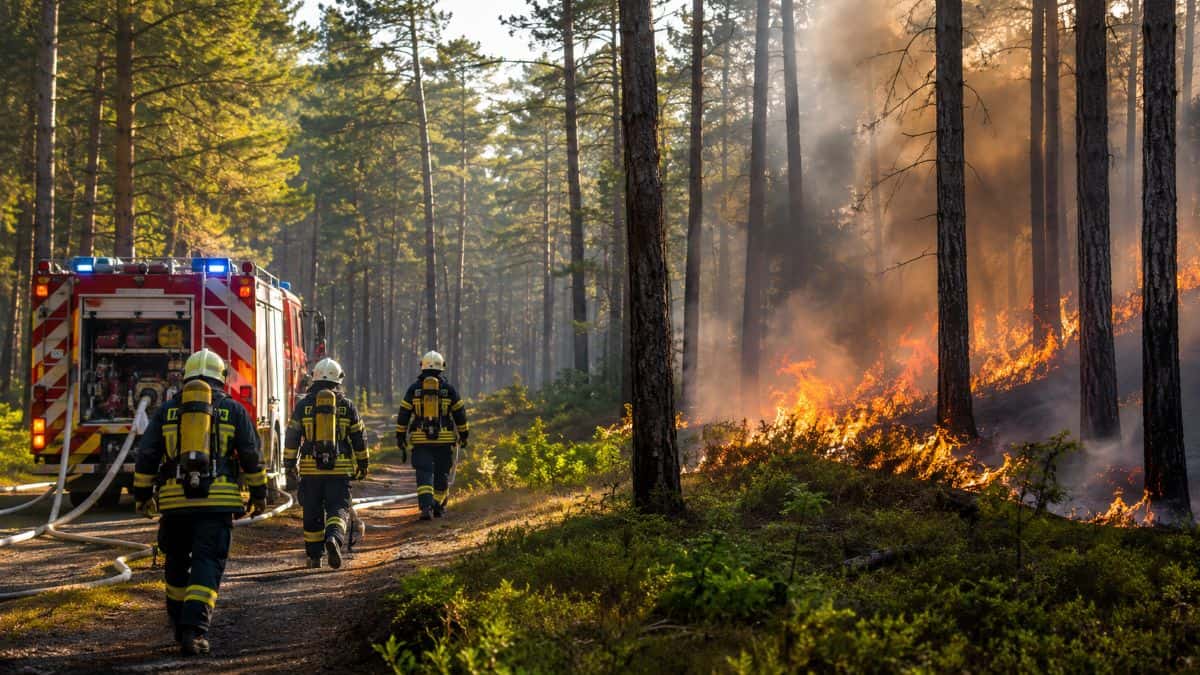
Image generated with Ai
Germany has successfully contained a significant wildfire that burned approximately 388 hectares inside Müritz National Park, one of the country’s most treasured protected landscapes. The operation marks an important step in preventing a larger environmental disaster during a period of prolonged dry weather and elevated wildfire risk across parts of Europe. Firefighters used strategic water barriers to halt the fire’s advance, while authorities continue monitoring conditions to prevent flare-ups and protect surrounding ecosystems.
The incident has also highlighted the growing importance of wildfire preparedness for destinations that attract nature lovers, hikers, cyclists, photographers, and eco-tourists throughout the summer season. Although the immediate danger has been reduced, officials continue urging visitors to avoid the affected sections of the national park while emergency operations, safety inspections, and environmental assessments remain underway. The response demonstrates Germany’s coordinated emergency management approach and reinforces the need for responsible travel during periods of extreme weather.
Advertisement
| Key Information | Details |
|---|---|
| Country | Germany |
| Location | Müritz National Park |
| Burned Area | Approximately 388 hectares |
| Firefighters Deployed | Around 370 |
| Main Containment Strategy | Water barriers and protective buffer zones |
| Fire Conditions | Dry weather and westerly winds |
| Current Situation | Fire contained and monitored |
| Public Advisory | Visitors asked to avoid affected areas |
Firefighters succeeded in containing the wildfire after an extensive emergency response involving approximately 370 personnel. Rather than relying solely on direct suppression, crews adopted a preventative containment strategy by creating water barriers throughout unaffected sections of the forest.
These barriers kept surrounding soil and vegetation moist, reducing the likelihood that flames could spread into healthy woodland. This approach proved particularly effective in slowing fire progression while giving emergency teams greater control over the incident.
Advertisement
Authorities confirmed that containment has significantly reduced the immediate threat, although monitoring operations continue to ensure changing weather conditions do not reignite hotspots.
| Environmental Factor | Impact on Fire |
|---|---|
| Extended dry conditions | Increased vegetation dryness |
| Westerly winds | Accelerated fire spread |
| Forest vegetation | Provided continuous fuel |
| Summer temperatures | Elevated wildfire risk |
| Moisture deficit | Reduced natural fire resistance |
Emergency officials stated that prolonged dry conditions created ideal circumstances for rapid wildfire development. Forest vegetation had become increasingly vulnerable after extended periods with limited rainfall.
Westerly winds further intensified the situation by carrying flames and embers deeper into forested sections, forcing firefighters to expand containment measures quickly.
Such weather patterns have become an increasing concern across many European forests during summer months, prompting authorities to strengthen wildfire monitoring and emergency preparedness.
| Firefighting Measure | Purpose |
|---|---|
| Water barriers | Prevent flame spread |
| Soil saturation | Reduce ignition risk |
| Tree moisture protection | Shield unaffected forests |
| Buffer zones | Slow wildfire progression |
| Continuous monitoring | Detect remaining hotspots |
Instead of focusing exclusively on extinguishing active flames, emergency teams concentrated on protecting areas that had not yet been affected.
By saturating forest floors and surrounding vegetation with water, firefighters created natural defensive lines capable of stopping the wildfire from advancing further into the national park.
This proactive strategy helped stabilize the situation while allowing emergency personnel to safely manage remaining hotspots.
| Situation Update | Status |
|---|---|
| Smoke intensity | Declining |
| Active flames | Reduced |
| Fire spread | Contained |
| Monitoring | Ongoing |
| Emergency response | Continuing |
Officials reported that smoke levels have steadily declined, indicating that fire activity has significantly weakened.
Although this represents encouraging progress, emergency authorities remain cautious. Forest fires can continue smouldering beneath vegetation and tree roots long after visible flames disappear.
Fire crews therefore continue conducting surveillance across affected sections to identify and extinguish any remaining sources of heat.
| Travel Advisory | Recommendation |
|---|---|
| Access to affected areas | Avoid travel |
| Hiking routes | May remain restricted |
| Nature tourism | Follow official guidance |
| Photography visits | Delay until reopening |
| Recreational activities | Use designated safe areas |
Authorities continue advising tourists, hikers, cyclists, campers, and wildlife enthusiasts to stay away from affected portions of Müritz National Park until emergency operations conclude.
Temporary access restrictions help ensure public safety while allowing firefighters and environmental specialists to work efficiently.
Visitors planning trips to northern Germany are encouraged to monitor local travel updates before entering protected natural areas during the summer season.
| Recovery Focus | Objective |
|---|---|
| Habitat assessment | Evaluate ecosystem damage |
| Wildlife monitoring | Protect affected species |
| Forest regeneration | Support natural recovery |
| Soil analysis | Measure environmental impact |
| Visitor management | Ensure safe reopening |
Containing the wildfire represents only the first stage of the recovery process.
Environmental experts will now assess damage to vegetation, wildlife habitats, and forest ecosystems. Depending on the severity of affected areas, some sections may recover naturally while others could require conservation measures to accelerate regeneration.
Protected landscapes like Müritz National Park play an important role in biodiversity conservation, making long-term ecological monitoring an essential part of post-fire management.
| Preparedness Measure | Expected Benefit |
|---|---|
| Early detection | Faster emergency response |
| Weather monitoring | Improved risk forecasting |
| Fire prevention planning | Reduced wildfire spread |
| Visitor awareness | Increased public safety |
| Emergency coordination | More effective containment |
The wildfire serves as another reminder that European forests face increasing pressure from warmer temperatures, prolonged drought, and changing weather patterns.
Germany continues investing in emergency preparedness, coordinated firefighting capabilities, and environmental monitoring to reduce future wildfire risks.
Improved cooperation between emergency responders, environmental agencies, and local authorities remains essential for protecting forests, communities, and tourism assets during periods of heightened wildfire danger.
For travelers, the incident reinforces the importance of respecting temporary closures, following local safety instructions, and remaining aware of weather-related advisories when visiting national parks throughout the summer season.
The successful containment of the 388-hectare wildfire in Germany’s Müritz National Park demonstrates the effectiveness of coordinated emergency response and strategic firefighting techniques under challenging weather conditions. While firefighters have prevented the blaze from spreading further through the use of water barriers and protective buffer zones, authorities remain vigilant as monitoring continues across the affected landscape. As environmental recovery begins, visitor safety and ecosystem restoration will remain priorities, ensuring that one of Germany’s most important natural destinations can gradually return to welcoming travelers while preserving its ecological value for future generations.
1. Where did the wildfire occur in Germany?
The wildfire occurred in Müritz National Park in northeastern Germany.
2. How large was the wildfire?
The fire burned approximately 388 hectares of forest.
3. How many firefighters responded to the incident?
Around 370 firefighters participated in the containment operation.
4. How was the wildfire contained?
Firefighters created water barriers and buffer zones by moistening soil and trees to stop the flames from spreading.
5. What caused the fire to spread quickly?
Prolonged dry weather and strong westerly winds accelerated the wildfire’s movement.
6. Is the wildfire fully extinguished?
Authorities have confirmed the fire has been contained, but monitoring continues for potential hotspots.
7. Can tourists visit Müritz National Park now?
Officials advise visitors to avoid affected areas until firefighting and safety operations are completed.
8. Has smoke from the wildfire improved?
Yes. Authorities report that smoke levels have declined, indicating reduced fire activity.
9. Why are national parks vulnerable during summer?
High temperatures, dry vegetation, and low rainfall significantly increase wildfire risks in forest ecosystems.
10. What should travelers do before visiting forest destinations during wildfire season?
Travelers should check official local advisories, respect temporary closures, monitor weather conditions, and follow all safety guidance issued by authorities.
Advertisement
Tags: eco tourism Germany, environmental conservation, Europe, Europe travel updates, European Forests
Advertisement
Advertisement












Friday, September 4, 2026
Friday, September 4, 2026

Friday, September 4, 2026
Friday, September 4, 2026

Thursday, September 3, 2026

Wednesday, September 2, 2026

Friday, September 4, 2026