
Thailand’s Visitor Economy Targets 6 Trillion Baht as Tourism Chases Higher-Value Travel by 2035

Published
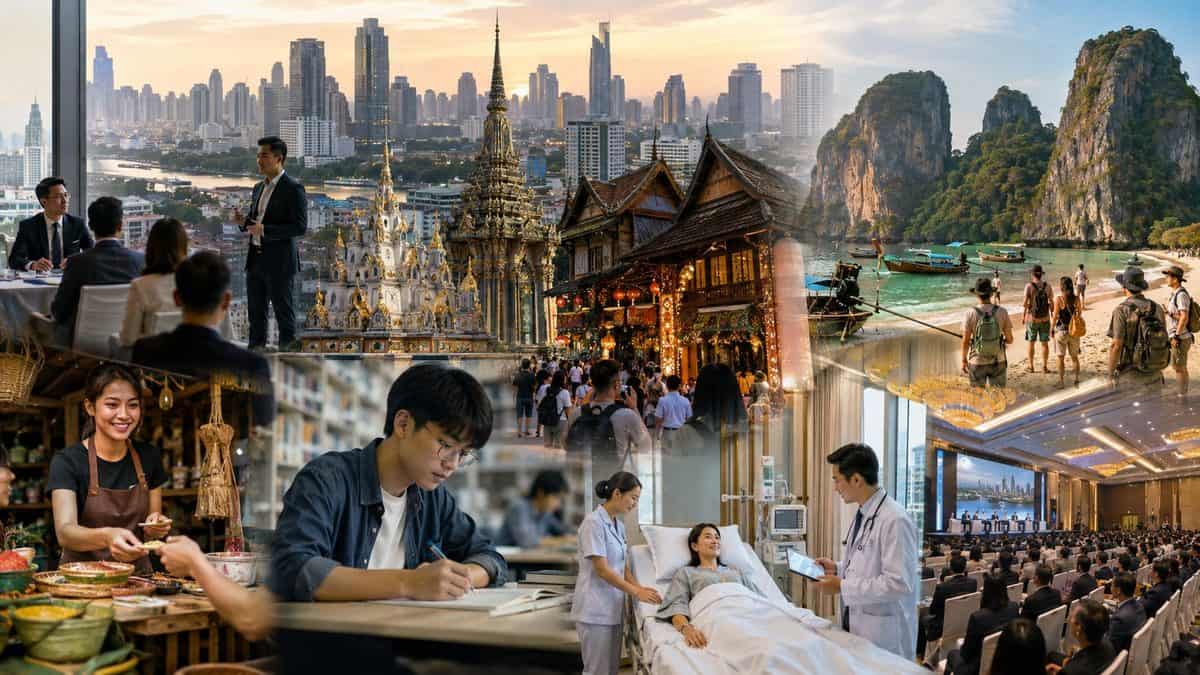
Image generated with Ai
Thailand is working on a plan to make 6 trillion baht from visitors by 2035. This plan will more than double the 2022 estimate on Thailand’s tourism income. It will also create more than 1.2 million jobs. The plan recognizes that visitors create economic value. The plan includes health, education, business, weddings, film production, and remote work. Initially, Bangkok, Chiang Rai, and Krabi will test this model as sandboxes. This plan will change how Thailand will design, build, and promote infrastructure. This plan shifts Thailand’s focus to how it will measure income from visitors instead of how many visitors it will have. This plan, along with other changes, will begin to shift how Thailand balances the positive and negative effects of tourism.
Thailand Visitor Economy Takes Centre Stage
Thailand is preparing to measure tourism in a fundamentally different way.
Advertisement
Advertisement
The country’s new Thailand visitor economy framework treats travel as an economic ecosystem rather than a standalone industry. That distinction matters because international visitors already spend money far beyond hotels, restaurants and attractions.
A medical traveller, for instance, can generate revenue for hospitals, airlines, pharmacies, taxis and accommodation providers. An international student can support universities, landlords, retailers, transport operators and food businesses.
Advertisement
Advertisement
Likewise, a wedding can bring together airlines, hotels, event companies, photographers, restaurants and local suppliers. A business traveller can generate value through conferences, accommodation, restaurants, transport and professional services.
Advertisement
Advertisement
The framework therefore seeks to capture those connections more accurately.
The government incorporated the concept into national planning on 19 August 2026. Deputy Prime Minister and Commerce Minister Suphajee Suthumpun established a working group to develop the strategy.
The group is chaired by Weerasak Kowsurat, chairman of the Working Group on Creative Economy Development and Visitor Economy. It is meeting weekly as officials develop the framework.
Weerasak told local media that Thailand should stop treating every visitor as the same type of tourist. He highlighted health, education, business, weddings, film production and Work from Anywhere as important travel purposes.
The strategy also recognises that visitor spending crosses traditional government and industry boundaries. That could make tourism policy more closely connected with education, healthcare, real estate, insurance, entertainment and digital services.
Advertisement
Advertisement
For travellers, the implications may eventually be visible in more destinations and more specialised travel products. However, the immediate priority remains data collection rather than a sudden change to entry rules or travel procedures.
Six Trillion Baht Changes the Tourism Equation
The scale of the 2035 ambition is striking.
Thailand wants its broader visitor economy to generate 6 trillion baht a year by 2035. The government also wants the framework to support at least 1.2 million additional jobs.
The target deliberately differs from a conventional international-arrival goal. Instead of asking how many people enter Thailand, policymakers want to understand how much economic value each visitor creates.
That approach closely follows Thailand’s existing push towards “Value over Volume” tourism. The Tourism Authority of Thailand has already prioritised quality revenue, longer stays, meaningful experiences and sustainable growth.
Advertisement
Advertisement
In 2025, Thailand recorded more than 32.9 million international arrivals, generating 41.3 billion euros in international tourism revenue, according to TAT. Long-haul markets surpassed 10 million arrivals for the first time.
The contrast becomes clearer when looking at current tourism performance.
| Indicator | Latest reported position | What It Shows |
|---|---|---|
| International arrivals in 2025 | 32.9 million+ | Thailand retains enormous visitor volume |
| International tourism revenue in 2025 | €41.3 billion | Higher-value travel remains strategically important |
| Long-haul arrivals in 2025 | 10 million+ | Distant markets are becoming more valuable |
| 2035 visitor economy target | 6 trillion baht annually | Government wants broader economic measurement |
| Additional jobs targeted by 2035 | At least 1.2 million | Employment becomes a central tourism metric |
| 2026 international arrivals forecast | 33 million | TAT continues a quality-led recovery strategy |
| 2026 total tourism revenue projection | 2.65 trillion baht | Near-term growth remains substantial |
The numbers show why policymakers are looking beyond arrivals.
Thailand’s official tourism statistics already distinguish between international and domestic activity. However, the proposed visitor economy approach seeks to connect spending across sectors that conventional tourism accounts can miss.
That could eventually provide policymakers with a much richer picture of tourism’s economic footprint.
Advertisement
Advertisement
Bangkok, Chiang Rai and Krabi Test the Model
The first practical experiment will take place in three contrasting destinations.
Bangkok, Chiang Rai and Krabi have been selected as destination sandboxes for the new framework. Each location offers a different visitor profile and economic structure.
Bangkok is Thailand’s major metropolitan and business hub. It combines leisure tourism with medical travel, international education, shopping, meetings, incentives, conferences and exhibitions.
Chiang Rai offers a different proposition. Its appeal includes culture, nature, wellness and slower-paced travel. It can also demonstrate how visitor spending might be retained more effectively within smaller regional economies.
Krabi provides another useful test. Its international leisure market sits alongside marine tourism, creative activity, events and community-based experiences.
Advertisement
Advertisement
The pilots will gather visitor economy data and establish benchmarks between destinations. Officials want to understand value per visitor, local spending retention, community benefits and green growth.
| Sandbox | Strategic Opportunity | Potential Visitor Segments |
|---|---|---|
| Bangkok | Business, healthcare, education and MICE | Business travellers, medical visitors, students, event delegates |
| Chiang Rai | Culture, nature and regional dispersal | Wellness travellers, cultural visitors, long-stay travellers |
| Krabi | Leisure, marine tourism and creative economy | Beach travellers, event groups, film-related visitors |
The pilot structure is significant because Thailand has long sought to spread tourism beyond its most established destinations.
Government tourism policy has increasingly promoted secondary cities, local experiences and regional products. TAT’s India strategy, for example, has highlighted destinations including Kanchanaburi, Khao Yai, Chiang Rai and Sukhothai alongside Bangkok, Pattaya, Phuket and Chiang Mai.
The new framework could give that dispersal strategy a stronger economic rationale.
More Than Tourists Will Count
One of the most important changes involves who qualifies as a visitor.
Advertisement
Advertisement
The proposed framework takes a wider view of non-residents travelling into or out of Thailand. It includes people whose journeys create economic activity but may not appear in traditional tourism measurements.
International students are a particularly revealing example.
Weerasak said the working group plans to work with the Ministry of Education to measure foreign student spending. That could include tuition fees, accommodation and other expenditure connected with international education.
This matters because education can create longer and deeper economic relationships than a conventional holiday.
A student may remain in Thailand for several years. During that period, spending can reach landlords, supermarkets, transport operators, restaurants, cultural venues and digital-service providers.
Advertisement
Advertisement
The same logic applies to healthcare.
Thailand has developed a strong reputation for medical and wellness travel. In August 2026, the government highlighted new quality standards and partnerships supporting its wellness tourism ambitions. A total of 694 tourism entities received recognition under Thai tourism standards at a 2026 ceremony.
The visitor economy model could therefore make these sectors more visible in national tourism planning.
| Visitor Purpose | Wider Economic Impact |
|---|---|
| Healthcare | Hospitals, accommodation, airlines, pharmacies and transport |
| Education | Tuition, housing, food, retail and local services |
| Business | Hotels, airlines, meetings, restaurants and professional services |
| Weddings | Venues, hotels, catering, photography and transport |
| Film production | Locations, accommodation, crews, logistics and local suppliers |
| Work from Anywhere | Accommodation, coworking, food, transport and digital services |
| Wellness | Clinics, resorts, therapists, food and wellness products |
This broader definition could also encourage government agencies to collaborate more closely.
Thailand Moves Beyond Arrival Numbers
Thailand’s tourism policy has already been moving away from a simple volume race.
Advertisement
Advertisement
In 2024, the country welcomed more than 35 million international visitors and generated over 1.8 trillion baht in tourism revenue. For 2025, TAT initially targeted between 36 million and 39 million international visitors while seeking stronger revenue growth.
By 2026, the language had shifted more firmly towards value.
TAT reported more than 14 million international visitors and around 679 billion baht in tourism revenue by 2 June 2026. Its full-year direction included approximately 33 million international arrivals and 2.65 trillion baht in combined domestic and international tourism revenue.
That progression is important.
The old model rewards more arrivals. The emerging model asks whether those arrivals stay longer, spend more, travel outside established hubs and contribute to local economies.
Advertisement
Advertisement
It also asks whether tourism creates better employment and infrastructure rather than simply placing additional pressure on popular destinations.
Thailand’s visitor economy framework therefore represents an extension of existing policy rather than an isolated initiative.
Travellers Could See More Regional Benefits
For travellers, the biggest potential change may not be a new policy at the airport.
Instead, the impact could emerge gradually through destination development.
If policymakers succeed in retaining more spending locally, regional businesses could gain greater access to tourism investment. That could encourage better transport links, accommodation, cultural attractions and visitor services outside the country’s established tourism centres.
Advertisement
Advertisement
Travellers could consequently find more compelling reasons to extend trips beyond Bangkok, Phuket or other major gateways.
The approach could also support more specialised itineraries.
A single Thailand journey might combine medical treatment, wellness, cultural experiences, remote work or a business event. Tourism providers could increasingly design products around those overlapping motivations.
The framework also has potential implications for sustainability.
The government wants the pilots to support green growth while improving community living standards. That places local economic retention alongside environmental performance.
Advertisement
Advertisement
For travellers, that could mean more community-based experiences and destination products designed around longer stays rather than rapid sightseeing.
However, these outcomes are not guaranteed.
The working group has explicitly acknowledged that the framework requires time to establish reliable data and coordination between agencies.
A Wider Economic Model Is Emerging
Thailand is not developing this strategy in isolation.
Across global tourism markets, governments and destination organisations increasingly focus on visitor value, resilience and local economic benefits. The common thread is a recognition that arrival figures alone do not adequately measure tourism’s success.
Advertisement
Advertisement
Thailand’s approach is distinctive because it seeks to connect traditionally separate economic sectors.
That ambition creates considerable potential, but it also creates measurement challenges.
A visitor may book a hotel through one platform, receive medical treatment elsewhere, study at another institution and spend locally through dozens of small businesses. Attributing that economic activity accurately will require coordinated data systems.
The government will therefore need strong cooperation between ministries and agencies.
The Thailand Convention and Exhibition Bureau already measures visitor economy activity linked to business travellers. Its involvement could help connect leisure tourism with the wider business-events ecosystem.
Advertisement
Advertisement
Meanwhile, the Ministry of Tourism and Sports maintains detailed tourism datasets covering arrivals, expenditure and visitor activity. Its public statistics infrastructure provides a foundation for more sophisticated measurement.
The challenge will be turning those separate datasets into one coherent economic picture.
What Travellers Should Watch Through 2035
The framework is still being built, so travellers should not expect immediate changes to Thailand holidays.
Instead, several developments will be worth watching over the coming years.
| Area | Likely Direction | Traveller Relevance |
|---|---|---|
| Destination development | Greater emphasis on secondary cities | More alternatives beyond major tourist hubs |
| Wellness | Stronger health and wellness positioning | More integrated wellness journeys |
| Education | Better measurement of international students | Expanded long-stay ecosystem |
| Business travel | Greater integration with leisure tourism | More bleisure opportunities |
| Remote work | Recognition of Work from Anywhere visitors | Longer stays may receive more attention |
| Sustainability | Greater focus on green growth | More responsible destination choices |
| Local economies | Spending retention becomes a key metric | More community-linked experiences |
| Visitor data | Broader measurement across sectors | More targeted tourism planning |
Safety and visitor confidence will remain equally important.
Advertisement
Advertisement
Thailand has continued to strengthen visitor support systems, including Tourist Assistance Centres and multilingual assistance. Government information states that such services coordinate responses to tourism-related problems and emergencies.
For travellers planning trips now, established entry, safety and destination rules remain more relevant than the emerging 2035 framework.
The visitor economy strategy is primarily a long-term economic planning initiative, not a new visa or border-control programme.
Thailand’s 2035 Ambition Is About Value
Thailand’s new plans in its visitor economy framework may change the way we measure success in one of Asia’s largest tourism markets.
The target is large: 6 trillion baht in value and 1.2 million jobs by 2035. However, the larger impact may come from how this number is measured.
Advertisement
Advertisement
Thailand aims to include students, patients, business travelers, guests to weddings, film crews, and remote workers, in addition to tourists. This may add to understanding the travel economy in greater depth.
The models being piloted in Bangkok, Chiang Rai, and Krabi will provide early insights on success. The ultimate goal of the new models is to equitably disperse Thailand’s tourism offerings beyond the traditional hotspots, strengthen regional economies, and offer an improved experience to travelers. Based on the models, Thailand could offer greater diversity within its travel economy for visitors to spend more time and money in Thailand beyond the traditional tourism circuits..
Advertisement
