
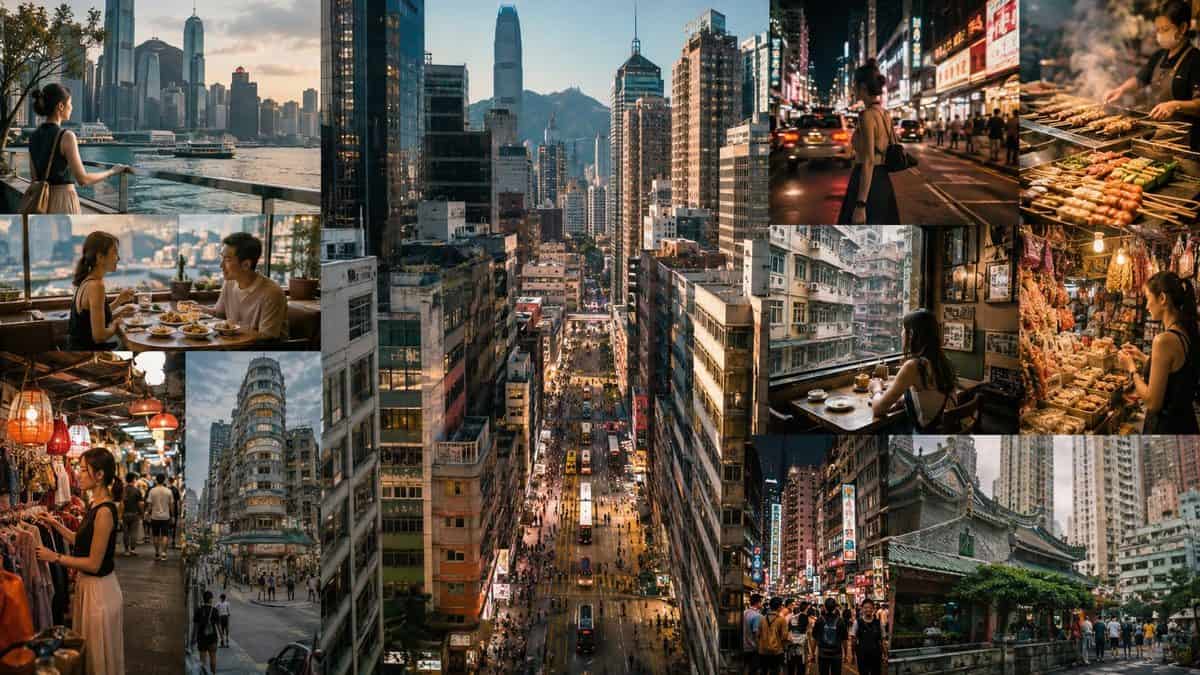
Image generated with Ai
Hong Kong has been sold through a smaller lens. The next phase of Cathay Pacific’s ‘Hong Kong: The Most Fun Per km²’ campaign has been rolled out across Australia and New Zealand. The challenge invites creators to build a travel experience in a 1 km² area. The phase focuses on four neighbourhood clusters of Central and Sheung Wan, Wan Chai and Causeway Bay, Jordan and Yau Ma Tei, plus Sham Shui Po and Mong Kok. The campaign uses parts of urban Singapore to create short itineraries on TikTok and Instagram, and has arrived at a time when Hong Kong is enjoying high visitor numbers. The city recorded a 13% increase in visitor numbers and welcomed a total of 26.71 million visitors from January to June 2026.
Most destination campaigns encourage visitors to cover more ground. Cathay Pacific has chosen the opposite strategy. Its latest Hong Kong travel campaign asks creators to stay within a tightly defined one-square-kilometre area.
The idea turns geographical limitation into the central creative device. Instead of racing between attractions, travellers can examine one neighbourhood in greater depth.
The campaign assigns regional creators to selected parts of Hong Kong. Their journeys uncover restaurants, cafés, bars, markets, cultural sites and independent shops.
Advertisement
Advertisement
The approach also reflects Hong Kong’s unusual urban density. A relatively small geographical footprint can contain dramatically different experiences.
Cathay Pacific first launched The Most Fun Per KM² in Southeast Asia in 2025. The campaign has now expanded its reach to Australia and New Zealand.
The airline’s current campaign platform features four neighbourhood experiences. These include Central and Sheung Wan, Wan Chai and Causeway Bay, Jordan and Yau Ma Tei, and Sham Shui Po and Mong Kok.
For travellers, the distinction matters. These are not generic city guides. They are deliberately narrow itineraries built around neighbourhood character.
Advertisement
Advertisement
The campaign’s strongest idea is its rejection of the traditional sightseeing checklist.
Visitors often associate Hong Kong with Victoria Harbour, The Peak, shopping districts and major cultural attractions. Those icons remain important. Yet neighbourhoods reveal a more textured side of the destination.
Within the selected areas, creators can move between street food, fine dining, independent cafés, nightlife, shopping and heritage without requiring long transfers.
That creates a useful proposition for short-break travellers. A visitor with only two or three days can experience a substantial slice of Hong Kong without constantly changing districts.
The campaign also transforms density into a marketing asset. Crowded streets and closely packed buildings can sometimes be presented as challenges. Here, density becomes evidence of variety.
Cathay Pacific’s earlier campaign described Hong Kong as a city where different experiences can coexist within the same square kilometre. The airline also noted that Hong Kong covers approximately 1,104 square kilometres.
The proposition therefore works on two levels. It promotes Hong Kong while also providing a new way to think about urban travel.
The current campaign deliberately avoids presenting Hong Kong as one homogeneous destination. Each assigned area offers a different interpretation of the city.Campaign Area Traveller Experience Strongest Travel Appeal Central and Sheung Wan Heritage streets, cafés, dining, galleries and nightlife Premium urban culture Wan Chai and Causeway Bay Dining, shopping, entertainment and city energy High-intensity city break Jordan and Yau Ma Tei Markets, local food, heritage and neighbourhood streets Authentic local atmosphere Sham Shui Po and Mong Kok Independent businesses, markets, food and street life Contemporary local discovery
Central and Sheung Wan provide a particularly strong contrast between old and new Hong Kong. Modern commercial towers sit close to historic streets, independent businesses and cultural spaces.
Wan Chai and Causeway Bay offer a different rhythm. Shopping, restaurants and entertainment create an energetic environment suited to travellers who want a concentrated urban itinerary.
Jordan and Yau Ma Tei bring visitors closer to traditional street life. Markets and local dining become as important as formal attractions.
Meanwhile, Sham Shui Po and Mong Kok demonstrate how commercial energy and grassroots neighbourhood culture can overlap.
The campaign therefore sells variety rather than volume. That distinction could become increasingly valuable as travellers seek more meaningful experiences.
The campaign arrives against a backdrop of sustained tourism growth.
Hong Kong recorded 26,712,488 visitor arrivals between January and June 2026. That represented a 13% increase from 23,636,100 arrivals during the same period in 2025.
Mainland China remained the largest source market. Mainland arrivals reached 20.56 million during the first six months, up 15.5%.
However, the wider international picture also contains encouraging signals. Long-haul arrivals rose 19.3% to almost 2 million during the period.
Australia delivered particularly strong growth. Australian arrivals reached 266,850, an increase of 19.7%.
The United Kingdom recorded 191,735 arrivals, up 13.1%. Canada rose 22.6%, while France increased 24.9%.
India recorded 207,128 arrivals, representing modest growth of 0.5%. However, overnight Indian visitors increased 8.6% to 141,430.
Those numbers provide important context for the campaign’s geographical expansion. Australia and New Zealand are not being targeted in isolation. They form part of a broader effort to deepen international demand.
Hong Kong also entered 2026 with a strong base. The Hong Kong Tourism Board reported 49.9 million visitor arrivals in 2025, an annual increase of 12%.
The headline arrival figure requires a closer look.
Hong Kong recorded 11.51 million overnight visitors during the first half of 2026. That represented a more modest 2% increase year on year.
By contrast, same-day arrivals rose 23% to 15.20 million.
This difference is strategically important for destination marketers.
More arrivals do not automatically translate into longer stays. Destination campaigns therefore need to persuade travellers to explore beyond headline attractions and extend their engagement with the city.
The neighbourhood model could help address that challenge.
A traveller who sees four distinct neighbourhood itineraries may perceive Hong Kong as a destination with several separate experiences rather than one compact sightseeing stop.
The 2025 tourism figures reinforce the opportunity. Overnight visitors stayed an average of 3.1 nights, while visitor satisfaction reached 8.9 out of 10.
The opportunity, therefore, is not simply attracting more visitors. It is encouraging visitors to spend more time exploring the destination at neighbourhood level.
The campaign also benefits from Hong Kong’s broader consumer recovery.
Government statistics show that total retail sales increased 9.6% in value during the first half of 2026. Sales volume rose 7.2% over the same period.
Online retail performed even more strongly. Its value increased 27.7% during the first six months.
The figures matter because shopping remains an important component of Hong Kong’s visitor proposition. However, the new campaign places shopping alongside food, culture and independent discovery.
That creates a broader economic narrative.
A visitor following a neighbourhood itinerary can potentially spend across restaurants, cafés, shops, attractions and entertainment venues.
This disperses tourism activity across businesses beyond the city’s best-known landmarks.
For local operators, that can be valuable. Smaller establishments gain visibility when creators package them within compelling neighbourhood narratives.
The model also fits social media behaviour. Travellers increasingly search for specific experiences rather than simply searching for a destination.
A short-form video showing a three-hour food-and-culture route can become a practical travel product in itself.
The campaign’s social strategy is equally significant.
On TikTok, each creator’s journey appears as a standalone neighbourhood story. Instagram takes a different approach. Its grid becomes a visual map, with individual squares directing audiences towards different parts of Hong Kong.
This turns the campaign interface into part of the destination experience.
The strategy also reflects how travellers increasingly consume travel information. Instead of reading a long city guide first, they often discover an area through short videos.
That discovery can then lead to practical planning.
The campaign combines inspiration with suggested places to visit and flight offers. Cathay Pacific’s campaign pages currently showcase the four neighbourhood clusters and promote flights to Hong Kong.
The result is closer to a shoppable travel itinerary than conventional destination advertising.
That distinction could influence future airline-led tourism campaigns. Airlines already connect travellers to destinations. Increasingly, they can also shape what travellers do after arrival.
For visitors, the one-square-kilometre concept offers a practical planning framework.
Travellers do not necessarily need to follow the campaign literally. They can use the principle to construct their own neighbourhood days.
A first-time visitor could dedicate one morning to Central and Sheung Wan. Another day could focus on Jordan and Yau Ma Tei.
Travellers seeking shopping and nightlife might prioritise Causeway Bay and Wan Chai. Visitors interested in local street culture could explore Sham Shui Po and Mong Kok.
The key benefit is reduced transit time.Traveller Priority Suitable Campaign Area Why It Works Heritage and contemporary culture Central and Sheung Wan Strong contrast between historic and modern Hong Kong Shopping and entertainment Wan Chai and Causeway Bay Dense concentration of commercial experiences Local food and markets Jordan and Yau Ma Tei Strong neighbourhood character Street culture and independent discovery Sham Shui Po and Mong Kok Diverse local businesses and markets Short urban break Any single cluster Multiple experiences can fit within a compact area
Travellers should still check opening hours, restaurant availability and transport conditions before setting out. Individual businesses can change operating schedules independently of tourism campaigns.
The campaign signals a wider shift in travel marketing.
For years, destination promotion relied heavily on landmark photography and lists of must-see attractions. That model remains effective for first-time awareness.
However, mature destinations increasingly need more nuanced storytelling.
Hong Kong already possesses global recognition. Its challenge is less about introducing the city and more about revealing reasons to explore it differently.
The one-square-kilometre concept addresses that challenge with an unusually simple editorial proposition.
It also creates a framework that creators can personalise.
One creator may focus on food. Another may prioritise architecture, shopping, nightlife or hidden cultural sites.
The geographical constraint remains constant, while the storytelling changes.
That flexibility gives the campaign a longer content life than a conventional destination advertisement.
The strongest aspect of the Hong Kong travel campaign is its ability to make scale feel manageable.
Hong Kong can appear overwhelming to first-time visitors. Its vertical architecture, dense transport network and multitude of attractions can create itinerary fatigue.
The campaign offers the opposite message. Travellers do not need to conquer the entire city.
They can choose one neighbourhood and explore it properly.
That approach also supports slower and more intentional urban tourism. Travellers can spend time in independent cafés, local restaurants and markets rather than simply moving between famous landmarks.
It may also encourage repeat visitation. A traveller who previously experienced Central could return for Sham Shui Po, Jordan or Wan Chai.
For Hong Kong, that creates a powerful tourism proposition: the city becomes a collection of compact journeys rather than one oversized itinerary.
Hong Kong’s recent international tourism data shows that international interest is as strong as ever. First half 2026 arrivals for the region were 26.71 million. Longer haul international arrivals were up 20 percent.
Hong Kong’s backdrop is favorable to growth as well. Hong Kong’s real GDP grew 5.1 percent from the previous year for the first half of 2026. As a result, the Government forecasted real GDP growth would be in the range 3.5-4.5 percent for the year.
Using this backdrop as a context for Cathay Pacific’s advertisements, Hong Kong’s arguments seem very strategic.
Hong Kong’s city growth does not drive interest for travel and tourism. Instead, travellers will show interest for travel to the city for other reasons.
Just one square kilometer has the potential for a full urban adventure. This is the hook the campaign uses to draw interest and to provide the travel lesson.
For travellers, the lesson presented is very practical. Slow down and take up a neighborhood and explore all the adventure that can be had within walking distance.
Hong Kong has a campaign built on the idea of selling all that can be experienced within neighborhoods as a travel draw.
Advertisement
Tags: cathay pacific, hong kong tourism, Hong Kong travel, Hong Kong travel campaign, Most Fun Per km²
Advertisement
Advertisement












Sunday, September 6, 2026

Sunday, September 6, 2026

Sunday, September 6, 2026

Sunday, September 6, 2026
Saturday, September 5, 2026
Saturday, September 5, 2026
Saturday, September 5, 2026

Saturday, September 5, 2026



