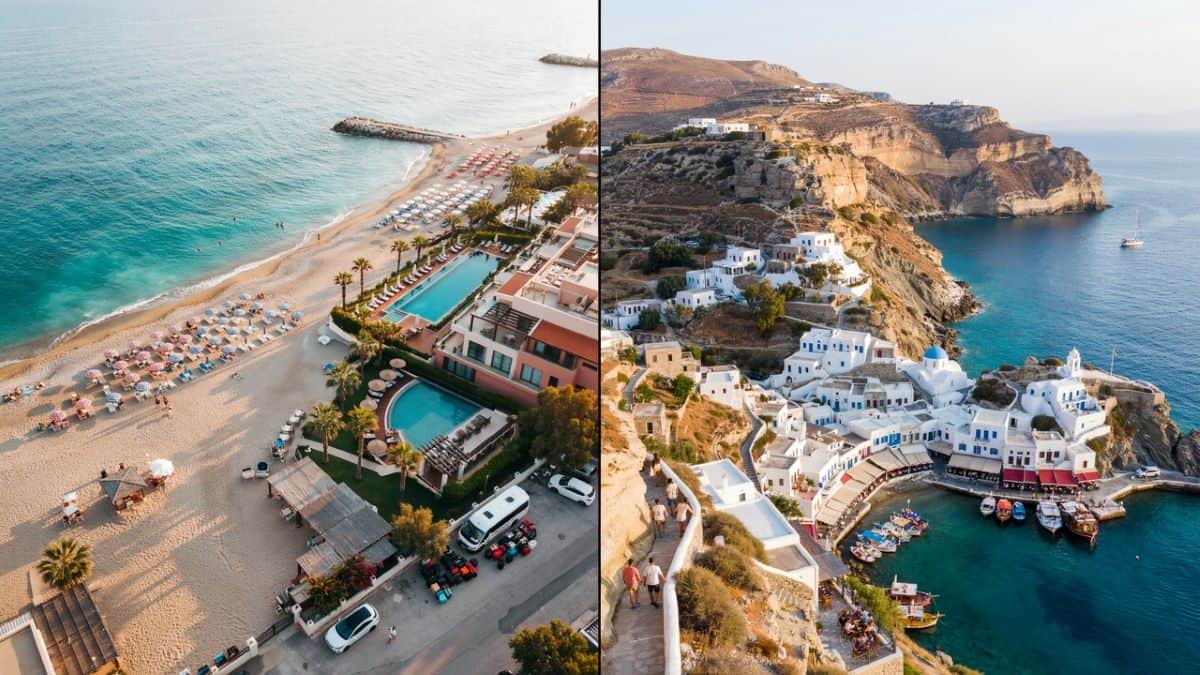
Image generated with Ai
Turkey holidays for tourists are getting more attention as travellers look closely at costs, access and value compared to Greece. People are weighing up the Mediterranean options carefully. Official data shows that Türkiye is still a player in Europe’s tourism scene. At the time Greece keeps breaking travel income records and sees strong growth in visitors. So the decision isn’t about which country is cheaper. It’s more complicated, than that. Exchange rates inflation what’s included in holiday packages, flight availability and the time of year you travel can all make a difference to the final price. This report checks verified tourism numbers, economic facts and entry rules as of 4 August 2026. Its goal is to help British holidaymakers know what they need to understand before booking a trip to either country.
Claims that Türkiye has become the obvious low-cost alternative to Greece have gained visibility as British households continue to examine the full cost of overseas holidays. The comparison is understandable. Both countries offer extensive Mediterranean and Aegean coastlines, established resort regions, significant air connectivity and accommodation ranging from self-catering apartments to large all-inclusive properties.
Advertisement
Yet the official evidence demands a more careful conclusion. Government statistics confirm that Türkiye tourism operates on enormous scale and attracts substantial international demand. They also show that Greece continues to strengthen its tourism economy, with travel receipts and visitor numbers rising. What the figures do not establish is that every Turkish resort, hotel or package costs less than its Greek equivalent.
Holiday prices depend on the entire booking. This includes the departure airport, travel dates, flight schedule, room category, board basis, hold luggage, airport transfers, local transport and cancellation conditions. A seven-night all-inclusive package in Antalya cannot be compared fairly with a room-only stay on a Greek island unless all additional expenses are considered.
Advertisement
The correct question is therefore not simply whether Türkiye is cheaper. It is where and when British tourists can obtain better overall value after comparing like-for-like products.
This article uses information published by official bodies and available by the requested cut-off date of 4 August 2026. Developments or figures released after that date are excluded, even when later information may now be available.
Türkiye’s position in the global visitor economy provides essential context for the price debate. According to the Turkish Statistical Institute, the country recorded 62.2 million visitors in 2024. Official Turkish statistics also placed the country fifth globally and fourth in Europe for international tourist arrivals using the relevant UN Tourism ranking.
That scale matters. A destination receiving tens of millions of visitors can sustain extensive aviation networks, large resort inventories, organised transfers and a broad range of tourism businesses. Antalya, Muğla, İzmir and İstanbul serve different markets, enabling travellers to choose between coastal packages, cultural breaks and combined itineraries.
Türkiye’s tourism income continued to rise. The Turkish Statistical Institute’s Türkiye in Statistics 2025 reported tourism income from visitors of approximately US$64.45 billion in 2025, excluding the separately identified contribution from transfer passengers. It placed average expenditure per visitor at US$1,008.
These figures do not prove that holidays are inexpensive. They demonstrate that Türkiye has developed a high-volume tourism economy capable of serving budget, mid-market and premium travellers simultaneously.
Türkiye’s coastal tourism structure is particularly relevant to British consumers. Antalya and neighbouring resort areas contain large accommodation clusters designed around organised leisure travel. Many properties offer half-board, full-board or all-inclusive arrangements.
This structure can make the total holiday bill more predictable. Travellers paying for meals and selected facilities before departure may face fewer discretionary expenses after arrival. That can be important for families and groups attempting to control their spending.
However, “all-inclusive” is not a standardised government classification of everything a visitor will receive. Inclusions differ between hotels and travel organisers. Premium drinks, speciality restaurants, spa treatments, late check-out, water sports and private transfers can remain chargeable.
The value of a Turkish package must therefore be judged from its written conditions, not from the all-inclusive label alone.
Any claim that British holidaymakers are abandoning Greece would require strong evidence. Official Greek data instead show an expanding and highly valuable tourism sector.
The Bank of Greece reported that travel receipts reached €23.63 billion in 2025, an increase of 9.4% from 2024. Receipts from residents of European Union countries reached €12.69 billion, while receipts from residents of other countries increased to €9.92 billion.
This matters because the United Kingdom is outside the EU and has long been an important source market for Greece. The increase in non-EU receipts demonstrates that demand from markets beyond the bloc remained economically significant.
Greece had already generated €21.59 billion in travel receipts during 2024, according to the Bank of Greece’s final annual data. That represented a 4.8% increase from 2023. The continued advance in 2025 indicates that demand was not collapsing in response to competition from Türkiye.
Official figures available before 4 August 2026 showed that Greece’s tourism economy began the year strongly. Bank of Greece data for January to April 2026 recorded travel receipts of €2.79 billion, up 36.9% from the corresponding period of 2025.
Inbound traveller flows rose by 27.1%, while average expenditure per trip increased by 8.6%. The travel-services surplus expanded to €1.66 billion, compared with approximately €1.05 billion during the same period one year earlier.
April alone produced €1.11 billion in travel receipts, representing annual growth of 9.5%. Receipts from EU residents rose by 10.7%, while those from residents of other countries increased by 8.2%.
The Bank of Greece’s monetary policy assessment connected this performance with a longer tourism season and Greece’s continued attractiveness during a period of geopolitical uncertainty.
These are not the figures of a destination losing its international appeal. They point to continued demand, growing revenue and broader seasonal strength.
No comprehensive government index establishes that one country always provides cheaper holidays than the other for British residents.
National consumer price indices measure changes in domestic prices. They are not package-holiday comparison tools. Tourism receipts measure money earned from international visitors, but they do not reveal what an individual British household paid for a particular flight-and-hotel combination.
Average expenditure per visitor also requires caution. It can be influenced by the length of stay, purpose of travel, accommodation category and type of traveller. A destination attracting more long-stay visitors may record higher spending per trip without necessarily having higher daily prices.
Similarly, a favourable exchange rate does not automatically make every imported, energy-intensive or tourism-facing service inexpensive. Businesses may adjust prices as wages, food, fuel and financing costs change.
The defensible finding is that Türkiye can provide strong package value in particular resorts and periods. It is not defensible, using government evidence alone, to say that it is universally cheaper.
A holiday has at least two cost layers:
A competitively priced Turkish all-inclusive package may reduce the importance of local prices. Conversely, a low-cost flight to Greece combined with reasonably priced self-catering accommodation may produce a lower total for travellers who control their daily spending.
The reverse can also occur. A traveller may buy a cheap room-only holiday but spend heavily on meals, transfers and beach services. Another may pay more initially for a comprehensive package and spend very little after arrival.
Meaningful comparisons must calculate the complete expected cost.
Currency movements are central to perceptions of affordable Türkiye travel. British visitors often notice that sterling converts into a large numerical amount of Turkish lira. This can make Türkiye appear inexpensive when prices are viewed only through the exchange rate.
The Central Bank of the Republic of Türkiye publishes official indicative exchange rates and historical series. These sources allow travellers and analysts to examine currency movements without relying on unverified social-media claims.
However, a weaker lira does not transfer automatically into equivalent savings for foreign visitors. Türkiye has experienced substantial domestic price growth. Hotels, restaurants and transport businesses face changing costs for labour, energy, food, maintenance and imported goods.
When domestic prices rise, businesses may increase their lira prices. The exchange-rate benefit for a sterling holder can therefore be partly or substantially offset.
Türkiye’s inflation environment is essential to any responsible comparison. A destination can remain attractive to foreign-currency holders while becoming more expensive in local-currency terms.
This is why old anecdotes and prices are unreliable. A meal, taxi journey or attraction ticket quoted in an article from a previous year may no longer represent current conditions. Travellers should obtain current prices from official operators or the supplier itself.
The same principle applies to Greece. Greece uses the euro, meaning British travellers face movements in the sterling-euro exchange rate. Although the currency relationship is generally less dramatic than sterling’s movement against the lira, it still affects the holiday budget.
Currency is therefore one component of value, not a guarantee of it.
The scale of British overseas travel explains why Türkiye and Greece compete so intensely for this market. The Office for National Statistics estimated that UK residents made 94.6 million visits abroad in 2024 and spent £78.6 billion.
This was a substantial increase from the 86.2 million overseas visits estimated for 2023. It demonstrates the depth of UK demand for international travel after the disruption of the pandemic period.
Neither Greece nor Türkiye depends on a single type of British visitor. Both serve families, couples, younger travellers, retirees, independent tourists and organised groups. Both also offer products at different price levels.
British demand can affect capacity and pricing. When airlines and travel organisers add seats and rooms, competition may improve availability. When school-holiday demand concentrates on particular weeks, prices can rise sharply regardless of the destination’s general reputation.
The dates of travel often matter more than the country name. Flights and accommodation during the English school summer holiday period may be considerably more expensive than equivalent products in May, June, September or October.
Families tied to school calendars should compare:
A headline saving can disappear when luggage, seat selection, transfers or meals are added. Conversely, a package that initially appears expensive may represent better value if it includes these components.
Entry requirements can influence the attractiveness of a holiday even when they do not create a major direct expense.
Official UK guidance states that British citizen passport holders can visit Türkiye without a visa for up to 90 days in any 180-day period for tourism or business. Travellers using other types of British passport may need a visa and should verify the requirements.
The UK Foreign, Commonwealth and Development Office’s Türkiye guidance also explains passport-validity conditions. Travellers should check the issue date and expiry date requirements before departure rather than relying on a travel forum or previous experience.
Greece is part of the Schengen area. British citizens can generally travel within the Schengen area for up to 90 days in any rolling 180-day period without a visa for tourism, subject to the applicable passport and border conditions.
The FCDO Greece travel advice should be checked before travel because border systems and implementation details can change.
Travellers who have recently visited other Schengen countries must include those stays when calculating time available for Greece. The Greek allowance is not a separate 90-day entitlement.
Türkiye is not part of Schengen, so time spent there does not consume the traveller’s Schengen allowance. This can make Türkiye useful for longer multi-country itineraries, remote workers or repeat travellers, although tourism permission must not be confused with permission to work or reside.
Passport replacement, denied boarding or disrupted travel can impose costs far greater than small differences between hotel prices. Entry compliance should therefore form part of holiday planning.
Price should never be the only consideration. Both countries experience seasonal and regional risks that travellers must evaluate through official advice.
The FCDO warns of a high risk of wildfires in Türkiye during the summer season, generally from April to October. It advises travellers to follow local authorities and monitor official information.
The FCDO also advises against all travel to areas within 10 kilometres of the Türkiye–Syria border. This warning concerns a specific region and should not be casually applied to the entire country. Equally, resort popularity should not be used to dismiss official regional warnings.
Greece also faces a high risk of summer wildfires. Heat, dry conditions and strong winds can contribute to rapidly changing situations on islands and the mainland.
The FCDO advises travellers to obtain appropriate insurance covering their itinerary and planned activities. Travellers should declare medical conditions, examine policy exclusions and understand the process for contacting the insurer.
A cheap holiday can become financially damaging if insurance is inadequate. Medical treatment, evacuation, replacement transport and additional accommodation can create significant costs.
Visitors should also retain copies of passports, insurance details and booking documents. They should follow instructions from civil-protection authorities during wildfires, extreme heat or other emergencies.
Official warnings do not mean that all travel must stop. They mean that travellers must understand the risks, avoid restricted areas and prepare appropriately.
Greece is frequently discussed as though it were a single island market. In reality, its tourism geography is exceptionally diverse.
High-profile islands can command premium prices during peak periods, particularly where room supply is constrained and international demand is concentrated. Yet Greece also offers mainland cities, coastal regions, mountain areas and less internationally saturated islands.
Athens and Thessaloniki support urban tourism. Crete, Rhodes, Corfu and other established destinations offer substantial resort capacity. Mainland regions provide archaeological, cultural, nature-based and coastal experiences.
This diversity means that “Greece is expensive” is no more reliable than “Türkiye is cheap”. Prices vary significantly by location, season, hotel class and travel style.
Bank of Greece analysis has identified a longer tourism season as one factor supporting stronger travel performance. This has implications for travellers seeking value.
May, early June, late September and October can offer a different balance of weather, demand and availability from July and August. Flight schedules and property opening periods still need to be checked, especially on smaller islands.
Travelling outside the busiest weeks can also reduce pressure on destinations. Visitors may experience less congestion while supporting employment and tourism revenue beyond the traditional peak.
This does not guarantee low prices. It expands the number of dates on which travellers can compare viable products.
Türkiye’s reputation for large coastal resorts is justified, but incomplete. İstanbul is a major cultural and urban destination. İzmir and the Aegean coast support city, heritage and seaside travel. Cappadocia attracts visitors for its geological landscape and cultural sites. Ankara, Bursa, Konya and other cities add further historical and business dimensions.
The country’s geographical scale creates opportunities for combined trips. A visitor can pair a coastal stay with urban or cultural travel, although domestic flights and ground transport increase the total budget.
Türkiye’s broad product base also helps it attract visitors outside the summer peak. City breaks, heritage tourism, gastronomy and wellness products can support year-round demand.
For British tourists, the practical value depends on how efficiently these components are packaged. An itinerary with several internal journeys may offer a richer experience while costing more than a single-resort stay.
Tourism is a major source of foreign-currency earnings, employment and regional business for both Türkiye and Greece. Rising receipts can support hotels, restaurants, transport companies, cultural sites, retailers and supply chains.
In Türkiye, official tourism income exceeding US$65 billion when transfer-passenger revenue is included illustrates the sector’s national importance. The industry brings foreign currency into an economy where exchange-rate conditions and inflation remain important policy concerns.
In Greece, the travel-services surplus contributes significantly to the external balance. The €23.63 billion of 2025 travel receipts and strong growth in early 2026 show why tourism performance matters to the wider economy.
National revenue growth can result from several factors:
It cannot automatically be interpreted as evidence of price increases. Nor does it prove that every destination is overcrowded.
Local conditions matter. A national tourism economy may grow while particular areas face capacity pressure and others seek additional demand.
Responsible reporting must therefore separate national statistics from local experience.
The competition between Türkiye and Greece gives airlines, travel organisers and accommodation providers strong reasons to refine their products.
Türkiye’s large all-inclusive inventory can appeal to customers prioritising budget certainty. Greek destinations may compete through location, cultural access, island diversity, smaller properties or flexible self-catering products.
Travel businesses should avoid presenting value only as the lowest headline price. Customers increasingly need clarity about the total cost. Transparent descriptions of luggage, transfers, meals, local charges and cancellation rules allow meaningful comparisons.
Misleading price claims can damage trust. A low advertised figure that excludes unavoidable additions may produce a high click-through rate but a poor customer experience.
Hotels and other operators in both countries must manage labour, energy, food, maintenance and financing expenses. In Türkiye, high domestic inflation can make cost planning especially difficult. In Greece, seasonal labour availability and island logistics can influence operating expenses.
Businesses cannot indefinitely absorb every increase. Some costs will be reflected in room rates, menus or service charges.
This explains why historic assumptions about “cheap destinations” become outdated. Tourism markets respond to domestic costs, international demand, exchange rates and capacity.
A reliable comparison should begin with the same travel requirements for both countries.
First, choose fixed dates and the same holiday duration. Next, compare departures from the same airport or include the cost of reaching alternative airports. Then match the accommodation category, room occupancy and board basis.
Travellers should add:
The resulting total is more meaningful than the displayed package price.
Families and groups can divide the complete expected cost by the number of travellers and nights. This produces a comparable per-person, per-day figure.
The method is not perfect because holiday experiences differ. It nevertheless exposes hidden costs and makes board arrangements easier to compare.
Travellers should also assign value to convenience. A direct flight, included transfer and flexible cancellation may justify a higher price. A cheaper itinerary with a long connection or distant airport may not represent better value.
British consumers booking packages should confirm what financial protection applies and retain the organiser’s documentation. Flight-inclusive packages sold by qualifying UK businesses may be covered by ATOL, while other arrangements may fall under different protections.
The UK Civil Aviation Authority provides official information about ATOL. Travellers should verify protection directly rather than assuming that every online booking has the same safeguards.
Financial protection is distinct from travel insurance. Consumers may need both.
Türkiye and Greece have strong incentives to pursue tourism growth, but future policy is likely to focus increasingly on resilience, seasonality, infrastructure and visitor management.
Climate risks are already material. Wildfires and extreme heat can affect visitors, residents, workers and ecosystems. Water supply, waste management and transport capacity can become strained during peak periods.
Policies that extend the season or distribute travellers more widely may reduce pressure while supporting local economies for more months of the year.
A sustainable tourism strategy cannot rely solely on low wages, weak currencies or discounted accommodation. Long-term competitiveness requires infrastructure, safety, skilled workers, environmental protection and consistent service quality.
For Türkiye, currency conditions can help attract foreign demand, but inflation complicates pricing and investment. For Greece, strong demand supports receipts but can create pressure in highly concentrated destinations.
Both countries must balance affordability for visitors with viable returns for businesses and acceptable living conditions for residents.
The verified evidence available by 4 August 2026 points to continued competition rather than a decisive migration from Greece to Türkiye.
Türkiye possesses the scale, resort capacity and tourism infrastructure to remain a powerful option for British holidaymakers. Its visa-free conditions for short tourist visits and large all-inclusive market strengthen its appeal.
Greece enters the comparison from a position of strength. Its travel receipts reached a new high in 2025, while early 2026 data showed major growth in inbound flows and revenue. Greece’s varied islands, mainland regions and expanding tourism season continue to support demand.
The most likely outcome is not that one destination replaces the other. It is that travellers choose more selectively according to price, inclusions, climate, access and preferred experience.
Turkey holidays for tourists can offer compelling Mediterranean value but official evidence does not justify declaring Turkey universally cheaper than Greece. Turkey’s scale, resort capacity visa‑free access and currency environment strengthen Turkey’s appeal while domestic inflation means local prices cannot be judged from exchange rates. Greece remains competitive supported by rising receipts expanding visitor flows and established demand. Travellers should compare dates, departure airports, board arrangements, baggage and transfer costs before booking. The clearest conclusion is that both Turkey and Greece remain choices with value determined by the complete holiday price rather, than a headline claim alone.
[Source:- Greek Times]
Advertisement
Advertisement
Advertisement











Wednesday, September 2, 2026

Wednesday, September 2, 2026

Wednesday, September 2, 2026

Wednesday, September 2, 2026

Wednesday, September 2, 2026

Tuesday, September 1, 2026

Wednesday, September 2, 2026

Wednesday, September 2, 2026



