
Storm Boelo Sparks UK Travel Disruption Fears for Scottish Ferries and Northern England Rail After Storm Austen

Published
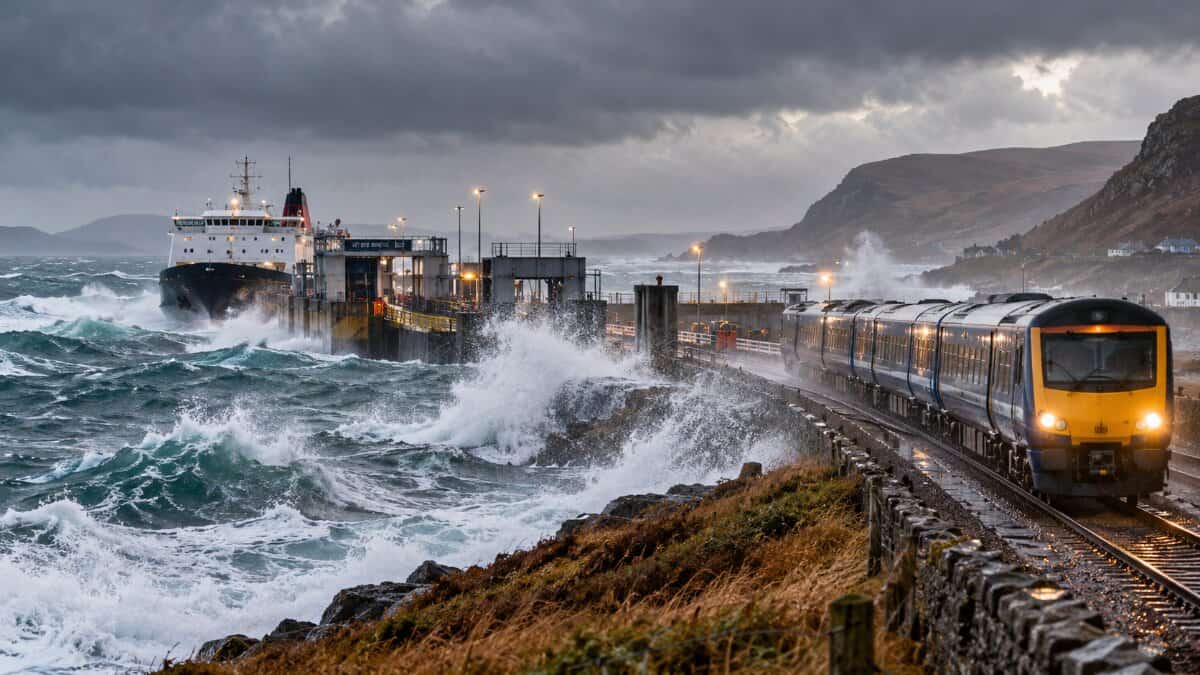
Storm Boelo is putting weekend journeys across Scotland, Northern Ireland, and northern England at risk, arriving shortly after Storm Austen swept through southern Britain and Wales. According to the Met Office, a yellow wind warning covers mainland Scotland, the Western Isles, Orkney, and northern parts of England from 18:00 on Saturday, 24 October, until 21:00 on Sunday, 25 October (with Northern Ireland’s alert ending at 15:00 on Sunday). Northern has already announced train service reductions, while Network Rail plans precautionary speed restrictions. Ferry cancellations remain route-dependent and should not be assumed. Travellers combining trains, ferries, road transfers, and island accommodation face the greatest planning complexity.
Storm Boelo Adds a Second Travel Alert as Strong Winds Move North
The Met Office named Storm Boelo on 22 October as a separate Atlantic low-pressure system from Storm Austen, which was expected to clear into the North Sea on Friday evening. Boelo is forecast to reach Northern Ireland and western Scotland on Saturday afternoon, followed by stronger winds overnight and into Sunday.
Advertisement
Advertisement
The yellow warning runs from 18:00 BST on Saturday until 21:00 GMT on Sunday, spanning the overnight clock change. Widely forecast gusts reach 55–65 mph, with 70–80 mph possible at exposed coasts and higher ground. Northern Ireland has a separate warning ending at 15:00 GMT on Sunday.
Friday also matters. According to the Met Office, Storm Austen brings a yellow rain warning to southern and eastern Scotland, with 20–40 mm likely across warned areas and 60–80 mm possible locally. This creates a cumulative hazard without establishing widespread cancellations.
Advertisement
Advertisement
| Critical period | Confirmed official information | Travel significance |
|---|---|---|
| Friday, 23 October | Scottish rain warning; rail speed restrictions announced | Longer rail journeys could affect onward connections |
| Saturday, 24 October | Storm Boelo moves east; wind warning begins at 18:00 | Recheck late rail, road and ferry journeys |
| Sunday, 25 October | Northern wind warning continues until 21:00 GMT | Ferry links and return journeys remain exposed |
| Monday, 26 October | Northern train service reductions planned through Monday | Recovery-day connections need separate verification |
Scotland Rail Services Face Confirmed Precautions Before the Weekend Peak
Network Rail announced on 22 October that Friday speed restrictions would affect sections of the West Coast Main Line and East Coast Main Line, together with routes across southern and eastern Scotland. They are a safety response to forecast heavy rain, flooding potential and the danger of debris or fallen trees on tracks. Operating trains can still miss onward connections.
Further restrictions are possible during Boelo; no blanket Scottish rail closure has been announced. ScotRail passengers should check journey-specific updates rather than rely on an ordinary timetable, especially when travelling between long-distance services and onward road or ferry departures.
Advertisement
Advertisement
A booked rail seat does not guarantee a connection with a separately ticketed ferry or transfer.
Northern England Train Reductions Extend Beyond the Storm Weekend
Northern has confirmed changes to services from Friday, 23 October, through Monday, 26 October. On Friday, it identifies fewer trains at some stations on Leeds–York via Harrogate, Newcastle–Ashington, Leeds–Bradford Interchange and Blackburn–Manchester via Todmorden.
It also lists fewer services between Blackburn and Rochdale via Bolton and Manchester Victoria.
For Saturday to Monday, Northern states that several routes will operate fewer trains, but the full route-by-route detail had not yet been published in the advisory reviewed. Journey planners may take time to reflect late changes. It would therefore be inaccurate to describe every named Friday route as cancelled for the entire weekend.
Reduced feeder services can undermine onward cross-border trains and booked transfers even when the next service is operating. Both legs need checking.
Scottish Island Ferries Require Route-Level Checks, Not Blanket Cancellation Claims
Scottish ferry operations can change independently of mainland rail restrictions. The Met Office warns that ferry services may experience longer journey times or cancellations, but its forecast does not confirm cancellations for individual sailings.
Advertisement
Advertisement
Caledonian MacBrayne directs passengers to its service-status system for live route information. Its winter timetable began on 19 October and runs until 25 March 2027, meaning weekend visitors must use current winter schedules rather than older summer departure times.
CalMac also states that remaining summer 2026 tickets ceased to be valid when the winter season began. On the Oban–Colonsay–Islay route, it specifies a 30-minute check-in deadline, making late rail arrivals consequential.
Islay has an additional, unrelated constraint: Port Ellen closed for upgrades in June 2026, and Kennacraig sailings use Port Askaig during the closure, scheduled until 2029.
For Orkney and Shetland, NorthLink Ferries operates services through Aberdeen, Lerwick, Kirkwall, Scrabster and Stromness. Its published guidance requires check-in at least 30 minutes before departure and warns that weather or technical conditions can change timetables at short notice. Neither warning establishes widespread cancellations.
The Overlooked Sunday Clock Change Creates an Extra Connection Risk
A second scheduling factor makes this weekend unusual. According to UK government guidance, clocks move back one hour at 02:00 British Summer Time on Sunday, 25 October, returning to 01:00 Greenwich Mean Time. The Met Office wind warning therefore starts on Saturday under BST and finishes on Sunday under GMT.
Flight-to-rail and rail-to-ferry itineraries require checking digital calendars, overseas time-zone settings and operator timetables. The clock change does not alter a service automatically, but mistaken timing can erase a connection margin.
Advertisement
Advertisement
Together with CalMac’s winter timetable switch just six days earlier, the Sunday time change creates two independent reasons to reconfirm departure times.
Booking agents should specify the local day, time zone and check-in deadline in their client instructions rather than assuming that every document has updated automatically.
Roads and Port Access Could Become the Weakest Link
Traffic Scotland’s warnings cover Highland and the Western Isles, Grampian, central Scotland, Strathclyde and the south-west and Borders. They identify crosswinds, longer journeys, obstacles from trees and debris, and risks to high-sided vehicles.
Friday’s Scottish rain warning also identifies possible flooding, reduced visibility and longer stopping distances.
Even when ferries run, coaches and hire cars must reach ports before check-in. Remote hotel transfers also depend on safe roads.
NorthLink separately identifies weekday A9 roadworks near Spittal from 6 to 30 October, with no works scheduled on Saturdays or Sundays. Those planned works are not storm damage, but they are relevant when assessing Friday arrivals and Monday departures via Scrabster.
Advertisement
Advertisement
How One Missed Connection Could Undermine an Entire Holiday
The most significant exposure is not necessarily the cancelled train or sailing in isolation. It is the dependency between several bookings controlled by different organisations.
A train arriving late can cause a missed ferry check-in; a replacement sailing can require an additional mainland hotel night; an island accommodation reservation may still be governed by separate cancellation conditions. These are scenarios, not confirmed incidents.
Outbound and return risks may differ. An island visitor who arrives before peak winds could face a Sunday return problem; someone delaying travel may encounter Monday rail reductions. Neither outcome is confirmed.
The overlooked issue is the interaction of operator decisions and separate booking terms. Travel businesses can reduce this exposure by identifying the last workable onward connection, establishing alternative accommodation options and documenting which provider is responsible for each journey segment.
This assessment synthesises official operational notices and passenger-rights rules; it does not imply verified widespread holiday cancellations.
| Travel chain | Potential failure point | Required confirmation |
|---|---|---|
| Northern England local train to cross-border rail | Reduced feeder frequency or delayed interchange | Both train operators and live journey planner |
| Scottish rail to west-coast ferry | Speed restriction followed by missed check-in | Train arrival, port transfer and named sailing |
| Mainland road transfer to Orkney ferry | Crosswinds, road delays or 30-minute check-in rule | Traffic Scotland and NorthLink service update |
| Ferry to island accommodation | Sailing amendment affects hotel arrival | Ferry status and property’s written booking terms |
Official Tourism Figures Reveal the Scale of Travel Networks at Stake
Official statistics do not measure losses from the October storms. They nevertheless show why transport resilience matters to Scotland’s visitor economy.
Advertisement
Advertisement
According to VisitScotland’s 2025 Great Britain Tourism Survey, residents of Great Britain took 10.4 million overnight trips in Scotland, spending £3.822 billion. The average trip lasted 2.9 nights, leaving relatively little flexibility for disrupted short breaks.
| Measure | Latest cited reporting period | Official result |
|---|---|---|
| Scotland domestic overnight tourism | 2025 | 10.4 million trips; £3.822 billion spend |
| Scotland international tourism | 2024 | 4.4 million trips; £4.0 billion spend |
| ScotRail passenger journeys | 2024–25 | 84.7 million journeys |
| Ferry passengers on routes within Scotland | 2024 | 8.0 million passengers |
| CalMac passengers on routes within Scotland | 2024 | 5.0 million passengers |
Transport Scotland records 8.0 million passengers on ferry routes within Scotland in 2024, including 5.0 million carried by CalMac. These figures show network dependence, not storm losses. Different periods and populations cannot be added to estimate disruption.
Rail Refunds and Weather-Related Ferry Compensation Differ
The Office of Rail and Road explains that passengers who choose not to travel because their train is disrupted can seek a refund without an administration fee.
Passengers who travel but arrive late may qualify for delay compensation through the train company. Northern specifies eligibility for its Delay Repay scheme from a delay of 15 minutes. A forecast warning alone is not equivalent to a cancelled service.
CalMac’s own passenger-rights policy offers rerouting where practicable or a refund if a sailing is cancelled or expected to depart over 90 minutes late.
However, its policy excludes weather-related delay compensation and weather-related overnight accommodation reimbursement. It also excludes claims for consequential losses such as unused hotels, flights or excursions.
Advertisement
Advertisement
NorthLink likewise advises travellers to protect against financial exposure from weather-related sailing disruption.
Government maritime guidance distinguishes refunds and rerouting from compensation and accommodation. Rights depend on the ticket and cause.
Package Holiday Organisers Have Additional Legal Responsibilities
The Package Travel and Linked Travel Arrangements Regulations 2018 provide a different framework where transport, accommodation or other qualifying services form a legally defined package.
In specified unavoidable and extraordinary circumstances that significantly affect the package or travel to its destination, travellers may be entitled to cancel before departure without a fee and obtain a refund. The law does not turn every yellow weather warning into an automatic entitlement.
If significant elements cannot be provided after a package begins, the organiser may need to offer appropriate alternatives and assistance. Agents must distinguish packages from separate services and document changes and costs.
Essential Operational Steps for Travel Agents and Tour Operators
- Recheck Met Office warning boundaries and timings, including the Sunday change from BST to GMT.
- Revalidate every rail leg individually; do not treat a scheduled connection as protected across separate bookings.
- Confirm ferry sailings directly with CalMac or NorthLink and observe the specific port check-in cut-off.
- Check road warnings and port access before dispatching coaches, hire vehicles or luggage transfers.
- Contact rural and island accommodation providers early about late arrivals, unused nights and extension options.
- Preserve booking records, alerts, operator messages and itemised receipts for possible refunds or insurance claims.
- Give group leaders and travellers one updated itinerary identifying who authorises changes and alternative transport.
What Storm Boelo Means for UK Travel Planning Beyond This Weekend
The immediate priority is traveller safety and accurate disruption advice, not an unverified total of cancelled services or economic losses.
Advertisement
Advertisement
Storm Austen and Storm Boelo demonstrate how successive systems can create connected operational pressure across rail, sea and road networks.
The combination with a ferry timetable change and the return to GMT underscores the value of coordinated, time-specific travel information.
For international travel planners, better cross-operator communication and flexible rebooking arrangements offer a more durable response than treating every weather alert as a standalone incident. Actual outcomes will depend on updated forecasts and individual operator decisions through 26 October.
Advertisement
