
Germany Travel Faces a Workforce Gap as Companies Put Rail First

Published
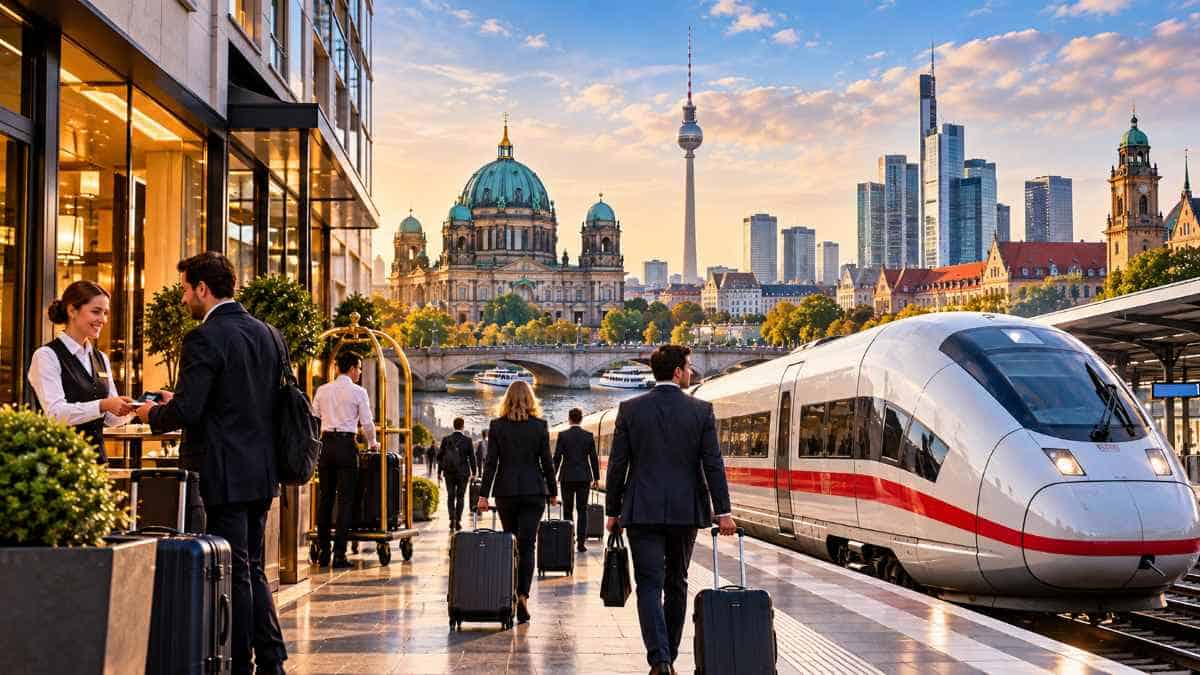
The travel sector in Germany is experiencing two major challenges, one in relation to recruiting enough staff to serve future demand, and the second in reducing emissions from business travel. Both trends are going to impact how tourism businesses will prepare for their future, in order to preserve their position as a major player on the European tourism market and attract leisure tourists, business travellers, and hold events in Germany. As an example of the first challenge, it has been estimated that there could be a 26 per cent shortage of skilled staff in the tourism and travel sector in Germany by 2035 compared to the demand. Although this number is only indicative of the magnitude of the recruitment issue, it is still dependent on the specifics of calculations and what particular occupations are included in the projection. On the other hand, business travel policies in Europe are increasingly looking at rail travel as an alternative to domestic air travel where train travel can replace air travel conveniently. Germany is an important market for this trend, as the country has a very extensive rail network connecting big cities like Berlin, Hamburg, Frankfurt and Munich, among others.
Germany’s Labour Market Signals a Long-Term Challenge
Germany’s demographic outlook adds weight to concerns about future recruitment. An ageing workforce and the retirement of experienced employees are increasing the importance of attracting younger workers and making skilled migration part of long-term workforce planning.
The Federal Employment Agency reported in September 2026 that Germany had 157 occupational categories experiencing skilled-worker shortages in 2025. Although this was six fewer than in the previous year, the agency said labour supply remained a significant challenge, with demographic change expected to increase the importance of immigration.
For travel and hospitality, the consequences can extend across hotel operations, restaurants, visitor attractions, tour companies and event venues. Businesses require staff with language skills, local destination knowledge and the ability to manage international guests. Recruitment gaps can also increase pressure on existing employees and make it harder to maintain consistent service during major events and peak holiday periods.
Advertisement
Advertisement
The projected 26 per cent talent shortfall by 2035 should be treated as a forecast rather than an established outcome. Its reliability depends on the model’s assumptions about tourism demand, productivity, migration and workforce participation. Nevertheless, Germany’s broader skills shortages reinforce the need for employers to plan ahead.
Potential responses include expanding vocational training, improving career pathways, retaining experienced workers and making tourism jobs more attractive to younger applicants. International recruitment could also help fill specific vacancies, provided qualifications, language requirements and employment conditions align with the roles available.
Advertisement
Advertisement
Corporate Travel Policies Put Rail in Focus
The second pressure concerns how German businesses organise their travel. Companies are increasingly examining transport choices as they assess emissions, sustainability targets and the environmental impact of business operations.
Rail is particularly relevant for domestic journeys connecting major business centres. High-speed services can provide an alternative to flying on routes where journey times, departure frequency and connections suit the traveller’s schedule. For companies, choosing rail can also reduce the emissions associated with certain business trips.
Advertisement
Advertisement
Germany’s rail network plays a substantial role in European passenger transport. Eurostat data show that Germany recorded 109.1 billion passenger-kilometres in rail transport in 2024, making it the largest contributor among EU countries in the dataset. This scale gives rail an important place in discussions about how European mobility could become less carbon-intensive.
Deutsche Bahn’s bahn.business programme also offers corporate customers tools to track train journeys and assess potential emissions savings compared with air travel or company cars. Such reporting can help employers document travel patterns and incorporate transport decisions into sustainability reporting.
However, a rail-first policy does not mean that every domestic flight can be replaced. The practicality of a train journey depends on distance, connections, service reliability, ticket costs and the time available for business commitments. For some destinations, flying may remain necessary, while international journeys may require a combination of rail and air transport.
Carbon Reporting Raises the Stakes
European companies are facing greater scrutiny of their environmental performance, but reporting requirements differ according to an organisation’s size, activities and applicable rules. It would therefore be inaccurate to suggest that a single EU directive mandates every German company to replace domestic flights with high-speed rail.
Advertisement
Advertisement
Instead, corporate travel rules are often shaped by a combination of emissions-reduction targets, internal policies, reporting obligations and cost considerations. Businesses can establish preferred transport modes, require justification for flights on suitable routes or provide employees with emissions comparisons during booking.
The reported 14.8 per cent fall in emissions per traveller-kilometre across Europe also requires a clearly defined source, period and calculation method before it can be applied as a general industry trend. Emissions comparisons vary according to vehicle type, occupancy, electricity generation and the treatment of aviation’s wider climate effects.
For travel managers, reliable data are essential. Tracking journeys by mode, distance and emissions allows businesses to identify where rail substitution is practical and where other measures are needed.
What It Means for Germany’s Travel Industry
Germany’s tourism industry has two responsibilities: first, to secure sufficient labour to cater to the demand of the business and secondly, to align corporate mobility with environmental considerations. Labour forecast will bring about a requirement for more effective hiring and retention practices, while business travel using rail services is a viable option for companies to reduce carbon emissions during travel. In both cases, there are no simple solutions. Effective training and improved working conditions, together with effective hiring, can ensure a better labour supply, while practical rail transportation and reliable reporting of emissions data can support decision-making when travelling.
Advertisement
