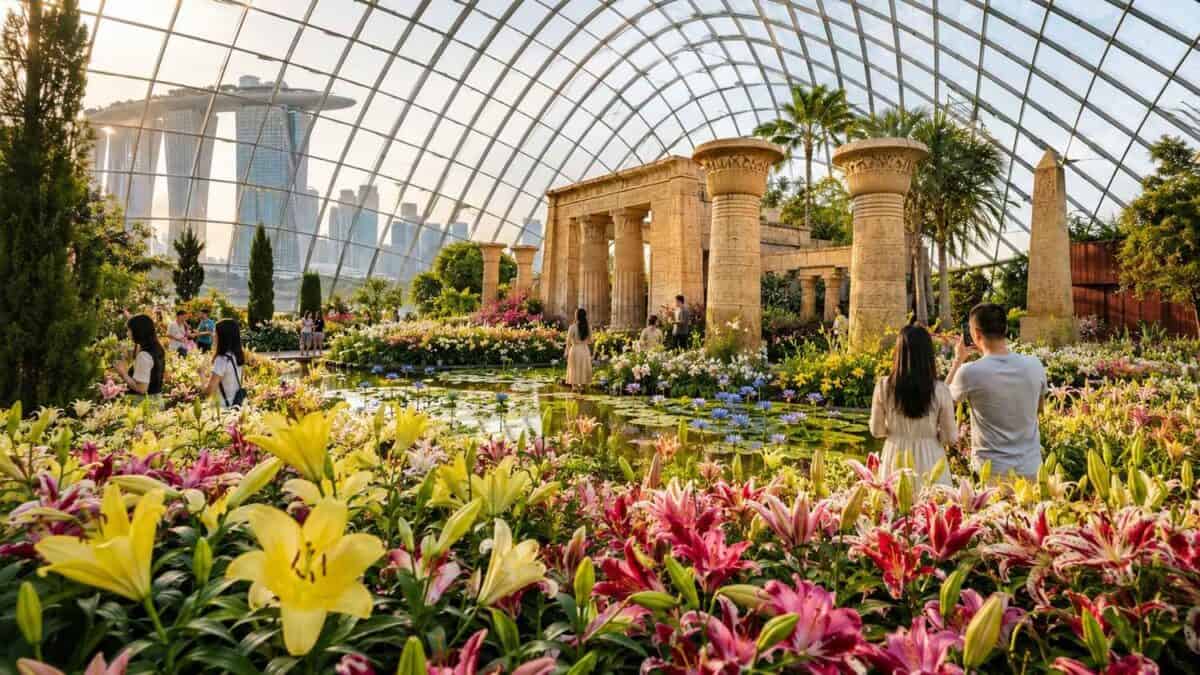
Image generated with Ai
Singapore wants Vietnamese tourists to enjoy five-day holidays from August 29 to September 2 by adding new attractions. Among many activities, the Singapore Tourism Board encourages travelers to attend Lilytopia 2026, an event taking place at Gardens By The Bay. Singapore has the one of the best urban vacation destinations with a combination of family activities, nature-oriented trips, shopping, sustainability, and creative trips. The trip is highly recommended because Vietnam is important traveler market. Vietnam is estimated to cover almost 163,720 trips out of 2026 estimated total of Singapore’s traveler count up till now, according to trade statistics recently released by the Singapore tourism ministry.
Singapore is aligning its destination marketing with one of Vietnam’s most useful outbound travel periods of 2026. Vietnamese civil servants and public employees will receive a five-day National Day break from Saturday, 29 August, to Wednesday, 2 September.
That length of holiday can support an international journey without requiring travellers to take a long period of additional leave. It creates an attractive booking window for families, couples and groups seeking a compact regional escape.
Singapore’s response centres on experiences that are either new, seasonal or difficult to replicate at another time. Lilytopia 2026 will fill the Flower Dome at Gardens by the Bay with lilies and historical displays. GREEN-HOUSE Festival 2026 will bring environmental activities, independent brands and practical workshops to Temasek Shophouse.
Advertisement
Advertisement
The timing is central to the strategy. GREEN-HOUSE Festival will run from 28 to 30 August, directly overlapping with the opening weekend of Vietnam’s National Day holiday. Lilytopia will remain available throughout the break and beyond, running from 21 August to 27 September.
These dates give Vietnamese visitors a clear reason to travel during the holiday rather than postpone a Singapore break. They also give airlines, hotels, travel agents and attraction operators a defined period around which to build itineraries.
The campaign consequently goes beyond general destination advertising. It connects a specific source market, a public holiday and a collection of time-sensitive visitor experiences.
Approximately 163,720 visitors from Vietnam travelled to Singapore in the first half of 2026, according to figures cited by the Singapore Tourism Board in its August destination information. Singapore recorded 8.19 million international arrivals across all markets during those six months.
Advertisement
Advertisement
Vietnam therefore accounted for about 2% of Singapore’s total international arrivals during the period. Although the share is smaller than that of Singapore’s largest source markets, the volume demonstrates an established flow of visitors capable of supporting targeted holiday campaigns.
Vietnam is also geographically well placed for short breaks to Singapore. The journey can be completed without a long-haul flight, major time-zone disruption or a lengthy itinerary. This helps Singapore compete for travellers who want to use a five-day holiday efficiently.
Air services form an important part of that opportunity. Changi Airport’s network connects Singapore with several Vietnamese cities, while additional links have continued to strengthen regional access. A new daily Phu Quoc–Singapore service began on 25 July 2026, according to Changi Airport’s published route information.
Changi reported that Vietnam delivered its strongest traffic increase during the second quarter of 2026. That performance underlines the wider expansion of air travel between the two countries.
The market is not restricted to passengers from Hanoi and Ho Chi Minh City. Links involving Da Nang, Nha Trang and Phu Quoc help broaden the geographical base from which Vietnamese travellers can reach Singapore.
Better connectivity does not guarantee tourism growth on its own. However, it gives destination campaigns a practical foundation. Seasonal attractions become easier to sell when travellers have more departure points, schedule choices and price options.
The available statistics show why Singapore is investing in new products and carefully timed campaigns.Tourism indicator Official period Reported result Source or context Singapore international visitor arrivals January–June 2026 8.19 million Singapore Tourism Board information released in August 2026 Visitors from Vietnam January–June 2026 Approximately 163,720 Singapore Tourism Board information released in August 2026 Full-year Singapore visitor arrivals 2025 16.9 million Singapore Tourism Board, Tourism Industry Conference 2026 Singapore tourism receipts 2025 S$32.8 billion Singapore Tourism Board, Tourism Industry Conference 2026 Singapore visitor arrivals 2024 16.5 million Singapore Tourism Board Singapore tourism receipts 2024 S$29.8 billion Singapore Tourism Board Singapore visitor arrivals 2023 13.6 million Singapore Tourism Board Tourism 2040 receipts target 2040 S$47–50 billion Singapore Tourism Board roadmap Core tourism workforce Updated May 2026 More than 76,000 workers Singapore Tourism Board
The figures show that Singapore’s tourism recovery has progressed from rebuilding visitor volume to increasing the economic value of travel.
International arrivals rose from 13.6 million in 2023 to 16.5 million in 2024. Tourism receipts reached a then-record S$29.8 billion in 2024. The following year, arrivals reached 16.9 million and receipts climbed to a new record of S$32.8 billion.
The 2025 results are significant because tourism receipts increased even though visitor volume grew more moderately than it had during the earlier recovery period. This reflects Singapore’s focus on what the government describes as quality tourism.
Under that approach, destination performance is not judged only by the number of people entering the country. Spending, length of stay, visitor experience, business opportunities and benefits for residents also matter.
The Vietnamese National Day campaign fits this model. It does not promote travel solely through a generic city image. It gives visitors activities that can encourage admission purchases, dining, shopping, workshop participation and additional time in Singapore.
Singapore’s organised destination development dates to 1964, when the Singapore Tourist Promotion Board was established. The organisation was renamed the Singapore Tourism Board in 1997 as its role expanded beyond marketing.
That evolution is important. Modern destination management in Singapore involves attraction development, business support, regulation, workforce capability, infrastructure, events and international promotion.
Singapore has limited land and does not compete primarily through vast natural territory. Its tourism model depends on connectivity, efficient urban planning, strong public infrastructure and the regular renewal of experiences.
This has produced a destination where gardens, cultural districts, shopping, food, meetings, entertainment, architecture and airport services can be combined within a relatively compact area.
Gardens by the Bay demonstrates that model particularly clearly. The attraction uses horticulture, environmental design, cooled conservatories and changing displays to create reasons for both first-time and repeat visits.
Lilytopia is the latest example of the renewal strategy. It gives travellers a temporary exhibition within a permanent attraction. Visitors familiar with the Flower Dome can therefore encounter a substantially different presentation during a return journey.
GREEN-HOUSE Festival takes another approach. It uses sustainability, local products and participation to connect visitors with Singapore’s community and creative economy.
Together, the two events show how Singapore can refresh its visitor offer without presenting an entirely new national tourism identity each season.
The official Gardens by the Bay Lilytopia programme confirms that the 2026 exhibition will run daily from 21 August to 27 September, between 9am and 9pm. Normal Flower Dome admission charges apply.
The 2026 presentation is Gardens by the Bay’s first Ancient Egypt-themed floral display. This official description differs from the broader Mediterranean framing reported in some early promotional coverage.
Lilytopia will use lilies, water lilies and lilies of the Nile to explore a colourful side of ancient Egypt. The design draws attention to the gardens once found along the Nile and within palaces and temples.
The presentation also considers how ancient buildings were painted with colours produced from botanical and mineral pigments. Those colours have largely faded from surviving stone structures, shaping the modern public image of ancient Egypt as a landscape dominated by sand and uncoloured monuments.
The exhibition intends to reconstruct some of that lost visual richness through planted gardens, temple-inspired settings and historically influenced artefacts.
A major botanical feature will be the Egyptian blue lotus. Despite its common name, the plant is a water lily. It held cultural and religious importance in ancient Egypt and was associated with rebirth and the sun.
For Vietnamese visitors, the exhibition adds several layers to a conventional garden visit. It offers horticulture, history, indoor recreation and photography in one location.
Its long opening period also gives travellers flexibility. Those unable to reach Singapore during the first holiday weekend can still visit during the remainder of Vietnam’s National Day break.
The Flower Dome’s cooled indoor environment makes Lilytopia a dependable component of a short itinerary.
Weather can disrupt sightseeing in any tropical destination. High temperatures, humidity and heavy rain can make outdoor plans difficult, particularly for families with young children or older relatives.
An indoor attraction reduces that risk. Visitors can schedule the Flower Dome for the hottest part of the day or retain it as an alternative when rainfall affects outdoor activities.
This reliability matters during a five-day break. Travellers have limited time and may not be able to postpone an attraction until another week.
The display can serve several visitor groups without requiring separate programmes. Children can engage with the colour and scale of the flowers. Adults can explore the historical presentation. Couples and photography enthusiasts can use the designed landscapes as visual backdrops.
Gardens by the Bay also occupies a strategic location near Marina Bay. A visit can be combined with other landmarks, waterfront walks, dining or evening activities.
That geographical concentration can reduce travel time between experiences. It strengthens Singapore’s appeal as a destination where a relatively short stay can contain a varied programme.
GREEN-HOUSE Festival 2026 will run from 28 to 30 August at Temasek Shophouse. The festival’s official programme lists opening hours of 10am to 7pm and confirms free admission.
Its theme, “living light”, brings environmental responsibility into ordinary daily choices. Rather than treating sustainability only as a policy issue, the festival turns it into activities that families, shoppers and curious travellers can experience directly.
The event will include three immersive Reef Missions focused on Singapore’s coral reefs. These activities are designed to build understanding of reef stewardship and climate action.
They also introduce an easily overlooked tourism story. Singapore is known internationally for its skyline, airport and urban attractions, but its marine environment contains coral ecosystems requiring protection and restoration.
By placing reef education inside a public festival, organisers can make conservation accessible to visitors who might not otherwise seek a scientific or environmental programme.
The festival’s approach is particularly relevant to family tourism. Children can learn through tasks and interaction rather than a long formal presentation. Parents can connect a holiday activity with environmental education.
The official programme further states that profits from customisable merchandise will support coral restoration. This provides a direct connection between visitor participation and a conservation purpose.
The GREEN-HOUSE marketplace will feature 74 local brands across fashion, food, beauty, home and lifestyle categories.
That element gives the festival an economic role beyond attendance numbers. Visitors can encounter Singaporean products that may be absent from conventional tourist shopping lists.
Tourism spending often concentrates around accommodation, transport and major attractions. A curated marketplace can distribute part of that expenditure towards smaller brands, designers, food producers and lifestyle businesses.
For international travellers, local products can also provide a stronger sense of place. A purchase from a Singaporean maker may feel more distinctive than an item available in global retail chains.
The marketplace complements Singapore’s established shopping reputation while changing its emphasis. It presents shopping as a form of discovery involving local design, sustainability and entrepreneurship.
Free admission lowers the barrier to entry. Travellers do not need to commit part of their attraction budget before seeing the market. They can visit briefly, stay for workshops or combine the event with surrounding heritage and commercial areas.
However, free entry does not mean the festival lacks tourism value. Visitors may spend on products, refreshments, transport and nearby businesses. They may also extend their activity schedule into the evening.
This is an important distinction for destination economics. An event can stimulate spending across an area even when it does not sell admission tickets.
The festival will offer workshops covering embroidery, woodcraft, kombucha brewing and kokedama, the Japanese practice of cultivating plants in moss-covered balls.
These activities support the growing field of creative tourism. Visitors do not simply observe a display. They learn a process, meet practitioners and produce something connected to the experience.
Participation can make a short holiday more memorable. Major landmarks may define a first visit, but practical activities can create more personal memories for returning travellers.
Workshops also give tour operators material for differentiated itineraries. A standard package may include sightseeing, shopping and meals. Adding a craft or food workshop introduces a participatory element without requiring travellers to leave the city.
Different activities can appeal to different customer groups. Embroidery and woodcraft can attract visitors interested in design and handmade goods. Kombucha brewing connects with food and wellness. Kokedama combines horticulture, craft and home decoration.
The format also supports slower tourism. Visitors spend more time in one location, speak with local practitioners and engage with the subject instead of moving rapidly between photo stops.
This does not transform a short city break into community-based tourism in the traditional rural sense. It does, however, create a more direct connection between travellers, local businesses and contemporary Singaporean life.
GREEN-HOUSE Festival sits within a broader government direction. Singapore’s Tourism Sustainability Programme supports tourism businesses seeking to develop environmentally responsible practices and capabilities.
The Singapore Tourism Board has also published sustainability roadmaps for tourism jobs and attractions. These place environmental performance alongside workforce skills, business transformation and destination competitiveness.
This matters because sustainable tourism cannot depend entirely on one festival. Events can raise public awareness, but hotels, attractions, transport operators and travel businesses influence the overall environmental cost of a journey.
Singapore’s strategy aims to build sustainability into business operations and industry skills. The focus includes helping tourism companies understand environmental practices, redesign operations and prepare employees for changing job requirements.
Lilytopia and GREEN-HOUSE make this direction visible to consumers. One uses botanical storytelling in a major garden attraction. The other presents reef protection, conscious consumption and local enterprise.
Neither event alone can establish Singapore as a completely sustainable destination. Such a claim would require much broader evidence. They do show how environmental themes are being incorporated into the visitor experience.
For Vietnamese travellers increasingly familiar with sustainability debates at home, this programming can make the holiday relevant as well as entertaining.
Singapore’s current tourism development is guided by the government’s Tourism 2040 roadmap. The strategy seeks to maintain growth amid intensifying destination competition, demographic change and resource constraints.
The roadmap projects annual tourism receipts of between S$47 billion and S$50 billion by 2040.
Singapore reached S$32.8 billion in tourism receipts in 2025. Achieving the 2040 range will therefore require continued development over many years rather than reliance on a short-term recovery surge.
Tourism 2040 is built around quality growth. Singapore wants tourism receipts to rise faster than visitor arrivals. This places emphasis on distinctive products, business events, premium experiences and stronger visitor engagement.
Seasonal events support that direction by creating more reasons to spend time and money in the destination. They can also improve repeat visitation, because the experience available during one trip may differ from that offered a year later.
The roadmap further recognises that tourism must create meaningful opportunities for Singaporeans. Local-brand marketplaces, tourism employment and skills development connect visitor expenditure with residents and businesses.
Singapore’s core tourism industries employ more than 76,000 workers. These industries include hotels, attractions, integrated resorts, meetings and events, cruises, travel agencies and tourist guiding.
No official employment estimate has been published for Lilytopia, GREEN-HOUSE Festival or the Vietnamese National Day campaign. It would therefore be misleading to assign a specific job figure to these events.
Their relevance lies in supporting demand across a much larger tourism system that already sustains tens of thousands of roles.
Changi Airport is crucial to Singapore’s tourism model because almost every visitor from Vietnam arrives by air.
In 2025, Changi handled close to 70 million passenger movements. By January 2026, approximately 100 airlines were operating more than 7,300 scheduled flights each week, connecting Singapore with over 170 cities.
During the second quarter of 2026, Vietnam recorded Changi’s strongest traffic increase. That development is particularly relevant to the National Day campaign because it indicates growing passenger activity immediately before the holiday period.
The new daily Phu Quoc connection introduced in July 2026 added another direct link. Earlier additions involving Da Nang and Nha Trang had already broadened Changi’s Vietnamese network.
More routes can benefit travellers in several ways. They may reduce dependence on connecting flights, broaden departure choices and make short trips more practical.
For airlines, a five-day public holiday can create concentrated demand in both directions. Vietnamese residents may travel to Singapore, while Singapore-based passengers may use the same network for trips to Vietnam.
Airlines must still manage capacity and pricing commercially. The available official material does not promise lower fares or additional National Day services. Travellers should compare schedules and total ticket costs directly before booking.
The airport itself adds another dimension. Jewel Changi, dining, retail and passenger facilities can turn arrival or departure time into part of the visitor experience.
The campaign creates an opportunity for Singapore hotels to capture short-stay demand at the end of August and beginning of September.
A five-day holiday does not necessarily produce five hotel nights. Flight schedules, budgets and work commitments may lead travellers to select three- or four-night stays.
Even so, the period can support demand across several accommodation segments. Families may favour rooms with sufficient space and access to child-friendly facilities. Couples may prioritise Marina Bay, Orchard Road or heritage neighbourhoods. Budget-conscious travellers may seek properties connected to public transport.
Seasonal attractions can help hotels create more useful packages. Rather than selling only a room, a property can organise suggested itineraries around Gardens by the Bay, Temasek Shophouse, local dining and shopping.
The GREEN-HOUSE Festival’s free entry may be particularly helpful to visitors balancing accommodation costs against entertainment spending.
Lilytopia requires Flower Dome admission, so travellers should include ticket costs in their holiday budgets and check official rates before arrival.
The wider economic benefit depends on how spending flows through the sector. Room revenue supports hotel operations, while guests also create demand for food, housekeeping, transport, retail and attraction services.
No official forecast has been released for hotel occupancy or revenue generated specifically by Vietnamese travellers during the 2026 National Day break. Any precise prediction would therefore be speculative.
Vietnamese tour operators and Singapore destination-management companies can use the two events to move beyond standard city itineraries.
A traditional first-time programme may include Marina Bay, Gardens by the Bay, Sentosa, shopping and cultural districts. Lilytopia can update that structure by giving the Flower Dome a seasonal narrative.
GREEN-HOUSE Festival can add local brands, workshops and environmental learning. This is particularly useful for repeat visitors who have already seen Singapore’s main landmarks.
Operators can segment products more precisely:Traveller segment Relevant experience Practical tourism value Families Reef Missions and Flower Dome Education, indoor comfort and shared activities Couples Lilytopia and Marina Bay Visual settings and compact sightseeing Young travellers Workshops and local-brand market Creative participation and independent retail Sustainability-focused visitors GREEN-HOUSE Festival Conservation, responsible consumption and community themes Repeat visitors Seasonal displays and workshops Fresh reasons to return Budget-conscious visitors Free festival admission Lower-cost itinerary component Photography enthusiasts Lilytopia floral landscapes Designed indoor visual experience
Tour operators should avoid presenting the SG Arrival Card as a visa. It is an arrival declaration and does not replace any visa requirement that may apply to an individual traveller.
They should also verify workshop availability, registration rules and admission terms directly with organisers. Festival access may be free, but individual sessions can have separate capacity or booking conditions.
The 74-brand marketplace provides a direct route through which tourism can support local enterprise.
For participating businesses, Vietnamese visitors represent both immediate buyers and potential future customers. A traveller may discover a product in Singapore and later follow the company online or recommend it within Vietnam.
The festival also provides brand exposure within an experience-led environment. Products are not presented only on retail shelves. They are connected with workshops, sustainability themes and social activity.
Food and beverage businesses can benefit from longer dwell time at the event. Nearby cafés, restaurants and shops may also receive additional footfall.
The wider opportunity extends to transport providers, guides and neighbourhood businesses. Visitors rarely attend one event in isolation. They may combine it with cultural districts, museums, shopping streets or evening activities.
This is how a relatively small event can contribute to regional development within a city. It draws people towards a particular area and creates opportunities for adjacent businesses.
The official programme does not publish an expected visitor number or economic-impact estimate. The commercial effect should therefore be described as an opportunity rather than a guaranteed outcome.
All travellers arriving in Singapore must check the current entry requirements before departure.
The Immigration and Checkpoints Authority requires most travellers to submit the SG Arrival Card within three days before arrival, including the day of arrival. The service is free.
Travellers should use the official ICA SG Arrival Card service or the MyICA mobile application. The SG Arrival Card is not a visa.
Visitors should be cautious of commercial websites that resemble official services and request payment. ICA does not charge travellers to submit the card through its authorised platform.
Foreign visitors receive an electronic Visit Pass after immigration clearance. The e-Pass replaces the inked passport endorsement and is sent to the email address declared in the arrival submission.
The e-Pass shows the period of stay granted by immigration authorities. Travellers should check it and retain access to the email account used in their application.
Entry remains subject to immigration clearance. A completed SG Arrival Card does not guarantee admission and does not extend the permitted period of stay.
Vietnamese passengers should also confirm passport validity and any applicable entry conditions using official sources before travelling. Requirements can change, and airline staff may check documents before boarding.
Vietnamese travellers can organise the holiday around the time-sensitive events while retaining room for Singapore’s established attractions.
Day one: Arrive through Changi Airport, complete immigration formalities and retrieve the e-Pass. Travellers with suitable arrival times can explore Jewel before travelling to their accommodation.
Day two: Visit GREEN-HOUSE Festival at Temasek Shophouse. Families can take part in reef-related activities, while other visitors can explore the marketplace and workshops. The surrounding day can include nearby heritage, dining or shopping stops.
Day three: Visit Lilytopia in the Flower Dome. Travellers can combine the exhibition with other Gardens by the Bay areas and Marina Bay activities.
Day four: Build the itinerary around personal interests. Options can include cultural districts, museums, food exploration, Sentosa or further shopping.
Day five: Use the remaining time for local dining, souvenir purchases or airport activities before departure.
This is an illustrative structure rather than an official package. Travellers should adjust it according to flight times, attraction bookings, opening hours, weather and personal mobility needs.
The principal advantage is geographical efficiency. Singapore allows several different types of activity to be combined without the long internal journeys required in larger destinations.
The 2025 record of S$32.8 billion in tourism receipts illustrates why Singapore is focusing on visitor value as well as arrival volume.
A Vietnamese family visiting Lilytopia may pay for flights, accommodation, attraction admission, meals, local transport and retail purchases. A traveller attending the free sustainability festival may still spend on workshops, products and nearby dining.
These individual transactions flow through airlines, airports, hotels, attraction operators and smaller businesses.
Tourism also supports employment. STB states that Singapore’s core tourism industries employ more than 76,000 people. The jobs range from hotel operations and guiding to event management, attractions, cruises and travel services.
Between June 2023 and June 2025, Singapore’s tourism workforce grew by more than 8%, from approximately 69,000 to 75,000. During the second quarter of 2025, more than 5,000 tourism job postings representing about 6,700 vacancies appeared on the MyCareersFuture portal.
Those figures show that visitor demand has a labour-market dimension. However, tourism growth also increases the need for skills, productivity and workforce planning.
Singapore’s official programmes consequently focus on training, job redesign, digital capability and sustainability knowledge.
Small seasonal events should be understood within that broader structure. They create demand and encourage spending, while government and industry programmes work to ensure businesses and workers can serve visitors effectively.
Singapore’s campaign benefits from infrastructure built over decades.
Changi Airport provides international access. The public transport network connects the airport, city districts and major visitor areas. Digital arrival processing reduces reliance on paper documentation.
Gardens by the Bay demonstrates another form of tourism infrastructure: a major permanent attraction capable of hosting changing exhibitions.
Temasek Shophouse provides a community-oriented venue in which sustainability, retail and participation can be combined.
Digital information also helps visitors organise short stays. Official attraction websites provide opening times and programme details, while tourism and transport applications can support navigation.
These systems matter because convenience is one of Singapore’s strongest advantages in the regional city-break market.
Vietnamese travellers using a five-day holiday need predictability. They must know how to enter the country, reach accommodation, find attractions and return to the airport within a compact schedule.
Infrastructure does not remove every travel difficulty. Holiday demand can affect airfares and availability. Popular attractions can become crowded. Workshops may have limited places.
It does, however, reduce the friction associated with combining multiple experiences in a short period.
Although the immediate promotion targets Vietnam’s National Day market, the attractions remain relevant to visitors from other countries.
Lilytopia runs for more than five weeks, creating a wider international travel window. GREEN-HOUSE Festival is a public event rather than a programme restricted by nationality.
The Vietnamese campaign therefore illustrates a broader destination-marketing technique: connecting globally available experiences with the holiday calendar of a specific source market.
Singapore can repeat that method across markets without changing the underlying attraction. Different campaigns can emphasise families, sustainability, photography or local shopping according to traveller interests.
This creates efficiency for the destination while allowing more relevant communication.
For international visitors already planning Singapore journeys, the dates provide an opportunity to add seasonal events to existing itineraries.
Travellers should nevertheless consult official event pages before attending. Schedules, capacities and admission arrangements can change.
Singapore’s long-term direction is clear from Tourism 2040. The country intends to grow tourism receipts to between S$47 billion and S$50 billion by 2040 while pursuing quality and sustainable development.
The strategy responds to rising global competition, changing traveller profiles and resource constraints. It calls for distinctive experiences, industry transformation and stronger benefits for Singaporeans.
The Vietnamese National Day campaign supports these objectives on a smaller scale. It uses fresh attractions to stimulate regional travel demand. It connects sustainability with visitor participation. It places local brands within an international tourism setting.
Official policy also points towards continued workforce development. Digital transformation and sustainability are creating new skill requirements across hotels, attractions, travel agencies and events.
Aviation connectivity will remain essential. Changi’s direct links with Vietnamese cities provide the access needed to convert campaign interest into actual journeys.
The official sources do not publish a future target for Vietnamese arrivals, nor do they predict the number of visitors expected during the five-day holiday.
The outlook should therefore remain grounded in what has been announced: Singapore will continue developing differentiated tourism products, improving industry capabilities and pursuing its Tourism 2040 receipts objective.
Conclusion
Singapore’s National Day campaign is an ample opportunity for Vietnamese travelers to take a short vacation in the Asia-Pacific region from August 29 to September 2, 2026. Lilytopia features an indoor flower path with chapters of Ancient Egypt. The GREEN-HOUSE Festival offers coral conservation, workshops and 74 local brands. These trips within Singapore contribute to the country’s quality tourism strategy to attract visitors, increase expenditure, and enhance frequent visits. Although travel from Vietnam to Singapore is easy due to the strong air links and digital entry processes, travelers should make sure they are aware of all the latest requirements and have verifiable tickets to travel. The campaign is evidence that a public holiday can be used to generate economic activity in the tourism and business sectors.
Advertisement
Advertisement
Advertisement











Wednesday, September 2, 2026

Wednesday, September 2, 2026

Wednesday, September 2, 2026
Wednesday, September 2, 2026

Wednesday, September 2, 2026
Tuesday, September 1, 2026
Wednesday, September 2, 2026
Wednesday, September 2, 2026



